Stars, supernovae, black holes and stellar remnants

Post Reply
weatheriscool
Posts: 24486
Joined: Sun May 16, 2021 6:16 pm
Contact:

Stars, supernovae, black holes and stellar remnants

Post by weatheriscool »

I've decided to make a thread centered around stars and what they become...As I don't believe they belong in the space general thread but they're still interesting to discus. The general thread should focus on exploration of man and robots.

New supergiant fast X-ray transient discovered
https://phys.org/news/2022-07-supergian ... sient.html
by Tomasz Nowakowski , Phys.org
Image
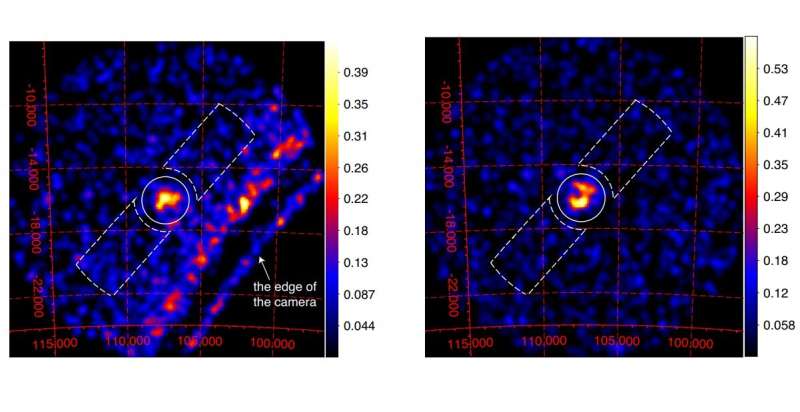
An international team of astronomers reports the detection of a new supergiant fast X-ray transient with the Monitor of All-sky X-ray Image (MAXI) instrument. The newfound transient, designated MAXI J0709−159, was identified in the constellation Canis Majoris and lasted about three hours. The finding was detailed in a paper published July 5 on the arXiv pre-print server.

Generally, X-ray binaries are composed of a normal star or a white dwarf transferring mass onto a compact neutron star or a black hole. Based on the mass of the companion star, astronomers divide them into low-mass X-ray binaries (LMXB) and high-mass X-ray binaries (HMXB).

Supergiant fast X-ray transients (SFXTs) are a class of HMXBs with supergiant companions. They showcase significant X-ray flaring activity, experiencing outbursts with very fast rise times and typical durations of a few hours that are associated with supergiant stars.

Now, a group of astronomers led by Mutsumi Sugizaki of National Astronomical Observatories in Beijing, China, has detected a new SFXT—MAXI J0709−159 (or MAXI J0709 for short). The transient, lasting approximately three hours, was identified on January 25, 2022, by the MAXI instrument onboard the International Space Station (ISS). Follow-up observations of this source have been also conducted, using NuSTAR, Swift, and eROSITA, in order to determine its properties.
Last edited by weatheriscool on Wed Oct 16, 2024 3:16 pm, edited 3 times in total.
weatheriscool
Posts: 24486
Joined: Sun May 16, 2021 6:16 pm
Contact:

Re: Stars, Super nova, white dwarfs and black holes news and discussion

Post by weatheriscool »

A new measurement record for strongest magnetic field in universe
https://phys.org/news/2022-07-strongest ... verse.html
by Chinese Academy of Sciences
Neutron stars have the strongest magnetic fields in the universe, and the only way to measure their surface magnetic field directly is to observe the cyclotron absorption lines in their X-ray energy spectra. The Insight-HXMT team has recently discovered a cyclotron absorption line with an energy of 146 keV in the neutron star X-ray binary Swift J0243.6+6124, corresponding to a surface magnetic field of more than 1.6 billion Tesla. After direct measurement of the strongest magnetic field in the universe at about 1 billion Tesla in 2020, the world records for the highest energy cyclotron absorption line and direct measurement of the strongest magnetic field in the universe have been broken.

The findings, obtained jointly by the Key Laboratory for Particle Astrophysics at the Institute of High Energy Physics (IHEP) of the Chinese Academy of Sciences and the Institute for Astronomy and Astrophysics, Kepler Center for Astro and Particle Physics, University of Tübingen (IAAT), were published on June 28 in Astrophysical Journal Letters (ApJL). Dr. Kong Lingda, Prof. Zhang Shu, and Prof. Zhang Shuangnan from IHEP are the corresponding authors of the paper. Dr. Victor Doroshenko and Prof. Andrea Santangelo from the University of Tübingen significantly contributed to the discovery.
weatheriscool
Posts: 24486
Joined: Sun May 16, 2021 6:16 pm
Contact:

Re: Stars, Super nova, white dwarfs and black holes news and discussion

Post by weatheriscool »

International team of astronomers discovers two rare binary star systems
https://phys.org/news/2022-07-internati ... inary.html
by Chris Sasaki, University of Toronto
Image
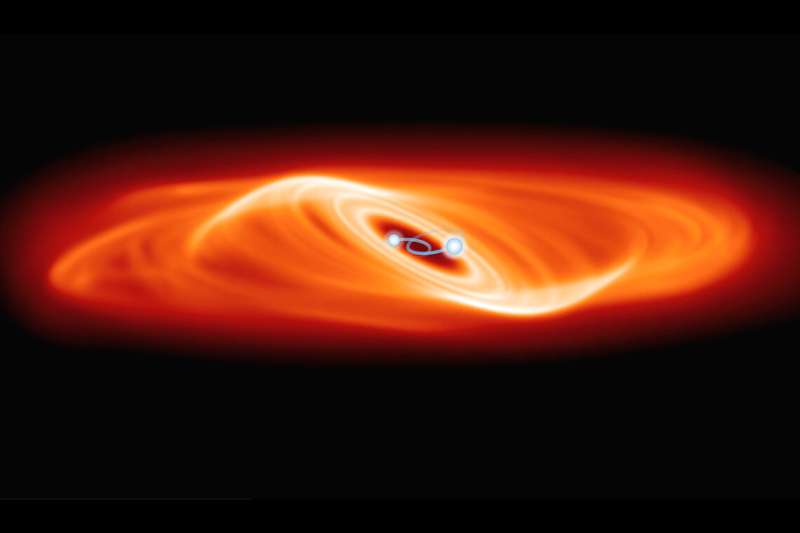
An international team of astronomers has identified only the second and third examples of a rare type of star system comprising two central stars orbiting each other, encompassed by a remarkable disk of gas and dust.

"If there were a planet in one of these systems, it would be like the planet Tatooine from Star Wars," says Michael Poon, a Ph.D. student in the Faculty of Arts & Science's David A. Dunlap Department of Astronomy & Astrophysics and one of two University of Toronto researchers involved in the discovery.

"You would see two suns in the sky orbiting each other. In addition, there's a disk around the stars. Picture Saturn's rings but much, much larger—with the stars in the middle."

Such disks are referred to as protoplanetary disks because they eventually form into families of planets like our solar system. The newly discovered systems are rare because their disks lie at an angle to the orbits of their central stars.
Last edited by weatheriscool on Fri Jul 15, 2022 6:56 am, edited 1 time in total.
User avatar
wjfox
Site Admin
Posts: 13583
Joined: Sat May 15, 2021 6:09 pm
Location: Essex, UK
Contact:

Re: Stars, supernovae, black holes and stellar remnants

Post by wjfox »

Hope you don't mind, but I changed the thread title slightly, to include a wider range of objects.

Edit: Also, would be nice to have some pictures included with these articles, as they tend to be visually interesting. :)
User avatar
Lorem Ipsum
Posts: 117
Joined: Tue May 24, 2022 4:51 pm

Re: Stars, supernovae, black holes and stellar remnants

Post by Lorem Ipsum »

wjfox wrote: Wed Jul 13, 2022 9:04 pm Hope you don't mind, but I changed the thread title slightly, to include a wider range of objects.
Space Phenomena News and Discussions?
weatheriscool
Posts: 24486
Joined: Sun May 16, 2021 6:16 pm
Contact:

Re: Stars, supernovae, black holes and stellar remnants

Post by weatheriscool »

Sounds awesome wjfox

Modeling the merger of a black hole with a neutron star and the subsequent process in a single simulation
https://phys.org/news/2022-07-merger-bl ... -star.html
by Max Planck Society
Image
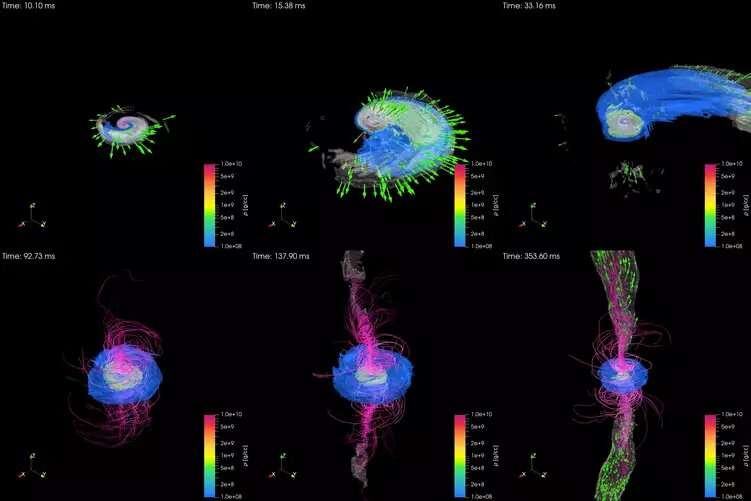
Using supercomputer calculations, scientists at the Max Planck Institute for Gravitational Physics in Potsdam and from Japan show a consistent picture for the first time: They modeled the complete process of the collision of a black hole with a neutron star. In their studies, they calculated the process from the final orbits through the merger to the post-merger phase in which, according to their calculations, high-energy gamma-ray bursts may occur. The results of their studies have now been published in the journal Physical Review D.

Almost seven years have passed since the first detection of gravitational waves. On September 14, 2015, the LIGO detectors in the U.S. recorded the signal of two merging black holes from the depths of space. Since then, a total of 90 signals have been observed: from binary systems of two black holes or neutron stars, and also from mixed binaries. If at least one neutron star is involved in the merger, there is a chance that not only gravitational-wave detectors will observe the event, but also telescopes in the electromagnetic spectrum.

When two neutron stars merged in the event detected on August 17, 2017 (GW170817), about 70 telescopes on Earth and in space observed the electromagnetic signals. In the two mergers of neutron stars with black holes observed so far (GW200105 and GW200115), no electromagnetic counterparts to the gravitational waves were detected. But when more such events are measured with the increasingly sensitive detectors, the researchers expect electromagnetic observations here as well. During and after the merger, matter is ejected from the system and electromagnetic radiation is generated. This probably also produces short gamma-ray bursts, as observed by space telescopes.
weatheriscool
Posts: 24486
Joined: Sun May 16, 2021 6:16 pm
Contact:

Re: Stars, supernovae, black holes and stellar remnants

Post by weatheriscool »

'Black hole police' discover a dormant black hole outside the Milky Way galaxy
https://phys.org/news/2022-07-black-hol ... milky.html
by Harvard-Smithsonian Center for Astrophysics
A team of international experts who are known for debunking black hole discoveries have found a dormant stellar-mass black hole in the Large Magellanic Cloud, a galaxy that neighbors the Milky Way. The team includes Kareem El-Badry—nicknamed by fellow astronomers as the "black hole destroyer"—of the Center for Astrophysics | Harvard & Smithsonian (CfA).

"For the first time, our team got together to report on a black hole discovery, instead of rejecting one," says study lead Tomer Shenar, a Marie-Curie Fellow at Amsterdam University in the Netherlands.

The team found that the star that gave rise to the black hole vanished without any sign of a powerful explosion.

"We identified a needle in a haystack," says Shenar. Though other similar black hole candidates have been proposed, the team claims this is the first "dormant" stellar-mass black hole to be unambiguously detected outside of the Milky Way galaxy. The work was published today in the journal Nature Astronomy.

Stellar-mass black holes form when massive stars reach the end of their lives and collapse under their own gravity. In a binary, a system of two stars revolving around each other, this process leaves behind a black hole in orbit with a luminous companion star. The black hole is "dormant" if it does not emit high levels of X-ray radiation, which is how such black holes are typically detected
.
weatheriscool
Posts: 24486
Joined: Sun May 16, 2021 6:16 pm
Contact:

Re: Stars, supernovae, black holes and stellar remnants

Post by weatheriscool »

Supermassive black hole influences star formation
https://phys.org/news/2022-07-supermass ... ation.html
by University of Cologne
A European team of astronomers led by Professor Kalliopi Dasyra of the National and Kapodistrian University of Athens, Greece, under participation of Dr. Thomas Bisbas, University of Cologne modeled several emission lines in Atacama Large Millimeter Array (ALMA) and Very Large Telescope (VLT) observations to measure the gas pressure in both jet-impacted clouds and ambient clouds. With these unprecedented measurements, published recently in Nature Astronomy, they discovered that the jets significantly change the internal and external pressure of molecular clouds in their path.

Depending on which of the two pressures changes the most, both compression of clouds and triggering of star formation and dissipation of clouds and delaying of star formation are possible in the same galaxy. "Our results show that supermassive black holes, even though they are located at the centers of galaxies, could affect star formation in a galaxy-wide manner," said Professor Dasyra. "Studying the impact of pressure changes in the stability of clouds was key to the success of this project. Once few stars actually form in a wind, it is usually very hard to detect their signal on top of the signal of all other stars in the galaxy hosting the wind."

It is believed that supermassive black holes lie at the centers of most galaxies in our universe. When particles that were infalling onto these black holes are trapped by magnetic fields, they can be ejected outwards and travel far inside galaxies in the form of enormous and powerful jets of plasma. These jets are often perpendicular to galactic disks. In IC 5063 however, a galaxy 156 million light years away, the jets are actually propagating within the disk, interacting with cold and dense molecular gas clouds. From this interaction, compression of jet-impacted clouds is theorized to be possible, leading to gravitational instabilities and eventually star formation due to the gas condensation.
weatheriscool
Posts: 24486
Joined: Sun May 16, 2021 6:16 pm
Contact:

Re: Stars, supernovae, black holes and stellar remnants

Post by weatheriscool »

Astronomers develop novel way to 'see' the first stars through the fog of the early universe
https://phys.org/news/2022-07-astronome ... verse.html
by University of Cambridge
A team of astronomers has developed a method that will allow them to "see" through the fog of the early universe and detect light from the first stars and galaxies.

The researchers, led by the University of Cambridge, have developed a methodology that will allow them to observe and study the first stars through the clouds of hydrogen that filled the universe about 378,000 years after the Big Bang.

Observing the birth of the first stars and galaxies has been a goal of astronomers for decades, as it will help explain how the universe evolved from the emptiness after the Big Bang to the complex realm of celestial objects we observe today, 13.8 billion years later.

The Square Kilometre Array (SKA)—a next-generation telescope due to be completed by the end of the decade—will likely be able to make images of the earliest light in the universe, but for current telescopes the challenge is to detect the cosmological signal of the stars through the thick hydrogen clouds.
User avatar
caltrek
Posts: 9280
Joined: Mon May 17, 2021 1:17 pm

Re: Stars, supernovae, black holes and stellar remnants

Post by caltrek »

Distant Galaxy Hosted One of the Most Powerful Explosions Since the Big Bang
by Kiona Smith
July 27, 2022

Introduction:
(Inverse) THE SMALL, dim, red dot in the center of a newly-released image of a distant galaxy shows it endured one of the most powerful explosions since the Big Bang.

Astronomer Brendan O’Connor and his colleagues recently discovered this still-unnamed galaxy 9 billion light years away in data from the Gemini North Telescope in Hawai’i, and they say it’s the source of a brief, brilliant flare of gamma radiation that dazzled NASA’s Swift Observatory in late 2015.
Imagine an explosion releasing as much energy as our Sun will produce in 10 billion years – compressed into a burst of less than two seconds.

Astronomers call this almost unimaginable cataclysm a short gamma-ray burst, and the universe hasn’t witnessed a brighter or more powerful explosion since the Big Bang. What could cause such an event? The answer seems to involve two neutron stars colliding.

Binary star systems aren’t vanishingly rare in the universe; one of our nearest neighbors, Alpha Centauri, is actually a pair of stars fairly similar to our Sun. On the other hand, binaries involving two neutron stars — the dense ball of neutrons left behind by the death of a star massive enough to cause a supernova, but not quite massive enough to collapse into a black hole — seem to be much rarer.

But every once in a while, a binary pair of neutron stars will pull each other into a gravitational death spiral, eventually colliding with enough force to release a brief burst of gamma rays brighter than a whole galaxy. Astrophysicists say this happens, in most galaxies, a few times every million years.
Read more here: https://www.inverse.com/science/this-g ... cataclysm
Don't mourn, organize.

-Joe Hill
weatheriscool
Posts: 24486
Joined: Sun May 16, 2021 6:16 pm
Contact:

Re: Stars, supernovae, black holes and stellar remnants

Post by weatheriscool »

Exploring how stars determine their own masses
https://phys.org/news/2022-08-exploring ... asses.html
by Northwestern University
Last year, a team of astrophysicists including key members from Northwestern University launched STARFORGE, a project that produces the most realistic, highest-resolution 3D simulations of star formation to date. Now, the scientists have used the highly detailed simulations to uncover what determines the masses of stars, a mystery that has captivated astrophysicists for decades.

In a new study, the team discovered that star formation is a self-regulatory process. In other words, stars themselves set their own masses. This helps explain why stars formed in disparate environments still have similar masses. The new finding may enable researchers to better understand star formation within our own Milky Way and other galaxies.

The study was published last week in the Monthly Notices of the Royal Astronomical Society. The collaborative team included experts from Northwestern, University of Texas at Austin (UT Austin), Carnegie Observatories, Harvard University and the California Institute of Technology. The lead author of the new study is Dávid Guszejnov, a postdoctoral fellow at UT Austin.
weatheriscool
Posts: 24486
Joined: Sun May 16, 2021 6:16 pm
Contact:

Re: Stars, supernovae, black holes and stellar remnants

Post by weatheriscool »

Brightest stars in the night sky can strip Neptune-sized planets to their rocky cores
https://phys.org/news/2022-08-brightest ... sized.html
by Robert Sanders, University of California - Berkeley
Over the last 25 years, astronomers have found thousands of exoplanets around stars in our galaxy, but more than 99% of them orbit smaller stars—from red dwarfs to stars slightly more massive than our sun, which is considered an average-sized star.

Few have been discovered around even more massive stars, such as A-type stars—bright blue stars twice as large as the sun—and most of the exoplanets that have been observed are the size of Jupiter or larger. Some of the brightest stars in the night sky, such as Sirius and Vega, are A-type stars.

University of California, Berkeley, astronomers now report a new, Neptune-sized planet—called HD 56414 b—around one of these hot-burning, but short-lived, A-type stars and provide a hint about why so few gas giants smaller than Jupiter have been seen around the brightest 1% of stars in our galaxy.

Current exoplanet detection methods most easily find planets with short, rapid orbital periods around their stars, but this newly found planet has a longer orbital period than most discovered to date. The researchers suggest that an easier-to-find Neptune-sized planet sitting closer to a bright A-type star would be rapidly stripped of its gas by the harsh stellar radiation and reduced to an undetectable core.
weatheriscool
Posts: 24486
Joined: Sun May 16, 2021 6:16 pm
Contact:

Re: Stars, supernovae, black holes and stellar remnants

Post by weatheriscool »

Astronomers detect new eclipsing post-common-envelope binary
https://phys.org/news/2022-08-astronome ... inary.html
by Tomasz Nowakowski , Phys.org
Astronomers have conducted photometric and spectroscopic observations of a binary system known as TIC 60040774. Results of the observational campaign shed more light on the properties of this system, revealing that it is an eclipsing post-common-envelope binary. The study was published August 5 on arXiv.org.

A common envelope (CE) is gas that contains a binary star system. Observations show that once the more massive star in a binary leaves the main sequence, and depending on the initial conditions, dynamically unstable mass transfer or a tidal instability may force such a system to enter the CE phase.

The CE evolution produces a significant population of close, but detached white-dwarf/main-sequence (WDMS) binaries. Approximately a quarter of WDMS are close enough that they must be the so-called post-common-envelope binaries (PCEBs), and about 10% of these systems exhibit eclipses. Studies of PCEBs could advance our knowledge regarding formation and evolution of close compact binary stars.

That is why a team of astronomers led by Rhorom Priyatikanto of the National Research and Innovation Agency in Bandung, Indonesia, investigated TIC 60040774—one of the close binaries with a low-mass secondary star, located some 437 light years away. Previous studies have suggested that it may be a PCEB.
weatheriscool
Posts: 24486
Joined: Sun May 16, 2021 6:16 pm
Contact:

Re: Stars, supernovae, black holes and stellar remnants

Post by weatheriscool »

Astronomers discover new accreting millisecond X-ray pulsar
https://phys.org/news/2022-08-astronome ... ulsar.html
by Tomasz Nowakowski , Phys.org
Using the Neutron Star Interior Composition Explorer (NICER), an international team of astronomers have detected a new accreting millisecond X-ray pulsar. The newfound pulsar, designated MAXI J1816–195, has a spin period of about 1.89 milliseconds. The finding is reported in a paper published August 9 on the arXiv pre-print repository.

X-ray pulsars exhibit strict periodic variations in X-ray intensity, which can be as short as a fraction of a second. Accreting millisecond X-ray pulsars (AMXPs) are a peculiar type of X-ray pulsars in which short spin periods are caused by long-lasting mass transfer from a low-mass companion star through an accretion disk onto a slow-rotating neutron star. Astronomers perceive AMXPs as astrophysical laboratories that could be crucial in advancing our knowledge about thermonuclear burst processes.

AMXPs are relatively rare and to date only a few dozen objects of this type have been identified. In order to expand the list of these peculiar objects, the scientific community is still actively searching for such sources using space observatories like NICER installed on the International Space Station (ISS).
User avatar
Time_Traveller
Posts: 3025
Joined: Sun May 16, 2021 4:49 pm
Location: New York City, USA, November 5th 2032 C.E.

Re: Stars, supernovae, black holes and stellar remnants

Post by Time_Traveller »

Astronomers Have Discovered a Black Hole Jet That Is 50 Times Larger Than Its Galaxy
20 August 2022

Image

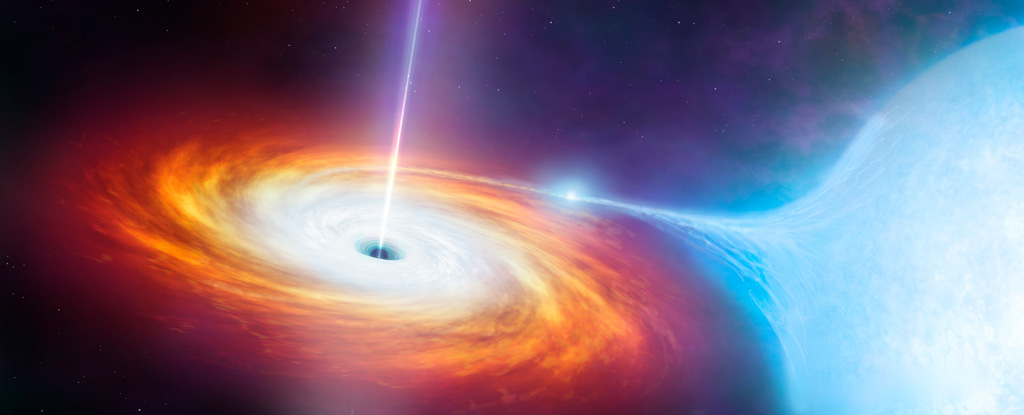
Astronomers at Western Sydney University have discovered one of the biggest black hole jets in the sky.

Spanning more than a million light years from end to end, the jet shoots away from a black hole with enormous energy, and at almost the speed of light. But in the vast expanses of space between galaxies, it doesn't always get its own way.

At a mere 93 million light-years away, the galaxy NGC2663 is in our neighborhood, cosmically speaking. If our galaxy were a house, NGC2663 would be a suburb or two away.

Looking at its starlight with an ordinary telescope, we see the familiar oval shape of a "typical" elliptical galaxy, with about ten times as many stars as our own Milky Way.

Typical, that is, until we observed NGC2663 with CSIRO's Australian Square Kilometre Array Pathfinder (ASKAP) in Western Australia – a network of 36 linked radio dishes forming a single super-telescope.
https://www.sciencealert.com/astronomer ... its-galaxy
“In the quantum multiverse, every choice, every decision you've ever and never made exists in an unimaginably vast ensemble of parallel universes.”
weatheriscool
Posts: 24486
Joined: Sun May 16, 2021 6:16 pm
Contact:

Re: Stars, supernovae, black holes and stellar remnants

Post by weatheriscool »

Researchers detect dozens of new variable stars
https://phys.org/news/2022-08-dozens-va ... stars.html
by Tomasz Nowakowski , Phys.org

By observing the field of globular cluster Palomar 2 with the Indian Astronomical Observatory (IAO), astronomers have discovered 32 new variable stars. The newfound variables are mostly RR Lyrae stars and cluster members. The finding is reported in a paper published August 16 on the arXiv pre-print repository.

Variable stars could offer important hints into aspects of stellar structure and evolution. They could also help us better understand the distance scale of the universe. In particular, the so-called RR Lyrae (RRL) variables are a powerful tool for studying the morphology, metallicity and age of galaxies, especially those with low surface brightness. In general, RRLs are pulsating horizontal branch stars of spectral class A or F, with a mass of around half the sun's.

Now, a team of astronomers led by Armando Arellano Ferro of the National Autonomous University of Mexico (UNAM) reports the detection of dozens of new variables. The discovery is a result of long-term observations of the field of Palomar 2 with IAO's 2.0-m telescope. Palomar 2 is a distant globular cluster located some 100,000 light years in the constellation of Auriga and so far no variables have been reported in this stellar grouping.

"A CCD VI imaging time-series over 11-year is employed to explore the light curves of stars in the field of Palomar 2.... The data were obtained between December 12, 2010 and February 12, 2021 with the 2.0-m telescope at the Indian Astronomical Observatory (IAO), Hanle, India," the researchers wrote in the paper.
weatheriscool
Posts: 24486
Joined: Sun May 16, 2021 6:16 pm
Contact:

Re: Stars, supernovae, black holes and stellar remnants

Post by weatheriscool »

ALMA witnesses deadly star-slinging tug-of-war between merging galaxies
https://phys.org/news/2022-08-alma-witn ... f-war.html

Image
by Amy C. Oliver, National Radio Astronomy Observatory
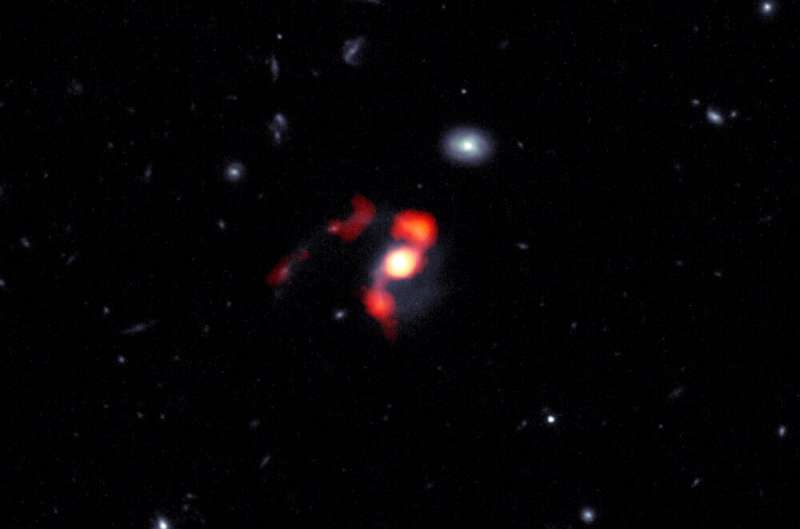
While observing a newly-dormant galaxy using the Atacama Large Millimeter/submillimeter Array (ALMA) and the Hubble Space Telescope (HST), scientists discovered that it had stopped forming stars not because it had used up all of its gas but because most of its star-forming fuel had been thrown out of the system as it merged with another galaxy. The result is a first for ALMA scientists. What's more, if proven common, the results could change the way scientists think about galaxy mergers and deaths. The results of the research are published in The Astrophysical Journal Letters.

As galaxies move through the universe, they sometimes encounter other galaxies. As they interact, each galaxy's gravity pulls on the other. The ensuing tug-of-war flings gas and stars away from the galaxies, leaving behind streams of material known as tidal tails.

And that's just what scientists believe happened to SDSS J1448+1010, but with a plot twist. The massive galaxy, which was born when the universe was about half its current age, has nearly completed merging with another galaxy. During observations with the HST and ALMA—an international collaboration in which the U.S. National Science Foundation's National Radio Astronomy Observatory (NRAO) is a partner—scientists discovered tidal tails containing roughly half of the entire system's cold, star-forming gas. The discovery of the forcefully discarded material—equal to 10 billion times the mass of Earth's sun—was an indication that the merger may be responsible for snuffing out star formation, and that's something scientists didn't expect.
weatheriscool
Posts: 24486
Joined: Sun May 16, 2021 6:16 pm
Contact:

Re: Stars, supernovae, black holes and stellar remnants

Post by weatheriscool »

Ten new pulsating variable stars discovered
https://phys.org/news/2022-08-ten-pulsa ... stars.html
by Tomasz Nowakowski , Phys.org
By analyzing the data from NASA's Transiting Exoplanet Survey Satellite (TESS), Turkish astronomers have detected 10 new pulsating variable stars, including five Delta Scuti variables. The finding is reported in a paper published August 25 on the arXiv pre-print server.

Detecting and studying variable stars could offer important hints into aspects of stellar structure and evolution. Investigation of variables could be also helpful for a better understanding of the distance scale of the universe. In general, there are two main-sequence A-F type pulsating variables: Delta Scuti and Gamma Doradus stars.

Delta Scuti stars are pulsating variables with spectral types between A0 and F5, named after the Delta Scuti variable in the constellation Scutum. They exhibit radial and non-radial pulsations spanning periods from 20 minutes to eight hours. Studying pulsation behavior of Delta Scuti variables could help us advance our knowledge about stellar interiors. When it comes to Gamma Doradus stars, they are dwarf and/or sub-dwarf variables with a spectral type of A7-F5 and periods on the order of one day.

Now, a team of astronomers led by Filiz Kahraman Alicavus of the Çanakkale Onsekiz Mart University in Turkey, report the finding of 10 new pulsating variables by inspecting the TESS database.
User avatar
caltrek
Posts: 9280
Joined: Mon May 17, 2021 1:17 pm

Re: Stars, supernovae, black holes and stellar remnants

Post by caltrek »

Betelgeuse’s Great Dimming: The Aftermath
by Colin Stewart
August 25, 2022

Introduction:
(Sky & Telescope) An international team of astronomers has revealed why the star Betelgeuse famously dimmed back in 2019. The dying star coughed out a huge chunk of material weighing several times more the Moon, which then blocked out some of its light.

Betelgeuse is the 10th brightest star in the night sky and marks Orion's right shoulder (his left shoulder from our point of view). It is a red supergiant, an engorged monster that would stretch out to the orbit of Jupiter if it replaced the Sun in our solar system. Betelgeuse is well on its way to ending its life by detonating as a cataclysmic supernova; meanwhile, astronomers get unprecedented insight into a giant star’s final stages.

The situation became more intriguing in late 2019 when Betelgeuse mysteriously dropped in brightness, an event that came to be known as The Great Dimming. The fading was pronounced enough, more than a magnitude, to notice even with the unaided eye. Lots of possible explanations have been mooted, but now a team led by Andrea Dupree (Center for Astrophysics, Harvard & Smithsonian) thinks they know what happened.

By piecing together data from a slew of telescopes, including the Hubble Space Telescope, Dupree is pointing the finger at an event called a Surface Mass Ejection (SME). Our own Sun regularly burps material from its corona, ejecting a billion tonnes of solar material — about the mass of Mount Everest. But Betelgeuse’s SME spit out 400 billion times more material, equivalent to several times more mass than the Moon. As the ejected material cooled, it formed a cloud of dust that partially blocked, and thus dimmed, our view of Betelgeuse.

"We've never before seen a huge mass ejection of the surface of a star,” Dupree says. “We are left with something going on that we don't completely understand.”
Read more here: https://skyandtelescope.org/astronomy- ... ftermath/

Image
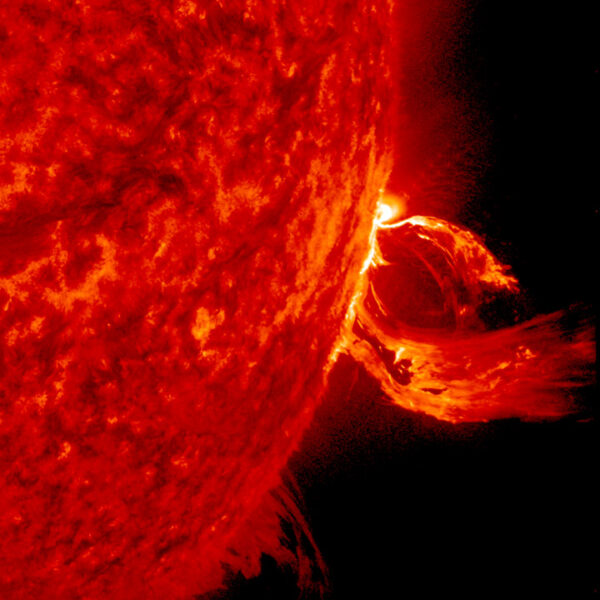
A coronal mass ejection, which is distinct from a surface mass ejection, in the act.
NASA
Don't mourn, organize.

-Joe Hill
weatheriscool
Posts: 24486
Joined: Sun May 16, 2021 6:16 pm
Contact:

Re: Stars, supernovae, black holes and stellar remnants

Post by weatheriscool »

Red giant Betelgeuse was yellow some 2,000 years ago
https://phys.org/news/2022-09-red-giant ... years.html
by Sebastian Hollstein, Friedrich-Schiller-Universität Jena
An interdisciplinary team centered around a Jena astrophysicist utilized observations from antiquity to prove that Betelgeuse—the bright red giant star in the upper left of the constellation Orion—was yellow-orange some 2,000 years ago.

As nuclear fusion in the center of a star progresses, brightness, size, and color also change. Astrophysicists can derive from such properties important information on the age and mass of a star. Those stars with significantly more mass than our sun are blue-white or red—the transition from red to yellow and orange is relatively rapid for astronomical time-scales.

Astrophysicists of Friedrich Schiller University Jena, Germany, together with colleagues of other subjects from the U.S. and Italy, have now successfully detected and dated such a color change in a bright star. With several historical sources, they found that Betelgeuse—the bright red giant star in the upper left of the constellation Orion—was yellow-orange some 2,000 years ago. They report about their results in the current issue of Monthly Notices of the Royal Astronomical Society.
Post Reply