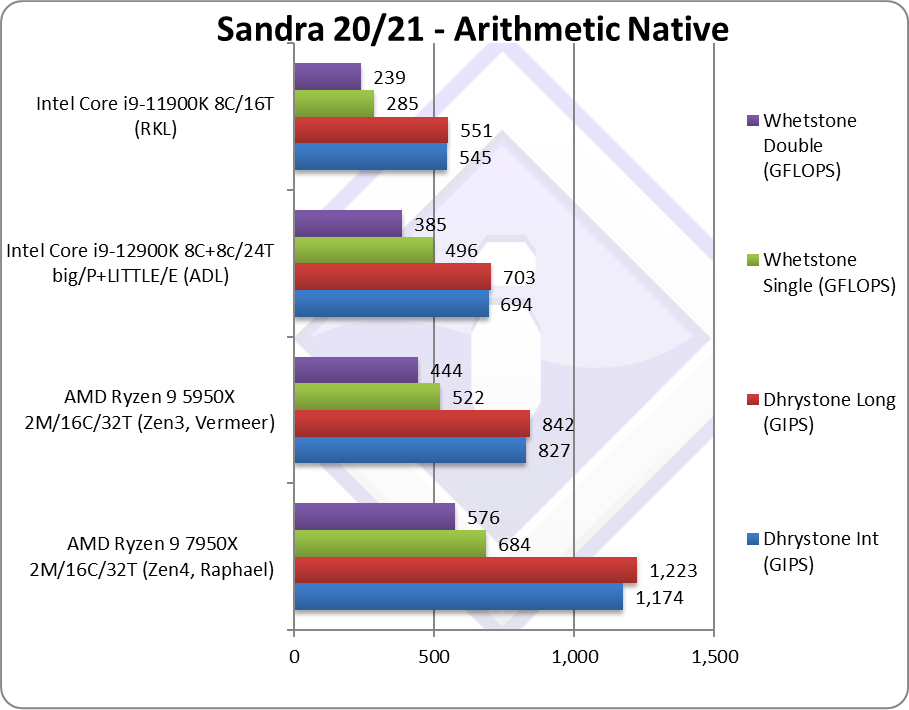
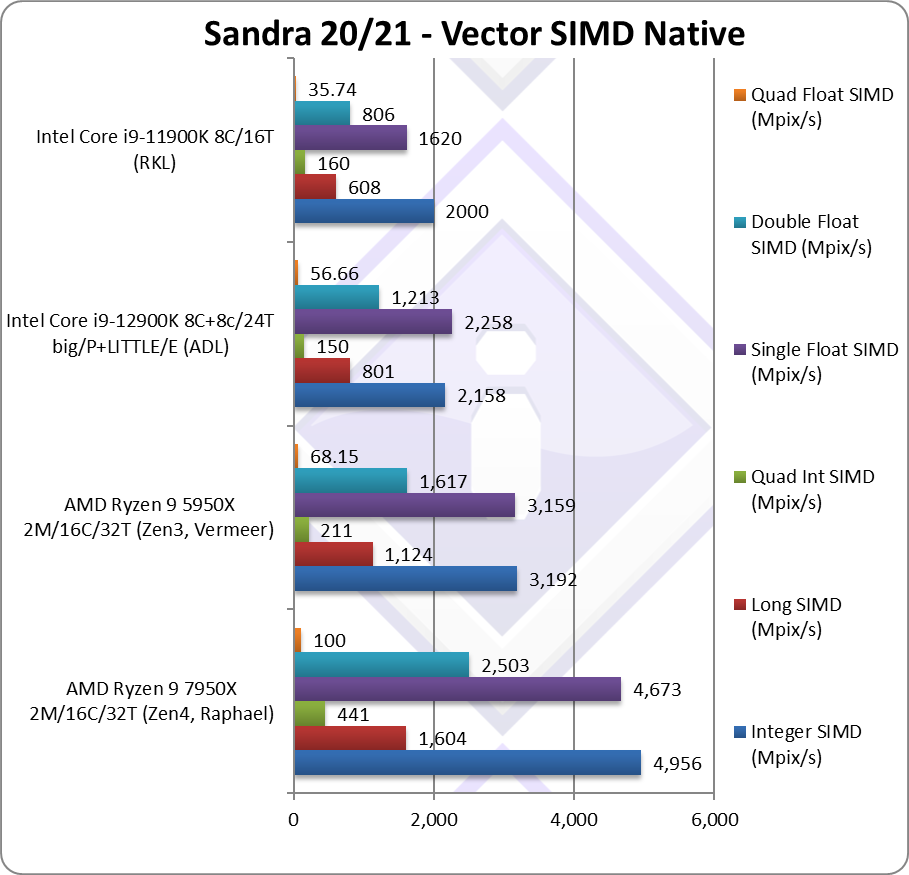
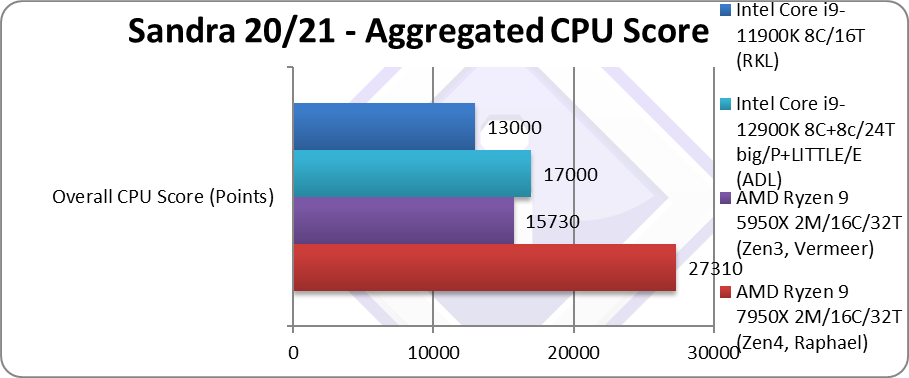
There's a substantial improvement over 5950X and for $100 less, after 2 years. I think it's a decent CPU for both entertainment and work.
Without DLSS 3.0 (upscaling + interpolation), even the 4090 struggles with heavier ray-tracing or with 8K without ray-tracing.Nanotechandmorefuture wrote: ↑Wed Jan 05, 2022 10:42 am Next gen VR is going to be nuts never mind the gaming graphics!
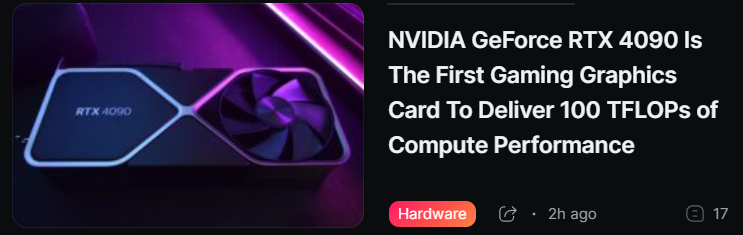
The RTX 4080 12GB is a fantastic graphics card, but it’s not named right. Having two GPUs with the 4080 designation is confusing.
So, we’re pressing the “unlaunch” button on the 4080 12GB. The RTX 4080 16GB is amazing and on track to delight gamers everywhere on November 16th.
If the lines around the block and enthusiasm for the 4090 is any indication, the reception for the 4080 will be awesome.

https://www.pcmag.com/news/japan-to-man ... p-from-ibm
Japan's bid to become a major producer of the most advanced chips in the world received a boost this week thanks to a new partnership with IBM.
As the Japan Times reported(Opens in a new window) last month, eight Japanese companies including Toyota, Sony, NTT, SoftBank, Kioxia, Denso, NEC, and MUFG Bank joined forces and invested in a new company called Rapidus. The goal of Rapidus is to research, develop, design, and manufacture advanced logic semiconductors in Japan, and it has the backing of and subsidies ($500 million) from the Japanese government to help it do so.
Yesterday, IBM announced(Opens in a new window) it will be partnering with Rapidus to further develop and implement IBM's 2nm node technology. The desired end result being to allow Rapidus to manufacture 2nm chips in its Japanese fabrication facilities. As part of the agreement, Rapidus scientists and engineers will work at the Albany NanoTech Complex in New York with IBM researchers, as well as at IBM Japan in Tokyo.
Recap: AMD launched the Radeon RX 7900 XTX and RX 7900 XT last Tuesday and all their regular board partners participated, bar one. MSI was conspicuously absent and has almost entirely ignored the new generation, prompting fans to ask when the company plans on releasing its custom designs for the GPUs.
MSI has hardly acknowledged the two new AMD GPUs despite them being on the calendar for more than a month. Its website still hasn't been updated and continues to proudly advertise the 6950 XT. MSI's only comment on the new generation is a retweet of an AMD promotional video with a caption saying that the GPUs will be available soon.
Define "soon."
As the rumors started to swell last week, Andreas Schilling from HardwareLuxx.de shared his understanding that MSI was waiting until next year to unveil its custom cards. He says that MSI has chosen not to use any AMD reference designs this generation, including the standard reference design that AMD encourages all its board partners to resell with their logos slapped on the side. MSI has sold reference designs like that in the past.
It's strange that MSI is so far behind. It's often one of the first companies to share pictures of its prototypes. In our testing, the reference designs for both the 7900 XTX and 7900 XT seemed pretty good -- the former peaked at 80c and the latter at 76c during an hour of strenuous gaming while the fans stayed under 2,000 RPM and the clocks and volume held at a reasonable level.
Demand for graphics cards significantly increased during the pandemic as some people spent more time at home playing games, whereas others tried to mine Ethereum to get some cash. But it looks like now that the world has re-opened and Ethereum mining on GPUs is dead, demand for desktop discrete GPUs has dropped dramatically. In fact, shipments of discrete graphics cards hit a ~20-year low in Q3 2022, according to data from Jon Peddie Research.
The industry shipped around 6.9 million standalone graphics boards for desktop PCs — including the best graphics cards for gaming — and a similar number of discrete GPUs for notebooks in the third quarter. In total, AMD, Intel, and Nvidia shipped around 14 million standalone graphics processors for desktops and laptops, down 42% year-over-year based on data from JPR. Meanwhile, shipments of integrated GPUs totaled around 61.5 million units in Q3 2022.
Apple supplier Taiwan Semiconductor Manufacturing Co. (TSMC) today started mass production of next-generation 3-nanometer chips that will be used in future Apple devices like iPhones, reports Bloomberg.
3nm apple silicon feature






 3 more CPU comparisons (within ~10 years of each other)