Material Science News and Discussions

Post Reply
weatheriscool
Posts: 24486
Joined: Sun May 16, 2021 6:16 pm
Contact:

Re: Material Science News and Discussions

Post by weatheriscool »

A counterintuitive way to make stronger alloys
https://phys.org/news/2023-02-counterin ... lloys.html
by Kelly Oakes, Norwegian University of Science and Technology
Humans have been mixing metals to create more useful materials for thousands of years. The Bronze Age, which started around 3300 BC, was characterized by the use of bronze, an alloy of copper and tin which is stronger than either metal alone.

Now, researchers at NTNU have discovered a counterintuitive way to make a much more recent invention—nanograined alloys, featuring nano-sized grains of the alloying element—even stronger.

Aluminum is a metal that is widely used to make components in the aerospace, transport, and construction industries, in part because it is lightweight yet durable. Alloys of aluminum retain these qualities but are stronger than aluminum alone.

"If it was a pure aluminum, of course, it's not strong enough," says Yanjun Li, Professor of Physical Metallurgy in the Department of Materials Science and Engineering at NTNU.
Large particles decrease strength

But in recent years, researchers attempting to make nanograined alloys of aluminum containing copper have run into a problem: the copper atoms have a tendency to clump together, forming coarse particles with aluminum inside the material, especially at temperatures higher than 100°C.

When the copper is no longer evenly distributed throughout the material, the alloy becomes weaker.

weatheriscool
Posts: 24486
Joined: Sun May 16, 2021 6:16 pm
Contact:

Re: Material Science News and Discussions

Post by weatheriscool »

Technology transforms plastic waste bottles into polymers for lithium-ion batteries
https://phys.org/news/2023-02-technolog ... m-ion.html
by Agency for Science, Technology and Research (A*STAR), Singapore
A team of A*STAR scientists has successfully upcycled waste polyethylene terephthalate (PET) plastic into polymer electrolytes, which are key components for safer lithium-ion batteries (LiBs). The study is the first known report of a working lithium-ion battery assembled using polymers upcycled from PET plastics, which are used to make plastic bottles.

The study was published in Journal of Materials Chemistry A in November 2022.

Plastic waste is a mounting problem in the world today, and it is set to grow bigger with the rising demand for plastics. 460 million tons of plastics were produced globally in 2019, but only 9% are recycled, with the remainder either being incinerated or disposed in landfills and the environment.

Plastic waste is conventionally recycled through mechanical and chemical processes, which have their drawbacks. For mechanical recycling, only a small proportion of recycled PET can eventually be used, as their physical properties degrade with each round of recycling due to polymer chain cleavage. Chemical recycling involves high energy usage, requires purified monomers and can be more costly compared to using virgin polymers.
weatheriscool
Posts: 24486
Joined: Sun May 16, 2021 6:16 pm
Contact:

Re: Material Science News and Discussions

Post by weatheriscool »

Perovskites, a 'dirt cheap' alternative to silicon, just got a lot more efficient
https://phys.org/news/2023-02-perovskit ... licon.html
by University of Rochester

Silicon, the standard semiconducting material used in a host of applications—computer central processing units (CPUs), semiconductor chips, detectors, and solar cells—is an abundant, naturally occurring material. However, it is expensive to mine and to purify.

Perovskites—a family of materials nicknamed for their crystalline structure—have shown extraordinary promise in recent years as a far less expensive, equally efficient replacement for silicon in solar cells and detectors. Now, a study led by Chunlei Guo, a professor of optics at the University of Rochester, suggests that perovskites may become far more efficient.

Researchers typically synthesize perovskites in a wet lab, and then apply the material as a film on a glass substrate and explore various applications

Guo instead proposes a novel, physics-based approach. By using a substrate of either a layer of metal or alternating layers of metal and dielectric material—rather than glass—he and his co-authors found they could increase the perovskite's light conversion efficiency by 250%.

Their findings are reported in Nature Photonics.

"No one else has come to this observation in perovskites," Guo says. "All of a sudden, we can put a metal platform under a perovskite, utterly changing the interaction of the electrons within the perovskite. Thus, we use a physical method to engineer that interaction."
weatheriscool
Posts: 24486
Joined: Sun May 16, 2021 6:16 pm
Contact:

Re: Material Science News and Discussions

Post by weatheriscool »

This Startup Is Making Ultra-Strong Building Panels Out of Grass
Vanessa Bates Ramirez
https://singularityhub.com/2023/02/15/t ... -of-grass/
Construction is a major carbon emitter. The manufacture of cement alone accounts for eight percent of the world’s emissions. But humanity certainly isn’t about to stop building things—in fact, fixing the housing shortage should be near the top of our list of problems to solve. So we need to find more sustainable ways to build, and if they can be cheaper to boot, even better.

Companies are working on all kinds of solutions in the sustainable construction space, from 3D printed homes to carbon-negative concrete. A new potential solution is joining their ranks, and a recent infusion of funding indicates this unique idea could have a lot of promise.

Plantd is a startup that makes engineered building materials out of grass. That’s right—grass! The fastest-growing perennial grass on Earth, according to the company.

Based in Durham, North Carolina, Plantd closed its Series A funding round to the tune of $10 million in January. Two of its three cofounders are former SpaceX engineers.
What’s Great About Grass

Like trees, grass captures and stores carbon as it grows, and some varieties can even capture more carbon than trees do. This is mostly because of their growth speed. Think about it: a tree takes at least 10 years—if not 20 or more—to reach a mass large enough to be used for lumber, whereas grass can be harvested multiple times in one season (though there is at least one startup out there that’s engineering trees that grow faster and capture more carbon).

After testing several different types of grass and other raw materials, Plantd settled on a perennial (meaning it grows back every year and doesn’t need to be re-planted) long grass that can grow 20 to 30 feet in a year.

Though grass is obviously softer than wood, it contains a similar cellulose fiber that can be broken down then reconstituted and engineered in such a way that the final product is even stronger than wood (check out this video that made the rounds on LinkedIn last year: a regular wood panel and a Plantd panel are subjected to a sledgehammer, and just one of the two withstands the test).
Plantd panel
Image Credit: Plantd

Plantd makes structural building panels for wall sheathing, roof decking, and subflooring, and they say their product outcompetes wood on every metric: it’s stronger, cheaper, lighter, more moisture-resistant, and captures more carbon—all for the same cost as wood. The panels are meant to be a replacement for a plywood-like material called traditional oriented strand board, or OSB. Custom-built machinery uses heat and pressure to press shredded grass into panels, with a standard four-by-eight-foot panel using about 50 pounds of grass.
weatheriscool
Posts: 24486
Joined: Sun May 16, 2021 6:16 pm
Contact:

Re: Material Science News and Discussions

Post by weatheriscool »

Designing advanced 'BTS' materials for temperature and long-wave infrared sensing
https://phys.org/news/2023-02-advanced- ... -wave.html
by Thamarasee Jeewandara , Phys.org
Materials scientists are often inspired by nature and therefore use biological compounds as cues to design advanced materials. It is possible to mimic the molecular structure and functional motifs in artificial materials to offer a blueprint for a variety of functions. In a new report in Science Advances, Tae Hyun Kim and a research team at the California Institute of Technology and the Samsung Advanced Institute of Technology in the U.S. and South Korea, created a flexible biomimetic thermal sensing polymer, abbreviated BTS, which they designed to mimic ion transport dynamics of pectin; a plant cell wall component.

The researchers used a versatile synthetic procedure and engineered the properties of the polymer to be elastic, flexible and stretchable in nature. The flexible polymer outperformed state-of-the-art temperature sensing materials such as vanadium oxide. Despite mechanical deformations, the thermal sensor-integrated material showed high sensitivity and stable functionality between 15° and 55° Celsius. The properties of the flexible BTS polymer made it well suited to map temperature variations across space-time and facilitate broadband infrared photodetection relevant for a variety of applications.
All-organic electronic materials developed with pectin

Organic electronic materials are competitive alternatives to conventional silicon-based microelectronics due to their cost-effective, multifunctional nature. Materials scientists seek to tailor the properties of such materials at the molecular level for a range of sensing applications for wearable and implantable devices with specific characteristics such as flexibility and elasticity. At present, there is an increasing demand for all-organic electronic devices to form a range of soft and active materials. For instance, organic thermal sensors are suited for remote health care and robotics, albeit with limitations.

Researchers have therefore sought to develop organic materials with a high thermal response and flexibility using a relatively simple scaffold through recent studies of pectin; a plant cell wall component made of a structurally and functionally complex polysaccharide. Since devices developed with pectin as a sensing element are structurally unstable, Kim and colleagues introduced a new, flexible biomimetic thermal sensing (BTS) polymer, bioinspired by the structural and functional motifs of pectin. The researchers used a versatile, living radical polymerization method to engineer the structures with inherent mechanical stability and flexibility, suited for organic electronic materials.
Film formation behavior and component analysis of the block copolymer. (A) Digital images of the cross-linke
weatheriscool
Posts: 24486
Joined: Sun May 16, 2021 6:16 pm
Contact:

Re: Material Science News and Discussions

Post by weatheriscool »

A newly developed catalyst makes single-use plastics easier to upcycle, recycle and biodegrade
https://phys.org/news/2023-02-newly-cat ... asier.html
by Ames Laboratory

Researchers created a new catalyst that transforms hydrocarbons into chemicals and materials that are higher value, easier to recycle, and biodegrade in the environment. This catalyst transforms materials such as motor oil, plastics in single-use grocery bags, water or milk bottles, and their caps, and even natural gas. It was developed by a team of scientists led by Aaron Sadow, a scientist at Ames National Laboratory, director of the Institute for Cooperative Upcycling of Plastic (iCOUP), and professor of chemistry at Iowa State University.

The new catalyst is designed to introduce functional groups into aliphatic hydrocarbons. Aliphatic hydrocarbons are organic compounds made up of only hydrogen and carbon. They typically do not mix with water, instead creating distinct layers, partly because they do not contain functional groups. Functional groups are specific groupings of atoms within molecules that have unique characteristics. Adding functional groups to these hydrocarbon chains can drastically affect their properties and make the materials recyclable.
weatheriscool
Posts: 24486
Joined: Sun May 16, 2021 6:16 pm
Contact:

Re: Material Science News and Discussions

Post by weatheriscool »

Strange new material discovered in "fossilized lightning"
By Michael Irving
April 12, 2023
https://newatlas.com/science/fossilized ... phosphite/
In what sounds like a superhero’s origin story, scientists have discovered a new type of material created after lightning struck a tree. This particular form of crystalline phosphorus has never been seen on Earth, and could belong to a new mineral group.

During a thunderstorm in the summer of 2012, lightning struck a tree in New Port Richey, Florida, which flash-melted soil and sand around the roots to form a structure called a fulgurite, or “fossilized lightning.” The owners of the property found and sold the fulgurite to University of South Florida (USF) geoscientist, Matthew Pasek.

Fulgurites can be a goldmine for intriguing minerals, thanks to the strange chemical reactions that occur as a result of the extreme energy of a lightning strike. And when the USF team cracked this one open, they discovered a strange new form of calcium phosphite.

“We have never seen this material occur naturally on Earth – minerals similar to it can be found in meteorites and space, but we've never seen this exact material anywhere,” said Pasek.

By examining the fulgurite in detail, the team pieced together how this material likely formed. Iron is known to accumulate around tree roots in wet areas like Florida, and the lightning strike caused that iron to combust, and fuse with silicon in the sand around the tree root. At the same time, carbon in the tree itself combusted too, and together these elements underwent a chemical reaction that formed the fulgurite and the new phosphite material within.
weatheriscool
Posts: 24486
Joined: Sun May 16, 2021 6:16 pm
Contact:

Re: Material Science News and Discussions

Post by weatheriscool »

New recipe makes concrete that absorbs more CO2 than it emits
By Michael Irving
April 18, 2023
https://newatlas.com/materials/carbon-n ... d-biochar/
Concrete is one of the most common materials on Earth, thanks to its high strength and low cost – but it’s also one of the largest single sources of carbon dioxide emissions. Engineers at Washington State University (WSU) have developed a new method for making concrete that absorbs more carbon than it emits.

The process of making cement requires very high temperatures, and that usually requires burning fuels which, of course, emits CO2. That can be partly offset by switching to renewable energy sources, but chemical reactions in the mixture also release huge amounts of CO2, and this is harder to avoid. All up, it’s estimated that cement production accounts for as much as 8% of humanity’s total carbon dioxide emissions.

Scientists have been tweaking the formula to try to reduce concrete’s carbon footprint, by substituting limestone for volcanic rock, or adding ingredients like titanium dioxide, construction waste, baking soda or a clay commonly discarded during mining. Other teams have even tried using microalgae to grow the required limestone.

For the new study, the WSU researchers investigated a new method involving biochar, a charcoal made from organic waste. While biochar has been added to cement before, this time the team treated it first using concrete washout wastewater. This boosted its strength and allowed a higher proportion of the additive to be mixed in. But most importantly, the biochar was able to absorb up to 23% of its own weight in carbon dioxide from the air around it.
weatheriscool
Posts: 24486
Joined: Sun May 16, 2021 6:16 pm
Contact:

Re: Material Science News and Discussions

Post by weatheriscool »

ChatGPT makes materials research much more efficient
https://phys.org/news/2023-04-chatgpt-m ... cient.html
by Jason Daley, University of Wisconsin-Madison
The artificial intelligence developer OpenAI promises to reshape the way people work and learn with its new chatbot called ChatGPT. At the University of Wisconsin–Madison, in fact, the large language model is already aiding materials engineers, who are harnessing its power to quickly and cost-effectively extract information from scientific literature.

For several years, Dane Morgan, a professor of materials science and engineering at UW–Madison, has used machine learning, a type of data-based AI, in his lab to evaluate and search for new types of materials with great success. Maciej Polak, a staff scientist who works closely with Morgan, brainstormed other tasks AI might help with.

"AI can increasingly help with tasks that are quite complex and time consuming," says Polak. "And we thought, 'What is something materials scientists do very often that we wish we had more time for?' One key thing is reading papers to get data."

Polak says materials scientists often download and then comb through long research papers to search for one small group of numbers to add to their data sets.

"We thought we could just offload all of these time-consuming tasks onto an AI that could read those papers for us and give us that information," says Polak.
weatheriscool
Posts: 24486
Joined: Sun May 16, 2021 6:16 pm
Contact:

Re: Material Science News and Discussions

Post by weatheriscool »

Latest Kevlar EXO fabric is lighter, more flexible and bulletproof
By David Szondy
April 25, 2023
https://newatlas.com/materials/dupont-k ... mid-fiber/
DuPont has debuted a new version of its famous bulletproof Kevlar fabric called EXO at this year's United States Army Rangers' Best Ranger Competition at Fort Benning Georgia. The company says it is the most significant aramid fiber innovation in over 50 years with not only better ballistic protection, but it's also lighter, more flexible, and more heat resistant.

Mention Kevlar and it's likely to bring up images of bulletproof vests, but the material has many more applications. Blankets of it protect the International Space Station from micrometeorites, it reinforces composite boat hulls, is spun into cordage, woven into sails, formed into helmets and fire-resistant clothing, used as a substitute for asbestos, and turned into everything from hockey sticks to tennis rackets.

Small wonder that 55 million tonnes of it under various names are produced worldwide every year.

Technically, Kevlar is an aramid fiber, which is short for aromatic polyamide – a synthetic polymer material formed from aromatic rings of six carbon atoms arranged along the axis of the fiber. Put simply, this makes the end result very strong, abrasion resistant, heat resistant, nonconductive, and non-inflammable under normal conditions.
weatheriscool
Posts: 24486
Joined: Sun May 16, 2021 6:16 pm
Contact:

Re: Material Science News and Discussions

Post by weatheriscool »

Researchers create antimicrobial 'superfoam'
https://phys.org/news/2023-04-antimicro ... rfoam.html
by University of Georgia
A versatile new foam material developed by researchers at the University of Georgia could significantly reduce health care-related infections caused by implanted medical devices—or drastically improve cleanup efforts following environmental disasters like oil spills.

This research, titled "Superhydrophobic and Conductive Foams with Antifouling and Oil-Water Separation Properties" was published in the ACS Applied Materials & Interfaces January issue.

Like a spongy Swiss Army knife, the porous three-dimensional foam is water-repellent—meaning it resists blood, microbes and proteins, while also exhibiting antimicrobial and oil-water separation properties. Its versatility, functionality and relatively inexpensive production costs could make it a valuable resource for future clinicians and environmental remediation professionals alike.

"Making a multifunctional and versatile surface is an extremely challenging task," said Hitesh Handa, an associate professor in UGA's School of Chemical, Materials and Biomedical Engineering. "You can find a surface that is only antimicrobial, or you can find one that can only prevent blood clotting. To be able to fabricate materials that are anticlotting, antimicrobial and antifouling is a significant improvement on current standards."
weatheriscool
Posts: 24486
Joined: Sun May 16, 2021 6:16 pm
Contact:

Re: Material Science News and Discussions

Post by weatheriscool »

Removing the sluggishness associated with using hydrogen to make steel
https://phys.org/news/2023-04-sluggishn ... steel.html
by Bob Yirka , Phys.org

A team of metallurgists and materials scientists at the Max-Planck-Institut für Eisenforschung GmbH has uncovered the reason for the sluggishness that occurs when attempting to use hydrogen instead of coke to make steel. In their study, reported in the journal Physical Review Letters, the group isolated the problem and offer solutions for producing steel with reduced carbon emissions.

Prior research has shown that making steel accounts for approximately 7% to 9% of carbon dioxide emissions into the atmosphere, which has led scientists to look for cleaner ways of making the material. Thus far, the prime approach has been using hydrogen to heat the iron oxide. But this has proven to be too sluggish. In this new effort, the research team has found the reason for the sluggishness and has also found a solution.

To make steel, coke (which has a high carbon content) is burned inside of a blast furnace to heat up a quantity of iron oxide. As this happens, a reaction occurs between the carbon and the oxygen in the iron, resulting in the release of carbon dioxide into the air as the iron is converted to steel. Prior research has shown that as the oxygen leaves the iron during the reaction, pores remain in the iron which must then be cleared of oxygen by heating the metal a second time. In this new effort, the researchers found that these pores led to problems when attempting to use the much cleaner hydrogen to heat the iron oxide.
User avatar
caltrek
Posts: 9280
Joined: Mon May 17, 2021 1:17 pm

Re: Material Science News and Discussions

Post by caltrek »

Twenty Self-Assembling Crystal Form Discovered
by Stephen Luntz
April 28, 2023

Introduction:
(IFL Science) Like a murmuration of starlings or a school of fish, some shapes can make patterns out of disorder in a way that feels as though it should require a guiding intelligence, or at least life. There are still major gaps in our knowledge of the characteristics that enable this to happen, but two scientists have made enough progress to use targeted discovery to identify components that will self-assemble into crystals that have never been seen before.

The capacity of molecular building blocks to self-assemble can be extremely useful, but still tends to be discovered by chance or on a trial-and-error basis. PhD student Hillary Pan and her supervisor Dr Julia Dshemuchadse of Cornell University set out to change that, identifying the “interaction potential” of shapes in simulations and then modifying features to see if they will come together to form crystals. In a new paper, they announce the work has yielded 20 previously unknown crystal structures.

“To design self-assembled crystals, it is important to know which structures are feasible as well as the interparticle interactions that will form that structure,” Pan and Dshemuchadse write. Some of these features have been identified. They give the example of a steep repulsive interaction between molecules paired with an attractive well which forms highly coordinated structures that pack spherical shapes.

However, our understanding of how longer-range interactions for molecular charges work remains poor. As a result, some structures form unexpectedly. The authors are interested in the formation of hollow frames that can trap atoms or molecules inside. One example, zeolites, has been our key source of knowledge about the early Earth, with radioactive isotopes inside these durable crystals enabling us to determine the age of rocks by the proportion that have decayed.

More recently another category of self-assembling porous structure, metal-oxide frameworks (MOFs) have attracted interest for the ability to trap and store large quantities of gasses and pollutants. Being able to identify molecules that will self-assemble using targeted discovery could lead us to other potential applications.

Read more here: https://www.iflscience.com/20-new-self ... red-68675
Don't mourn, organize.

-Joe Hill
weatheriscool
Posts: 24486
Joined: Sun May 16, 2021 6:16 pm
Contact:

Re: Material Science News and Discussions

Post by weatheriscool »

Liquid-metal-coated smart fabric 'heals' itself when cut, repels bacteria
By Paul McClure
May 02, 2023

Science continues to advance smart fabrics that respond to environmental changes, and provide more ‘services’ to their wearers. Now, a team of international researchers has created a wearable textile that repairs itself, is antibacterial, and could even be used to monitor a person’s heart rhythm. Researchers from the US, Australia, and South Korea created the highly conductive textile by dipping it in liquid metal (LM) particles.

LM particles have many advantages: high heat and electrical conductivity, low toxicity, and antimicrobial properties. The gallium-based liquid metals the researchers used as part of this study remain in a liquid state at room temperature, meaning that, unlike solid metals, they can be molded onto surfaces in unconventional ways.

The researchers dip-coated the fabric with LM particles, which ensured the textile’s pores were not clogged, making it ‘breathable.’ They found that applying force to the LM-coated textile ruptured the non-conductive, oxygen-based layer that formed after dip-coating, making the particles conductive.
https://newatlas.com/materials/liquid-m ... -bacteria/
weatheriscool
Posts: 24486
Joined: Sun May 16, 2021 6:16 pm
Contact:

Re: Material Science News and Discussions

Post by weatheriscool »

Scintillating science: Researchers improve materials for radiation detection and imaging technology
https://phys.org/news/2023-05-scintilla ... ology.html
by Bill Wellock, Florida State University
A team of Florida State University researchers has further developed a new generation of organic-inorganic hybrid materials that can improve image quality in X-ray machines, CT scans and other radiation detection and imaging technologies.

Professor Biwu Ma from the Department of Chemistry and Biochemistry and his colleagues have developed a new class of materials that can act as highly efficient scintillators, which emit light after being exposed to other forms of high energy radiations, such as X-rays.

The team's most recent study, published in Advanced Materials, is an improvement upon their previous research to develop better scintillators. The new design concept produces materials that can emit light within nanoseconds, orders of magnitude faster than previously developed materials, allowing for better imaging.

"Reducing the radioluminescence decay lifetime of scintillators to nanoseconds is an important breakthrough," Ma said. "Using a hybrid material made up of both organic and inorganic components means each component can be used for the part of the process where it is most effective."
weatheriscool
Posts: 24486
Joined: Sun May 16, 2021 6:16 pm
Contact:

Re: Material Science News and Discussions

Post by weatheriscool »

New surface coating technology increases materials' electron emission seven-fold
https://phys.org/news/2023-05-surface-c ... ctron.html
by Tohoku University
An international research group has developed a new surface coating technology that is capable of significantly increasing electron emission in materials. Their breakthrough is expected to improve the production of high-efficiency electron sources and lead to increased performances in electron microscopes, electron beam lithography systems and synchrotron radiation facilities. The research was published in the journal Applied Physics Letters on April 3, 2023.

Free electrons are those not bound to a specific atom or molecule, wondering freely within a material. They play a vital role in a wide range of applications, from photoreactors and microscopes to accelerators.

One property that measurers the performance of free electrons is work function: the minimum energy required for electrons to escape from a materials surface into a vacuum. Materials with a low work function require less energy to remove electrons and make them free to move around; whereas materials with a high work function need more energy to remove electrons.

A lower work function is critical for enhancing the performance of electron sources and contributes to the development of advanced materials and technologies that can have practical applications in various fields, such as electron microscopy, accelerator science, and semiconductor manufacturing.
weatheriscool
Posts: 24486
Joined: Sun May 16, 2021 6:16 pm
Contact:

Re: Material Science News and Discussions

Post by weatheriscool »

Self-healable and crack-resistant hydrogel microfibers inspired by spider silk
https://techxplore.com/news/2023-05-sel ... pider.html
by Ingrid Fadelli , Tech Xplore
In recent years, material scientists have been creating new materials with a variety of advantageous properties that could enhance the performance of different technologies and devices. This includes hydrogel-based fibers and artificial skins, which could help to create soft humanoid robots, prosthetics, and even comfortable smart clothes or wearable devices.

Researchers at Donghua University in China recently created new hydrogel-based microfibers that are robust, self-healable and crack-resistant. These microfibers, introduced in Nature Communications, were fabricated using a process inspired by how spiders spin their webs.

"We noticed that although plenty of synthetic hydrogel fibers have been synthesized to mimic the basic functions of biological fibers like silk, muscle, and nerve fibers, most of them have very poor damage resistance, which greatly limits their durability," Shengtong Sun, one of the researchers who carried out the study, told Tech Xplore. "This may be solved by learning the structure of spider silk, which represents almost the limit of toughness of known natural biological materials."

Spiders spin very strong silk webs from an aqueous dope, a liquid crystalline solution in which protein molecules can move freely while retaining some degree of order. The webs they create follow a hierarchical nanoconfined structure with advantageous mechanical properties.

"We envisaged that the ionic complex of a hygroscopic, positively charged polyelectrolyte (PDMAEA-Q) and polymethacrylic acid (PMAA) could be an ideal system to produce damage-tolerant hydrogel fibers." Sun explained. "In the formed fiber, PMAA would form strong hydrogen bonded clusters embedded in the soft matrix of ionic complexes. This could theoretically mimic the nanoconfined structure of spider silk for an improved mechanical performance."

The researchers' hydrogel microfibers were produced under ambient conditions, just as those in which spiders produce their web. They used a technique known as pultrusion spinning to form the fibers from an aqueous solution containing PMAA and PDMAEA-Q.
weatheriscool
Posts: 24486
Joined: Sun May 16, 2021 6:16 pm
Contact:

Re: Material Science News and Discussions

Post by weatheriscool »

New 'designer' titanium alloys made using 3D printing
https://techxplore.com/news/2023-05-tit ... ys-3d.html
by RMIT University
A team of researchers has created a new class of titanium alloys that are strong and not brittle under tension, by integrating alloy and 3D-printing process designs.

The breakthrough, published in the journal Nature, could help extend the applications of titanium alloys, improve sustainability and drive innovative alloy design.

Their discovery holds promise for a new class of more sustainable high-performance titanium alloys for applications in aerospace, biomedical, chemical engineering, space and energy technologies.

RMIT University and the University of Sydney led the innovation, in collaboration with Hong Kong Polytechnic University and the company Hexagon Manufacturing Intelligence in Melbourne.

Lead researcher, Ma Qian a professor from RMIT, said the team embedded circular economy thinking in their design, creating great promise for producing their new titanium alloys from industrial waste and low-grade materials.

"Reusing waste and low-quality materials has the potential to add economic value and reduce the high carbon footprint of the titanium industry," said Qian from RMIT's Center for Additive Manufacturing in the School of Engineering.
weatheriscool
Posts: 24486
Joined: Sun May 16, 2021 6:16 pm
Contact:

Re: Material Science News and Discussions

Post by weatheriscool »

Buckle up: A new class of materials is here
https://phys.org/news/2023-06-buckle-cl ... rials.html
by University of Amsterdam
Usually, the two characterizations of a material are mutually exclusive: something is either stiff, or it can absorb vibrations well—but rarely both. However, if we could make materials that are both stiff and good at absorbing vibrations, there would be a whole host of potential applications, from design at the nanoscale to aerospace engineering.

A team of researchers from the University of Amsterdam has now found a way to create materials that are stiff, but still good at absorbing vibrations—and equally importantly, that can be kept very light-weight.

David Dykstra, lead author of the study published in the journal Advanced Materials, explains, "We discovered that the trick was to use materials that buckle, like thin metal sheets. When put together in a clever way, constructions made out of such buckled sheets become great absorbers of vibrations—but at the same time, they preserve a lot of the stiffness of the material they are made out of. Moreover, the sheets do not need to be very thick, and so the material can be kept relatively light."
weatheriscool
Posts: 24486
Joined: Sun May 16, 2021 6:16 pm
Contact:

Re: Material Science News and Discussions

Post by weatheriscool »

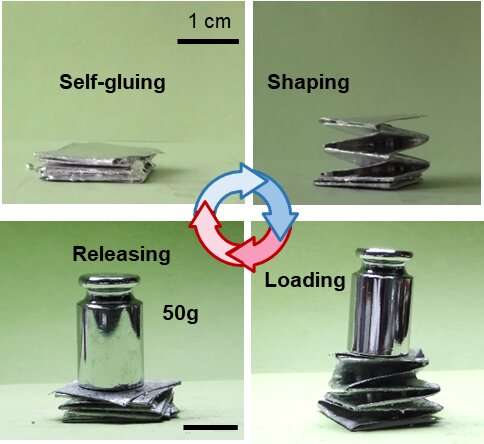
Liquid metal sticks to surfaces without a binding agent
https://phys.org/news/2023-06-liquid-me ... agent.html
Image
by Cell Press
Everyday materials such as paper and plastic could be transformed into electronic "smart devices" by using a simple new method to apply liquid metal to surfaces, according to scientists in Beijing, China. The study, published June 9 in the journal Cell Reports Physical Science, demonstrates a technique for applying a liquid metal coating to surfaces that do not easily bond with liquid metal. The approach is designed to work at a large scale and may have applications in wearable testing platforms, flexible devices, and soft robotics.

"Before, we thought that it was impossible for liquid metal to adhere to non-wetting surfaces so easily, but here it can adhere to various surfaces only by adjusting the pressure, which is very interesting," said Bo Yuan, a scientist at Tsinghua University and the first author of the study.
Post Reply