Extrapolations aren't the safest action and they don't have to come true. CPUs went from 1 core to 4 cores between 2004 and 2006. Server CPUs got to 8 cores in 2010 (AMD's mainstream to 6) and mainstream CPUs in 2017 (i7 in 2018).
$266 Q6600 from July 2007 is 20x slower according to PassMark than the current day Ryzen 7 7700X which is about the same price. It has 2x more cores and 4x more threads, which is not that many more. According to Moore's Law, equivalent CPU in 2023 could have 2^8=256 times more cores, which would be 1024 cores. The highest core count this year will be 128 for the highest-end server CPU (AMD Bergamo) so we are far from that.
GPU and CPU news and discussions
-
weatheriscool
- Posts: 26101
- Joined: Sun May 16, 2021 6:16 pm
- Contact:
Re: GPU and CPU news and discussions
The Incoming Nvidia RTX 4070 Only Consumes 186W in Gaming
That's roughly equivalent to an RTX 3060.
By Josh Norem April 3, 2023
https://www.extremetech.com/gaming/the- ... -in-gaming
That's roughly equivalent to an RTX 3060.
By Josh Norem April 3, 2023
https://www.extremetech.com/gaming/the- ... -in-gaming
Nvidia's upper-midrange RTX 4070 is supposedly in reviewers' hands as we type this, and it's expected to launch on April 13. So far, it's been confirmed that it will be priced at $599, the same price as the Ampere-based RTX 3070 Ti, and $100 more than the RTX 3070 when it launched. Despite the price hike, it sounds like a very efficient GPU. New leaked specs posted by Videocardz show it consumes just 186W while gaming, roughly the same as an RTX 3060.
-
Tadasuke
 some different CPUs comparison from tenstorrent
186 watts for a lower-mid-range graphics card is quite a lot in my opinion. Just a reminder that GTX 970 was $329 in 2014 and even less later ($299 for example).
Here's an alleged comparison of different companies single-threaded integer performance of different CPUs. There are Amazon CPUs, AMD CPUs, Nvidia Grace CPU, Intel CPUs and tenstorrent CPUs, according to tenstorrent. Zen 5 looks to be 2.056x faster in single-threaded than Zen 1 server CPU and 30% faster with 5% higher clockspeed than Zen 4. Kim Keller, who showed these slides, was the man leading the whole Zen team at AMD and they work on processors years before the are actually available for purchase. Earlier this year, I've seen a comparison showing Zen 4 being 2x faster in single-threaded than Zen 1 and 6x faster in multi-threaded, while Intel Sapphire Rapids being 1.5-1.6x faster than Skylake in single-threaded and 3-3.2x in multi-threaded. I don't know. There seem to be varying info. 96 cores Zen 4 has almost 3x higher MSRP than 32 cores Zen 1, I don't know about 128 core Bergamo. I own one old server Xeon, but that's it. I don't own any server CPU from recent years to check any benchmarks.
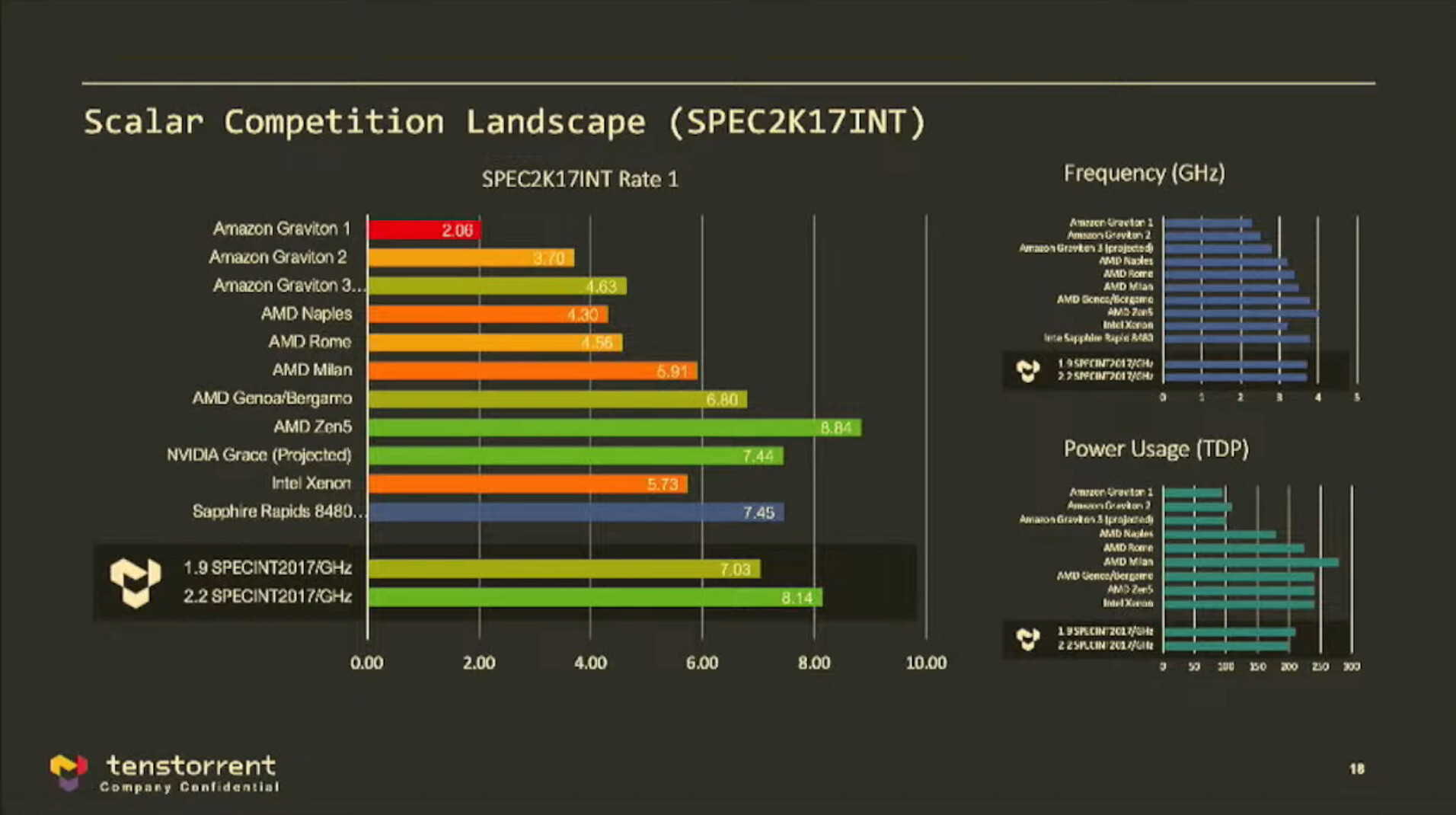
Here's an alleged comparison of different companies single-threaded integer performance of different CPUs. There are Amazon CPUs, AMD CPUs, Nvidia Grace CPU, Intel CPUs and tenstorrent CPUs, according to tenstorrent. Zen 5 looks to be 2.056x faster in single-threaded than Zen 1 server CPU and 30% faster with 5% higher clockspeed than Zen 4. Kim Keller, who showed these slides, was the man leading the whole Zen team at AMD and they work on processors years before the are actually available for purchase. Earlier this year, I've seen a comparison showing Zen 4 being 2x faster in single-threaded than Zen 1 and 6x faster in multi-threaded, while Intel Sapphire Rapids being 1.5-1.6x faster than Skylake in single-threaded and 3-3.2x in multi-threaded. I don't know. There seem to be varying info. 96 cores Zen 4 has almost 3x higher MSRP than 32 cores Zen 1, I don't know about 128 core Bergamo. I own one old server Xeon, but that's it. I don't own any server CPU from recent years to check any benchmarks.
-
Tadasuke
 achieving stable 60 fps in modern games - the cost-effective way
From what I've seen over the years in various written tests and on YouTube, if you turn off all unnecessary backgrounds tasks, then all you need for stable 60 fps in modern games from the last 7 years or so, is 7700K @ 5 GHz, so 4-core Skylake architecture running at 5 GHz with two-way multithreading. Or, if you want a new CPU, then choose 12100F which has lower clocks, but higher per clock performance and a low price of only $75 (as of 07/04/2023). Take for example Assassin's Creed games from Unity onwards (which are all on the same AnvilNext 2.0 engine). With 7600K (or 8350K), you won't get stable 60 fps, but with (overclocked) 7700K you can, same with (stock) 12100F. Alternatively, Ryzen 3600 can be chosen with lower single-threaded, but higher corecount and threadcount, probably giving similar results. GPU 6600 XT, 6650 XT, 6700 XT or 6750 XT. Anything below 6600 XT will certainly cause you framerate problems. 
-
weatheriscool
- Posts: 26101
- Joined: Sun May 16, 2021 6:16 pm
- Contact:
Re: GPU and CPU news and discussions
Overclocker Takes AMD's Ryzen 7 7800X3D to 5.4 GHz on Launch Day
You'll need an Asus motherboard and a bit of luck to reproduce the results.
By Josh Norem April 6, 2023
https://www.extremetech.com/computing/o ... launch-day
You'll need an Asus motherboard and a bit of luck to reproduce the results.
By Josh Norem April 6, 2023
https://www.extremetech.com/computing/o ... launch-day
AMD's latest salvo across Intel's bow is launching today, April 6, and already overclockers are taking it to heights never envisioned by Team Red. The Ryzen 7 7800X3D is the final V-Cache CPU in the Zen 4 lineup, and at $449, it's by far the most attractive chip yet due to its gaming performance parity with much more expensive CPUs, including AMD's own Ryzen 9 SKUs. However, its extra cache has caused AMD to lock down overclocking on the chip to prevent constant thermal throttling. An overclocker has figured out a workaround for this issue, taking a single core up to 5.4GHz, 400MHz beyond stock.
SkatterBencher is a well-known Asus extreme overclocker. He strapped the Ryzen 7 7800X3D to an Asus ROG Crosshair X670E motherboard with two external clock generators for overclocking. This advanced function lets you disable the CPU's base clock limits and generate new ones for overclocking CPUs with limitations set up by the manufacturer. For example, this was previously used to allow overclocking of non-K (non-unlocked) Intel CPUs. Using these clock generators, AMD's Precision Boost Overdrive (PBO), and AMD's Curve Optimizer, he was able to overclock the CPU to the same maximum boost clock as its non-V-Cache sibling, the Ryzen 7 7700X.
-
weatheriscool
- Posts: 26101
- Joined: Sun May 16, 2021 6:16 pm
- Contact:
Re: GPU and CPU news and discussions
Google's WebGPU API Accelerates Graphics in a Web Browser
It'll be supported in ChromeOS, macOS, and Windows in Chrome 113, which is due in a few weeks.
By Josh Norem April 10, 2023
It'll be supported in ChromeOS, macOS, and Windows in Chrome 113, which is due in a few weeks.
By Josh Norem April 10, 2023
https://www.extremetech.com/internet/go ... eb-browserWhen we think of a game offering killer graphics, it's usually because we're running it off dedicated hardware instead of in software like in the olden days. Now Google has officially unveiled a new API for its Chrome browser called WebGPU that will let your GPU handle some heavy lifting when running games and other GPU-based workloads. The new API will be enabled by default in Chrome 113, which is currently only offered in the beta channel. It's expected to receive a public release in a few weeks, and Google will also expand its availability to other browsers in the future as well. WebGPU can run on Windows, ChromeOS, and macOS, but it'll also come to Android and Linux in the future.
-
Tadasuke
more on the topic of holding stable 60 fps in modern and future games
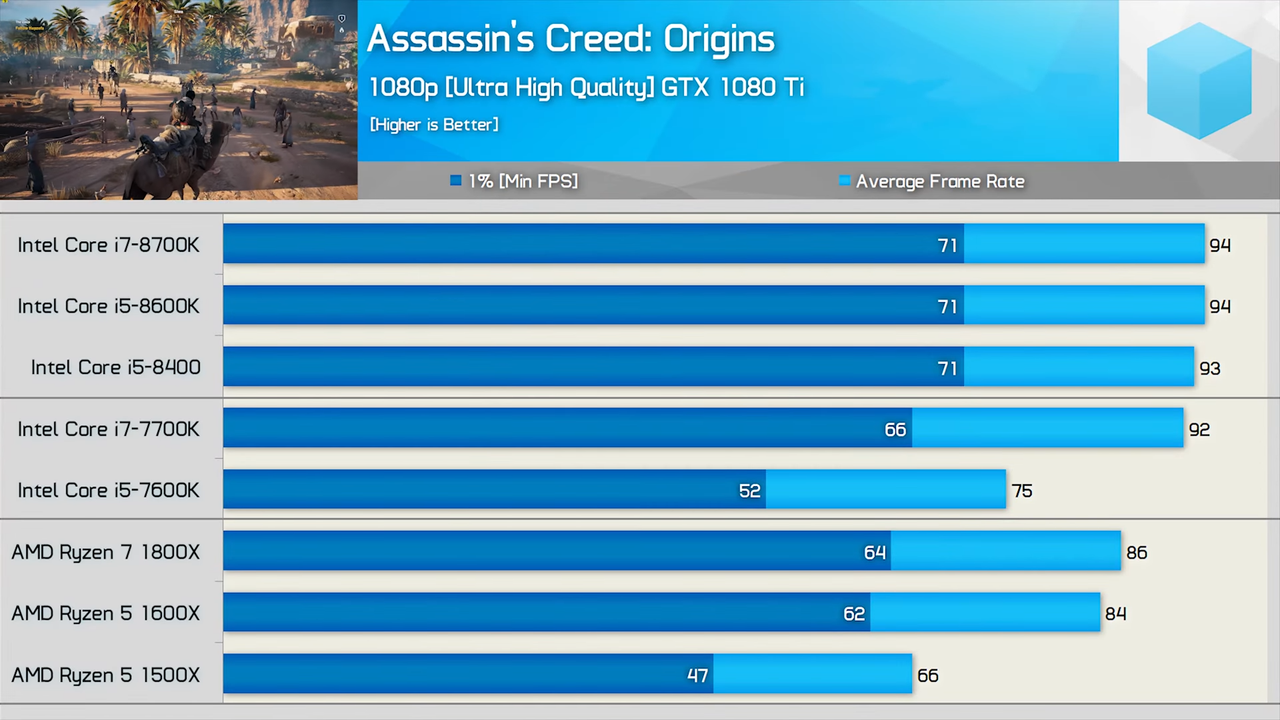
Below is a screenshot from a Hardware Unboxed YouTube video, showing how 2017 CPUs perform in a 2017 AAA video game. DRM has an impact on the CPU unfortunately, but what can we do about it? Future games probably won't be less demanding than AC Origins. You don't want to be barely at 60 fps (look at the 1% lows). Other than OCed Core i7-7700K, also 8400, 8500, 8600, 8600K, 8700, 8700K, 9400, 9400F, 9500, 9500F, 9600, 9600K, 9600KF, 10400, 10400F, 10500, 11400, 11400F, 12100, 12100F, 12300, 13100F, Ryzen (AM4) 3300X, 3500, 3600, 4500, 4600G, 4600GE, 5500, 5600, 5600G, 5600GE and 5600X will probably all grant 60 fps 1% lows and even 0.1% lows (assuming no extra tasks running in background). I've seen examples that in some heavy-action many-player online matches, Ryzen 3100 was dropping below 60 fps, while Ryzen 3300X was just above 60 fps (in 1% lows). So there you see. It is entirely possible that future games will require at least Ryzen 3700X/9900K or so, console CPUs are about equal to Ryzen 3600 probably, but on PC you also get DRM and possible background processes which tax CPUs more than games on consoles.
-
weatheriscool
- Posts: 26101
- Joined: Sun May 16, 2021 6:16 pm
- Contact:
Re: GPU and CPU news and discussions
Nvidia 'Blackwell' Architecture Rumored to Use TSMC 3nm, Up to 2.6X Faster Than RTX 40 Series
Nvidia will also stick with a monolithic design, for now.

By Josh Norem April 10, 2023
https://www.extremetech.com/gaming/nvid ... 26x-faster
Nvidia will also stick with a monolithic design, for now.
By Josh Norem April 10, 2023
https://www.extremetech.com/gaming/nvid ... 26x-faster
Given the company's two-year release cadence, Nvidia's next-generation Blackwell architecture is due in late 2024. Despite that timeframe, sources inside Nvidia are already discussing what it might bring to the table, according to several YouTube tech journalists. The most interesting revelation is that Nvidia will likely stick with a monolithic die for the 50-seres GPUs instead of switching to a chiplet design similar to AMD's 7900 series. These sources said that based on the performance and issues with AMD's first chiplet-based GPUs, they have no interest in going down that path, at least for now. Nvidia will likely use chiplets in future HPC GPUs, however.
YouTubers Moore's Law is Dead and RedGamingTech have reportedly been talking to Nvidia insiders, and they have much to say. Notable Twitter tipsters are also starting to chime in with Blackwell info, and Wccftech has collected this batch of rumors. The big news is that, like Ada Lovelace, Blackwell will be a quantum leap forward for Nvidia as it moves from TSMC's 4/5nm process to the much-hyped 3nm node. This could allow it to deliver a 2-2.6X performance improvement over its current GPUs, even with a monolithic design. The flagship GB102 is expected to offer just 144 SMs, the same as AD102. Therefore, the advancements will come not from throwing more hardware at the problem but from a new, more efficient design.
-
Tadasuke
 some graphics cards comparisons at a constant price
According to Nvidia's marketing? Sure.
In real-world use? No way. Zero chance.
I made a comparison of $599 GPUs (graphics cards) from different years, so you can see, how they have been changing since 2010. Real-world performance improvement (7.29x) is very much in-line with CPU performance improvement at a constant price. There is a stagnation in gigapixels and VRAM since 1080 Ti, which was going for about $599 in 2018. Performance has been rising by 16.5% year over year on average. In-line with my moderate growth prediction (between 10 and 49%). This is also about as much as the new Ryzen 7800X3D is faster than the 7700X from 2022 (at the same price). Expect a 35.7% faster card (I don't mean flops) at the same price in 2 years (probably RTX 5070).

-
Tadasuke
 Snapdragon 8 Gen 3 GPU Could be 50% More Powerful Than Current Gen Adreno 740
https://www.techpowerup.com/307222/snap ... adreno-740An online tipster, posting on the Chinese blog site Weibo, has let slip that Qualcomm's upcoming Snapdragon 8 Gen 3 mobile chipset is touted to pack some hefty graphical capabilities. The suggested Adreno "750" smartphone and tablet GPU is touted to offer a 50% increase over the present generation Adreno 740 - as featured on the recently released and cutting-edge Snapdragon 8 Gen 2 chipset. The current generation top-of-the-range Snapdragon is no slouch when it comes to graphics benchmarks, where it outperforms Apple's prime contender - the Bionic A16 SoC.
-
Tadasuke
Nvidia GPU comparison 1997, 2010 and 2023
I made a simple comparison table of the top of the line single processor Nvidia graphics cards in 1997, 2010 and 2023, so that there is a 13 years time span between them. You can see for yourself, how they have changed through the years. Changes since 1997 were huge, but they were more substantial in the first 13 years. Power requirements, die sizes and transistor counts have increased enormously between 1997 and 2010. Of course, the number of transistors in the table doesn't take VRAM transistors into account, only the GPU die itself. Almost 1000x transistors and memory increase in the first 13 years, amazing. The price has also increased - by 4.6x in the first 13 years and 3.3x in the latter 13 years, 15.4x in total. 4090 and 4090 Ti have 8x more VRAM than the 580. The 580 is about 1200x faster (possibly, I think, or maybe more, perhaps 3000x by some measures) than Riva 128, for 60x more electricity and heat. So the efficiency improvement (real performance/watt) is about 20x. The first GTX Titan in 2013 was $1000, 6 GB VRAM and about 87% faster than the 580. The GTX 980 in 2014 was $550, 4 GB VRAM and about 2x faster than the 580. In 2016, Titan Pascal was 4x faster with 4x more VRAM for $1200, so 2x higher price than the 580. 4090 Ti will be about 15x faster than GTX 580 for 2x more energy, so the efficiency improvement is about 7.5x, still very significant. 20x vs 7.5x (150x in total in 26 years). Things have slowed down after 2010. Change is more gradual and moderate than it used to be for some time in this space. Limiting factors are die size, heat output, electricity requirement, tunneling effects and new nodes design & manufacturing costs.

Last edited by Tadasuke on Sat Apr 15, 2023 2:08 pm, edited 1 time in total.
-
Tadasuke
24-core Golden Cove vs 24-core Zen 3 workstation
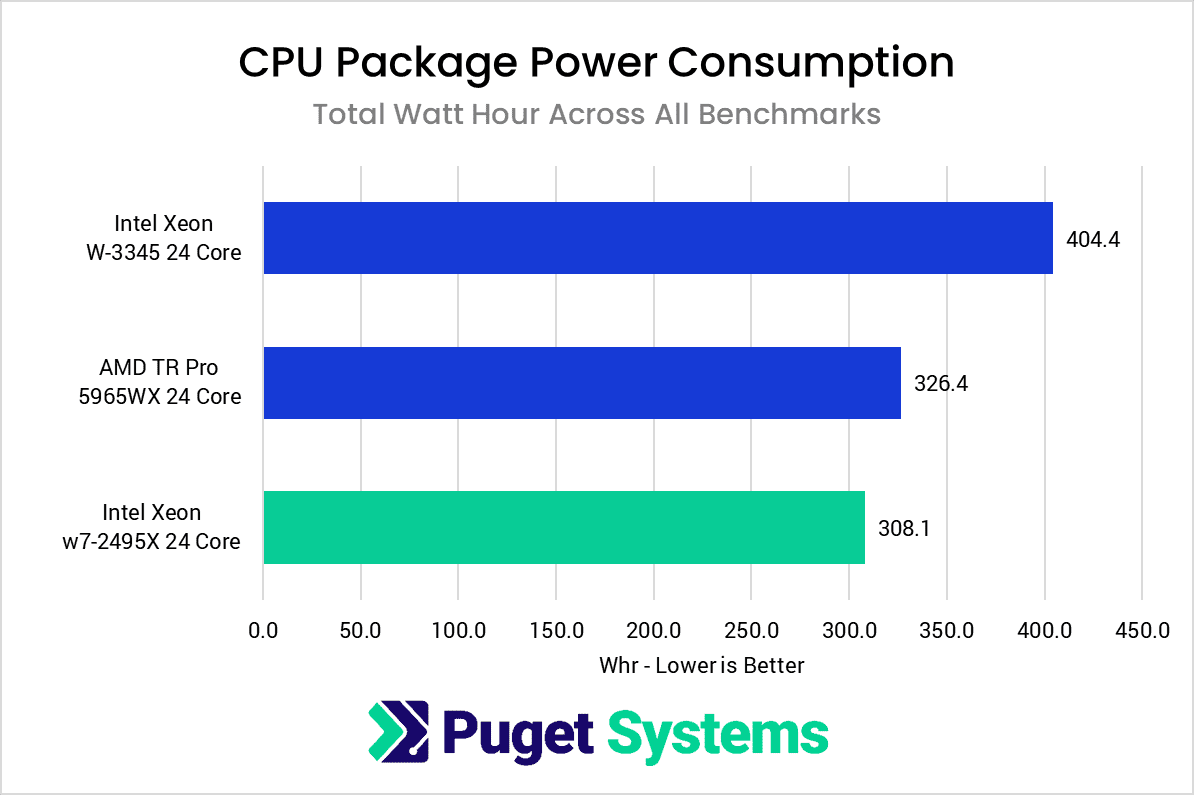
Sapphire Rapids looks to be more energy efficient than Zen 3 after all:
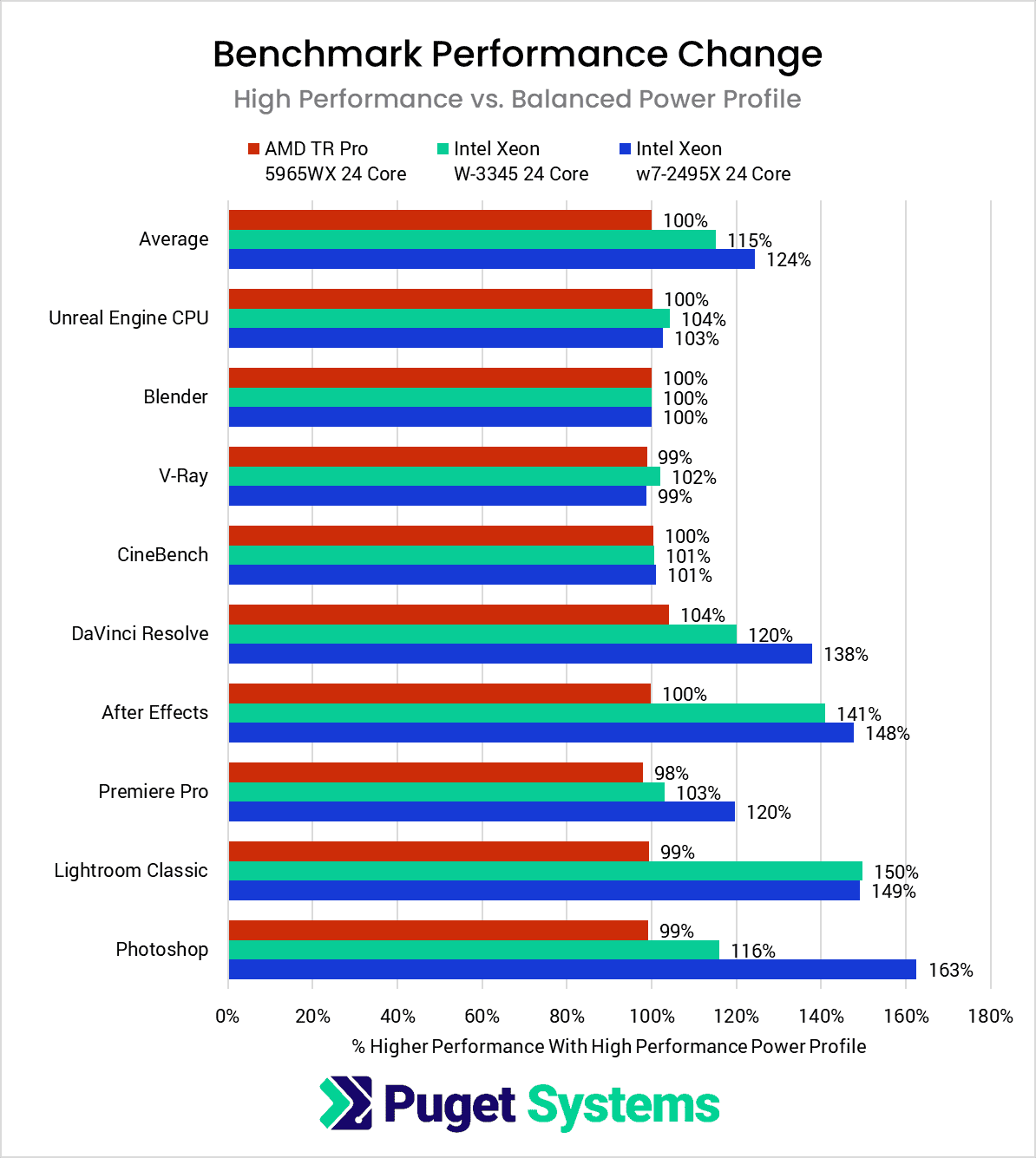
And faster as well:
source: https://www.pugetsystems.com/labs/artic ... on-review/
And faster as well:
source: https://www.pugetsystems.com/labs/artic ... on-review/
-
Tadasuke
comparing some Nvidia graphics cards from Riva 128
Between the 1997 Riva 128 and the 1998 Riva TNT, performance doubled and memory doubled as well. Same with Riva TNT and 1999 Riva TNT2. And the same with GeForce 256 DDR compared to Riva TNT2. In Quake III at 800x600, you would get ~24 fps with Riva 128, ~48 fps with Riva TNT, ~96 fps with Riva TNT2 and ~192 fps with GeForce 256 DDR (~164 with SDR). Memory bandwidth rose by 3x between Riva 128 and 256 DDR (pixel and texture fill rate by ~5x). GeForce2 Ultra doubled performance again, but with $499 (!) MSRP. GeForce 6800 Ultra Extreme in 2004 was the first card to reach ~100 gigaflops. 1 year later, the 7800 GTX reached ~200 gigaflops and the 8800 GTX Ultra in 2007 ~400 gigaflops. GPU performance (and even memory) used to be doubling about every year indeed for some time, that was true, but it stopped being the case. Even when it was doubling, it was happening with the expense of power and cost (even size as well). Then GeForce 285 in 2009 was ~700 gigaflops and GeForce 580 in 2010 ~1600 gigaflops, about as much as the 8th gen consoles (the PS4 is about as fast as the 580). Xbox Series S (the new gaming baseline when excluding Switch) is ~4x faster than Xbox One and ~3x faster than PS4 in GPU performance (~5x in CPU) and GTX 580. 
-
Tadasuke
Samsung Galaxy S22 Ultra vs S23 Ultra 3DMark comparison
Here's a comparison of a 3DMark for Android Sling Shot Extreme Unlimited score between these two:
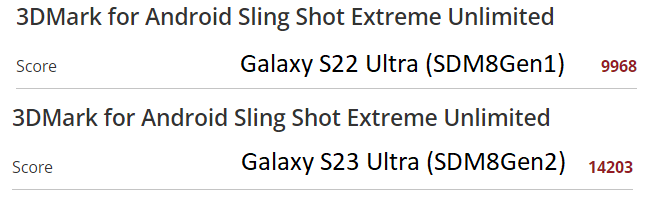
As you can see, the S23 is 42.5% faster than the S22 after 1 year. This is in-line with my 10 to 49.9% once per year evaluation and prediction.
They won't get exactly 42.5% faster every year, but improvements won't be far from that.
As you can see, the S23 is 42.5% faster than the S22 after 1 year. This is in-line with my 10 to 49.9% once per year evaluation and prediction.
They won't get exactly 42.5% faster every year, but improvements won't be far from that.
-
Nanotechandmorefuture
- Posts: 478
- Joined: Fri Sep 17, 2021 6:15 pm
- Location: At the moment Miami, FL
Re: GPU and CPU news and discussions
Its so nice those high quality NVIDIA GPUs can so much with little effort especially when bought all together with a nice setup.
-
Tadasuke
AMD 2010-2022 mid-range CPU comparison
Here's the comparison, all three are hex core AMD CPUs:
Phenom II X6 1055T | 2010 | $199 | 346 mm² | K10 | DDR3-1333 | 2.8 GHz | 3.3 GHz | CB R15 score 446
Ryzen 5 1600X | 2017 | $249 | 213 mm² | Zen 1 | DDR4-2666 | 3.6 GHz | 4.0 GHz | CB R15 score 1126 (2.52x more)
Ryzen 5 7600X | 2022 | $299 | 193 mm² | Zen 4 | DDR5-5200 | 4.7 GHz | 5.3 GHz | CB R15 score 2415 (2.14x more)
I think there is a trend here that you can see. Prices are going up mostly because of inflation ($199 from 2010 is $275 today), die sizes are becoming smaller, frequencies are going up, memory speeds are going up and benchmark scores are going up as well. Of course, Cinebench R15 isn't the only benchmark out there, but I'm trying to simplify things. It's one of the more standard benchmarks. So 7600X looks to be about 5.4x faster than Phenom II X6 1055T, which had the same number of cores 13 years ago. Things aren't stagnant, but they aren't evolving very quickly.
In 2010, PC enthusiasts regarded Pentium E6600 or any Core2Duo as weak, Phenom II X6 was mid-range and pretty good, while i7-980 was the high-end.
Phenom II X6 1055T | 2010 | $199 | 346 mm² | K10 | DDR3-1333 | 2.8 GHz | 3.3 GHz | CB R15 score 446
Ryzen 5 1600X | 2017 | $249 | 213 mm² | Zen 1 | DDR4-2666 | 3.6 GHz | 4.0 GHz | CB R15 score 1126 (2.52x more)
Ryzen 5 7600X | 2022 | $299 | 193 mm² | Zen 4 | DDR5-5200 | 4.7 GHz | 5.3 GHz | CB R15 score 2415 (2.14x more)
I think there is a trend here that you can see. Prices are going up mostly because of inflation ($199 from 2010 is $275 today), die sizes are becoming smaller, frequencies are going up, memory speeds are going up and benchmark scores are going up as well. Of course, Cinebench R15 isn't the only benchmark out there, but I'm trying to simplify things. It's one of the more standard benchmarks. So 7600X looks to be about 5.4x faster than Phenom II X6 1055T, which had the same number of cores 13 years ago. Things aren't stagnant, but they aren't evolving very quickly.
In 2010, PC enthusiasts regarded Pentium E6600 or any Core2Duo as weak, Phenom II X6 was mid-range and pretty good, while i7-980 was the high-end.
-
Tadasuke
AMD Ryzen 8000 "Granite Ridge" Zen 5 Processor to Max Out at 16 Cores
source: https://www.techpowerup.com/308614/amd- ... t-16-coresAMD's next-generation Ryzen 8000 "Granite Ridge" desktop processor based on the "Zen 5" microarchitecture, will continue to top out at 16-core/32-thread as the maximum CPU core-count possible, says a report by PC Games Hardware. The processor will retain the chiplet design of the current Ryzen 7000 "Raphael" processor, with two 8-core "Zen 5" CCDs, and one I/O die. It's very likely that AMD will reuse the same 6 nm client I/O die (cIOD) as "Raphael," just the way it used the same 12 nm cIOD between Ryzen 3000 "Matisse" and Ryzen 5000 "Vermeer;" but with updates that could enable higher DDR5 memory speeds. Each of the up to two "Eldora" Zen 5 CCDs has 8 CPU cores, with 1 MB of dedicated L2 cache per core, and 32 MB of shared L3 cache. The CCDs are very likely to be built on the TSMC 3 nm EUV silicon fabrication process.
Perhaps the most interesting aspect of the PCGH leak would have to be the TDP numbers being mentioned, which continue to show higher-performance SKUs with 170 W TDP, and lower tiers with 65 W TDP. With its CPU core-counts not seeing increases, AMD would bank on not just the generational IPC increase of its "Zen 5" cores, but also max out performance within the power envelope of the new node, by dialing up clock speeds. AMD could ride out 2023 with its Ryzen 7000 "Zen 4" processors on the desktop platform, with "Granite Ridge" slated to enter production only by Q1-2024. The company could update its product stack in the meantime, perhaps even bring the 4 nm "Phoenix" monolithic APU silicon to the Socket AM5 desktop platform. Ryzen 8000 is expected to retain full compatibility with existing Socket AM5, and AMD 600-series chipset motherboards.
-
weatheriscool
- Posts: 26101
- Joined: Sun May 16, 2021 6:16 pm
- Contact:
Re: GPU and CPU news and discussions
AMD CTO Confirms It'll Use Hybrid Designs in Future CPUs
The company is looking at changing the types of cores it uses in future CPUs instead of just increasing the number of them.
By Josh Norem May 19, 2023
https://www.extremetech.com/computing/a ... uture-cpus
The company is looking at changing the types of cores it uses in future CPUs instead of just increasing the number of them.
By Josh Norem May 19, 2023
https://www.extremetech.com/computing/a ... uture-cpus
Intel and AMD have taken very different paths to arrive at almost the same spot in the CPU hierarchy. Intel famously adopted a hybrid big.LITTLE core architecture for its Alder and Raptor Lake CPUs, while AMD has stuck to its guns with a standard Zen 3/4 core design so far. That's paid off for both companies as they are neck-and-neck in the outright performance war, but AMD can no longer afford to ignore the benefits of a hybrid design. In a recent interview, its CTO explicitly stated that the company would move to a hybrid architecture for client CPUs, albeit at some undetermined point in the future.
AMD's plans were revealed by Mark Papermaster, the company's CTO since 2011. He was speaking to Tom's Hardware on the sidelines of a tech conference in Belgium. Mr. Papermaster was asked about AMD's history of sticking with 16 cores at the top of its stack and whether the company still sees that as the "sweet spot" for client CPUs. The CTO began by stating that AMD has already started deviating from tradition by using dedicated AI hardware in its current Ryzen 7040 mobile APUs and that this trend of specialized hardware will continue in the future, as he segued to discuss hybrid architectures.
-
weatheriscool
- Posts: 26101
- Joined: Sun May 16, 2021 6:16 pm
- Contact:
Re: GPU and CPU news and discussions
Samsung To Officially Unveil Its 3nm, 4nm Technologies In June, With Up To 34 Percent Power Efficiency Improvements
Omar Sohail
Omar Sohail
https://wccftech.com/samsung-unveiling- ... s-in-june/In an attempt to compete with TSMC while also making efforts to take its foundry business to new heights, Samsung is all set to unveil its 3nm and 4nm technologies at the VLSI Symposium 2023 in June. Coming to the specifics, the Korean giant will showcase the benefits of its SF3 and SF4X processes, and we will provide their advantages here.
Samsung is not making a direct comparison to its first-generation 3nm process but claims that its SF3 node is 22 percent faster than SF4 (4nm LPP)
The SF3 process will utilize Samsung’s 3nm GAP technology and will rely on GAA, or Gate All Around transistor, which the manufacturer refers to as MBCFETs, or Multi-Bridge-Channel Field-Effect Transistors. This approach is said to bring further improvements to SF3, but strange enough, Samsung has not directly compared this technology to its first-generation 3nm one, suggesting that the difference may not be much.
-
weatheriscool
- Posts: 26101
- Joined: Sun May 16, 2021 6:16 pm
- Contact:
Re: GPU and CPU news and discussions
Intel Announces First CPU Rebrand in 15 Years for Meteor Lake
The company is resetting the dial on its CPU naming scheme and starting over with the number 1.
By Josh Norem June 15, 2023
The company is resetting the dial on its CPU naming scheme and starting over with the number 1.
By Josh Norem June 15, 2023
https://www.extremetech.com/computing/i ... eteor-lakeLast month, Intel confirmed it was planning to change its CPUs' branding when its upcoming 14th Generation Meteor Lake platform launches later this year. Now the company has made it official, and it's big news as it's the first change to its branding since it adopted the Intel Core brand in 2006. It later added the "i" to the brand in 2008, and now it's starting almost from scratch for its next launch and into the future.
In the future, it'll be segmenting its client CPUs into either mainstream or performance categories, denoted by the word "Ultra" in the brand or the lack of it. The numbering will stay the same as far as 3/5/7/9 goes but without the "i" involved. The generational handle will still be there too, but not at 14 like we expected, starting over with the number one. That means we'll see names like Intel Core Ultra 9 1009K instead of 14900K, or something along those lines.