Mars News and Discussions

weatheriscool
Posts: 24487
Joined: Sun May 16, 2021 6:16 pm
Contact:

Re: Mars News and Discussions

Post by weatheriscool »

UAE spacecraft takes close-up photos of Mars' little moon
https://phys.org/news/2023-04-uae-space ... -mars.html
Image
by Marcia Dunn
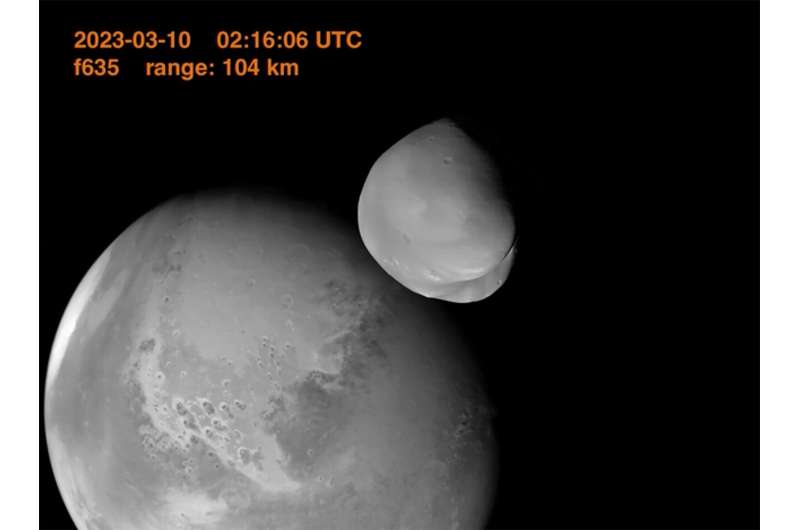
A spacecraft around Mars has sent back the most detailed photos yet of the red planet's little moon.

The United Arab Emirates' Amal spacecraft flew within 62 miles (100 kilometers) of Deimos last month and the close-up shots were released Monday. Amal—Arabic for Hope—got a two-for-one when Mars photobombed some of the images. It was the closest a spacecraft has been to Deimos in almost a half-century.

The spacecraft also observed the little explored far side of the odd-shaped, cratered moon, just 9 miles by 7 miles by 7 miles (15 kilometers by 12 kilometers by 12 kilometers).

Mars' other moon, Phobos, is almost double that size and better understood since it orbits much closer to Mars—just 3,700 miles (6,000 kilometers) away, the closest of any planet's moon in our solar system.

Deimos' orbit around Mars stretches 14,000 miles (23,000 kilometers) out. That's close to the inner part of the spacecraft's orbit—"which is what made observing Deimos such a compelling idea," said the mission's lead scientist Hessa al-Matroushi.
weatheriscool
Posts: 24487
Joined: Sun May 16, 2021 6:16 pm
Contact:

Re: Mars News and Discussions

Post by weatheriscool »

Scientists detect seismic waves traveling through Martian core for the first time
https://phys.org/news/2023-04-scientist ... -core.html
by University of Maryland
Scientists observed seismic waves traveling through Mars' core for the first time and confirmed model predictions of the core's composition.

An international research team—which included University of Maryland seismologists—used seismic data acquired by the NASA InSight lander to directly measure properties of Mars's core, finding a completely liquid iron-alloy core with high percentages of sulfur and oxygen. Published in the Proceedings of the National Academy of Sciences on April 24, 2023, these findings reveal new insights into how Mars formed and the geological differences between Earth and Mars that may ultimately play a role in sustaining planetary habitability.

"In 1906, scientists first discovered the Earth's core by observing how seismic waves from earthquakes were affected by traveling through it," said UMD Associate Professor of Geology Vedran Lekic, second author of the paper. "More than a hundred years later, we're applying our knowledge of seismic waves to Mars. With InSight, we're finally discovering what's at the center of Mars and what makes Mars so similar yet distinct from Earth."
weatheriscool
Posts: 24487
Joined: Sun May 16, 2021 6:16 pm
Contact:

Re: Mars News and Discussions

Post by weatheriscool »

China's Mars rover finds signs of recent water in sand dunes
https://abcnews.go.com/Technology/wireS ... d-98944600
A new study suggests water on Mars may be more widespread and recent than previously thought
ByMARCIA DUNN AP Aerospace Writer
April 28, 2023, 11:10 AM
CAPE CANAVERAL, Fla. -- Water may be more widespread and recent on Mars than previously thought, based on observations of Martian sand dunes by China's rover.

The finding highlights new, potentially fertile areas in the warmer regions of Mars where conditions might be suitable for life to exist, though more study is needed.

Friday's news comes days after mission leaders acknowledged that the Zhurong rover has yet to wake up since going into hibernation for the Martian winter nearly a year ago.

Its solar panels are likely covered with dust, choking off its power source and possibly preventing the rover from operating again, said Zhang Rongqiao, the mission's chief designer.
weatheriscool
Posts: 24487
Joined: Sun May 16, 2021 6:16 pm
Contact:

Re: Mars News and Discussions

Post by weatheriscool »

Images from NASA's Perseverance may show record of wild Martian river
https://phys.org/news/2023-05-images-na ... rtian.html
by JPL/NASA
Image

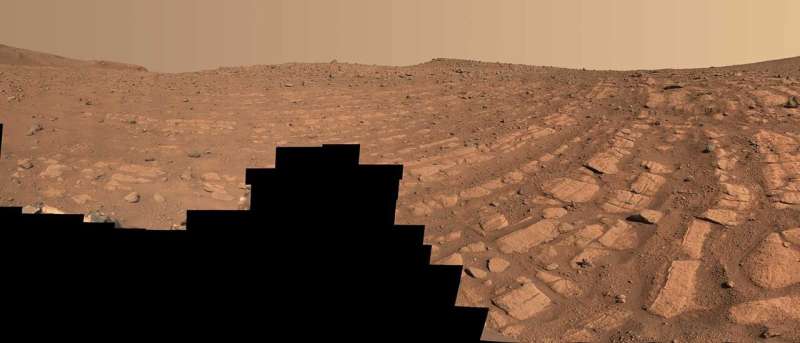
New images taken by NASA's Perseverance rover may show signs of what was once a rollicking river on Mars, one that was deeper and faster-moving than scientists have ever seen evidence for in the past. The river was part of a network of waterways that flowed into Jezero Crater, the area the rover has been exploring since landing more than two years ago.

Understanding these watery environments could help scientists in their efforts to seek out signs of ancient microbial life that may have been preserved in Martian rock.

Perseverance is exploring the top of a fan-shaped pile of sedimentary rock that stands 820 feet (250 meters) tall and features curving layers suggestive of flowing water. One question scientists want to answer is whether that water flowed in relatively shallow streams—closer to what NASA's Curiosity rover has found evidence of in Gale Crater—or a more powerful river system.

Stitched together from hundreds of images captured by Perseverance's Mastcam-Z instrument, two new mosaics suggest the latter, revealing important clues: coarse sediment grains and cobbles.

"Those indicate a high-energy river that's truckin' and carrying a lot of debris. The more powerful the flow of water, the more easily it's able to move larger pieces of material," said Libby Ives, a postdoctoral researcher at NASA's Jet Propulsion Laboratory in Southern California, which operates the Perseverance rover. With a background in studying Earth-based rivers, Ives has spent the last six months analyzing images of the Red Planet's surface. "It's been a delight to look at rocks on another planet and see processes that are so familiar," Ives said.
weatheriscool
Posts: 24487
Joined: Sun May 16, 2021 6:16 pm
Contact:

Re: Mars News and Discussions

Post by weatheriscool »

Space scientists provide new insight into the evolution of Mars' atmosphere
https://phys.org/news/2023-05-space-sci ... -mars.html
by Laura Bandell, The Open University
Scientists at The Open University (OU) have analyzed isotopic measurements in the atmosphere of Mars, providing new information on the evolution of the Martian climate throughout history and the origin of surface organics on Mars.

The atmosphere of Mars, which is mostly made of carbon dioxide (CO2), is relatively enriched in "heavy" carbon (13C) with respect to Earth due to the preferential escape of "light" carbon (12C) to space over several billion years.

Scientists from the OU's Atmospheric Research and Surface Exploration group have analyzed data from the ExoMars Trace Gas Orbiter (TGO) mission, which indicate that Martian carbon monoxide (CO) is depleted in heavy carbon instead.
weatheriscool
Posts: 24487
Joined: Sun May 16, 2021 6:16 pm
Contact:

Re: Mars News and Discussions

Post by weatheriscool »

Researchers determine global thickness and density of Martian crust
https://phys.org/news/2023-05-global-th ... crust.html
by Barbara Vonarburg, ETH Zurich
A strong quake in the last year of the NASA Mars InSight mission, enabled researchers at ETH Zurich to determine the global thickness and density of the planet's crust. On average, the Martian crust much thicker than the Earth's or the moon's crust, and the planet's main source of heat is radioactive.

After more than three years of daily monitoring and with the power levels decreasing on InSight's seismometer, researchers were rewarded with data from a sizeable Marsquake in May 2022. The surface waves observed from this estimated 4.6 magnitude quake not only traveled from the quake's source to the measuring station, they also continued to travel around the entire planet several times. This data not only provided information about specific areas of Mars, but also enabled a global view of the planet.
weatheriscool
Posts: 24487
Joined: Sun May 16, 2021 6:16 pm
Contact:

Re: Mars News and Discussions

Post by weatheriscool »

First-of-its-kind Mars livestream by ESA spacecraft interrupted at times by rain on Earth
https://phys.org/news/2023-06-first-of- ... craft.html
by Marcia Dunn
A European spacecraft around Mars sent its first livestream from the red planet to Earth on Friday to mark the 20th anniversary of its launch, but rain in Spain interfered at times.

The European Space Agency broadcast the livestream with views courtesy of its Mars Express, launched by a Russian rocket from Kazakhstan in 2003.

It took nearly 17 minutes for each picture to reach Earth, nearly 200 million miles (300 million kilometers) away, and another minute to get through the ground stations.

The transmission was disrupted at times by rainy weather at the deep space-relay antenna in Spain.
weatheriscool
Posts: 24487
Joined: Sun May 16, 2021 6:16 pm
Contact:

Re: Mars News and Discussions

Post by weatheriscool »

Researchers discover jet streams in Mars' magnetosheath
https://phys.org/news/2023-06-jet-strea ... heath.html
by Sara-Lena Brännström, Umea University

A research team from Umeå University and the Swedish Institute of Space Physics in Kiruna has discovered jet streams in the magnetosheath of Mars using data collected by NASA's MAVEN spacecraft. This is the first time such a jet has been found in the magnetosheath of a planet other than Earth. The results are published in the journal Science Advances.

A magnetosheath jet is a clump of flowing plasma in the magnetosheath. It is distinguished by being faster or denser than its surroundings, sometimes both faster and denser. The magnetosheath is the part of space where the solar wind is forced to flow around a planet.

"Jet streams in magnetosheaths have been seen near Earth for 25 years and we were really curious if they could be found elsewhere," says Herbert Gunell, Associate Professor at Umeå University, who led the study.

NASA's MAVEN spacecraft has been in orbit around Mars since 2014 to study the Martian atmosphere and its interaction with the solar wind.
User avatar
caltrek
Posts: 9280
Joined: Mon May 17, 2021 1:17 pm

Re: Mars News and Discussions

Post by caltrek »

Mars Rover Sends a Stunning Panorama of the Red Planet Home to Earth
by Kiona Smith
June 14, 2023

Introduction:
(Inverse) It takes a lot of work to send a postcard from Mars.

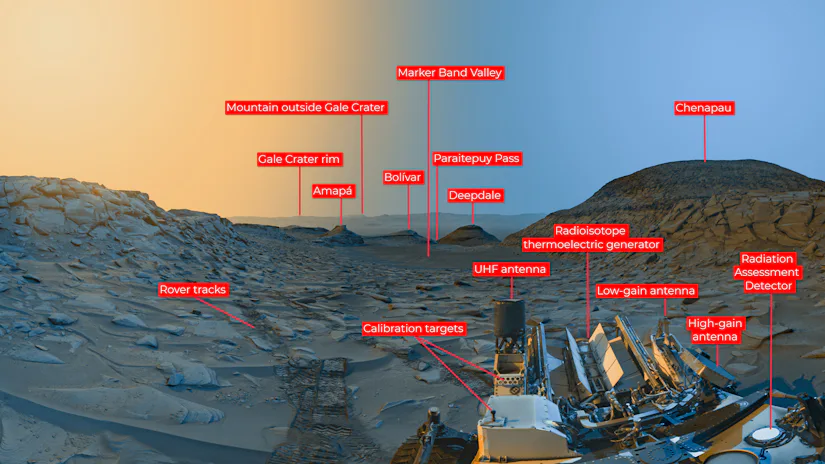
NASA’s Curiosity Rover recently pointed its navigation cameras back the way it had come to capture two panoramic photos of the rover’s tracks leading out of Marker Band Valley. Curiosity imaging team members created a composite of the images, which was released Monday.

You can still get a hint that it’s a composite: The giveaway is in the drastically different angles of the shadows on each side of the image. One panorama shows a mid-morning view, while the other shows late afternoon — both timed to take advantage of the most dramatic natural lighting and the dark, deep shadows of Martian winter.

The Marker Band Valley gets its name from a thin, dark, and surprisingly tough layer of rock that runs along the valley’s walls. Scientists aren’t sure exactly what the marker band is made of because the frustratingly tough rock has resisted all of Curiosity’s efforts to drill out a sample. But it’s home to surprising traces of an ancient lake in an area that mission planners expected to have been dry even during Mars’s warmer, wetter past, Curiosity found layers of rippled rock, still bearing the texture left behind by waves in an ancient lake.

If you want to send home a panoramic view from Mars, though, it’s not quite as easy as clicking the panorama option on your phone’s camera and then panning around the horizon (yet). Combined, the two images took about 15 minutes to capture, and each one arrived on Earth as five individual photos, which NASA teams had to carefully stitch together using computer software.

Read more here: https://www.inverse.com/science/a-post ... ing-view

Image
This panorama is actually ten separate photos, carefully stitched together and with false color added.
NASA
Don't mourn, organize.

-Joe Hill
weatheriscool
Posts: 24487
Joined: Sun May 16, 2021 6:16 pm
Contact:

Re: Mars News and Discussions

Post by weatheriscool »

Data from InSight suggests Mars has an all-liquid core and internal mass anomalies
https://phys.org/news/2023-06-insight-m ... ernal.html
by Bob Yirka , Phys.org

A team of planetary scientists from Belgium, the U.S., France and Germany has found evidence from the InSight lander that suggests Mars has an all-liquid core and internal mass anomalies. In their paper published in the journal Nature, the group describes their analysis of data sent back to Earth from the lander.

As the research team notes, determining the interior characteristics of the solar system's planets is hindered by their inaccessibility. In this instance, they were referring to work by research teams attempting to determine the inner makeup of Mars. To date, no one has been able to show whether its core is solid or liquid, for example—a characteristic that could impact work exploring whether the plane
t ever harbored life.
weatheriscool
Posts: 24487
Joined: Sun May 16, 2021 6:16 pm
Contact:

Re: Mars News and Discussions

Post by weatheriscool »

NASA's MAVEN Mars Orbiter Sends Back Amazing Ultraviolet Images
Image
https://www.extremetech.com/science/nas ... let-images
These false color images reveal what's going on during the planet's winter and summer cycles.
By Ryan Whitwam June 27, 2023

Mars is often called the red planet for obvious reasons, but it looks anything but red in the latest images from NASA's MAVEN orbiter. These stunning images were captured at opposite ends of the planet's orbit, revealing how the atmosphere changes as Mars cycles through the seasons.

MAVEN (Mars Atmosphere and Volatile EvolutioN) left Earth behind in 2013, arriving in orbit of Mars in 2014. It was the first NASA mission intended primarily to study the Martian atmosphere, and it provided many useful insights into the planet. For example, data from 2015 showed that Mars lost more of its already thin atmosphere during solar storms, confirming the sun's role in transforming Mars from a watery and potentially habitable world to one dominated by an endless frigid desert.

The spacecraft is getting on in years, but all its instruments are still online and returning useful data about the planet's atmosphere. In 2022 and 2023, NASA used MAVEN to image Mars during the planet's summer and winter phases. MAVEN has an impressive suite of eight instruments, but the one best suited to this task was the Imaging Ultraviolet Spectrometer (IUVS), built and maintained by the University of Colorado Boulder Laboratory for Atmospheric and Space Physics.
weatheriscool
Posts: 24487
Joined: Sun May 16, 2021 6:16 pm
Contact:

Re: Mars News and Discussions

Post by weatheriscool »

Germany is building a tiny rover that will roam the surface of Phobos
https://phys.org/news/2023-06-germany-t ... rface.html
by Matt Williams, Universe Today
At this very moment, eleven robotic missions are operating in orbit or on the surface of Mars, more than at any point during the past 60 years. These include the many orbiters surveying the red planet from orbit, the handful of landers and rovers, and one helicopter (Ingenuity) studying the surface.

In the coming years, many more are expected, reflecting the growing number of nations participating in the exploration process. Once there, they will join in the ongoing search for clues about the planet's formation, evolution, and possible evidence that life once existed there.

However, there's also the mystery concerning the origin of Phobos and Deimos, Mars' two satellites. While scientists have long suspected that these two moons began as asteroids kicked from the Main Belt that were captured by Mars' gravity, there is no scientific consensus on this point.
weatheriscool
Posts: 24487
Joined: Sun May 16, 2021 6:16 pm
Contact:

Re: Mars News and Discussions

Post by weatheriscool »

Mars rover Perseverance sets new record for making oxygen on Red Planet

By Leonard David published about 15 hours ago
Tucked inside NASA's Perseverance Mars rover is a device known as MOXIE, short for Mars Oxygen In Situ Resource Utilization Experiment. MOXIE is the first experiment to suck in the planet's thin, carbon dioxide-laden air and transform that native resource into oxygen. The toaster-sized device, if built to a larger scale, can be used not just for astronaut expeditions to Mars for breathing, but also for rocket fuel.

Earlier this month, the experiment achieved a major milestone when researchers pushed MOXIE to a maximum production level — a factor of two higher than reached earlier.

Riskiest run
"We got great results," said Michael Hecht, MOXIE's principal investigator and an associate director of the Massachusetts Institute of Technology's (MIT) Haystack Observatory in Westford, Massachusetts.

"This was the riskiest run we've done," Hecht told Space.com in an exclusive interview. "This could have gone wrong," he said, and could have led to minor damage to the instrument, but it didn't. The milestone setting Mars run took place on June 6, operating during the Martian night, and lasted 58 minutes, Hecht said.
More:
https://www.space.com/mars-perseverance ... xie-record
User avatar
caltrek
Posts: 9280
Joined: Mon May 17, 2021 1:17 pm

Re: Mars News and Discussions

Post by caltrek »

CHAPEA: Inside NASA's Futuristic Mars Base Simulation Mission
by Doris Elín Urrutia
June 27, 2023

Introduction:
(Inverse) For 378 days, a NASA team will live in a 1,700-square-foot habitat without the ability to leave.

This 3D-printed dwelling is designed to replicate a futuristic Mars base. Its dimensions are akin to where astronauts might shelter from the unforgiving Martian environment on some yet-to-be-manifested mission. NASA, which is already preparing to return astronauts into deep space with Artemis II, announced the beginning of CHAPEA. This is the first mission to test the challenges of Artemis’ most ambitious goal: putting humans on Mars.

On Monday, NASA broadcasted the entrance of the participants to CHAPEA, short for Crew Health and Performance Exploration Analog. The inaugural CHAPEA crew includes biomedical researcher Kelly Haston, structural engineer Ross Brockwell, emergency medicine physician Nathan Jones, and U.S. Navy microbiologist Anca Selariu.
Read more here: https://www.inverse.com/science/chapea ... imulation


Image
The badge for CHAPEA - Mission 1.
NASA
Don't mourn, organize.

-Joe Hill
weatheriscool
Posts: 24487
Joined: Sun May 16, 2021 6:16 pm
Contact:

Re: Mars News and Discussions

Post by weatheriscool »

Gullies on Mars could have been formed by recent periods of liquid meltwater, study suggests
https://phys.org/news/2023-06-gullies-m ... water.html
by Brown University
A study led by Brown University researchers offers new insights into how water from melting ice could have played a recent role in the formation of ravine-like channels that cut down the sides of impact craters on Mars.

The study, published in Science, focuses on Martian gullies, which look eerily similar to gullies that form on Earth in the Dry Valleys of Antarctica and are caused by water erosion from melting glaciers. The researchers, including Brown planetary scientist Jim Head, built a model that simulates a sweet spot for when conditions on Mars allow the planet to warm above freezing temperatures, leading to periods of liquid water on Mars when ice on and beneath the surface melts.

The scientists found that when Mars tilts on its axis to 35 degrees, the atmosphere becomes dense enough for brief episodes of melting to occur at gully locations. They then matched the data from their model to periods in Mars history when the gullies in the planet's Terra Sirenum region are believed to have expanded rapidly downhill from high elevation points—a phenomenon that could not be explained without the occasional presence of water.

"We know from a lot of our research and other people's research that early on in Mars history, there was running water on the surface with valley networks and lakes," said Head, a professor of geological sciences at Brown. "But about 3 billion years ago, all of that liquid water was lost, and Mars became what we call a hyper-arid or polar desert. We show here that even after that and in the recent past, when Mars' axis tilts to 35 degrees, it heats up sufficiently to melt snow and ice, bringing liquid water back until temperatures drop and it freezes again."
weatheriscool
Posts: 24487
Joined: Sun May 16, 2021 6:16 pm
Contact:

Re: Mars News and Discussions

Post by weatheriscool »

NASA's Mars helicopter 'phones home' after no contact for 63 days

https://phys.org/news/2023-06-ingenuity ... -home.html
The mini rotorcraft, which hitched a ride to the Red Planet with the Perseverance rover in early 2021, has already survived well beyond its initial 30-day mission to prove the feasibility of its technology in five test flights.

Long time, no speak: NASA has re-established contact with the intrepid Ingenuity Mars Helicopter after more than two months of radio silence, the space agency said Friday.

The mini rotorcraft, which hitched a ride to the Red Planet with the Perseverance rover in early 2021, has already survived well beyond its initial 30-day mission to prove the feasibility of its technology in five test flights.

Since then, it has been deployed dozens of times, acting as an aerial scout to assist its wheeled companion in searching for signs of ancient microbial life from billions of years ago, when Mars was much wetter and warmer than today.

Ingenuity's 52nd flight launched on April 26, but mission controllers at NASA's Jet Propulsion Laboratory (JPL) in California lost contact as it descended to the surface following its two minute, 1,191-foot (363-meter) hop.

The loss of communications was expected, because a hill stood between Ingenuity and Perseverance, which acts as a relay between the drone and Earth.
User avatar
caltrek
Posts: 9280
Joined: Mon May 17, 2021 1:17 pm

Re: Mars News and Discussions

Post by caltrek »

Scientists Gain New Insights on Magnetic Fields of Mars
by Matt Williams, et. al.
July 4, 2023

Introduction:
(Inverse) The Zhurong rover has operated on the surface of Mars for over a year since it deployed on May 22nd, 2021. Before the rover suspended operations on May 20, 2022, due to the onset of winter and the approach of seasonal sandstorms, Zhurong managed to traverse a total distance of 1.921 km (1.194 mi).

During the first kilometer of this trek, the rover obtained vital data on Mars’ extremely weak magnetic fields. According to a new study by researchers from the Chinese Academy of Science (CAS), these readings indicate that the magnetic field is extremely weak beneath the rover’s landing site.
Conclusion:
Knowing how and when Mars’ magnetic field disappeared is vital to the ongoing astrobiological studies on Mars. By understanding how and when it transitioned from a warmer planet with flowing water on its surface to the extremely cold and desiccated place it is today, scientists hope to learn whether or not there was enough time for life to emerge on Mars. Knowing this could also provide insight into where it might still be found today.

Read more here: https://www.inverse.com/science/mars-l ... agnetism
Don't mourn, organize.

-Joe Hill
weatheriscool
Posts: 24487
Joined: Sun May 16, 2021 6:16 pm
Contact:

Re: Mars News and Discussions

Post by weatheriscool »

NASA tests rocket motors for returning Mars soil samples to Earth
By David Szondy
August 02, 2023
https://newatlas.com/space/nasa-tests-r ... -to-earth/
In anticipation of one of history's most ambitious planetary missions, NASA has successfully tested the two solid rocket motors that will be used to help return the first geological samples from Mars to Earth for laboratory analysis.

The Mars Sample Return mission is attempting a staggeringly complex task – and one that many people don't realize has been underway for years. NASA's Perseverance Mars rover is currently roaming the surface of the Red Planet, collecting soil and drilling samples as it goes. These are being sealed in special tubes and dropped along the way like containers for a bit of Martian geocaching.

These sample tubes will be collected later by Perseverance and two backup helicopters, which will return the samples to a retrieval lander with NASA's Mars Ascent Vehicle (MAV) aboard. A special arm on the lander will place the sample cache inside the small solid-fueled rocket. This, in turn, will blast the sample cache into orbit around Mars where it will rendezvous with an ESA orbiter, which will bring the payload back to Earth by about 2030.
weatheriscool
Posts: 24487
Joined: Sun May 16, 2021 6:16 pm
Contact:

Re: Mars News and Discussions

Post by weatheriscool »

Curiosity rover faces its toughest climb yet on Mars
https://phys.org/news/2023-08-curiosity ... -mars.html
by NASA
On Aug. 5, NASA's Curiosity rover will notch its 11th year on Mars by doing what it does best: studying the Red Planet's surface. The intrepid bot recently investigated a location nicknamed "Jau" that is pockmarked with dozens of impact craters. Scientists have rarely gotten a close-up view of so many Martian craters in one place. The largest is estimated to be at least as long as a basketball court, although most are much smaller.

Jau is a pit stop on the rover's journey into the foothills of Mount Sharp, a 3-mile-tall (5-kilometer-tall) mountain that was covered with lakes, rivers, and streams billions of years ago. Each layer of the mountain formed in a different era of Mars's ancient climate, and the higher Curiosity goes, the more scientists learn about how the landscape changed over time.

The path up the mountain over the last several months required the most arduous climb Curiosity has ever made. There have been steeper climbs and riskier terrain, but the mission has never faced the trifecta of challenges posed by this slope: a sharp 23-degree incline, slippery sand, and wheel-size rocks. This trifecta left the rover struggling through a half-dozen drives in May and June, vexing Curiosity's drivers back on Earth.
User avatar
caltrek
Posts: 9280
Joined: Mon May 17, 2021 1:17 pm

Re: Mars News and Discussions

Post by caltrek »

Study Examines Earth and Mars to Determine How Climate Change Affects the Paths of Rivers
August 3 , 2023

Introduction:
(Euirekalert) In a new study published in Nature Geosciences, researchers, led by a Tulane University sedimentologist, investigated why the paths of meandering rivers change over time and how they could be affected by climate change.

Chenliang Wu, PhD, a postdoctoral researcher at Tulane University School of Science and Engineering, began this research by looking at the Mississippi River before adding other rivers on Earth and ancient riverbeds on Mars to the study.

The study specifically looks at river sinuosity, or how much rivers curve. The sinuosity of rivers changes over time, depending on the age of the river and environmental changes. Some of these changes include sediment and water supply and riverbank vegetation, all of which are affected by climate change. The study found that river sinuosity is related to the changes in how much water flows through the river. Rivers have different water levels depending on environmental factors, like precipitation levels.

The researchers looked at maps of the rivers on Earth over time by using historical data from as early as the fifth century and images from as early as 1939. They used data of 21 lowland meandering rivers. For the ancient riverbeds on Mars, they used previously identified ancient river channels from remote sensing data.

The ancient riverbeds on Mars, untouched by human influence, gave Wu and his team a system to test their hypotheses on how the river systems migrated and what their sinuosity looked like by the time they dried up. Their analysis is also a step toward understanding what the hydroclimate on Mars was like when there was still surface water.
Read more here: https://www.eurekalert.org/news-releases/997679

caltrek’s comment: What I like about this article is the way that it shows that understanding Mars can help us to better understand processes here on earth.
Don't mourn, organize.

-Joe Hill
Post Reply