Exploration of the gas giants

weatheriscool
Posts: 24486
Joined: Sun May 16, 2021 6:16 pm
Contact:

Re: Exploration of the gas giants

Post by weatheriscool »

Webb's First Raw Saturn Images Have Arrived
The NIRCam images haven't been processed yet, so they may not look like the Webb images you've previously seen, but they're amazing even raw.
https://www.extremetech.com/science/web ... ve-arrived
Image
By Ryan Whitwam June 27, 2023
We live in interesting times, which are often more tragic than boring ones. It's not all gloom and doom—we live at a time when the James Webb Space Telescope has just come online, and it could explore distant corners of the cosmos for another 20 years. NASA has also used the telescope to peer at nearer objects like Jupiter. Now, it's Saturn's turn, and you can get a preview of Webb's Saturn photospread right now.

The Webb Telescope is currently hovering in space out past the orbit of the moon at the Earth-Sun L2 Lagrange point, instead of in low Earth orbit like Hubble. Webb needed to be all the way out there to protect its sensitive infrared instruments from heat. Since it captures infrared data with its primary Near Infrared Spectrograph (NIRSpec) instrument, the data has to be processed to make it more accurate to the human eye.
The JWST Feed website isn't associated with NASA or any other aerospace agency. It exists solely to publish every scrap of data received by Webb as soon as it's released. Right now, it's pumping out new views of Saturn. The images haven't been processed yet, but they look incredible—this is what Webb sees when it looks at the ringed planet.

weatheriscool
Posts: 24486
Joined: Sun May 16, 2021 6:16 pm
Contact:

Re: Exploration of the gas giants

Post by weatheriscool »

weatheriscool
Posts: 24486
Joined: Sun May 16, 2021 6:16 pm
Contact:

Re: Exploration of the gas giants

Post by weatheriscool »


SHIT! Nasa sucking dick.
firestar464
Posts: 7202
Joined: Wed Oct 12, 2022 7:45 am

Re: Exploration of the gas giants

Post by firestar464 »

weatheriscool
Posts: 24486
Joined: Sun May 16, 2021 6:16 pm
Contact:

Re: Exploration of the gas giants

Post by weatheriscool »

NASA's Juno is getting ever closer to Jupiter's moon Io
https://phys.org/news/2023-07-nasa-juno ... -moon.html

by Jet Propulsion Laboratory

The spinning, solar-powered spacecraft will take another look of the fiery Jovian moon on July 30.
When NASA's Juno mission flies by Jupiter's fiery moon Io on Sunday, July 30, the spacecraft will be making its closest approach yet, coming within 13,700 miles (22,000 kilometers) of it. Data collected by the Italian-built JIRAM (Jovian InfraRed Auroral Mapper) and other science instruments is expected to provide a wealth of information on the hundreds of erupting volcanoes pouring out molten lava and sulfurous gases all over the volcano-festooned moon.

"While JIRAM was designed to look at Jupiter's polar aurora, its capability to identify heat sources is proving to be indispensable in our hunt for active volcanos on Io," said Juno Principal Investigator Scott Bolton of the Southwest Research Institute in San Antonio.

"As we get closer with each flyby, JIRAM and other instruments aboard Juno add to our library of data on the moon, allowing us to not only better resolve surface features but understand how they change over time."

Launched in 2011, the spinning, solar-powered spacecraft has been studying the Jovian system since 2016 and will begin the third year of its extended mission on July 31.
weatheriscool
Posts: 24486
Joined: Sun May 16, 2021 6:16 pm
Contact:

Re: Exploration of the gas giants

Post by weatheriscool »

Hundred-year storms? That's how long they last on Saturn
https://phys.org/news/2023-08-hundred-y ... aturn.html
by Robert Sanders, University of California - Berkele
The largest storm in the solar system, a 10,000-mile-wide anticyclone called the Great Red Spot, has decorated Jupiter's surface for hundreds of years.

A new study now shows that Saturn—though much blander and less colorful than Jupiter—also has long-lasting megastorms with impacts deep in the atmosphere that persist for centuries.

The study was conducted by astronomers from the University of California, Berkeley, and the University of Michigan, Ann Arbor, who looked at radio emissions from the planet, which come from below the surface, and found long-term disruptions in the distribution of ammonia gas.

The study was published today in the journal Science Advances.
User avatar
wjfox
Site Admin
Posts: 13575
Joined: Sat May 15, 2021 6:09 pm
Location: Essex, UK
Contact:

Re: Exploration of the gas giants

Post by wjfox »

User avatar
caltrek
Posts: 9280
Joined: Mon May 17, 2021 1:17 pm

Re: Exploration of the gas giants

Post by caltrek »

Something Just Smacked Into Jupiter and Amateur Astronomers Captured It
Tom Hale
September 1, 2023

Introduction:
(IFL Science) A celestial object recently smashed into Jupiter, the undisputed king of the planets, releasing a short but sharp flash of energy. While objects frequently collide with Jupiter – much more so than any other planet in the Solar System – it’s pretty exceptional for scientists to document the crash in action. Remarkably, this latest collision was accidentally captured by an amateur astronomer.

The impact was first spotted by the Okinawa-based astronomical observation projects OASES and PONCOTS at 1:45 am Japan Standard Time on August 29 (4:45 pm UTC, August 28). In a social media post, they raised the alarm and put out a message saying: “If you were observing Jupiter around the same time, please check the shooting data again, and if you find a flash, please report it on TL or DM this account!”

Shortly after, the MASA Planetary Log replied with some imagery showing the dramatic collision.

"When I woke up in the morning and opened X (Twitter), I saw information that a flash had been observed on the surface of Jupiter. That night, when I checked the video of the corresponding time, I saw a flash,” the person behind the MASA Planetary Log account told Space.com.

https://www.iflscience.com/something-ju ... -it-70524

Don't mourn, organize.

-Joe Hill
weatheriscool
Posts: 24486
Joined: Sun May 16, 2021 6:16 pm
Contact:

Re: Exploration of the gas giants

Post by weatheriscool »

weatheriscool
Posts: 24486
Joined: Sun May 16, 2021 6:16 pm
Contact:

Re: Exploration of the gas giants

Post by weatheriscool »

James Webb Space Telescope Finds Clues to Europa's Hidden Ocean
There's more to the Jovian moon than meets the eye.
By Jessica Hall September 22, 2023
https://www.extremetech.com/science/jam ... dden-ocean
The smallest of the Galilean moons, Jupiter's moon Europa is covered pole to pole in a sheet of water ice 10 miles thick. Below the rime of ice that glazes the planet, scientists are all but certain that Europa has a hidden ocean of liquid water, so deep that it makes the Mariana Trench look like a surface scratch. NASA's forthcoming Europa Clipper probe is planned to visit the Jovian moon in 2030 or thereabouts, and that data would be invaluable. But between now and then, scientists have a secret weapon: the James Webb Space Telescope. While the JWST excels at deep-field images, it can also pull its focus inward to look at targets within our solar system, and do fine-grained spectral analysis of its target.

This week, two papers appeared in Science from two independent teams that used data from their own Webb telescope time to arrive at the same conclusion. Both teams zeroed in on a bright spot on Europa called Tara Regio, where the ice is relatively very young and the crust so thoroughly disrupted that scientists call it "chaos terrain." There, they found evidence of carbon—specifically, carbon dioxide ice, otherwise scarce on Europa's surface. This suggests that it was dredged up from below. It could be from the churning ice, shattered and thrown around by the titanic tidal forces of Jupiter itself. Or, it could have been uncovered when an impact smashed the crust, like when an asteroid hits Jupiter and leaves a telltale "splash" of subsurface chemicals. But in either case, it's strong evidence for the hidden ocean below Europa's obscuring ice.
User avatar
wjfox
Site Admin
Posts: 13575
Joined: Sat May 15, 2021 6:09 pm
Location: Essex, UK
Contact:

Re: Exploration of the gas giants

Post by wjfox »

Next stop, Europa? Nano subs to get test beneath Antarctic ice in 2026

By Andrew Jones
published 2 days ago

Submarines, it turns out, could have a big future in space exploration.

The subsurface oceans of the Jupiter moon Europa and Saturn satellite Enceladus are perhaps the most tantalizing places in the solar system in the search for alien life. But these water bodies remain out of reach, hundreds millions of miles away and beneath thick icy crusts.

Now, a European collaboration aims to break through some of the technological and physical barriers in the way of future exploration of icy moons and their waters, using Antarctica as a proving ground.

The TRIPLE-nanoAUV 2 project (TRIPLE stands for "Technologies for Rapid Ice Penetration and subglacial Lake Exploration," while AUV means "Autonomous Underwater Vehicle") is building craft that could melt their way through ice and then unleash tiny submarines to explore the dark, unknown depths at the South Pole — or on icy moons.

The nano-AUVs will be very small — 19.7 inches (50 centimeters) long and 3.9 inches (10 cm) in diameter — allowing them to be contained in an ice-melting probe. These will be supported by a Launch and Recovery System (LRS), which will act as an underwater docking station for AUVs, allowing them to transmit their collected data and charge their batteries.

https://www.space.com/scientists-test-s ... -enceladus


Image
weatheriscool
Posts: 24486
Joined: Sun May 16, 2021 6:16 pm
Contact:

Re: Exploration of the gas giants

Post by weatheriscool »

weatheriscool
Posts: 24486
Joined: Sun May 16, 2021 6:16 pm
Contact:

Re: Exploration of the gas giants

Post by weatheriscool »

NASA Tests Dragonfly Titan Drone in Wind Tunnels Ahead of Trip to Saturn
Set for launch in 2027, Dragonfly will be NASA's second flying drone.
By Ryan Whitwam October 27, 2023
NASA is headed to Saturn's moon Titan, and it won't be scooting around on the surface. The Dragonfly mission is built around a nuclear-powered drone that will zip through the moon's thick atmosphere, covering much more ground than a wheeled explorer. Before NASA can launch the mission, it must ensure Dragonfly can fly on Titan. The agency has wrapped up a new round of wind tunnel testing, bringing us that much closer to the skies of Titan.
https://www.extremetech.com/science/nas ... -to-saturn
weatheriscool
Posts: 24486
Joined: Sun May 16, 2021 6:16 pm
Contact:

Re: Exploration of the gas giants

Post by weatheriscool »

weatheriscool
Posts: 24486
Joined: Sun May 16, 2021 6:16 pm
Contact:

Re: Exploration of the gas giants

Post by weatheriscool »

Juno mission finds Jupiter's winds penetrate in cylindrical layers
https://phys.org/news/2023-11-juno-miss ... rical.html
by NASA
Gravity data collected by NASA's Juno mission indicates Jupiter's atmospheric winds penetrate the planet in a cylindrical manner, parallel to its spin axis. A paper on the findings was recently published in the journal Nature Astronomy.

The violent nature of Jupiter's roiling atmosphere has long been a source of fascination for astronomers and planetary scientists, and Juno has had a ringside seat to the goings-on since it entered orbit in 2016. During each of the spacecraft's 55 to date, a suite of science instruments has peered below Jupiter's turbulent cloud deck to uncover how the gas giant works from the inside out.

One way the Juno mission learns about the planet's interior is via radio science. Using NASA's Deep Space Network antennas, scientists track the spacecraft's radio signal as Juno flies past Jupiter at speeds near 130,000 mph (209,000 kph), measuring tiny changes in its velocity—as small as 0.01 millimeter per second. Those changes are caused by variations in the planet's gravity field, and by measuring them, the mission can essentially see into Jupiter's atmosphere.
weatheriscool
Posts: 24486
Joined: Sun May 16, 2021 6:16 pm
Contact:

Re: Exploration of the gas giants

Post by weatheriscool »

Scientists discern internal structure of mysterious dwarf planet Eris
Dwarf planet Eris, similar in size to its better-known cosmic cousin Pluto, has remained an enigma since being discovered in 2005 lurking in the solar system's far reaches. While Pluto was explored by NASA's New Horizons spacecraft during a 2015 flyby, Eris - about 40% further from the sun - has never been visited.

But scientists are gaining a fuller understanding of Eris and its differences with Pluto thanks to research that discerns details about this frigid remote world's internal structure and composition based on its orbital relationship with its moon Dysnomia.

Eris, the researchers said on Wednesday, appears to have a rocky interior below a shell of ice. Pluto also has an icy exterior with rock below, but possesses a higher ice content and is thought to harbor an underground liquid ocean.

"We already knew that Eris is more rock-rich than Pluto, but what we didn't know was whether Eris had separated the rock from the ice," said University of California Santa Cruz planetary scientist Francis Nimmo, lead author of the study published in the journal Science Advances.
https://www.reuters.com/science/scienti ... 023-11-15/
User avatar
caltrek
Posts: 9280
Joined: Mon May 17, 2021 1:17 pm

Re: Exploration of the gas giants

Post by caltrek »

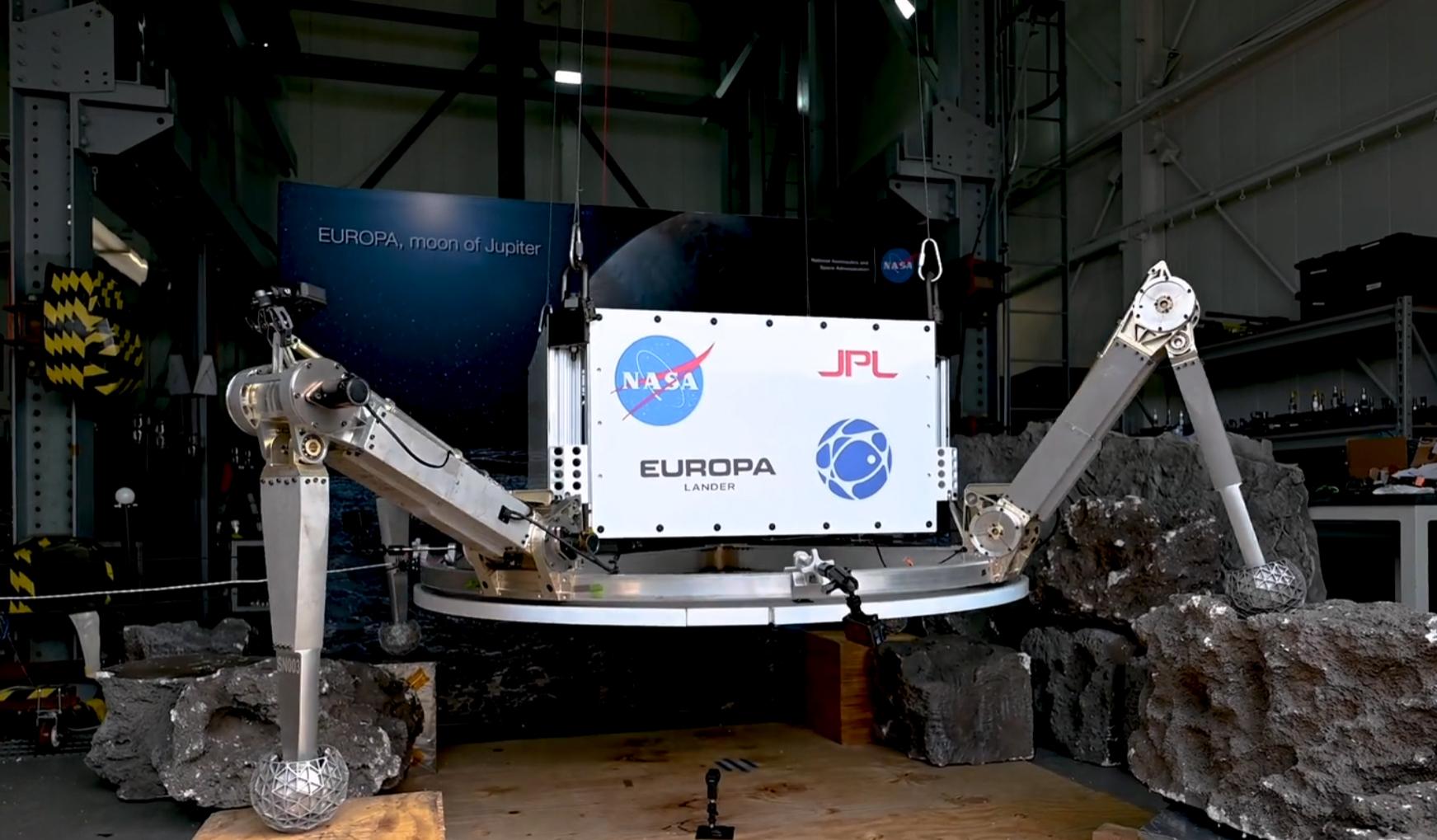
NASA Tests a Prototype Europa Lander
by Matt Williams
November 19, 2023

Introduction:
(Universe Today) In 2024, NASA will launch the Europa Clipper, the long-awaited orbiter mission that will fly to Jupiter (arriving in 2030) to explore its icy moon Europa. Through a series of flybys, the Clipper will survey Europa’s surface and plume activity in the hopes of spotting organic molecules and other potential indications of life (“biosignatures”). If all goes well, NASA plans to send a follow-up mission to land on the surface and examine Europa’s icy sheet and plumes more closely. This proposed mission is aptly named the Europa Lander.

While no date has been set, and the mission is still in the research phase, some significant steps have been taken to get the Europa Lander to the development phase. This past August, engineers at NASA’s Jet Propulsion Laboratory (JPL) in Southern California tested a prototype of this proposed landing system in a simulated environment. This system combines hardware used by previous NASA lander missions and some new elements that will enable a mission to Europa. It also could be adapted to facilitate missions to more “Ocean Worlds” and other celestial bodies in our Solar System.

Since the 1970s, when NASA’s Voyager 1 and 2 probes flew past Jupiter and its system of moons, scientists have been eager to get a closer look at Europa. Several missions have visited Jupiter since, including the NASA-ESA Ulysses probe, which flew past the system in 1992 and 2004. This was followed by the Cassini–Huygens probe that made a flyby in 2000 on its way to Saturn and the New Horizons mission that buzzed the system on its way to the Trans-Neptunian region. However, only two missions have traveled to the system and remained there to study Jupiter and its satellites: the Galileo (1995-2003) and Juno space probes (2016-present).
Read more here: https://www.universetoday.com/164332/n ... e-164332

Image
Testing Hardware for Potential Future Landing on Europa.
Credit: NASA JPL-Caltech
Don't mourn, organize.

-Joe Hill
User avatar
caltrek
Posts: 9280
Joined: Mon May 17, 2021 1:17 pm

Re: Exploration of the gas giants

Post by caltrek »

Jupiter’s Red Spot Keeps Getting Smaller
by Bob King
November 15, 2023

Introduction:
(Sky & Telescope) Observers have been tracking Jupiter's Great Red Spot (GRS) for more than 150 years and perhaps as long as 358 years if Giovanni Cassini's observations of a remarkably similar feature in 1665 are taken into account. Although the Spot's discovery is sometimes credited to an observation made by English polymath Robert Hooke in May 1664, Marco Forlani makes an excellent case for Cassini's primacy in a 1987 paper in the Journal of the British Astronomical Association. Either way, it's a remarkably long time for a storm to stick around.

The apple of every Jupiter observer's eye, the GRS is a persistent, high-pressure (anticyclonic) storm in the planet's southern hemisphere caught between two opposing jet streams that work in tandem to keep it spinning much like a ball of Play-Doh rolled one direction between the palms of your hand. Data from NASA's Galileo probe, which orbited the planet between 1995 and 2003, found that rising eddies of warm air from thunderstorms beneath the upper cloud deck provided the energy source to feed and maintain the monster spot. But a study published in 2021 based on Juno observations pointed to a source below the cloud base, revealing that the Great Red Spot's roots reach no more than 500 kilometers (300 miles) deep.

Like an earthly hurricane the storm's center is relatively calm, but farther out winds blast between 430 and 680 kilometers per hour (270 to 420 mph). Like the Cookie Monster from the children's TV show Sesame Street the GRS gobbles up smaller passing storms, which help to pump up its rotational energy while at the same time temporarily shrinking its diameter. Another key to its longevity is the fluid medium in which it resides. Unlike an earthly hurricane which quickly loses strength when passing over land, Jupiter is all atmosphere without the frictional barrier that land imposes.
Read more here: https://skyandtelescope.org/astronomy ... -smaller/

Image
NASA’s Juno spacecraft took this portrait of Jupiter's colorful and enigmatic Great Red Spot in 2017.
NASA / JPL-Caltech / Björn Jónsson
Don't mourn, organize.

-Joe Hill
weatheriscool
Posts: 24486
Joined: Sun May 16, 2021 6:16 pm
Contact:

Re: Exploration of the gas giants

Post by weatheriscool »

ESA's JUICE Probe Lines Up for First-Ever Earth-Moon Gravity Assist
JUICE will pick up speed from the moon and Earth for the first time, and that's just the start.
By Ryan Whitwam November 27, 2023
https://www.extremetech.com/science/esa ... ity-assist
The European Space Agency's JUICE spacecraft left Earth behind this past April en route to the gas giant Jupiter and its enormous collection of moons. That won't happen for a few years, though. For now, JUICE is headed back toward Earth, but this is intentional. The ESA is gearing up for a first-of-its-kind gravitational slingshot, utilizing both the moon and Earth to accelerate JUICE toward its final destination.

Lining up for the rendezvous was a major undertaking. The ESA notes that it took a 43-minute burn to adjust the spacecraft's trajectory for the Earth flyby. JUICE is large as fast as interplanetary missions go, tipping the scales at more than 13,000 pounds (about 6,000 kilograms). It took 800 pounds of fuel, almost 10% of the craft's reserves, to change its velocity by 200 meters per second for this maneuver.

The team will monitor JUICE (the Jupiter Icy Moons Explorer) as it continues on toward the Earth and moon encounter. This is expected to occur in August 2024, after which JUICE will be headed toward Venus for another gravity assist. It will whiz past Earth twice, in September 2026 and January 2029, before finally making a beeline for the Jovian system. It should get there in mid-2031 and will conduct observations of Jupiter's moons in the ensuing years.
weatheriscool
Posts: 24486
Joined: Sun May 16, 2021 6:16 pm
Contact:

Re: Exploration of the gas giants

Post by weatheriscool »

NASA study finds life-sparking energy source and molecule at Enceladus

by NASA
https://phys.org/news/2023-12-nasa-life ... ecule.html
A study zooms in on data that NASA's Cassini gathered at Saturn's icy moon and finds evidence of a key ingredient for life and a supercharged source of energy to fuel it.

Scientists have known that the giant plume of ice grains and water vapor spewing from Saturn's moon Enceladus is rich with organic compounds, some of which are important for life as we know it. Now, scientists analyzing data from NASA's Cassini mission are taking the evidence for habitability a step further: They've found strong confirmation of hydrogen cyanide, a molecule that is key to the origin of life.

The researchers also uncovered evidence that the ocean, which is hiding below the moon's icy outer shell and supplies the plume, holds a powerful source of chemical energy. Unidentified until now, the energy source is in the form of several organic compounds, some of which, on Earth, serve as fuel for organisms.

The findings, published in Nature Astronomy, indicate there may be much more chemical energy inside this tiny moon than previously thought. The more energy available, the more likely that life might proliferate and be sustained.

"Our work provides further evidence that Enceladus is host to some of the most important molecules for both creating the building blocks of life and for sustaining that life through metabolic reactions," said lead author Jonah Peter, a doctoral student at Harvard University who performed much of the research while working at NASA's Jet Propulsion Laboratory in Southern California.

"Not only does Enceladus seem to meet the basic requirements for habitability, we now ha
ve an idea about how complex biomolecules could form there, and what sort of chemical pathways might be involved."
Post Reply