https://www.space.com/ancient-earth-hit ... oids-often2 days ago
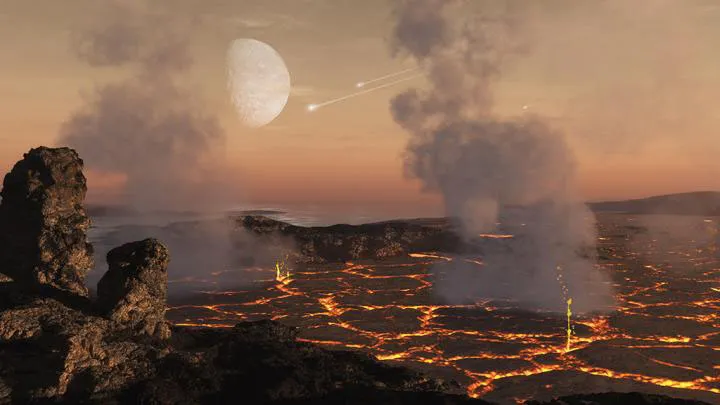
Asteroids the size of cities, like the one that wiped out the dinosaurs, slammed into the ancient Earth way more often than previously thought, a new study has found.
Approximately every 15 million years, our evolving planet would get a hit by a piece of rock about the size of a city, or even a bigger province, scientists with the new study said in a statement. The research was presented at the Goldschmidt geochemistry conference last week.
This violent period, which took place between 2.5 and 3.5 billion years ago, saw the planet in upheaval on a regular basis, with the chemistry near its surface undergoing dramatic changes that can be traced in the rocks in the ground even today, the researchers said.
In the study, Simone Marchi a principal scientist with the Southwest Research Institute in Boulder, Colorado and colleagues looked at the presence of the so-called spherules, small bubbles of vaporized rock that were thrown up to space by every asteroid impact, but then solidified and fell back to Earth, forming a thin layer that geologists see in the bedrock today.
Natural History (13.8 billion years BC – 3.3 million BC)
-
Time_Traveller

- Posts: 3025
- Joined: Sun May 16, 2021 4:49 pm
- Location: New York City, USA, November 5th 2032 C.E.
Re: Natural History (13.8 billion years BC – 3.3 million BC)
City-sized asteroids smacked ancient Earth 10 times more often than thought
“In the quantum multiverse, every choice, every decision you've ever and never made exists in an unimaginably vast ensemble of parallel universes.”
-
weatheriscool
- Posts: 26094
- Joined: Sun May 16, 2021 6:16 pm
- Contact:
Re: Natural History (13.8 billion years BC – 3.3 million BC)
Megaripples may be evidence of giant tsunami resulting from Chicxulub impact
https://phys.org/news/2021-07-megarippl ... lting.html
by Bob Yirka , Phys.org
https://phys.org/news/2021-07-megarippl ... lting.html
by Bob Yirka , Phys.org
A pair of geophysicists from the University of Louisiana at Lafayette working with two independent researchers has found what they believe might be evidence of a massive tsunami created by the Chicxulub asteroid impact. In their paper published in the journal Earth and Planetary Science Letters, the group describes their study of seismic data for a site in Louisiana and what they found.
Most scientists agree that approximately 66 million years ago, a large asteroid struck the Earth near what is now the Yucatan peninsula. It is also believed that the impact was so violent that it covered the globe with dust for several years, leading to the demise of the dinosaurs. Some in the field have suggested that the collision also resulted in the creation of a massive tsunami. In this new effort, the researchers reasoned that this tsunami would have made its way across what is now the Gulf of Mexico to the shores of North America. They suggest such a massive collision would have created a wave up to a mile high as it made its way onshore. If so, they further reasoned, there should be evidence of unique geographical formations—the kind that are known to be created by modern tsunamis.
To search for evidence of possible formations, the researchers studied the terrain at a place where the tsunami would have struck and then chose what they believed to be a good place to look more closely: inland Louisiana. To find the evidence they were looking for, the team obtained seismic data from a petroleum firm that allowed them to look at soil at depths up to 1,500 meters below the surface. They found evidence of what they describe as megaripples—huge fossilized ripples that would have been created by a massive influx of water, which then receded. The researchers then studied the ripples to learn more about the direction of the flow of water that had created them, and found they pointed straight to the Chicxulub asteroid impact site. The researchers suggest their find adds yet another piece to the emerging picture of the Chicxulub asteroid impact event.
-
Time_Traveller
- Posts: 3025
- Joined: Sun May 16, 2021 4:49 pm
- Location: New York City, USA, November 5th 2032 C.E.
Re: Natural History (13.8 billion years BC – 3.3 million BC)
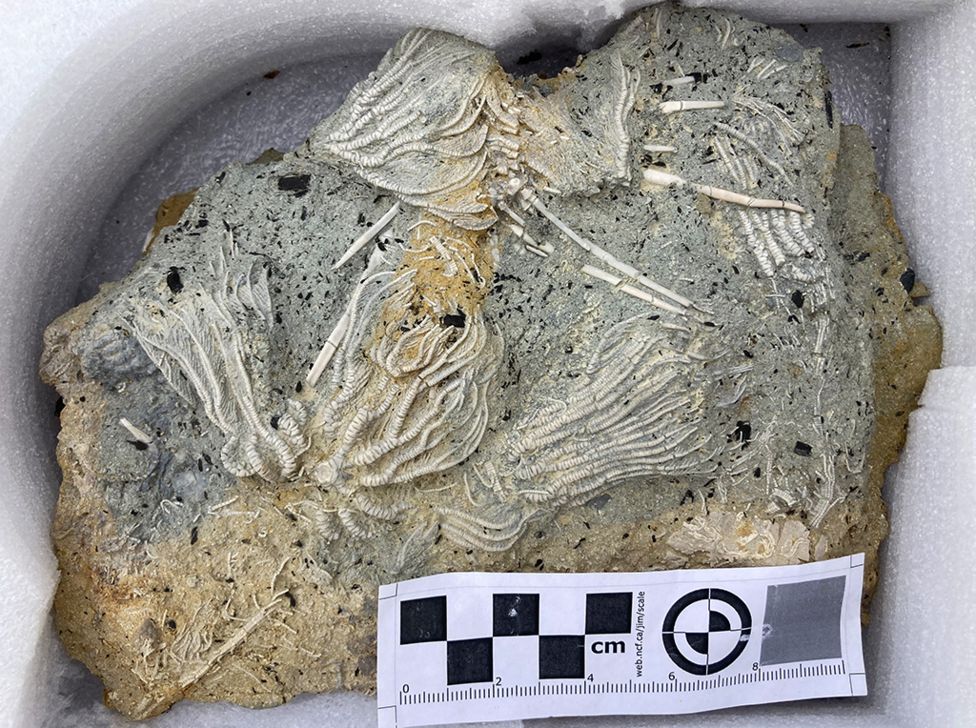
'Jurassic Pompeii' yields thousands of 'squiggly wiggly' fossils
https://www.bbc.co.uk/news/science-environment-5785353714 hours ago
"If they could squeal, I'm sure they would have done."
Palaeontologist Tim Ewin is standing in a quarry, recalling the calamity that's written in the rocks under his mud-caked boots.
"They tried to protect themselves, adopting the stress position of pulling their arms in," he continues. "But it was all in vain; you can see where their arms got snagged open, right up to the crown. They were pushed into the sediment and buried alive."
There's a little smile creeping across Tim's face, and he's got reason to be happy.
The misfortune that struck this place 167 million years ago has delivered to him an extraordinary collection of fossil animals in what is unquestionably one of the most important Jurassic dig sites ever discovered in the UK.
“In the quantum multiverse, every choice, every decision you've ever and never made exists in an unimaginably vast ensemble of parallel universes.”
-
weatheriscool
- Posts: 26094
- Joined: Sun May 16, 2021 6:16 pm
- Contact:
Re: Natural History (13.8 billion years BC – 3.3 million BC)
Newly-hatched pterosaurs may have been able to fly
https://phys.org/news/2021-07-newly-hat ... saurs.html
by University of Portsmouth
https://phys.org/news/2021-07-newly-hat ... saurs.html
by University of Portsmouth
Newly-hatched pterosaurs may have been able to fly but their flying abilities may have been different from adult pterosaurs, according to a new study.
Pterosaurs were a group of flying reptiles that lived during the Triassic, Jurassic and Cretaceous Periods (228 to 66 million years ago). Due to the rarity of fossilized pterosaur eggs and embryos, and difficulties distinguishing between hatchlings and small adults, it has been unclear whether newly-hatched pterosaurs were able to fly.
Researchers from the Universities of Portsmouth and Bristol, along with paleontologist Darren Naish, found that hatchling humerus bones were stronger than those of many adult pterosaurs, indicating that they would have been strong enough for flight.
-
weatheriscool
- Posts: 26094
- Joined: Sun May 16, 2021 6:16 pm
- Contact:
Re: Natural History (13.8 billion years BC – 3.3 million BC)
Icy waters of 'Snowball Earth' may have spurred early organisms to grow bigger
https://phys.org/news/2021-07-icy-snowb ... early.html
by Daniel Strain, University of Colorado at Boulder
https://phys.org/news/2021-07-icy-snowb ... early.html
by Daniel Strain, University of Colorado at Boulder
A new study from CU Boulder finds that hundreds of millions of years ago, small single-celled organisms may have evolved into larger multicellular life forms to better propel themselves through icy waters.
The research was led by paleobiologist Carl Simpson and appears today in the journal The American Naturalist. It hones in on a question that's central to the history of the planet: How did life on Earth, which started off teeny-tiny, get so big?
"Once organisms get big, they have a clear ecological advantage because the physics around how they capture food become totally different," said Simpson, assistant professor in the Department of Geological Sciences and the CU Museum of Natural History. "But the hard part for researchers has been explaining how they got big in the first place."
In his latest study, Simpson draws on a series of mathematical equations to argue that this all-important shift may have come down to hydrodynamics—or the pursuit of a more efficient backstroke.

Re: Natural History (13.8 billion years BC – 3.3 million BC)
Mysterious Oxygen Burst Was Tied to Earth's Biggest Mass Extinction, Scientists Say
by David Nield
August 4, 2021
https://www.sciencealert.com/ocean-oxyg ... tion-event
Introduction:
by David Nield
August 4, 2021
https://www.sciencealert.com/ocean-oxyg ... tion-event
Introduction:
caltrek's comment: If I recall correctly, the notion that an increase in oxygen levels can be tied to a mass extinction event has been discussed by scientists for decades. James Lovelock is an example of one such scientist.(Science Alert)The Permian-Triassic extinction event that happened some 252 million years ago is the worst extinction event our planet has ever seen. It wiped out around 90 percent of marine species and some 70 percent of vertebrate species on land, and was so severe that it's often called the Great Dying.
There are still lots of unanswered questions about the event, from its overall timescale to its causes, but a new study offers some intriguing extra detail on the calamity: a sudden spike in oxygen levels in the world's oceans at the same time as this widespread extinction was happening.
The researchers behind the study think that the sudden burst of oceanic oxygenation occurred around the start of the Great Dying, and was spread across tens of thousands of years, before oxygen levels then began to steadily drop again.
"For the geological record, that's practically instantaneous," says Earth scientist Sean Newby from Florida State University (FSU).
"And then you can of course compare that to modern, human-induced climate change, where we're having huge, rapid changes in fractions of the time compared to this mass extinction."
Don't mourn, organize.
-Joe Hill
-Joe Hill
Re: Natural History (13.8 billion years BC – 3.3 million BC)
Scientists Discover Fossils of ‘Real Life Dragon’ in Australia
by Jon Parton
August 9, 2021
https://www.courthousenews.com/scientis ... australia/
Introduction:
Artist’s impression of the fearsome Thapunngaka shawi.
Credit: Tim Richards
by Jon Parton
August 9, 2021
https://www.courthousenews.com/scientis ... australia/
Introduction:
(Courthouse News) — Scientists discovered the fossils of the largest flying reptile in Australia, a massive pterosaur with a 22-foot wingspan that made its home in the outback of Queensland.
“It’s the closest thing we have to a real life dragon,” said Tim Richards of the University of Queensland.
Richards and a team of researchers made the discovery while examining a fossil of the pterosaur’s jaw that was found in Northwest Queensland.
“The new pterosaur, which we named Thapunngaka shawi, would have been a fearsome beast, with a spear-like mouth and a wingspan around seven meters [22 feet],” Richards said in a statement. “It was essentially just a skull with a long neck, bolted on a pair of long wings.
“This thing would have been quite savage. It would have cast a great shadow over some quivering little dinosaur that wouldn’t have heard it until it was too late.”
Artist’s impression of the fearsome Thapunngaka shawi.
Credit: Tim Richards
Don't mourn, organize.
-Joe Hill
-Joe Hill
-
weatheriscool
- Posts: 26094
- Joined: Sun May 16, 2021 6:16 pm
- Contact:
Re: Natural History (13.8 billion years BC – 3.3 million BC)
Shark diversity unaffected when the dinosaurs were wiped out
https://phys.org/news/2021-08-shark-div ... saurs.html
by Public Library of Science
https://phys.org/news/2021-08-shark-div ... saurs.html
by Public Library of Science
A global catastrophe 66 million years ago led to the extinction of all non-avian dinosaurs, and large marine reptiles like mosasaurs and plesiosaurs. But what happened to the sharks? According to a study of sharks' teeth publishing August 10th in the open-access journal PLOS Biology by Mohamad Bazzi of Uppsala University and colleagues, shark-tooth diversity remained relatively constant across the mass extinction event at the end of the Cretaceous.
The researchers analyzed the morphology of 1239 fossil shark teeth, including species in eight existing orders and one now-extinct order. The teeth span a 27-million-year period from the late Cretaceous 83.6 million years ago to the early Paleogene 56 million years ago, across the so-called K-Pg boundary that brought the age of the dinosaurs to an end.
The scientists found that shark dental diversity was already declining prior to the K-Pg boundary, but remained relatively constant during the mass-extinction event itself. Some groups of apex predators, particularly those with triangular blade-like teeth, did suffer selective extinctions during the period studied, which may have been linked to the extinction of their prey species.

Re: Natural History (13.8 billion years BC – 3.3 million BC)
It something that tends to take me off guard every time I hear it: just how ancient sharks are. They're among the first large scale life forms on Earth!weatheriscool wrote: ↑Tue Aug 10, 2021 6:06 pm Shark diversity unaffected when the dinosaurs were wiped out
https://phys.org/news/2021-08-shark-div ... saurs.html
by Public Library of Science
A global catastrophe 66 million years ago led to the extinction of all non-avian dinosaurs, and large marine reptiles like mosasaurs and plesiosaurs. But what happened to the sharks? According to a study of sharks' teeth publishing August 10th in the open-access journal PLOS Biology by Mohamad Bazzi of Uppsala University and colleagues, shark-tooth diversity remained relatively constant across the mass extinction event at the end of the Cretaceous.
The researchers analyzed the morphology of 1239 fossil shark teeth, including species in eight existing orders and one now-extinct order. The teeth span a 27-million-year period from the late Cretaceous 83.6 million years ago to the early Paleogene 56 million years ago, across the so-called K-Pg boundary that brought the age of the dinosaurs to an end.
The scientists found that shark dental diversity was already declining prior to the K-Pg boundary, but remained relatively constant during the mass-extinction event itself. Some groups of apex predators, particularly those with triangular blade-like teeth, did suffer selective extinctions during the period studied, which may have been linked to the extinction of their prey species.
And remember my friend, future events such as these will affect you in the future
Re: Natural History (13.8 billion years BC – 3.3 million BC)
Ancient Australian Volcanic Rock May Hold the Secret to Life on Earth
by Tara Yarlagadda
August 9, 2021
https://www.inverse.com/science/volcano ... -of-oxygen
Extract:
by Tara Yarlagadda
August 9, 2021
https://www.inverse.com/science/volcano ... -of-oxygen
Extract:
(Inverse) THE PILBARA REGION OF WESTERN AUSTRALIA offers stunningly strange vistas of volcanic rock and granite domes that feel reminiscent of an ancient world — and for a good reason.
These arid mineral-rich lands support Australia’s mining and crude oil industries, but they also reveal remarkable geological secrets about ancient Earth long before humans roamed the planet.
According to new research, the Pilbara Craton — one of the few crusts remaining on Earth from the Archaean era 2.7 to 3.6 billion years ago — could help us understand the emergence of Earth’s most essential ingredient for life: oxygen.
…
WHY IT MATTERS — Most research on oxygen during the ancient Archaean era has focused on the Great Oxygenation Event, which occurred roughly 2.4 billion years ago. This event brought oxygen to early Earth’s oceans and atmosphere, creating the conditions for life to eventually flourish.
But previous research has shown that a brief, so-called “whiff” of oxygen emerged on Earth roughly 2.5 billion years ago, which meant that there was oxygen on Earth for 500 million years before the Great Oxygenation Event.
Don't mourn, organize.
-Joe Hill
-Joe Hill
Re: Natural History (13.8 billion years BC – 3.3 million BC)
Two New Dinosaur Species, Almost as Large as a Blue Whale, Discovered in China
by Jessie Yeung
Updated August 12, 2021
https://edition.cnn.com/2021/08/12/chin ... k-scli-scn
Introduction: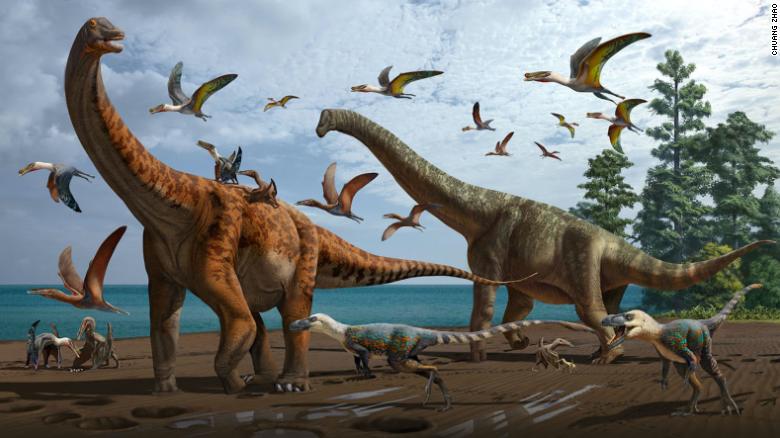
An artist's illustration showing Silutitan sinensis (left) and Hamititan xinjiangensis (right), with other theropods and dinosaur species in the surroundings.
by Jessie Yeung
Updated August 12, 2021
https://edition.cnn.com/2021/08/12/chin ... k-scli-scn
Introduction:
(CNN)Scientists have confirmed the discovery of two massive new dinosaur species in northwest China -- some of the first vertebrates uncovered in the region, according to a new study published Thursday.
A number of fossils have emerged from China's northwest region in recent years, including Xinjiang and the Turpan-Hami Basin. The fossils include a number of pterosaurs (flying reptiles), preserved eggs and embryos -- as well as fossil fragments of spinal vertebrae and rib cages, which scientists initially identified as belonging to three mystery dinosaurs.
The researchers have since determined that two of those specimens were from previously unknown species, which they have named Silutitan sinensis -- "silu" meaning "Silk Road" in Mandarin -- and Hamititan xinjiangensis, a nod to the region where it was found. Both incorporate the Greek word "titan," which means "giant," in reference to their size.
The Silutitan specimen is estimated to be over 20 meters (65.6 feet) long, while the Hamititan specimen was 17 meters (55.77 feet) long. That makes the dinosaurs almost as large as blue whales, which range from 23 to 30 meters (75 to 98 feet), depending on the hemisphere they're located in.
The researchers, from the Chinese Academy of Sciences and the National Museum of Brazil, published their findings in Scientific Reports, part of the Nature family of journals
An artist's illustration showing Silutitan sinensis (left) and Hamititan xinjiangensis (right), with other theropods and dinosaur species in the surroundings.
Don't mourn, organize.
-Joe Hill
-Joe Hill
-
Time_Traveller
- Posts: 3025
- Joined: Sun May 16, 2021 4:49 pm
- Location: New York City, USA, November 5th 2032 C.E.
Re: Natural History (13.8 billion years BC – 3.3 million BC)
A Chunk From The Sunken Continent of Zealandia Is Twice as Old as We Thought
https://www.sciencealert.com/a-portion- ... 7-RRbGdX_A14 AUGUST 2021
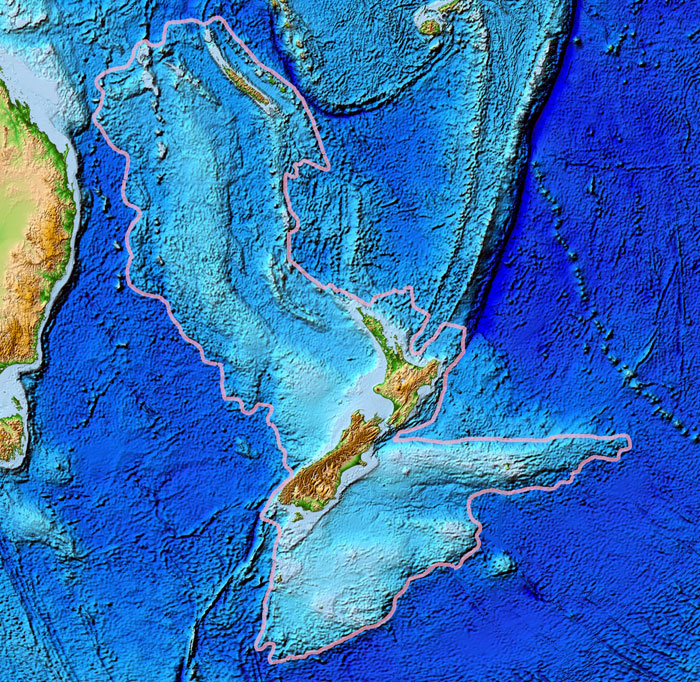
About 3,500 feet under the South Pacific sits a piece of land 2 million square miles in size – about half as big as Australia.
But scientists can't agree on whether this submerged landmass, called Zealandia, is a continent or not. A team of geologists declared it one in 2017, but not all researchers are convinced.
"It's not like a mountain, country, or planet. There is no formal body to approve a continent," Nick Mortimer, a geologist from New Zealand's GNS Science who led the 2017 group, told Insider.
While the definition of a continent is contentious, Mortimer's group suggested that a continent should have clearly defined boundaries, occupy an area greater than 386,000 square miles (1 million square kilometers), be elevated above the surrounding ocean crust, and have a continental crust thicker than that oceanic crust.
The results showed that crust was once part of another supercontinent known as Rodinia, which formed between 1.3 billion and 900 million years ago.
In other words, Zealandia's geologic history starts far earlier than 500 million years ago.
“In the quantum multiverse, every choice, every decision you've ever and never made exists in an unimaginably vast ensemble of parallel universes.”
Re: Natural History (13.8 billion years BC – 3.3 million BC)
How a Brazilian Police Raid Led to the Discovery of An "Exceptional" Ancient Fossil
by Tara Yarlagadda
August 25, 2021
https://www.inverse.com/science/police- ... nal-fossil
Introduction:
https://journals.plos.org/plosone/artic ... ne.0254789
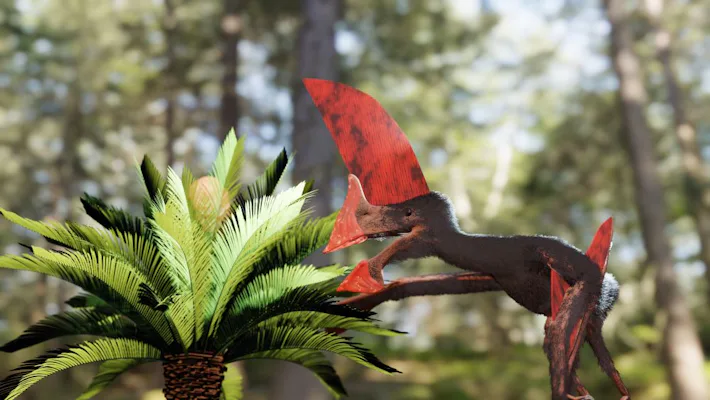
An artist’s rendering of Tupandactylus navigans based on the newly discovered fossil.
Victor Beccari
by Tara Yarlagadda
August 25, 2021
https://www.inverse.com/science/police- ... nal-fossil
Introduction:
From the journal Plos One:(Inverse) BRAZIL’S NATIONAL POLICE force typically makes headlines for their deadly drug busts and cracking down on illegal arms deals.
But in 2013, the Federal Police had a more unusual target in mind: ancient fossils dating back to when dinosaurs roamed the Earth.
The Federal Police conducted a sweeping investigation into the country’s illegal fossil trade, ultimately recovering more than 3,000 fossil specimens from the Brazilian states of São Paulo, Minas Gerais, and Rio de Janeiro.
One of the specimens was a tapejarid fossil neatly preserved in limestone rock. The fossil belongs to the species Tupandactylus navigans.
The Tapejaridae clade were unusual, toothless, Cretaceous-era pterosaurs. They’re known for their large crested heads, which scientists theorize may have been used as a “sail.”
https://journals.plos.org/plosone/artic ... ne.0254789
(Plos One) A remarkably well-preserved, almost complete and articulated new specimen (GP/2E 9266) of Tupandactylus navigans is here described for the Early Cretaceous Crato Formation of Brazil. The new specimen comprises an almost complete skeleton, preserving both the skull and post-cranium, associated with remarkable preservation of soft tissues, which makes it the most complete tapejarid known thus far. CT-Scanning was performed to allow the assessment of bones still covered by sediment.
An artist’s rendering of Tupandactylus navigans based on the newly discovered fossil.
Victor Beccari
Don't mourn, organize.
-Joe Hill
-Joe Hill
-
weatheriscool
- Posts: 26094
- Joined: Sun May 16, 2021 6:16 pm
- Contact:
Re: Natural History (13.8 billion years BC – 3.3 million BC)
Newly identified mosasaur was fish-hunting monster
by Michael Miller, University of Cincinnati
https://phys.org/news/2021-08-newly-mos ... nster.html
by Michael Miller, University of Cincinnati
https://phys.org/news/2021-08-newly-mos ... nster.html
Researchers at the University of Cincinnati identified a new species of mosasaur—an 18-foot-long fish-eating monster that lived 80 million years ago.
UC assistant professor-educator Takuya Konishi and his student, UC graduate Alexander Willman, named the mosasaur Ectenosaurus everhartorum after paleontologists Mike and Pamela Everhart. The mosasaur inhabited the Western Interior Seaway in what today is western Kansas.
The discovery was announced this week in the Canadian Journal of Earth Sciences.
The newly identified mosasaur marks only the second species in the genus Ectenosaurus.
"Mosasaurs in western Kansas have been well sampled and well researched. Those two factors create tall odds when you try to find something new," Konishi said.

Re: Natural History (13.8 billion years BC – 3.3 million BC)
How Small Was The Universe At The Start Of The Big Bang?
Aug 25, 2021,02:00am EDT
TL;DR –
After 0.00000000000000000000000000000000001 seconds = 1.5 metre radius
After 1 trillionth of a second = 1 AU
After 1 second = 10 light years
After 3 years = 100,000 light years
After 10,000 years = 10 million light years
https://www.forbes.com/sites/startswith ... 5e18ad5f79

Aug 25, 2021,02:00am EDT
TL;DR –
After 0.00000000000000000000000000000000001 seconds = 1.5 metre radius
After 1 trillionth of a second = 1 AU
After 1 second = 10 light years
After 3 years = 100,000 light years
After 10,000 years = 10 million light years
https://www.forbes.com/sites/startswith ... 5e18ad5f79

Re: Natural History (13.8 billion years BC – 3.3 million BC)
At one point, you could wrap your arms around the entire universe. lol
But then, as an habitant within it, it looks as if everything is static. That's general relativity for you.
But then, as an habitant within it, it looks as if everything is static. That's general relativity for you.
To know is essentially the same as not knowing. The only thing that occurs is the rearrangement of atoms in your brain.
-
weatheriscool
- Posts: 26094
- Joined: Sun May 16, 2021 6:16 pm
- Contact:
Re: Natural History (13.8 billion years BC – 3.3 million BC)
Massive new animal species discovered in half-billion-year-old Burgess Shale
https://phys.org/news/2021-09-massive-a ... rgess.html
by Royal Ontario Museum
https://phys.org/news/2021-09-massive-a ... rgess.html
by Royal Ontario Museum
Palaeontologists at the Royal Ontario Museum (ROM) have uncovered the remains of a huge new fossil species belonging to an extinct animal group in half-a-billion-year-old Cambrian rocks from Kootenay National Park in the Canadian Rockies. The findings were announced on September 8, 2021, in a study published in Royal Society Open Science.
Named Titanokorys gainesi, this new species is remarkable for its size. With an estimated total length of half a meter, Titanokorys was a giant compared to most animals that lived in the seas at that time, most of which barely reached the size of a pinky finger.
"The sheer size of this animal is absolutely mind-boggling, this is one of the biggest animals from the Cambrian period ever found," says Jean-Bernard Caron, ROM's Richard M. Ivey Curator of Invertebrate Palaeontology.
-
weatheriscool
- Posts: 26094
- Joined: Sun May 16, 2021 6:16 pm
- Contact:
Re: Natural History (13.8 billion years BC – 3.3 million BC)
Who was king before tyrannosaurus? Uzbek fossil reveals new top dino
by University of Tsukuba
https://phys.org/news/2021-09-king-tyra ... veals.html
by University of Tsukuba
https://phys.org/news/2021-09-king-tyra ... veals.html
Iconic tyrannosauroids like T. rex famously dominated the top of the food web at the end of the reign of the dinosaurs. But they didn't always hold that top spot.
In a new study published in Royal Society Open Science, a research team led by the University of Tsukuba has described a new genus and species belonging to the Carcharodontosauria, a group of medium- to large-sized carnivorous dinosaurs that preceded the tyrannosauroids as apex predators.
The new dinosaur, named Ulughbegsaurus uzbekistanensis, was found in the lower Upper Cretaceous Bissekty Formation of the Kyzylkum Desert in Uzbekistan, and therefore lived about 90 million years ago. Two separate evolutionary analyses support classification of the new dinosaur as the first definitive carcharodontosaurian discovered in the Upper Cretaceous of Central Asia.
"We described this new genus and species based on a single isolated fossil, a left maxilla, or upper jawbone," explains study first author Assistant Professor Kohei Tanaka. "Among theropod dinosaurs, the size of the maxilla can be used to estimate the animal's size because it correlates with femur length, a well-established indicator of body size. Thus, we were able to estimate that Ulughbegsaurus uzbekistanensis had a mass of over 1,000 kg, and was approximately 7.5 to 8.0 meters in length, greater than the length of a full-grown African elephant."
Re: Natural History (13.8 billion years BC – 3.3 million BC)
The World's Oldest Known Forest Was Not Like We Imagined, New Study Shows
by Carly Cassella
September 10, 2021
https://www.sciencealert.com/study-give ... ooked-like
Introduction:
by Carly Cassella
September 10, 2021
https://www.sciencealert.com/study-give ... ooked-like
Introduction:
(Science Alert) The fossilized web of a 385-million-year-old root network has scientists reimagining what the world's first forests might once have looked like.
The picture they have painted couldn't be more different to what now sits in its place. Near the small town of Cairo in upstate New York, under an old highway department quarry, scientists have reconstructed the remains of what was a mighty and mature old-growth forest – home to at least three of the world's earliest tree-like plants.
Some of these initial tree 'wannabes' (known as cladoxylopsids) would have looked like large stalks of celery, shooting 10 meters (32 feet) into the sky. Others resembled pine trees, but with hairy, fern-like fronds for leaves (Archaeopteris). The third long-lost plant would have taken after the palm tree, with a bulbous base and canopy of fern-like branches (Eospermatopteris).
Seven parallel cross-sections of the Cairo site have researchers thinking these primordial trees were quite old and large. As such, they were not packed densely together, but were relatively scattered across a floodplain which ebbed and flowed with the seasons.
Dry periods were a regular part of the cycle, and yet the Cairo forest, which traced the Catskill river, seemed to host primitive trees we once thought could only survive in swamps or river deltas. These tree-like plants belong to the genus Eospermatopteris, and they look sort of like tall ferns standing on bulbous stumps.
Don't mourn, organize.
-Joe Hill
-Joe Hill
-
weatheriscool
- Posts: 26094
- Joined: Sun May 16, 2021 6:16 pm
- Contact:
Re: Natural History (13.8 billion years BC – 3.3 million BC)
Prehistoric winged lizard unearthed in Chile
https://phys.org/news/2021-09-prehistor ... chile.htmlFossils confirmed to be of a rhamphorhynchine pterosaur—the first such creature to be found in Gondwana, the prehistoric supercontinent that later formed the southern hemisphere landmasses.
Chilean scientists have announced the discovery of the first-ever southern hemisphere remains of a type of Jurassic-era "winged lizard" known as a pterosaur.
Fossils of the dinosaur which lived some 160 million years ago in what is today the Atacama desert, were unearthed in 2009.
They have now been confirmed to be of a rhamphorhynchine pterosaur—the first such creature to be found in Gondwana, the prehistoric supercontinent that later formed the southern hemisphere landmasses.
Researcher Jhonatan Alarcon of the University of Chile said the creatures had a wingspan of up to two meters, a long tail, and pointed snout.