
The Future of Food, Agriculture, and Aquaculture

User avatar
caltrek
Posts: 9280
Joined: Mon May 17, 2021 1:17 pm

Re: The Future of Food, Agriculture, and Aquaculture

Post by caltrek »

New Potato-threatening Pathogens Reported for First Time in Pennsylvania and the U.S.
January17, 2024

Introduction:
(Potato News Today) Potato crops across the state of Pennsylvania and in the U.S. may face the threat of newly identified pathogen strains, according to Penn State researchers who made the finding and aim to develop management strategies. They published their work in the journal Systematic and Applied Microbiology.

As Katie Bohn reports in an article published on the Penn State website, the researchers collected potato stems or tubers that exhibited symptoms of black leg or soft rot — including wilting, stunting, black lesions and rotting tubers, among others, — from 26 potato fields in Pennsylvania. These diseases, which can lead to crop loss, are caused caused predominantly by bacteria in the Pectobacterium species and more recently the Dickeya species.

The researchers isolated, cultured and identified 456 samples of bacteria infecting the potatoes, including six species of Pectobacterium and one strain of Dickeya that previously had not been reported in Pennsylvania. One species of Pectobacterium previously had not been reported in the U.S.

Carolee Bull, corresponding author and professor of bacterial systematics and plant pathology, of plant pathology and of environmental microbiology, said the findings could inform methods for detecting and quantifying the pathogens causing blackleg and soft rot in Pennsylvania and beyond.

“In addition to surveillance, these insights could also help us better understand disease epidemiology,” Bull said. “For example, the pathogens may have different optimum temperatures for growing or for producing these symptoms in the potatoes. So, the severity of the disease may change depending on different climate conditions.”
Read more of the Potato News Today article here: https://www.potatonewstoday.com/2024/0 ... the-u-s/

For a technical presentation of the study results as published in ScienceDirect: https://www.sciencedirect.com/science/ ... ia%3Dihub
Don't mourn, organize.

-Joe Hill
User avatar
caltrek
Posts: 9280
Joined: Mon May 17, 2021 1:17 pm

Re: The Future of Food, Agriculture, and Aquaculture

Post by caltrek »

World's Largest Database of Weeds Lets Scientists Peer into the Past, and Future, of Global Agriculture
January 23, 2024

(Eurekalert) A new database of weeds that can help scientists understand how traditional agricultural systems were managed throughout history, could also provide insights into how global trends like the climate crisis could affect the resilience of our modern day food systems.

The database is the culmination of 30 years of collaborative research from archaeologists and ecologists working at the Universities of Sheffield and Oxford. It catalogues nearly 1000 species of weeds growing in traditional agricultural regimes in Europe, Western Asia and North Africa.

The open access resource, created and published by academics continuing the research project through the Oxford University Research Archive, offers researchers worldwide the opportunity to compare archaeobotanical data with ’traditional’ farming systems.

The database catalogues the functional traits of weeds growing amongst arable cereal and pulse crops for all 928 weed species. The aim of the project was to be able to compare past and present farming systems through the weeds that grow alongside arable crops.

Plant ecologist, John Hodgson, who worked at what is now the University of Sheffield’s School of Biosciences, was involved in the research from the 1990s. He said: “The data gives archaeologists and plant ecologists a way to understand the past and predict the future together.
Read more here: https://www.eurekalert.org/news-releases/1031986
Don't mourn, organize.

-Joe Hill
firestar464
Posts: 7205
Joined: Wed Oct 12, 2022 7:45 am

Re: The Future of Food, Agriculture, and Aquaculture

Post by firestar464 »

CRISPR-edited crops break new ground in Africa

https://www.nature.com/articles/d41586-024-00176-8
User avatar
caltrek
Posts: 9280
Joined: Mon May 17, 2021 1:17 pm

Re: The Future of Food, Agriculture, and Aquaculture

Post by caltrek »

Transforming Food Systems Could Create Multi-trillion Dollars of Economic Benefits Every Year
January, 2024

Introduction:
(Eurekalert) Transforming food systems around the world would lead to socio-economic benefits summing up to 5 to 10 trillion USD a year, shows a new global policy report produced by leading economists and scientists of the Food System Economics Commission (FSEC). The most ambitious and comprehensive study of food system economics so far underlines that food systems are currently destroying more value than they create and that an overhaul of food system policies is urgently needed. On the other hand, the cost of transformation would be much lower than the potential benefits, offering a better life to hundreds of millions of people.

“The costs of inaction to transform the broken food system will probably exceed the estimates in this assessment, given that the world continues to rapidly move along an extremely dangerous path. It is likely that we will not only breach the 1.5°C limit, but also face decades of overshoot”, states Johan Rockström, Director of the Potsdam Institute for Climate Impact Research (PIK) and FSEC Principal. “The only way to return back to 1.5°C is to phase out fossil-fuels, keep nature intact and transform food systems from source to sink of greenhouse gases. The global food system thereby holds the future of humanity on Earth in its hand”, he adds.

Food systems powerful means to potentially save 174 million lives from premature death

In the report, the scientists provide the most comprehensive modelling of the impacts of two possible futures for the global food system to date: our `Current Trends’ pathway, and the `Food System Transformation’ pathway.
Read more here: https://www.eurekalert.org/news-releases/1032724
Don't mourn, organize.

-Joe Hill
User avatar
caltrek
Posts: 9280
Joined: Mon May 17, 2021 1:17 pm

Re: The Future of Food, Agriculture, and Aquaculture

Post by caltrek »

Using CRISPR Technology, Researchers Succeed in Growing Tomatoes that Consume Less Water Without Compromising Yield
January 30, 2024

Introduction:
(Eurekalert) A new discovery by Tel Aviv University has succeeded in cultivating and characterizing tomato varieties with higher water use efficiency without compromising yield. The researchers, employing CRISPR genetic editing technology, were able to grow tomatoes that consume less water while preserving yield, quality, and taste.

The research was conducted in the laboratories of Prof. Shaul Yalovsky and Dr. Nir Sade and was led by a team of researchers from the School of Plant Sciences and Food Security at Tel Aviv University’s Wise Faculty of Life Sciences. The team included Dr. Mallikarjuna Rao Puli, a former postdoctoral fellow supervised by Prof. Yalovsky, and Purity Muchoki, a doctoral student jointly supervised by Prof. Yalovsky and Dr. Sade. Additional students and postdoctoral fellows from TAU’s School of Plant Sciences and Food Security, along with researchers from Ben Gurion University and the University of Oregon, also contributed to the research. The study’s findings were published in the academic journal PNAS.

The researchers explain that in light of global warming and the diminishing of freshwater resources, there is a growing demand for agricultural crops that consume less water without compromising yield. Naturally, at the same time, because agricultural crops rely on water to grow and develop, it is particularly challenging to identify suitable plant varieties.
Read more here: https://www.eurekalert.org/news-releases/1032809
Don't mourn, organize.

-Joe Hill
User avatar
caltrek
Posts: 9280
Joined: Mon May 17, 2021 1:17 pm

Re: The Future of Food, Agriculture, and Aquaculture

Post by caltrek »

A New Study Shows How
Africa Could Grow More Rice
February 7, 2024

Introduction:
(Eurekalert) Africa’s rice sector has major opportunities to increase its yield gains through improved agronomic practices while avoiding massive land conversion, a study by international scientists including a Husker co-investigator finds. The production advances can be important in meeting Africa’s projected food needs and reducing dependence on imports, the researchers concluded.

Rice demand in Africa is projected to more than double over the next 25 years due to population growth and increased rice consumption. At present, Africa imports nearly 40% of its rice.

“Nearly 15 million hectares of rice are waiting for yield improvement in Africa, but no yield gain can be achieved without better agronomy,” said Patricio Grassini, the University of Nebraska–Lincoln professor of agronomy who coordinated the team working on the research study, “Intensifying rice production to reduce imports and land conversion in Africa,” published in Nature Communications.

Agronomic practices involving improved land development, soil and plant nutrition, weed control and water management, as well as moderate cropland expansion, “could give the region a more optimistic future,” said Kazuki Saito, a former researcher at the Africa Rice Center who is currently at the International Rice Research Institute, who also contributed to the research.
Read more here: https://www.eurekalert.org/news-releases/1033840
Don't mourn, organize.

-Joe Hill
User avatar
caltrek
Posts: 9280
Joined: Mon May 17, 2021 1:17 pm

Re: The Future of Food, Agriculture, and Aquaculture

Post by caltrek »

Something that may affect future dietary patterns:
Eating Too Much Protein is Bad for Your Arteries
February 19, 2024

Introduction:
(Eurekalert) PITTSBURGH, Feb. 19, 2024 – University of Pittsburgh School of Medicine researchers discovered a molecular mechanism by which excessive dietary protein could increase atherosclerosis risk. The findings were published in Nature Metabolism today.

The study, which combined small human trials with experiments in mice and cells in a Petri dish, showed that consuming over 22% of dietary calories from protein can lead to increased activation of immune cells that play a role in atherosclerotic plaque formation, driving the disease risk. Furthermore, the scientists showed that one amino acid – leucine – seems to have a disproportionate role in driving the pathological pathways linked to atherosclerosis, or stiff, hardened arteries.

“Our study shows that dialing up your protein intake in pursuit of better metabolic health is not a panacea. You could be doing real damage to your arteries,” said senior and co-corresponding author Babak Razani, M.D., Ph.D., professor of cardiology at Pitt. “Our hope is that this research starts a conversation about ways of modifying diets in a precise manner that can influence body function at a molecular level and dampen disease risks.”

According to a survey of an average American diet over the last decade, Americans generally consume a lot of protein, mostly from animal sources. Further, nearly a quarter of the population receives over 22% of all daily calories from protein alone.

That trend is likely driven by the popular idea that dietary protein is essential to healthy living, says Razani. But his and other groups have shown that overreliance on protein may not be such a good thing for long-term health.
Read more here: https://www.eurekalert.org/news-releases/1034427
Don't mourn, organize.

-Joe Hill
User avatar
caltrek
Posts: 9280
Joined: Mon May 17, 2021 1:17 pm

Re: The Future of Food, Agriculture, and Aquaculture

Post by caltrek »

Potassium Depletion in Soil Threatens Global Crop Yields
February 19, 2024

Introduction:
(Eurekalert) Potassium deficiency in agricultural soils is a largely unrecognised but potentially significant threat to global food security if left unaddressed, finds new research involving researchers at UCL, University of Edinburgh and the UK Centre for Ecology & Hydrology.

The study, published in Nature Food, found that more potassium is being removed from agricultural soils than is being added, throughout many regions of the world. It also gives a series of recommendations for how to mitigate the issue.

Potassium is a vital nutrient for plant growth that helps with photosynthesis and respiration, the lack of which can inhibit plant growth and reduce crop yields. Farmers often spread potassium-rich fertilisers over their fields to replenish the depleted nutrient, but supply issues can inhibit its use, and there are lingering questions about its environmental impact.

The researchers report that globally, about 20% of agricultural soils face severe potassium deficiency, with particular regions likely to experience more critical shortages, including 44% of agricultural soils in South-East Asia, 39% in Latin America, 30% in Sub-Saharan Africa and 20% in East Asia, largely due to more intensive agricultural practices.
Conclusion:
The researchers put forward six recommendations for policies and practices to prevent potential crop yield declines, safeguard farmers from price volatility and address environmental concerns. The recommendations include:

1. Setting up a global assessment of current potassium stocks and flows to identify the most at-risk countries and regions
2. Establishing national capabilities for monitoring, predicting and responding to potassium price fluctuations
3. Helping farmers maintain sufficient soil potassium levels with further research about the yield implications of limited potassium in various crops and soils
4. Evaluating the environmental effects of potash mining and developing sustainable application practices
5. Developing a global circular potassium economy that minimises the use and maximises the reuse and recycling of the nutrient
6. Increasing intergovernmental cooperation through the UN and other agencies to develop global policy coordination akin to what’s been developed for nitrogen
Read more here: https://www.eurekalert.org/news-releases/1034521
Don't mourn, organize.

-Joe Hill
User avatar
caltrek
Posts: 9280
Joined: Mon May 17, 2021 1:17 pm

Re: The Future of Food, Agriculture, and Aquaculture

Post by caltrek »

Potato Discovery Could Lead to Tastier and Healthier Chips and Fries
by Matt Davenport
February 22, 2024

Introduction:
(Futurity) Researchers have discovered a key mechanism behind the darkening and potential health concerns associated with cold-stored potatoes.

The findings hold promise for the development of potato varieties that could be stored under cold temperatures and lead to healthier and tastier chips and fries.

These snacks have a market worth billions of dollars in the US. In Michigan—the nation’s leading producer of potatoes for chips—the potato industry is valued at $240 million annually.

But farmers can’t grow the crops year-round and snack makers need a constant supply of fresh spuds to meet their demands. Preserving spuds in cold storage ensures chip and fry producers have what they need, but the low temperatures also trigger a process called cold-induced sweetening, or CIS, which converts starches to sugars.

Processing tubers loaded with sugars results in darkened fries and chips. It also generates acrylamide, a carcinogenic compound formed during high-temperature processing, which has been linked to health concerns including an increased cancer risk.
Read more here: https://www.futurity.org/potatoes-snac ... 83332- 2/
Don't mourn, organize.

-Joe Hill
User avatar
caltrek
Posts: 9280
Joined: Mon May 17, 2021 1:17 pm

Re: The Future of Food, Agriculture, and Aquaculture

Post by caltrek »

Intel Ignite Tel Aviv Partners with Hebrew University Startup 'Rumafeed' for Innovative Potato Project
March 4, 2024

Introduction:
(Eurekalert) Hebrew University is thrilled to announce that "Rumafeed," a startup associated with Hebrew University and Yissum, led by Prof. Haim Rabinowitch, has been chosen by Intel Ignite Tel Aviv to partner with Holit on a Proof of Concept (POC). Their project has achieved a remarkable transformation of potato leaves, turning what is currently considered biological waste into a valuable product – animal fodder and silage with excellent digestibility compared to traditional fodder, along with excellent nutritional value.
Additional Extract:
While significant portions of the biomass of crops such as wheat, corn, and soy are utilized, Prof. Rabinowitch was aware that valuable components of important crops like potatoes and tomatoes are discarded due to the accumulation of toxic substances known as glycoalkaloids in the foliage.

Modern biology tools provide a solution by halting glycoalkaloid synthesis even under optimal conditions. Through this innovative approach, the project has successfully transformed what was once considered biological waste into a valuable feed. Notably, potato leaves have been found to be more digestible than traditional fodder, and feeding experiments have demonstrated normal and even superior development compared to standard hay feed for livestock.

he conventional method of growing potatoes involves vine-killing 10-20 days before harvesting the tubers, primarily achieved through the application of herbicides. Hence, posing environmental hazards and economic challenges. Up to this point, RumaFeed varieties farming follows the same cultivation methods as standard practice. However, it offers a unique solution in subsequent steps. Instead of disposing of the haulm by killing and trashing it, RumaFeed harvests and transforms the haulm into high-value fodder or silage, requiring no additional investments in resources. This environmentally friendly approach provides a highly nutritious alternative for animal feed, contributes to the income of potato growers, and mitigates environmental.
Global estimates suggest that integrating RumaFeed varieties could generate 150-200 million tons of high-quality feed, enabling more extensive production of human food and raw materials without compromising critical areas or natural values.
Read more here: https://www.eurekalert.org/news-releases/1036375
Don't mourn, organize.

-Joe Hill
User avatar
caltrek
Posts: 9280
Joined: Mon May 17, 2021 1:17 pm

Re: The Future of Food, Agriculture, and Aquaculture

Post by caltrek »

Marine Algae Implants Could Boost Crop Yields
March 6, 2024

Introduction:
(Eurekalert) Scientists have discovered the gene that enables marine algae to make a unique type of chlorophyll. They successfully implanted this gene in a land plant, paving the way for better crop yields on less land.

Finding the gene solves a long-standing mystery amongst scientists about the molecular pathways that allow the algae to manufacture this chlorophyll and survive.

“Marine algae produce half of all the oxygen we breathe, even more than plants on land. And they feed huge food webs, fish that get eaten by mammals and humans,” said UC Riverside assistant professor of bioengineering and lead study author Tingting Xiang. “Despite their global significance, we did not understand the genetic basis for the algae’s survival, until now.”

The study, published in Current Biology, also documents another first-of-its-kind achievement: demonstrating that a land plant could produce the marine chlorophyll. Tobacco plants were used for this experiment, but in theory, any land plant may be able to incorporate the marine algae gene, allowing them to absorb a fuller spectrum of light and achieve better growth.

Chlorophyll is a pigment that enables photosynthesis, the process of converting light into “food,” or chemical energy. Plants produce chlorophyll a and b, while most marine algae and kelp produce c, which enables them to absorb the blue-green light that reaches the water
Read more of the Eurekalert article here: https://www.eurekalert.org/news-releases/1036656
Don't mourn, organize.

-Joe Hill
User avatar
caltrek
Posts: 9280
Joined: Mon May 17, 2021 1:17 pm

Re: The Future of Food, Agriculture, and Aquaculture

Post by caltrek »

Some Academics Get Funding for Propping Up the Livestock Industry
by Georgina Gustin
March 13, 2024

Introduction:
(Mother Jones) When researchers at the United Nations published a bombshell report in 2006 called “Livestock’s Long Shadow,” the livestock industry soon realized it had a major public relations challenge on its hands.

Media outlets around the world covered the report and its main findings: Livestock are a major source of greenhouse gas emissions that need to be reined in, and cutting emissions from the industry should become a focus of public policy, on par with cutting emissions from fossil fuels. It was the first time such a high-level report had come to this conclusion.

In the following 17 years, the report has been scrutinized by researchers, attacked from every angle, and referenced again and again, held up as a clarion call for worldwide veganism on one side, and on the other, a symbol of the climate-hysterical global nanny state bent on stealing everyone’s cheeseburgers.

But as the public has been whipsawed over its findings, new research says it has become increasingly clear why. Since the publication of the UN report, the livestock industry has worked strategically to unravel or downplay the report’s findings, and the findings of subsequent research that has reached similar or related conclusions.

“A new study, published late last month in the journal Climatic Change, tracks the industry’s response to the report after it was published and in the ensuing years, charting how livestock, dairy, and grain companies, along with the agriculture lobby, have spent billions courting a crucial and influential voice—the academic specialist.
Read more of the Mother Jones article here: https://www.motherjones.com/environmen ... industry/

Extract from the study published in the journal Climatic Change:
Even if fossil fuel emissions were immediately eliminated, emissions from the food system emissions are on track to make it impossible to meet the Paris Climate Agreement’s goals (Clark et al. 2020). Animal-based foods, including livestock feed, account for 57% of global food production emissions (Xu et al. 2021). Animal agriculture is estimated to be responsible for more than one-third of all human-caused methane emissions and more than half of all human-caused nitrous oxide emissions (Shindell et al. 2021; Gerber et al. 2013). Scientists have continued to emphasize that reducing livestock emissions must be considered in mainstream mitigation policy (e.g., Reisinger et al. 2021) and highlighted the benefits of mitigating methane emissions with a shift of production and consumption away from meat products (Clark et al. 2020; Ocko et al. 2021; Reisinger et al. 2021; Shindell et al. 2021).

The USA is the headquarters to some of the largest meat and dairy companies globally (e.g., Tyson Foods, Cargill; Institute for Agriculture and Trade Policy and GRAIN 2018; Lazarus et al. 2021) and is among the leading consumers of meat per capita (OECD 2023). Livestock greenhouse gas emissions in the USA remain effectively unregulated (Lehner and Rosenberg 2017) and government programs continue to support the expansion of meat and dairy production and consumption (Hayes 2022). US meat and dairy companies have, like oil and gas producers, lobbied against climate policies and also supported organizations identified as part of the “climate change countermovement,” such as the American Farm Bureau Federation (Brulle 2014), to delay consensus and policy action on climate change (Lazarus et al. 2021).
Source: https://link.springer.com/article/10.1 ... -03690-w#
Don't mourn, organize.

-Joe Hill
Tadasuke

two positive WarpNews articles regarding food, soil and farming

Post by Tadasuke »

Another article about genetically modified potatoes:

🥔 Genetically modified potatoes increase yields and eliminate the need for pesticides

Scientists have tested genetically modified potatoes that show promising results in combating late blight, a disease that causes significant crop losses. In field trials, the GMO potato variety Vic.172 showed total resistance to late blight, potentially reducing the need for pesticides.

https://www.warpnews.org/food-tech/gene ... pesticides

And a short article about making salty soil into fertile soil:

🌱 Scientists have developed a method to transform salty soil into fertile farmland
The treatment involves burying crop stalks underground and covering them with plastic to retain soil moisture. China, ranked as the third-largest country with salt-alkali soil, sees potential in applying this technique to a third of these lands.

https://www.warpnews.org/innovation/sci ... e-farmland

I wonder if the future of food industry is GMO, vertical farming or precision fermentation. 🤔
User avatar
caltrek
Posts: 9280
Joined: Mon May 17, 2021 1:17 pm

Re: The Future of Food, Agriculture, and Aquaculture

Post by caltrek »

FDA to Finally Outlaw Soda Ingredient Prohibited Around the World
by Mike McCrae
March 11, 2024

Introduction:
(Science Alert) An ingredient once commonly used in citrus-flavored sodas to keep the tangy taste mixed thoroughly through the beverage could finally be banned for good across the US.

The FDA proposed in November to revoke the registration of a modified vegetable oil known as BVO in the wake of recent toxicology studies that make it difficult to support its ongoing use.

"The proposed action is an example of how the agency monitors emerging evidence and, as needed, conducts scientific research to investigate safety related questions, and takes regulatory action when the science does not support the continued safe use of additives in foods," James Jones, FDA deputy commissioner for human foods, explained when announcing the proposal.

BVO, or brominated vegetable oil, has been used as an emulsifying agent since the 1930s to ensure citrus flavoring agents don't float to the top of sodas. Sticking a dozen bromine atoms to a triglyceride creates a dense oil that floats evenly throughout water when mixed with less dense fats.

Yet that's not BVO's only trick. Animal studies have strongly implied the compound can slowly build up in our fat tissues. With bromine's potential ability to prevent iodine from doing its all-important work inside the thyroid, health authorities around the world have been suspicious of the emulsifier's risks for decades.
Read more here: https://www.sciencealert.com/fda-to-fi ... he-world
Don't mourn, organize.

-Joe Hill
User avatar
caltrek
Posts: 9280
Joined: Mon May 17, 2021 1:17 pm

Re: The Future of Food, Agriculture, and Aquaculture

Post by caltrek »

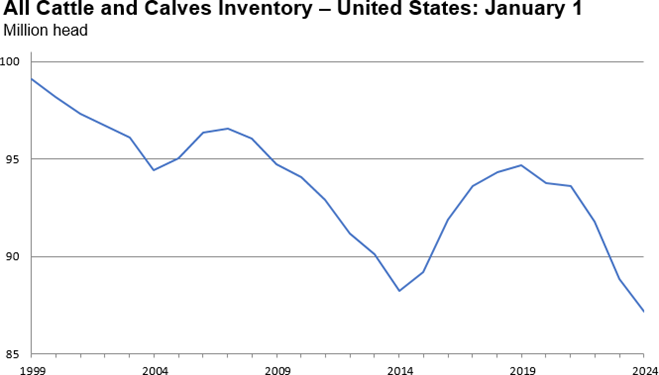
Droughts, Complicated by Climate Change, Result in U.S. Beef Herd Hitting Historic Low
by John McCracken
March 13, 2024

Introduction:
(Investigate Midwest) Thirty years ago, the weather on Annie Doerr’s family ranch felt reliable. Now that she’s taken over from her parents, it’s been anything but. In recent years, drought has made finding good pastureland for beef cattle to graze increasingly difficult.

“I always pray for a normal year,” she said, “which I don’t really know what that looks like anymore.”

Drought has affected operations at her 500-head beef cattle farm in Creighton, Nebraska, less than an hour from the South Dakota border.

In any given year, the nation experiences dry periods without rainfall. Livestock producers mitigate the effects by providing additional water sources directly to animals or crops, such as water lines to livestock or irrigation for crops. Droughts occur when dry conditions last longer than usual and water isn’t replenished to crops, groundwater, lakes or other bodies of water, resulting in water-supply problems, according to the United States Geological Survey.

During droughts, Doerr said she weans her calves off milk earlier than usual, a common practice in dry years, but one that can also put young cattle at higher risk of dying. She also slows the growth of her herd, and spends more money on sourcing feed for cattle.
Read more here: https://investigatemidwest.org/2024/03 ... ef-herd/

Image
Source: USDA
Don't mourn, organize.

-Joe Hill
User avatar
caltrek
Posts: 9280
Joined: Mon May 17, 2021 1:17 pm

Re: The Future of Food, Agriculture, and Aquaculture

Post by caltrek »

What Progress Has China Made in Agriculture Green Development Over the Past Five Years?
March 27,2024

Introduction:
(Eurekalert) Reconciling the tasks of producing adequate amounts of nutritious food for the increasing global population while preserving the environment and natural ecosystems simultaneously is an enormous challenge. The concept of agriculture green development (AGD) was detailed in 2017 and the necessary governmental policies were developed to address the aforementioned challenge in China and to help achieve the related global sustainable development goals. AGD emphasizes the synergy between green and development; current agriculture has to transform from the intensive farming with high inputs, high environmental impacts and low resource-use efficiency to a more sustainable agriculture, in order to ensure an adequate supply of nutritious food while delivering environmental integrity, improved economic profitability, and social equity. The AGD special plan distinguishes three main systems, including the natural system, the food system, and the human and social system. The food system has four subsystems: (1) green crop production, (2) green integrated crop-animal production, (3) green food and industry, and (4) green ecological environment and ecosystem services.

Prof. Fusuo Zhang and Jianbo Shen from China agricultural university and their team present the progress of AGD that has been made over the past 5 years and makes recommendations for more research and development, in order to better deliver agricultural green and sustainable development on national and international scales. The AGD research program was established as a collaboration between several universities, governments and the private sector in China, under the guidance of China Agricultural University in Beijing. Also, international universities are involved; for example, there is an ongoing joint PhD research program between Wageningen University and China Agricultural University involving 90 PhD students over a period of 7 years (2019−2025). The four research themes of the AGD research program each receive roughly similar financial research support.

In the past five years, the AGD research program has made innovative developments in the theory and practice of the four research themes. The research theme of Green Crop Production focuses on developing innovative crop production methods and technologies for producing adequate amounts of healthy and nutritious plant-based food with reduced agrochemical inputs and lower environmental impacts.
Read more of the Eurekalert article here: https://www.eurekalert.org/news-releases/1039394

Read study results as presented in Agricultural Science and Enginering here: https://journal.hep.com.cn/fase/EN/10.1 ... E-2024535
Don't mourn, organize.

-Joe Hill
User avatar
caltrek
Posts: 9280
Joined: Mon May 17, 2021 1:17 pm

Re: The Future of Food, Agriculture, and Aquaculture

Post by caltrek »

Understanding Cattle Grazing Personalities May Foster Sustainable Rangelands
March 27, 2024

Introduction:
(Eurekalert) Not all cattle are the same when it comes to grazing. Some like to wander while others prefer to stay close to water and rest areas.

Recognizing those personality differences could help ranchers select herds that best meet grazing needs on rangelands, leading to better animal health and environmental conditions, according to a new paper from the University of California, Davis, published in the journal Applied Animal Behaviour Science.

“Cattle can actually be beneficial for the rangelands,” said lead author Maggie Creamer, who recently earned her Ph.D. in animal behavior at UC Davis. “Vegetation in rangelands actually need these kinds of disturbances like grazing.”

Ranchers can add elements to the rangeland such as water, mineral supplements and fencing to influence where cattle graze, but little research has been done on how those efforts affect individual cows. Considering personalities could save money.
Additional extract:
Keying in on personality type may sound difficult, but the researchers also found some clues as to how to pinpoint the wanderers and homebodies. Unlike cattle at feedlots, the breeding cow population, especially on rangelands in California and other western states, live largely “wild” lives and are rarely handled, save for vaccinations and weaning.

Read more of the Eurekalert article here: https://www.eurekalert.org/news-releases/1039344

For a presentation of study results as published in Science Direct: https://www.sciencedirect.com/science/a ... 591240002
Don't mourn, organize.

-Joe Hill
User avatar
caltrek
Posts: 9280
Joined: Mon May 17, 2021 1:17 pm

Re: The Future of Food, Agriculture, and Aquaculture

Post by caltrek »

Complete Sugarcane Genome Sequence Opens Up New Era in Breeding
March 27,2024

Introduction:
(Eurekalert) The first comprehensive reference genome for ‘R570’, a widely cultivated modern sugarcane hybrid, has been completed in a landmark advancement for agricultural biotechnology.

Sugarcane contributes $2.2 billion to the Australian economy and accounts for 80 per cent of global sugar supply. The mapping of its genetic blueprint opens opportunities for new tools to enhance breeding programs around the world for this valuable bioenergy and food crop.

It is one of the last major crops to be fully sequenced, due to the fact its genome is almost three times the size of humans’ and far more complex, with more than 100 chromosomes.

The milestone marks a new era in breeding for the crop and was driven by an international research consortium, which included Australia’s national science agency CSIRO, The University of Queensland (UQ), and the Sugar Research Australia.

Principal Investigator and CSIRO Research Scientist Dr Karen Aitken said the breakthrough addresses the critical challenge of stagnating sugar yields by tapping into the previously inaccessible genetic information in the sugarcane genome.
Read more here: https://www.eurekalert.org/news-releases/1039240

Read more of study results as presented in Nature: https://www.nature.com/articles/s41586-024-07231-4
Don't mourn, organize.

-Joe Hill
User avatar
caltrek
Posts: 9280
Joined: Mon May 17, 2021 1:17 pm

Re: The Future of Food, Agriculture, and Aquaculture

Post by caltrek »

Vaccine Protects Cattle from Bovine Tuberculosis
March 28, 2024

Introduction:
(Eurekalert) UNIVERSITY PARK, Pa. — Bovine tuberculosis (TB) is a livestock disease that results in large economic losses to animal agriculture worldwide. The disease can also transmit to humans and cause severe illness and death. Researchers from Penn State, Addis Ababa University and the University of Cambridge have now demonstrated that a vaccine for TB currently used in humans significantly reduces infectiousness of vaccinated livestock, improving prospects for elimination and control. The study published today (March 28) in the journal Science.

The spillover of infection from livestock has been estimated to account for about 10% of human tuberculosis cases. While such zoonotic TB (zTB) infections are most commonly associated with gastrointestinal infections related to drinking contaminated milk, zTB can also cause chronic lung infections in humans. Lung disease caused by zTB can be indistinguishable from regular tuberculosis but is more difficult to treat due to natural antibiotic resistance in the cattle bacteria.

“For over a hundred years, programs to eliminate bovine tuberculosis have relied on intensive testing and slaughtering of infected animals,” said Vivek Kapur, professor of microbiology and infectious diseases and Huck Distinguished Chair in Global Health at Penn State and a corresponding author of the study. “This approach is unimplementable in many parts of the world for economic and social reasons, resulting in considerable animal suffering and economic losses from lost productivity, alongside an increased risk of spillover of infection to humans. By vaccinating cattle, we hope to be able to protect both cattle and humans from the consequences of this devastating disease.”

In the study, carried out in Ethiopia, the researchers examined the ability of the vaccine, Bacillus Calmette-Guérin (BCG), to directly protect cattle that receive it, as well as to indirectly protect both vaccinated and unvaccinated cattle by reducing transmission. They placed vaccinated and unvaccinated animals into enclosures with naturally infected animals in a novel crossover design performed over two years.

“Our study found that BCG vaccination reduces TB transmission in cattle by almost 90%,” said Andrew Conlan, associate professor of epidemiology at the University of Cambridge and a corresponding author of the study. “Vaccinated cows also developed significantly fewer visible signs of TB than unvaccinated ones. This suggests that the vaccine not only reduces the progression of the disease, but that if vaccinated animals become infected, they are also substantially less infectious to others.”
Read more here: https://www.eurekalert.org/news-releases/1039320

caltrek’s comment: I have been down lately on the idea that humans should be eating beef. Perhaps one way to discourage the conspiratorial minded anti-vaxers is to point out that their beef has been vaccinated. :)

I am so bad.
Don't mourn, organize.

-Joe Hill
User avatar
caltrek
Posts: 9280
Joined: Mon May 17, 2021 1:17 pm

Re: The Future of Food, Agriculture, and Aquaculture

Post by caltrek »

Rice Malt Shows Potential to Play a Bigger Role in Beer
March 29, 2024

Introduction:
(Eurekalert) FAYETTEVILLE, Ark. — Rice is showing potential to play a more prominent role in beer brewing, and it helps that Arkansas produces a lot of it.

Arkansas grows about half of the rice in the United States, mostly long-grain. Meanwhile, climate change and international conflicts are leading to a shortage of the raw materials traditionally used for brewing beer, especially barley.

A new study titled “Investigating the Malting Suitability and Brewing Quality of Different Rice Cultivars,” published in February by the Beverages journal, suggests the potential for malted rice to yield robust fermentations in gluten-free, all-malt beer and also in styles that use high adjunct inclusions. An adjunct is an additional source of sugar for beer fermentation.

Rice and corn have been used as an adjunct grain by American brewers since the 1860s. But the rice has been milled white rice, and not malted. Since the malting qualities of U.S. rice cultivars had not yet been evaluated for brewing qualities, one goal of the study was to identify rice cultivars with high malting potential.

University of Arkansas food science graduate student Bernardo P. Guimaraes was the lead author of the malted rice study, which provides the first publicly available data on 19 rice varieties important to the U.S. rice industry that were malted and analyzed for brewing qualities. Flavor chemist and assistant professor in the food science department Scott Lafontaine served as Guimaraes’ advisor on the research.
Read more of the Eurekalert article here: https://www.eurekalert.org/news-releases/1039590
(Beverages) Climate change [1] and international hostilities [2] are leading to a shortage of raw materials for brewing and are causing a subsequent increase in the cost of some ingredients, especially malting barley. Access to essential raw materials needed for beverage/ beer production (i.e., hops and grains like barley or wheat) will vary in availability and quality in the coming decades [3]. For example, although malted barley has been traditionally used as the main source of starch for brewing, malting barley prices in the United States have increased up to 63% in the last four years [4] due to these global pressures, and models project that barley yields will continue to be heavily impacted by climate change [5,6].

Rice (Oryza sativa L.) is a globally important food staple. In 2022, 512 million metric tons of rice were produced throughout the world, with the United States accounting for ~1.0% [7]. In the U.S., most rice is grown in the southern states; for example, Arkansas alone accounts for ~40% of all US rice [8]. Compared to barley, models predict that rice yields might be less impacted by climate change [9]. Therefore, by offering a more locally sourced grain, despite paddy rice being proportionally more CO2 intensive to grow than malting barley [10,11], the lack of international shipping may potentially make up the difference in CO2. Additionally, rice is a gluten-free source of starch for brewers and beverage/food producers.

Cited from the study as published in the Beverages journal: https://www.mdpi.com/2306-5710/10/1/16
Don't mourn, organize.

-Joe Hill
Post Reply