Stars, supernovae, black holes and stellar remnants

-
weatheriscool
- Posts: 25728
- Joined: Sun May 16, 2021 6:16 pm
- Contact:
Re: Stars, supernovae, black holes and stellar remnants
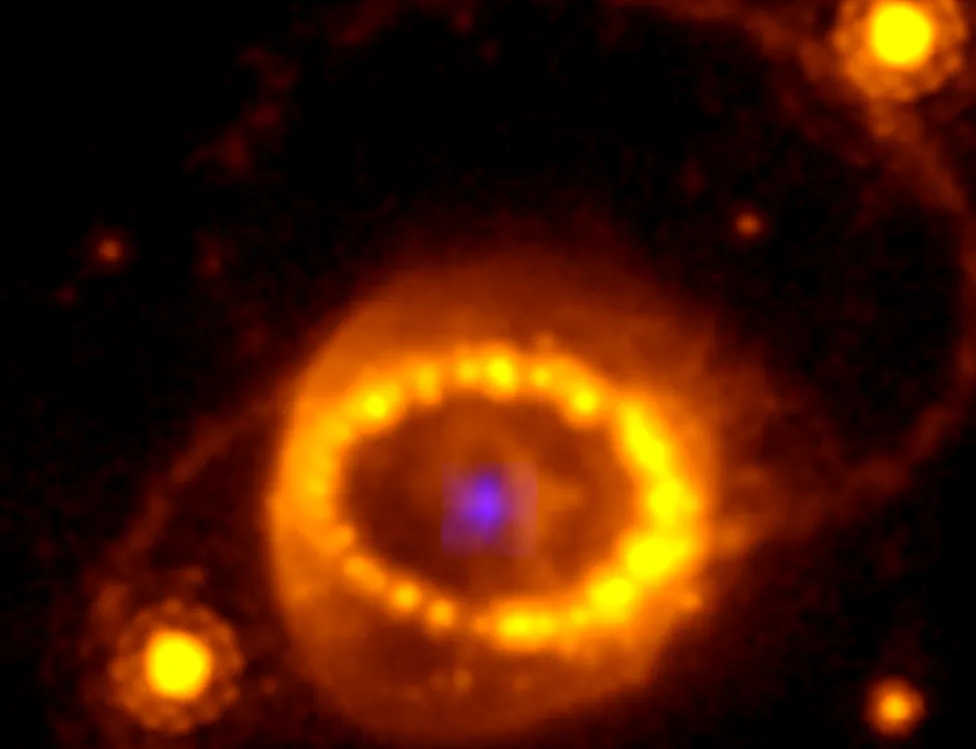
Astronomers find first strong evidence of neutron star remnant of exploding star
https://phys.org/news/2024-02-astronome ... -star.html
by University College London
https://phys.org/news/2024-02-astronome ... -star.html
by University College London
An international team of astronomers including UCL's (University College London's) Professor Mike Barlow has discovered the first conclusive evidence that a neutron star exists at the center of Supernova 1987A, a star explosion observed 37 years ago.
Supernovae are the spectacular end result of the collapse of stars more massive than 8–10 times the mass of the sun. They are the main sources of chemical elements (such as carbon, oxygen, silicon, and iron) that make life possible. The collapsed core of these exploding stars can result in much smaller neutron stars, composed of the densest matter in the known universe, or black holes.
Supernova 1987A, located in the Large Magellanic Cloud, a neighboring dwarf galaxy, was the nearest, brightest supernova seen in the night sky in 400 years.
Neutrinos, unimaginably small sub-atomic particles, were produced in the supernova and detected on Earth (23 February, 1987) the day before the supernova was seen, indicating that a neutron star must have formed. However, it has not been known whether the neutron star persisted or collapsed into a black hole, as the star has been obscured by dust that formed after the explosion.
-
Time_Traveller

- Posts: 3025
- Joined: Sun May 16, 2021 4:49 pm
- Location: New York City, USA, November 5th 2032 C.E.
Re: Stars, supernovae, black holes and stellar remnants
Supernova: Astronomers crack cosmic 'murder mystery'
https://www.bbc.co.uk/news/science-environment-683520441 hour ago
Scientists say they have solved the mystery of what lies at the heart of a celebrated cosmic explosion.
In February 1987, a star exploded in a neighbouring galaxy. It was visible from Earth for four months, shining with the power of 100 million suns.
There was so much debris, even the most powerful telescopes could not confirm what remained at its heart.
New results confirm it is a neutron star, so dense that a teaspoon of it would weigh 10 million tonnes.
BBC Sky at Night presenter Dr Maggie Aderin-Pocock said that the research team had "solved a murder mystery".
“In the quantum multiverse, every choice, every decision you've ever and never made exists in an unimaginably vast ensemble of parallel universes.”
-
weatheriscool
- Posts: 25728
- Joined: Sun May 16, 2021 6:16 pm
- Contact:
Re: Stars, supernovae, black holes and stellar remnants
Metal scar found on world-destroying star after its reign of terror
By Michael Irving
By Michael Irving
https://newatlas.com/space/metal-scar-w ... ying-star/
In a few billion years the Sun will destroy the solar system’s inner planets – and if it’s lucky it might get a big cool scar to brag about. That’s what happened to a white dwarf that astronomers have just found, which seems to have a bizarre metal scar on its surface, unlike anything ever seen before.
The white dwarf in question is named WD 0816-310, which at first feels like a classic example of astronomy’s uncreative naming processes, but if we want to stick to the theme it kind of sounds like a prison inmate number. Fittingly, this dying star bears a unique scar from its violent past.
White dwarfs are born among chaos – when a star of a certain mass exhausts its fuel supply, it chokes on its own waste and bursts outwards, leaving behind a dense core that then cools to the background temperature of the universe over trillions of years. And that usually spells doom for any planets that may have orbited the original star, whose shredded remains end up raining down onto the white dwarf.
Re: Stars, supernovae, black holes and stellar remnants
weatheriscool wrote: ↑Tue Feb 27, 2024 6:44 pm Metal scar found on world-destroying star after its reign of terror
By Michael Irvinghttps://newatlas.com/space/metal-scar-w ... ying-star/
In a few billion years the Sun will destroy the solar system’s inner planets – and if it’s lucky it might get a big cool scar to brag about. That’s what happened to a white dwarf that astronomers have just found, which seems to have a bizarre metal scar on its surface, unlike anything ever seen before.
The white dwarf in question is named WD 0816-310, which at first feels like a classic example of astronomy’s uncreative naming processes, but if we want to stick to the theme it kind of sounds like a prison inmate number. Fittingly, this dying star bears a unique scar from its violent past.
White dwarfs are born among chaos – when a star of a certain mass exhausts its fuel supply, it chokes on its own waste and bursts outwards, leaving behind a dense core that then cools to the background temperature of the universe over trillions of years. And that usually spells doom for any planets that may have orbited the original star, whose shredded remains end up raining down onto the white dwarf.
I wish you'd include the images with these articles.

An artist's impression of a white dwarf with a metal "scar" (the dark spot near its pole) caused by the destruction of planets and asteroids
ESO/L. Calçada
-
weatheriscool
- Posts: 25728
- Joined: Sun May 16, 2021 6:16 pm
- Contact:
Re: Stars, supernovae, black holes and stellar remnants
Astrophysicists unveil new phenomenon challenging textbook definition of white dwarf stars
https://phys.org/news/2024-03-astrophys ... ition.html
by University of Warwick
https://phys.org/news/2024-03-astrophys ... ition.html
by University of Warwick
Scientists have revealed why some white dwarfs mysteriously stop cooling—changing ideas on just how old stars really are and what happens to them when they die.
White dwarf stars are universally believed to be 'dead stars' that continuously cool down over time. However, in 2019, data from the European Space Agency's (ESA's) Gaia satellite discovered a population of white dwarf stars that have stopped cooling for more than eight billion years. This suggested that some white dwarfs can generate significant extra energy, at odds with the classical 'dead star' picture, and astronomers initially were not sure how this could happen.
Today, new research published in Nature, led by Dr. Antoine Bédard from the University of Warwick and Dr. Simon Blouin from the University of Victoria (Canada), unveils the mechanism behind this baffling observation.
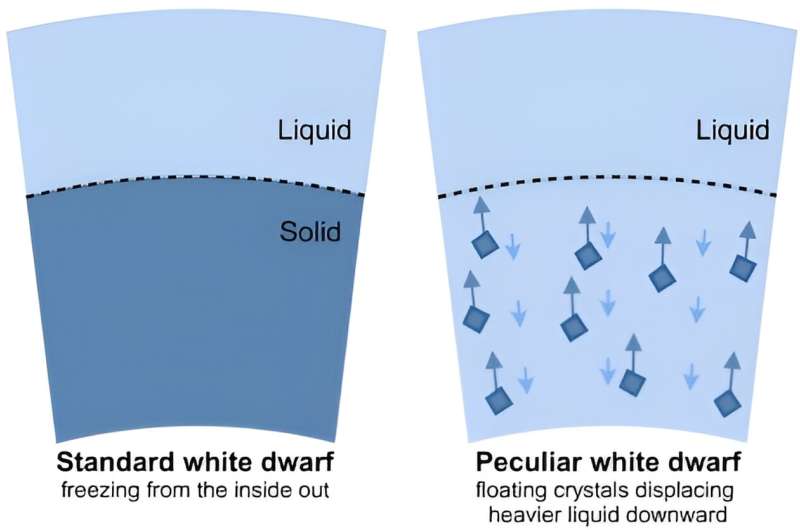
Over 97% of stars in the Milky Way will eventually become white dwarfs. Scientists have long considered these stars to be at the end of their lives. Having depleted their nuclear energy source, they stop producing heat and cool down until the dense plasma in their interiors freezes into a solid state, and the star solidifies from the inside out. This cooling process can take billions of years.
-
weatheriscool
- Posts: 25728
- Joined: Sun May 16, 2021 6:16 pm
- Contact:
Re: Stars, supernovae, black holes and stellar remnants
Largest-ever map of universe's active supermassive black holes released
https://phys.org/news/2024-03-largest-u ... holes.html
by Thomas Sumner, Simons Foundation
https://phys.org/news/2024-03-largest-u ... holes.html
by Thomas Sumner, Simons Foundation
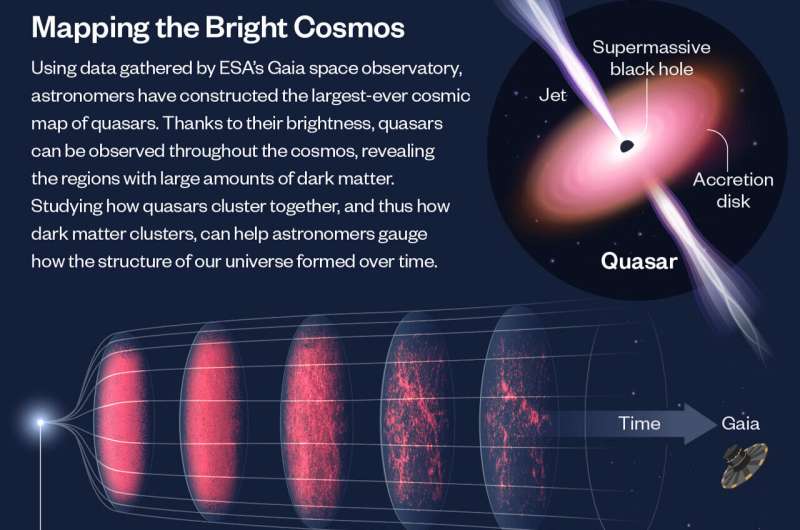
Astronomers have charted the largest-ever volume of the universe with a new map of active supermassive black holes living at the centers of galaxies. Called quasars, the gas-gobbling black holes are, ironically, some of the universe's brightest objects.
The new map logs the location of about 1.3 million quasars in space and time, the furthest of which shone bright when the universe was only 1.5 billion years old. (For comparison, the universe is now 13.7 billion years old.)
-
weatheriscool
- Posts: 25728
- Joined: Sun May 16, 2021 6:16 pm
- Contact:
Re: Stars, supernovae, black holes and stellar remnants
Astronomers Create 3D Map of Universe's Quasars
Now the largest-ever map of the universe by volume, the project reveals what can be achieved using scrap data.
By Adrianna Nine March 20, 2024
Now the largest-ever map of the universe by volume, the project reveals what can be achieved using scrap data.
By Adrianna Nine March 20, 2024
https://www.extremetech.com/science/ast ... es-quasars
Astronomers have mapped the universe's quasars in unprecedented detail thanks to a ream of accidental observations from the Gaia observatory. The new "3D catalog" is expected to offer researchers fresh insight into dark matter, cosmic expansion, and the distribution of material throughout the universe.
The European Space Agency's Gaia spacecraft is designed to capture precise three-dimensional images of the Milky Way. But sometimes, the observatory's billion-pixel camera captures data from outside our galaxy—namely, quasars and other galaxies. For most Gaia-related projects, these observations might be considered scrap data or noise polluting a research team's target image. But one scientist's trash is another scientist's treasure, and one international research team found the value hidden in Gaia's 6.6 million potential quasar findings.
A graph showing the distribution of quasars in the observable universe.

-
firestar464
- Posts: 8305
- Joined: Wed Oct 12, 2022 7:45 am
Re: Stars, supernovae, black holes and stellar remnants
Astronomers find evidence that blue supergiant stars can be formed by the merger of two stars
https://phys.org/news/2024-03-astronome ... stars.html
https://phys.org/news/2024-03-astronome ... stars.html

Re: Stars, supernovae, black holes and stellar remnants
These Ancient Rivers of Stars Have Flowed Since The Milky Way Began
by Michelle Starr
March 23, 2024
Introduction:
by Michelle Starr
March 23, 2024
Introduction:
Read more here: https://www.sciencealert.com/these-anc ... way-began(Science Alert) Relics of the Milky Way's birth have just been discovered hiding in plain sight.
Towards the center of the galaxy, two streams of stars nearly as old as the Universe have been discovered circling the heart of the Milky Way. A new analysis based on data from the European Space Agency's Gaia telescope strongly suggests that these ancient streams existed before the Milky Way even had its spiral arms – when it was just a baby galaxy extending its first tendrils of stars out into the space around it.
These two streams, discovered by astrophysicist Khyati Malhan and astronomer Hans Walter-Rix of the Max Planck Institute for Astronomy in Germany, have been named Shiva and Shakti after the creators of the Universe in Hindu mythology.
"What's truly amazing is that we can detect these ancient structures at all," Malhan says. "The Milky Way has changed so significantly since these stars were born that we wouldn't expect to recognize them so clearly as a group – but the unprecedented data we're getting from Gaia made it possible."
The Milky Way is thought to have started forming some 13 billion years ago, when the Universe was freshly minted and forging its first stars and galaxies at a tremendous rate. Piecing together that history is a field known as galactic archaeology, and it relies in part on finding populations of stars whose properties are consistent with an ancient origin.
Don't mourn, organize.
-Joe Hill
-Joe Hill
-
weatheriscool
- Posts: 25728
- Joined: Sun May 16, 2021 6:16 pm
- Contact:
-
firestar464
- Posts: 8305
- Joined: Wed Oct 12, 2022 7:45 am
Re: Stars, supernovae, black holes and stellar remnants
https://www.swpc.noaa.gov/news/update-g ... il-23-2023
NOAA report:
What implications is this supposed to have?
NOAA report:
What implications is this supposed to have?
-
Powers
- Posts: 1183
- Joined: Fri Apr 07, 2023 7:32 pm
- Location: a.k.a Lurking, Member, Lorem Ipsum, ..., --- and ººº.
Re: Stars, supernovae, black holes and stellar remnants
Nothing apparently?firestar464 wrote: ↑Sun Mar 24, 2024 6:19 pm https://www.swpc.noaa.gov/news/update-g ... il-23-2023
NOAA report:
What implications is this supposed to have?
Re: Stars, supernovae, black holes and stellar remnants
Powers wrote: ↑Sun Mar 24, 2024 9:25 pmNothing apparently?firestar464 wrote: ↑Sun Mar 24, 2024 6:19 pm https://www.swpc.noaa.gov/news/update-g ... il-23-2023
NOAA report:
What implications is this supposed to have?
https://thehill.com/homenews/nexstar_me ... t-to-know/(The Hill) …on Sunday, the SWPC (Space Weather Prediction Center) warned that the storm had reached “severe” G4 conditions. Those conditions could change into Monday, the agency said in a Sunday evening update.
…
The G4 storming observed Sunday is considered “severe,” the SWPC notes, saying a storm of this caliber is “a major disturbance in Earth’s magnetic field; often varying intensity between lower levels and severe storm conditions over the course of the event.” As alarming as it may sound, the agency is advising otherwise.
“The public should not anticipate adverse impacts and no action is necessary, but they should stay properly informed of storm progression by visiting our webpage,” the SWPC said in a Sunday update, adding that “infrastructure operators have been notified to take action to mitigate any possible impacts.”
…
Officials also noted that there may be increased and more frequent voltage control problems that are “normally mitigable;” an increased chance at “anomalies or effects to satellite operations;” and “more frequent and longer periods of GPS degradation possible.
Don't mourn, organize.
-Joe Hill
-Joe Hill
-
firestar464
- Posts: 8305
- Joined: Wed Oct 12, 2022 7:45 am
Re: Stars, supernovae, black holes and stellar remnants
https://phys.org/news/2024-03-stunning- ... birth.html
Stunning James Webb images show birth and death of massive stars
Stunning James Webb images show birth and death of massive stars
-
firestar464
- Posts: 8305
- Joined: Wed Oct 12, 2022 7:45 am
Re: Stars, supernovae, black holes and stellar remnants
https://phys.org/news/2024-03-analysis- ... -hole.html
New analysis reveals a tiny black hole repeatedly punching through a larger black hole's disk of gas
New analysis reveals a tiny black hole repeatedly punching through a larger black hole's disk of gas
-
weatheriscool
- Posts: 25728
- Joined: Sun May 16, 2021 6:16 pm
- Contact:
Re: Stars, supernovae, black holes and stellar remnants
Supercomputer simulations decode the mass puzzle of the first stars
https://phys.org/news/2024-04-supercomp ... uzzle.html
by ASIAA
https://phys.org/news/2024-04-supercomp ... uzzle.html
by ASIAA
Ching-Yao Tang and Dr. Ke-Jung Chen from the Institute of Astronomy and Astrophysics, Academia Sinica (ASIAA) have made substantial progress in decoding the birth mass of the first stars using the powerful supercomputer at Berkeley National Lab.
This new research is reported in the latest issue of the Monthly Notices of the Royal Astronomical Society.
During the earliest stages of the universe, only hydrogen and helium existed following the Big Bang, and crucial life-sustaining elements like carbon and oxygen had yet to emerge. Approximately 200 million years later, the first stars, known as Population III (Pop III) stars, began forming.
These stars initiated the production of heavier elements through nuclear burning at their cores. As these stars reached the end of their life cycles, some went supernovae, creating powerful explosions that dispersed newly synthesized elements into the early universe, becoming the foundation for life.
-
Time_Traveller
- Posts: 3025
- Joined: Sun May 16, 2021 4:49 pm
- Location: New York City, USA, November 5th 2032 C.E.
Re: Stars, supernovae, black holes and stellar remnants
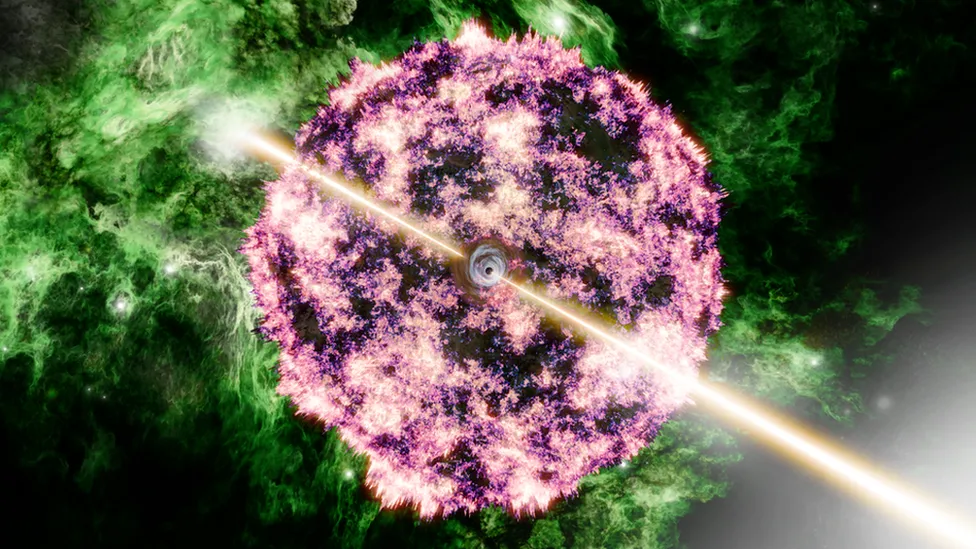
Brightest-ever cosmic explosion solved but new mysteries sparked
https://www.bbc.co.uk/news/science-environment-687875343 hours ago
Researchers have discovered the cause of the brightest burst of light ever recorded.
But in doing so they have run up against two bigger mysteries, including one that casts doubt on where our heavy elements - like gold - come from.
The burst of light, spotted in 2022, is now known to have had an exploding star at its heart, researchers say.
But that explosion, by itself, would not have been sufficient to have shone so brightly.
And our current theory says that such exploding stars, known as supernovas, also produce all the heavy elements in the universe such as gold and platinum.
“In the quantum multiverse, every choice, every decision you've ever and never made exists in an unimaginably vast ensemble of parallel universes.”
-
weatheriscool
- Posts: 25728
- Joined: Sun May 16, 2021 6:16 pm
- Contact:
Re: Stars, supernovae, black holes and stellar remnants
Stellar winds of three sun-like stars detected for the first time
https://phys.org/news/2024-04-stellar-sun-stars.html
by University of Vienna
https://phys.org/news/2024-04-stellar-sun-stars.html
by University of Vienna
An international research team led by a researcher from the University of Vienna has for the first time directly detected stellar winds from three sun-like stars by recording the X-ray emission from their astrospheres, and placed constraints on the mass loss rate of the stars via their stellar winds.
Astrospheres, stellar analogs of the heliosphere that surrounds our solar system, are very hot plasma bubbles blown by stellar winds into the interstellar medium, a space filled with gas and dust. The study of the stellar winds of low-mass stars similar to the sun allows us to understand stellar and planetary evolution, and ultimately the history and future of our own star and solar system. Stellar winds drive many processes that evaporate planetary atmospheres into space and therefore lead to atmospheric mass loss.