James Webb Space Telescope (JWST)

weatheriscool
Posts: 24486
Joined: Sun May 16, 2021 6:16 pm
Contact:

Re: James Webb Space Telescope (JWST)

Post by weatheriscool »

The 25 Best James Webb Space Telescope Images So Far

https://www.extremetech.com/science/the ... ges-so-far
Webb has two decades ahead of it, but it's already captured some stunning images.
By Ryan Whitwam July 6, 2023
The James Webb Space Telescope took decades to design and build, but that herculean effort is already paying off. Scarcely a year on the job, and Webb is already sending back stunning cosmic vistas, complete with a raft of scientific data that has helped scientists advance their understanding of the universe. The telescope may operate for 20 years, but let's look over the highlights of Webb's first year on the job. Here, in no particular order, are the 25 best Webb images to date.
Jupiter
Image
Neptune
Image
SaturnImage
User avatar
wjfox
Site Admin
Posts: 13578
Joined: Sat May 15, 2021 6:09 pm
Location: Essex, UK
Contact:

Re: James Webb Space Telescope (JWST)

Post by wjfox »

User avatar
wjfox
Site Admin
Posts: 13578
Joined: Sat May 15, 2021 6:09 pm
Location: Essex, UK
Contact:

Re: James Webb Space Telescope (JWST)

Post by wjfox »

Webb celebrates first year of science with close-up on birth of Sun-like stars

Jul 12, 2023

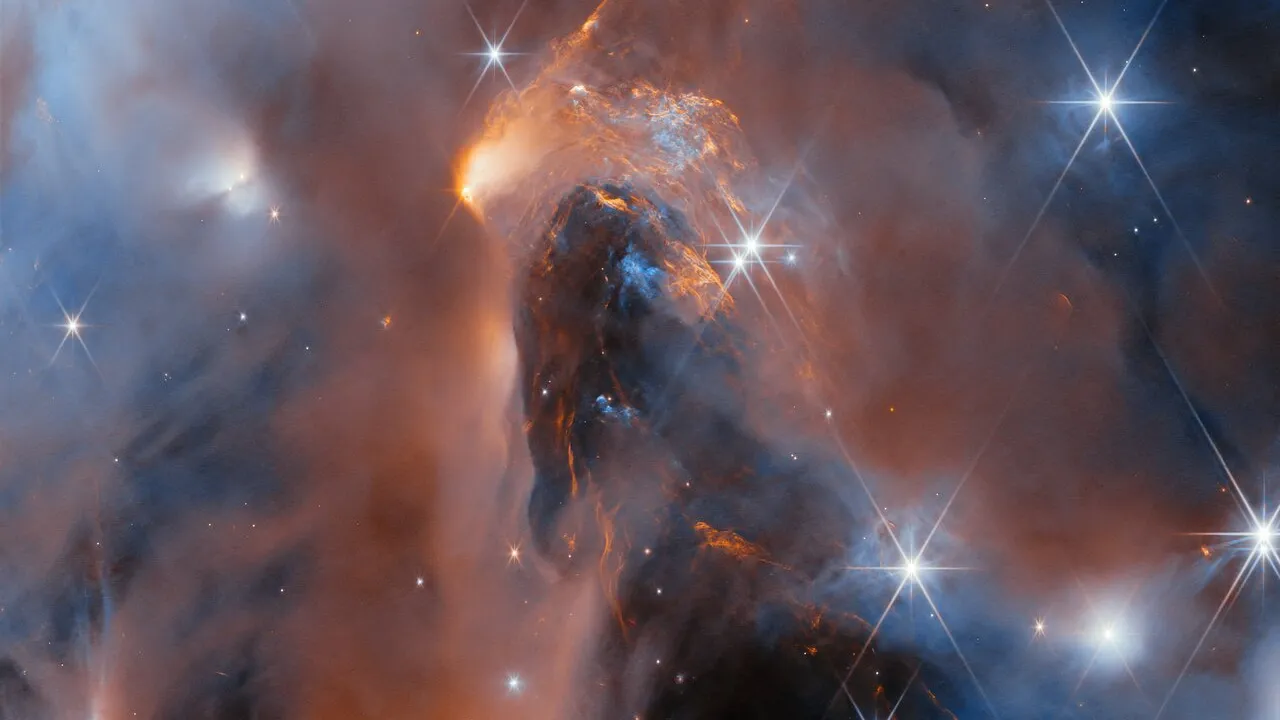
From our cosmic backyard in the solar system to distant galaxies near the dawn of time, NASA’s James Webb Space Telescope has delivered on its promise of revealing the universe like never before in its first year of science operations. To celebrate the completion of a successful first year, NASA has released Webb’s image of a small star-forming region in the Rho Ophiuchi cloud complex.

“In just one year, the James Webb Space Telescope has transformed humanity’s view of the cosmos, peering into dust clouds and seeing light from faraway corners of the universe for the very first time. Every new image is a new discovery, empowering scientists around the globe to ask and answer questions they once could never dream of,” said NASA Administrator Bill Nelson. “Webb is an investment in American innovation but also a scientific feat made possible with NASA’s international partners that share a can-do spirit to push the boundaries of what is known to be possible. Thousands of engineers, scientists, and leaders poured their life’s passion into this mission, and their efforts will continue to improve our understanding of the origins of the universe – and our place in it.”

The new Webb image released today features the nearest star-forming region to us. Its proximity at 390 light-years allows for a highly detailed close-up, with no foreground stars in the intervening space.

“On its first anniversary, the James Webb Space Telescope has already delivered upon its promise to unfold the universe, gifting humanity with a breathtaking treasure trove of images and science that will last for decades,” said Nicola Fox, associate administrator of NASA’s Science Mission Directorate in Washington. “An engineering marvel built by the world’s leading scientists and engineers, Webb has given us a more intricate understanding of galaxies, stars, and the atmospheres of planets outside of our solar system than ever before, laying the groundwork for NASA to lead the world in a new era of scientific discovery and the search for habitable worlds.”

Webb’s image shows a region containing approximately 50 young stars, all of them similar in mass to the Sun, or smaller. The darkest areas are the densest, where thick dust cocoons still-forming protostars. Huge bipolar jets of molecular hydrogen, represented in red, dominate the image, appearing horizontally across the upper third and vertically on the right. These occur when a star first bursts through its natal envelope of cosmic dust, shooting out a pair of opposing jets into space like a newborn first stretching her arms out into the world. In contrast, the star S1 has carved out a glowing cave of dust in the lower half of the image. It is the only star in the image that is significantly more massive than the Sun.

https://www.nasa.gov/feature/goddard/20 ... -new-image


Image
Credits: NASA, ESA, CSA, STScI, Klaus Pontoppidan (STScI)
User avatar
wjfox
Site Admin
Posts: 13578
Joined: Sat May 15, 2021 6:09 pm
Location: Essex, UK
Contact:

Re: James Webb Space Telescope (JWST)

Post by wjfox »

James Webb Telescope Catches Glimpse of Possible First-Ever ‘Dark Stars’

Jul 14, 2023

AUSTIN, Texas — Stars beam brightly out of the darkness of space thanks to fusion, atoms melding together and releasing energy. But what if there’s another way to power a star?

A team of astrophysicists including Katherine Freese at The University of Texas at Austin analyzed images from the James Webb Space Telescope (JWST) and found three bright objects that might be “dark stars,” theoretical objects much bigger and brighter than our sun, powered by particles of dark matter annihilating. If confirmed, dark stars could reveal the nature of dark matter, one of the deepest unsolved problems in all of physics.

“Discovering a new type of star is pretty interesting all by itself, but discovering it’s dark matter that’s powering this—that would be huge,” said Freese, director of the Weinberg Institute for Theoretical Physics and the Jeff and Gail Kodosky Endowed Chair in Physics at UT Austin.

Although dark matter makes up about 25% of the universe, its nature has eluded scientists. Scientists believe it consists of a new type of elementary particle, and the hunt to detect such particles is on. Among the leading candidates are Weakly Interacting Massive Particles. When they collide, these particles annihilate themselves, depositing heat into collapsing clouds of hydrogen and converting them into brightly shining dark stars. The identification of supermassive dark stars would open up the possibility of learning about the dark matter based on their observed properties.

The research is published in the Proceedings of the National Academy of Sciences. Along with Freese, the co-authors are Cosmin Ilie and Jillian Paulin at Colgate University.

https://news.utexas.edu/2023/07/14/jame ... ark-stars/


Image
Credit: NASA/ESA.
User avatar
caltrek
Posts: 9280
Joined: Mon May 17, 2021 1:17 pm

Re: James Webb Space Telescope (JWST)

Post by caltrek »

JWST Just Detected Carbon in The Cosmic Dawn… Before We Thought Carbon Was Possible
by Michele Starr
July 19, 2023

Introduction:
(Science Alert) Back when the Universe was still just a wee baby Universe, there wasn't a lot going on chemically. There was hydrogen, with some helium, and a few traces of other things. Heavier elements didn't arrive until stars had formed, lived, and died.

Imagine, therefore, the consternation of scientists when, using the James Webb Space Telescope to peer back into the distant reaches of the Universe, they discovered significant amounts of carbon dust, less than a billion years after the Big Bang.

The discovery suggests that there was some means of enhanced carbon production in the tumultuous early Universe – probably from the deaths of massive stars, spewing it out into space as they die.

"Our detection of carbonaceous dust at redshift 4-7 provides crucial constraints on the dust production models and scenarios in the early Universe," write a team led by cosmologist Joris Witstok of the University of Cambridge in the UK.

The first billion years of the Universe's life known as the Cosmic Dawn, following the Big Bang 13.8 billion years ago, was a critical time. The first atoms formed; the first stars; the first light bloomed in the darkness. But it took stars themselves to forge significant quantities of elements heavier than hydrogen and helium.
Read more here: https://www.sciencealert.com/jwst-just ... possible

Image
Wolf-Rayet star WR 140, spewing carbon-rich dust out into the space around it.
NASA/ESA/CSA/STScl/JPL-Caltech
Don't mourn, organize.

-Joe Hill
weatheriscool
Posts: 24486
Joined: Sun May 16, 2021 6:16 pm
Contact:

Re: James Webb Space Telescope (JWST)

Post by weatheriscool »

James Webb Space Telescope spies water near center of planet-forming disk in cosmic 1st


Astronomers have for the first time discovered that rocky alien worlds could possess large amounts of water from the moment they form, a new study finds.

Life is found virtually wherever there is water on Earth. As such, the search for potentially habitable exoplanets has mainly focused on hunting for the presence of water.

Previous research suggested that the newborn Earth got a lot of its water from water-bearing asteroids bombarding our young planet's surface after it formed. Now scientists may have discovered evidence that water could also serve as one of the initial ingredients of rocky planets available at birth.


Artist’s illustration of the PDS 70 system’s planet-forming disk. James Webb Space Telescope observations detected water in the inner disk, where normally terrestrial planets form. Two gas giant planets carved a wide gap in the disk made of gas and dust during their growth. (Image credit: MPIA)

In the new study, the researchers focused on the young star PDS 70, located about 370 light-years from Earth. About three-quarters the mass of the sun, PDS 70 is only about 5.4 million years old, compared to our sun's age of about 4.6 billion years.
More:
https://www.space.com/james-webb-space- ... etary-disk
User avatar
wjfox
Site Admin
Posts: 13578
Joined: Sat May 15, 2021 6:09 pm
Location: Essex, UK
Contact:

Re: James Webb Space Telescope (JWST)

Post by wjfox »


Image
weatheriscool
Posts: 24486
Joined: Sun May 16, 2021 6:16 pm
Contact:

Re: James Webb Space Telescope (JWST)

Post by weatheriscool »

User avatar
wjfox
Site Admin
Posts: 13578
Joined: Sat May 15, 2021 6:09 pm
Location: Essex, UK
Contact:

Re: James Webb Space Telescope (JWST)

Post by wjfox »

weatheriscool
Posts: 24486
Joined: Sun May 16, 2021 6:16 pm
Contact:

Re: James Webb Space Telescope (JWST)

Post by weatheriscool »

Webb snaps supersonic outflow of young star
https://phys.org/news/2023-09-webb-snap ... young.html

Image
by Space Telescope Science Institute
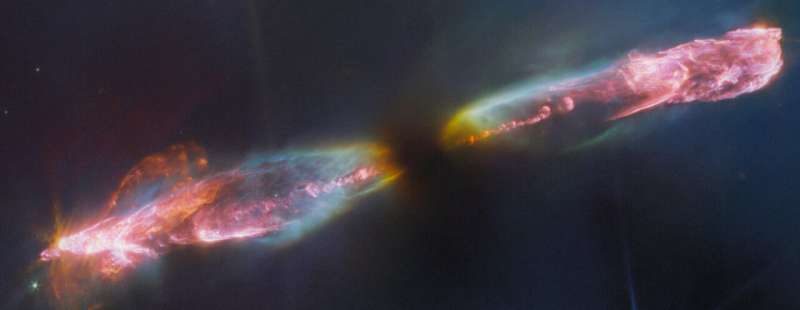
NASA's James Webb Space Telescope has captured a high-resolution look at Herbig-Haro 211 (HH 211), a bipolar jet traveling through interstellar space at supersonic speeds. At roughly 1,000 light-years away from Earth in the constellation Perseus, the object is one of the youngest and nearest protostellar outflows, making it an ideal target for Webb.

Herbig-Haro (HH) objects are luminous regions surrounding newborn stars, formed when stellar winds or jets of gas spewing from these newborn stars form shock waves colliding with nearby gas and dust at high speeds. This image of HH 211 from NASA's James Webb Space Telescope reveals an outflow from a Class 0 protostar, an infantile analog of our sun when it was no more than a few tens of thousands of years old and with a mass only 8% of the present-day sun. (It will eventually grow into a star like the sun.)

Infrared imaging is powerful in studying newborn stars and their outflows, because such stars are invariably still embedded within the gas from the molecular cloud in which they formed. The infrared emission of the star's outflows penetrates the obscuring gas and dust, making a Herbig-Haro object like HH 211 ideal for observation with Webb's sensitive infrared instruments. Molecules excited by the turbulent conditions, including molecular hydrogen, carbon monoxide, and silicon monoxide, emit infrared light that Webb can collect to map out the structure of the outflows.
User avatar
raklian
Posts: 1981
Joined: Sun May 16, 2021 4:46 pm
Location: North Carolina

Re: James Webb Space Telescope (JWST)

Post by raklian »

To know is essentially the same as not knowing. The only thing that occurs is the rearrangement of atoms in your brain.
Nanotechandmorefuture
Posts: 478
Joined: Fri Sep 17, 2021 6:15 pm
Location: At the moment Miami, FL

Re: James Webb Space Telescope (JWST)

Post by Nanotechandmorefuture »

weatheriscool wrote: Thu Jul 06, 2023 11:47 pm The 25 Best James Webb Space Telescope Images So Far

https://www.extremetech.com/science/the ... ges-so-far
Webb has two decades ahead of it, but it's already captured some stunning images.
By Ryan Whitwam July 6, 2023
The James Webb Space Telescope took decades to design and build, but that herculean effort is already paying off. Scarcely a year on the job, and Webb is already sending back stunning cosmic vistas, complete with a raft of scientific data that has helped scientists advance their understanding of the universe. The telescope may operate for 20 years, but let's look over the highlights of Webb's first year on the job. Here, in no particular order, are the 25 best Webb images to date.
Jupiter
Image
Neptune
Image
SaturnImage
The middle one looks like estimations for Triton. I know it sounds a little ridiculous though you have to remember its not like someone can go out there and verify things yet. For all we know there could be a star above Triton and all that since space is not perfectly flat like we see on diagrams. I still believe they took a general estimation of Andromeda and applied it for simplicity to the Milky Way. Maybe some day the actual height and width of our own galaxy can be verified.
User avatar
caltrek
Posts: 9280
Joined: Mon May 17, 2021 1:17 pm

Re: James Webb Space Telescope (JWST)

Post by caltrek »

The James Webb Space Telescope and an Amonia Trail to Exoplanets
November 11, 2023


Extract:
(Eurasia Review) Isotopes and isotopologues – molecules that differ only in the composition of their isotopes –…play an increasingly important role in astronomy. For example, the ratio of carbon-12 (12C) to carbon-13 (13C) isotopes in the atmosphere of an exoplanet allows scientists to infer the distance at which the exoplanet orbits its central star.

Until now, 12C and 13C bound in carbon monoxide were the only isotopologues that could be measured in the atmosphere of an exoplanet. Now a team of researchers has succeeded in detecting ammonia isotopologues in the atmosphere of a cold brown dwarf. As the team has just reported in the journal Nature, ammonia could be measured in the form of 14NH3 and 15NH3….

In search of ammonia

Brown dwarfs are somewhere in between stars and planets: they resemble giant gas planets in many ways, which is why they can be used as a model system to study gas giants. In their work, (astrophysicist Polychronis) Patapis and colleagues observed a brown dwarf, called WISE J1828, that’s 32.5 light years away from Earth; in the night sky, it is located in the constellation Lyra, the lyre. WISE J1828 cannot be seen with the naked eye: with an effective temperature (that is, the temperature of a blackbody that would emit the same amount of energy as the observed object) of only 100°C, it is far too cold for hydrogen fusion to take place and send light all the way to Earth. To spot this ultracold dwarf star of the Y spectral class, the mirrors of the James Webb Space Telescope (JWST) were turned in the direction of the lyre last summer.

The Mid-InfraRed Instrument (MIRI), an infrared detector installed on board the JWST, made it possible to reveal the ammonia isotopologues on WISE J1828. In the wavelength range between 4.9 and 27.9 μm, the Medium Resolution Spectrometer (MRS) of MIRI recorded a spectrum of the brown dwarf where, in addition to ammonia, the researchers observed water and methane molecules, each with characteristic absorption bands.

The ammonia trail only became tangible thanks to the JWST, confirming once again the enormous value and unparalleled performance of this space telescope
Read more here: https://www.eurasiareview.com/09112023 ... planets/
Don't mourn, organize.

-Joe Hill
weatheriscool
Posts: 24486
Joined: Sun May 16, 2021 6:16 pm
Contact:

Re: James Webb Space Telescope (JWST)

Post by weatheriscool »

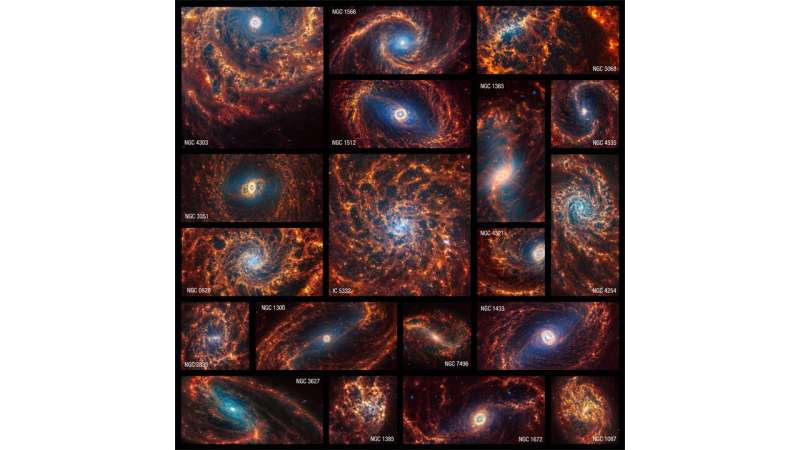
NASA's Webb depicts staggering structure in 19 nearby spiral galaxies
https://phys.org/news/2024-01-nasa-webb ... earby.html
by Space Telescope Science Institute
A new treasure trove of Webb images has arrived. Near- and mid-infrared images show off every facet of these face-on spiral galaxies.

Humanity has spent centuries mapping Earth's features—and we frequently repeat the process by using more advanced instruments. When we combine the data, we get a more complete understanding of our planet.

Now, look outward into space. Astronomers have observed nearby, face-on spiral galaxies for decades. Both space- and ground-based telescopes have contributed to a cache of data in wavelengths from radio to ultraviolet light. Astronomers have long planned to use NASA's James Webb Space Telescope to obtain the highest resolution near- and mid-infrared images ever taken of these galaxies, and today they are publicly available.
Image
weatheriscool
Posts: 24486
Joined: Sun May 16, 2021 6:16 pm
Contact:

Re: James Webb Space Telescope (JWST)

Post by weatheriscool »

James Webb captures first direct images of galaxies born at Cosmic Dawn
By Michael Irving
May 24, 2024
The James Webb Space Telescope has captured direct images of galaxies being born at the cosmic dawn. This is the first time this has ever been witnessed by astronomers, confirming models for galaxy formation.

With its incredibly powerful infrared eyes, the Webb telescope can peer farther back in space and time than any other instrument. It keeps breaking its own records for most distant stars and galaxies ever observed, as it edges closer to the cosmic dawn, the time when the lights first switched on in a previously pitch-black universe.

Now, Webb has managed to see some of the first ever galaxies forming at this dawn. The telescope captured images of three galaxies forming between 13.2 and 13.4 billion years ago, or just 400 to 600 million years after the Big Bang.

“You could say that these are the first 'direct' images of galaxy formation that we’ve ever seen,” said Kasper Elm Heintz, lead author of the study. “Whereas the James Webb has previously shown us early galaxies at later stages of evolution, here we witness their very birth, and thus, the construction of the first star systems in the universe.”
https://newatlas.com/space/james-webb-f ... smic-dawn/
User avatar
Time_Traveller
Posts: 3025
Joined: Sun May 16, 2021 4:49 pm
Location: New York City, USA, November 5th 2032 C.E.

Re: James Webb Space Telescope (JWST)

Post by Time_Traveller »

Nasa finds the most distant galaxy in the known universe
4 hours ago

Image

Nasa’s James Webb Space Telescope has found the two most distant galaxies ever seen, the space agency has said.

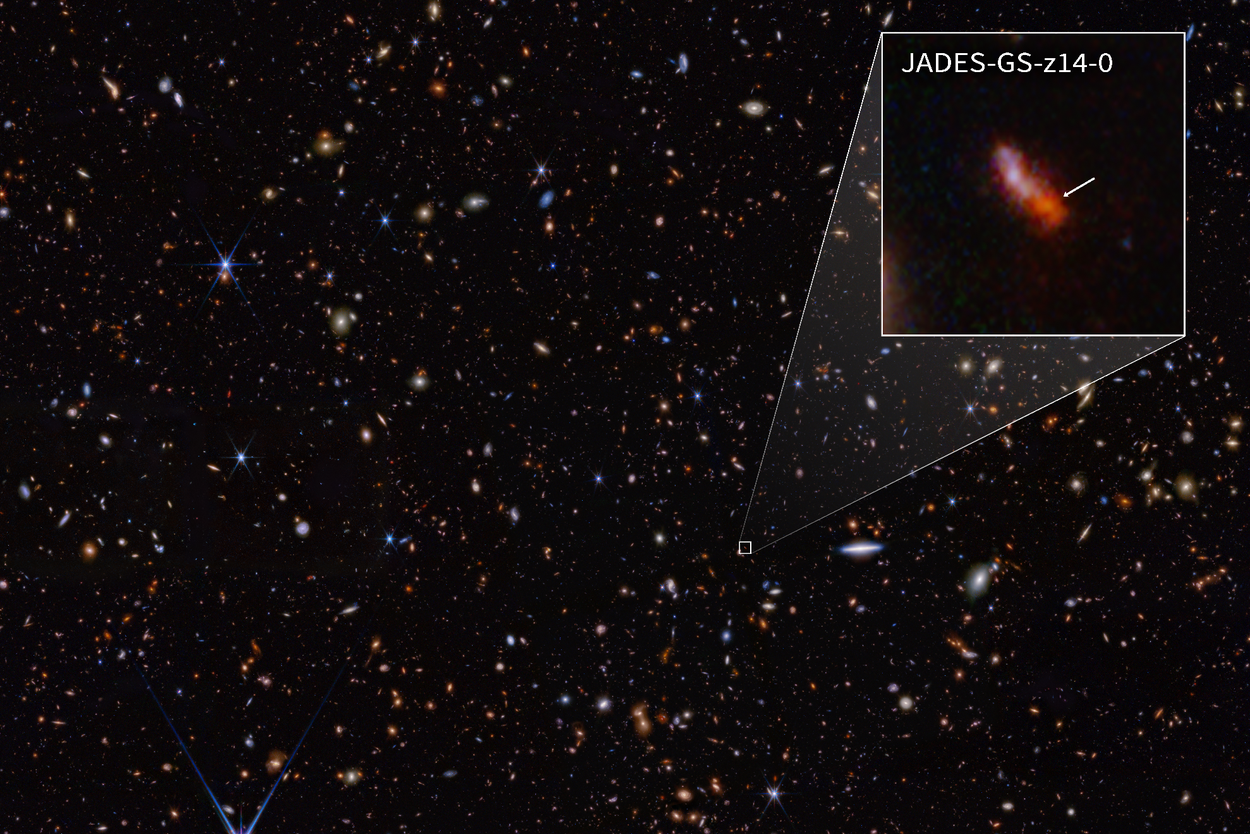
The two galaxies are the earliest ever seen in the universe, dating back to when the cosmos was just 300 million years old. The record-holding furthest galaxy is not only remarkable for its distance but also for how big and bright it is, experts said – a surprising result that could better help us understand how the universe began.

The galaxy, known as JADES-GS-z14-0, appears to be astonishingly bright and 1,600 light-years across. It is so bright that it is thought to be several hundreds of millions of times the mass of our Sun – and researchers are not clear how such a “bright, massive and large galaxy” could have been made in less than 300 million years.

“The size of the galaxy clearly proves that most of the light is being produced by large numbers of young stars,” said Daniel Eisenstein, a Harvard professor and chair of the astronomy department, “rather than material falling onto a supermassive black hole in the galaxy’s center, which would appear much smaller.”

It suggests that even in its infancy the universe was rapidly creating large, massive galaxies, scientists said. “It is stunning that the Universe can make such a galaxy in only 300 million years,” said Stefano Carniani of the Scuola Normale Superiore in Pisa, a lead author on the paper describing the findings.
https://www.independent.co.uk/space/nas ... 53967.html
“In the quantum multiverse, every choice, every decision you've ever and never made exists in an unimaginably vast ensemble of parallel universes.”
weatheriscool
Posts: 24486
Joined: Sun May 16, 2021 6:16 pm
Contact:

Re: James Webb Space Telescope (JWST)

Post by weatheriscool »

Scientists Use James Webb Space Telescope to Measure Universe Expansion Rate
This work could solve a vexing cosmology problem called the 'Hubble tension.'
By Ryan Whitwam August 16, 2024
NASA's James Webb Space Telescope has provided scientists with an unprecedented window on the universe, revealing the intricacies of black hole mergers, protoplanetary disks, and more. It may even help astronomers measure how fast the universe is expanding, which is easier said than done. A new study aims to use Webb data to measure the expansion rate more accurately than ever before. This work could solve the so-called "Hubble tension" problem once and for all by proving it doesn't exist.

We've known for almost a century that the universe is expanding, ever since astronomer Edwin Hubble noted that more distant objects appear to be moving away from us faster than more nearby ones. Since that day in 1929, scientists have struggled to determine the exact rate of expansion, sometimes called the Hubble constant. This value affects the total age of the universe, as well as the way it evolved over time. The numbers arrived at so far don't look dramatically different, but the astronomical implications when spread across billions of light-years are profound.
https://www.extremetech.com/science/sci ... -expansion
User avatar
Time_Traveller
Posts: 3025
Joined: Sun May 16, 2021 4:49 pm
Location: New York City, USA, November 5th 2032 C.E.

Re: James Webb Space Telescope (JWST)

Post by Time_Traveller »

James Webb Space Telescope finds 6 wandering 'rogue' planets that formed just like stars
published 30 minutes ago

Image

The James Webb Space Telescope (JWST) has identified half a dozen free-floating planets wandering alone in the Perseus Molecular Cloud.

The planets, ranging between five and 10 times the mass of Jupiter, don't orbit a star themselves. Instead, they are all thought to have formed like stars, condensing directly out of interstellar gas. In an added twist, one of the rogue planets is encircled by a disk of gas and dust that is forming moons or, perhaps, "mini-planets."

It's not the first time that JWST has discovered free-floating planets. In 2023, for instance, astronomers using the powerful observatory found about 40 binary pairs of free-floating gas giant planets in the Orion Nebula. But the six newly discovered objects, found in the reflection-nebula and open-star-cluster-combo called NGC 1333, about 960 light-years away from us, provide strong clues as to how they formed.

Although JWST has the sensitivity to detect rogue planets smaller than five times the mass of Jupiter, it didn't find any in NGC 1333. This fact sheds considerable light on how these free-floating planets formed. The planets of our solar system were born in a bottom-up process, accreting from raw materials in a protoplanetary disk of gas and dust encircling the sun, steadily growing larger and larger.

The other means of forming planets is top-down, which describes how, under gravity, they collapse directly from a cloud of gas and dust, just like a star does. The lack of free-floating planets in the range of about one to five times the mass of Jupiter strongly indicates that five Jupiter masses is the lower limit for the top-down formation process. Of course, there could be many rocky, Earth-sized worlds gone rogue after being ejected from their planetary systems, but these would likely be too small for JWST to detect.
https://www.space.com/james-webb-space- ... -formation
“In the quantum multiverse, every choice, every decision you've ever and never made exists in an unimaginably vast ensemble of parallel universes.”
User avatar
Time_Traveller
Posts: 3025
Joined: Sun May 16, 2021 4:49 pm
Location: New York City, USA, November 5th 2032 C.E.

Re: James Webb Space Telescope (JWST)

Post by Time_Traveller »

Three galactic 'red monsters' in the early Universe
November 13, 2024

An international team led by the University of Geneva (UNIGE) has identified three ultra-massive galaxies -- nearly as massive as the Milky Way -- already in place within the first billion years after the Big Bang. This surprising discovery was made possible by the James Webb Space Telescope's FRESCO program, which uses the NIRCam/grism spectrograph to measure accurate distances and stellar masses of galaxies. The results indicate that the formation of stars in the early Universe was far more efficient than previously thought, challenging existing galaxy formation models. The study is published in Nature.

In the theoretical model favored by scientists, galaxies form gradually within large halos of dark matter. Dark matter halos capture gas (atoms and molecules) into gravitationally bound structures. Typically, only at most ~20% of this gas is converted into stars in galaxies. However, new findings by an international team led by UNIGE with NASA's James Webb Space Telescope (JWST) challenges this view. They reveal that massive galaxies in the early Universe may have been much more efficient in building stars than their later counterparts, growing much more rapidly than previously thought.

Discovery of "Red Monsters"

JWST's unparalleled capabilities have allowed astronomers to systematically study galaxies in the very distant and early Universe, providing insights into massive and dust-obscured galaxies. By analyzing galaxies in the FRESCO survey, scientists found that most sources fit existing models. However, they also found three surprisingly massive galaxies, with stellar masses comparable to today's Milky Way. These are forming stars nearly twice as efficiently as their lower-mass counterparts and galaxies at later times. Due to their high dust content, which gives them a distinct red appearance in JWST images, they have been named the three "Red Monsters."

''Our findings are reshaping our understanding of galaxy formation in the early Universe,'' says Dr. Mengyuan Xiao, lead author of the new study and postdoctoral researcher in the Department of Astronomy at UNIGE Faculty of Science. ''The massive properties of these 'Red Monsters' were hardly determined before JWST, as they are optically invisible due to dust attenuation," says Dr. David Elbaz, director of research at CEA Paris-Saclay.

A Milestone in Galaxy Observations

The international team has developed a new program with the JWST to systematically analyze a complete sample of emission-line galaxies within the first billion years of cosmic history. This approach enabled the team to achieve precise distance estimates and reliable stellar mass measurements for the full galaxy sample.
https://www.sciencedaily.com/releases/2 ... 123127.htm
“In the quantum multiverse, every choice, every decision you've ever and never made exists in an unimaginably vast ensemble of parallel universes.”
weatheriscool
Posts: 24486
Joined: Sun May 16, 2021 6:16 pm
Contact:

Re: James Webb Space Telescope (JWST)

Post by weatheriscool »

Webb Captures the Sombrero Galaxy in a New Light
It's a stunning object even in the visible spectrum, with the wide, flat disk from which it gets its name.
By Ryan Whitwam November 27, 2024
Image
Since it came online in the summer of 2022, the James Webb Space Telescope has observed some of the most distant and ancient galaxies in the universe, as well as the planets in our own celestial backyard. Most of Webb's time is spent looking for the previously unknown, but sometimes astronomers turn it toward iconic objects like the Sombrero galaxy, also known as Messier 104. Webb can glean new details even from the most well-studied objects, but these images also serve to remind us how much progress has been made since the Hubble era.

The Sombrero galaxy, which is about the size of the Milky Way, is positioned some 30 million light-years away. The Webb telescope has several different instruments, but most of the widely shared images you've seen come from an infrared imager known as NIRCam. This new shot of the Sombrero galaxy is a bit different as it was captured using only MIRI (Mid-Infrared Instrument), which operates at longer wavelengths.
https://www.extremetech.com/science/web ... -new-light
Post Reply