WIYN 3.5-meter telescope at Kitt Peak Discovers Extremely Strange Orbit of Rare Hot Jupiter Exoplanet
July 17, 2024
Introduction:
(Eurekalert) At present there are over 5600 confirmed exoplanets in just over 4000 star systems. Within this population, about 300–500 exoplanets fall into the curious class known as hot Jupiters — large, Jupiter-like exoplanets that orbit very close to their star, some even as close as Mercury is to our Sun. How hot Jupiters end up in such close orbits is a mystery, but astronomers postulate that they begin in orbits far from their star and then migrate inward over time. The early stages of this process have rarely been observed, but with this new analysis of an exoplanet with an unusual orbit, astronomers are one step closer to unraveling the hot Jupiter mystery.
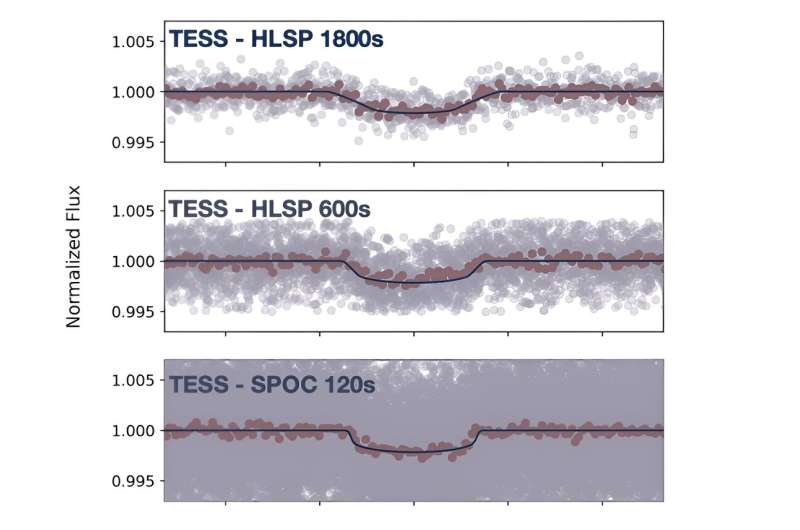
The discovery of this exoplanet, named TIC 241249530 b, originated with the detection by NASA’s Transiting Exoplanet Survey Satellite (TESS) in January 2020 of a dip in a star’s brightness consistent with a single Jupiter-sized planet passing in front of, or transiting, it. To confirm the nature of these fluctuations and eliminate other possible causes, a team of astronomers used two instruments on the WIYN 3.5-meter Telescope at the U.S. National Science Foundation Kitt Peak National Observatory (KPNO), a Program of NSF NOIRLab.
The team first utilized the NASA-funded NN-EXPLORE Exoplanet and Stellar Speckle Imager (NESSI) in a technique that helps to ‘freeze out’ atmospheric twinkling and eliminate any extraneous sources that might confuse the signal’s source. Then, using the NASA-funded NEID spectrograph, the team measured the radial velocity of TIC 241249530 b by carefully observing how its host star’s spectrum, or wavelengths of its emitted light, shifted as a result of the exoplanet orbiting it.
Arvind Gupta, NOIRLab postdoctoral researcher and lead author of the paper published in Nature, praised NESSI and NEID as being critical to the team’s efforts to characterize and confirm the exoplanet’s signal. “NESSI gave us a sharper view of the star than would have been possible otherwise, and NEID precisely measured the star’s spectrum to detect shifts in response to the orbiting exoplanet,” explained Gupta. Gupta particularly noted the unique flexibility of NEID’s observation-scheduling framework as it allows for swift adaptation of the team’s observing plan in response to new data.
Read more here:
https://www.eurekalert.org/news-releases/1051262
For a technical presentation of study results as published in
Nature:
https://www.nature.com/articles/s41586-024-07688-3
Don't mourn, organize.
-Joe Hill