I've been enjoying this series so far
https://www.quantamagazine.org/the-unra ... -20240925/
Physics News and Discussions

Re: Physics News and Discussions
I love this line:firestar464 wrote: ↑Sun Oct 06, 2024 9:19 pm I've been enjoying this series so far
https://www.quantamagazine.org/the-unra ... -20240925/
A belief has come to dominate theoretical physics that even nothingness ought to come from something — that space-time must break up into more primitive building blocks that don’t themselves inhabit space or time.
Don't mourn, organize.
-Joe Hill
-Joe Hill
Re: Physics News and Discussions
I would be a little careful with this one (see below) as it has not yet gone through peer review.
Light Experiment Shows Atoms “Seem to Spend A ‘Negative’ Amount of Time” In An Excited State
by Alfredo Carpineti
October 3, 2024
Introduction:
Light Experiment Shows Atoms “Seem to Spend A ‘Negative’ Amount of Time” In An Excited State
by Alfredo Carpineti
October 3, 2024
Introduction:
Read more here: https://www.iflscience.com/light-exper ... te-76204(IFL Science) Quantum mechanics just can’t keep from getting freaky. The latest thing is negative time, and how light going through a cloud of atoms might appear to come out before it goes in. Unfortunately, it is not a time machine – your best bet there is still a DeLorean – but a curious phenomenon with intriguing implications for optical applications.
Imagine that you are sending a pulse of light across a cloud of atoms. The atoms are at a temperature close to absolute zero, just tens of micro-degrees above it. Light passing through them would normally interact with them. The photons would be absorbed (creating an atomic excitation) and then reemitted. Overall, the light would gain a group delay.
What’s fun is that this group delay can theoretically be in the negative. The team used light whose frequency is close to the atomic resonance frequency of the atoms in the cloud – that means that excited atoms take a long time to release their photon. But in this experiment, the group delay can end up being negative: something weird is going on.
Obviously, the photons – particles of light – are not time traveling. The experimental setup is indicating the quantum weirdness of the interaction of a specific light with a specific set of atoms. The concept of "now" in quantum terms is a little less fixed, making this interaction seem impossible for our standard view of time as a linear progression from the past to the future. The atoms spend a negative time in an excited state; or simply, the photons do not accumulate any delay passing through – actually, they come out before they got in.
“It took a positive amount of time, but our experiment observing that photons can make atoms seem to spend a *negative* amount of time in the excited state is up!” senior author Aephraim Steinberg, from the University of Toronto, wrote on X.
Don't mourn, organize.
-Joe Hill
-Joe Hill

-
weatheriscool
- Posts: 26097
- Joined: Sun May 16, 2021 6:16 pm
- Contact:
Re: Physics News and Discussions
Researchers achieve world-record resolution in turbulence simulations
https://techxplore.com/news/2024-10-wor ... tions.html
by Tess Malone, Georgia Institute of Technology
https://techxplore.com/news/2024-10-wor ... tions.html
by Tess Malone, Georgia Institute of Technology
From the water that comes out of the faucet to the chemical reactions in jet engines that propel planes, turbulence affects our everyday lives. Researchers at Georgia Tech are studying the complex physics of turbulence in simplified settings that could help us better understand nature and engineering.
At its most basic, turbulence comprises disorderly fluctuations over a wide range of scales in both time and three-dimensional space. These complexities mean that many fundamental aspects are still not understood. Computers can help unravel the mystery, but direct numerical simulations based on exact physical laws have always been very resource-intensive. Their challenges are greatest when investigating rare, very large fluctuations.
Now, Frontier, the world's first—and still fastest—Exascale computer, capable of a quintillion operations per second, is helping researchers to better understand turbulence.
"Turbulence is very complex, theories are incomplete, and laboratory measurements are arduous," said P.K. Yeung, a professor in the Daniel Guggenheim School of Aerospace Engineering with a courtesy joint appointment in the George W. Woodruff School of Mechanical Engineering.
-
weatheriscool
- Posts: 26097
- Joined: Sun May 16, 2021 6:16 pm
- Contact:
-
weatheriscool
- Posts: 26097
- Joined: Sun May 16, 2021 6:16 pm
- Contact:
Re: Physics News and Discussions
First coherent picture of an atomic nucleus made of quarks and gluons
https://phys.org/news/2024-10-coherent- ... uarks.html
by Polish Academy of Sciences
https://phys.org/news/2024-10-coherent- ... uarks.html
by Polish Academy of Sciences
The atomic nucleus is made up of protons and neutrons, particles that exist through the interaction of quarks bonded by gluons. It would seem, therefore, that it should not be difficult to reproduce all the properties of atomic nuclei hitherto observed in nuclear experiments using only quarks and gluons. However, it is only now that an international team of physicists has succeeded in doing this.
It's been almost a century since the discovery of the main components of atomic nuclei: protons and neutrons. Initially, the new particles were considered indivisible. In the 1960s, however, there was a suggestion that, at sufficiently high energies, protons and neutrons would reveal their internal structure—the presence of quarks constantly held together by gluons.
-
Powers
- Posts: 1183
- Joined: Fri Apr 07, 2023 7:32 pm
- Location: a.k.a Lurking, Member, Lorem Ipsum, ..., --- and ººº.
Re: Physics News and Discussions
Brainlet question but there's a real photo or not?weatheriscool wrote: ↑Wed Oct 16, 2024 3:13 pm First coherent picture of an atomic nucleus made of quarks and gluons
https://phys.org/news/2024-10-coherent- ... uarks.html
by Polish Academy of SciencesThe atomic nucleus is made up of protons and neutrons, particles that exist through the interaction of quarks bonded by gluons. It would seem, therefore, that it should not be difficult to reproduce all the properties of atomic nuclei hitherto observed in nuclear experiments using only quarks and gluons. However, it is only now that an international team of physicists has succeeded in doing this.
It's been almost a century since the discovery of the main components of atomic nuclei: protons and neutrons. Initially, the new particles were considered indivisible. In the 1960s, however, there was a suggestion that, at sufficiently high energies, protons and neutrons would reveal their internal structure—the presence of quarks constantly held together by gluons.
-
weatheriscool
- Posts: 26097
- Joined: Sun May 16, 2021 6:16 pm
- Contact:
Re: Physics News and Discussions
Powers wrote: ↑Sat Oct 19, 2024 6:23 pmBrainlet question but there's a real photo or not?weatheriscool wrote: ↑Wed Oct 16, 2024 3:13 pm First coherent picture of an atomic nucleus made of quarks and gluons
https://phys.org/news/2024-10-coherent- ... uarks.html
by Polish Academy of SciencesThe atomic nucleus is made up of protons and neutrons, particles that exist through the interaction of quarks bonded by gluons. It would seem, therefore, that it should not be difficult to reproduce all the properties of atomic nuclei hitherto observed in nuclear experiments using only quarks and gluons. However, it is only now that an international team of physicists has succeeded in doing this.
It's been almost a century since the discovery of the main components of atomic nuclei: protons and neutrons. Initially, the new particles were considered indivisible. In the 1960s, however, there was a suggestion that, at sufficiently high energies, protons and neutrons would reveal their internal structure—the presence of quarks constantly held together by gluons.

-
firestar464
- Posts: 8408
- Joined: Wed Oct 12, 2022 7:45 am
Re: Physics News and Discussions
I think that might be an illustration though
-
weatheriscool
- Posts: 26097
- Joined: Sun May 16, 2021 6:16 pm
- Contact:
Re: Physics News and Discussions
Research team achieves first-ever acceleration of positive muons to 100 keV
https://phys.org/news/2024-10-team-posi ... s-kev.html
by Bob Yirka , Phys.org
https://phys.org/news/2024-10-team-posi ... s-kev.html
by Bob Yirka , Phys.org
A team of engineers and physicists affiliated with a host of institutions across Japan, working at the Japan Proton Accelerator Research Complex, has demonstrated acceleration of positive muons from thermal energy to 100 keV—the first time muons have been accelerated in a stable way. The group has published a paper describing their work on the arXiv preprint server.
Muons are sub-atomic particles similar to electrons. The main difference is their mass; a muon is 200 times heavier than an electron. They are also much shorter lived. Physicists have for many years wanted to build a muon collider to conduct new types of physics research, such as experiments that go beyond the standard model.
Unfortunately, such efforts have been held back by the extremely short muon lifespan—approximately 2 microseconds—after which they decay to electrons and neutrinos. Making things even more difficult is their tendency to zip around haphazardly, which makes forming them into a single beam extremely challenging. In this new effort, the research team has overcome such obstacles using a new technique.
-
weatheriscool
- Posts: 26097
- Joined: Sun May 16, 2021 6:16 pm
- Contact:
Re: Physics News and Discussions
Scientists provide direct evidence of breakdown of spin statistics in ion-atom charge exchange collisions
https://phys.org/news/2024-10-scientist ... s-ion.html
by Liu Jia, Chinese Academy of Sciences
https://phys.org/news/2024-10-scientist ... s-ion.html
by Liu Jia, Chinese Academy of Sciences
Since the first X-ray image of a comet was reported using an X-ray telescope in 1996, the investigation of charge exchange in collisions between highly charged ions and atoms or molecules has emerged as a hot research topic.
Astrophysicists require more atomic data to model observed X-ray spectra. Traditionally, the charge exchange is assumed to follow statistical rules regarding the total spin quantum number. These assumptions of pure spin statistics are of fundamental importance across various fields.
However, a new study published in Physical Review Letters on October 22 has challenged the assumptions by providing direct evidence of the breakdown of spin statistics in ion-atom charge exchange collisions. This study was led by scientists from the Institute of Modern Physics (IMP) of the Chinese Academy of Sciences (CAS).
The experiment was performed at the low-energy setups of the Heavy Ion Research Facility in Lanzhou, employing the high-resolution reaction microscope, which is characterized by high precision, sensitivity and detection efficiency. The neutral helium was used as a target in collisions with C3+ ions in the experiment.
-
Time_Traveller

- Posts: 3025
- Joined: Sun May 16, 2021 4:49 pm
- Location: New York City, USA, November 5th 2032 C.E.
Re: Physics News and Discussions
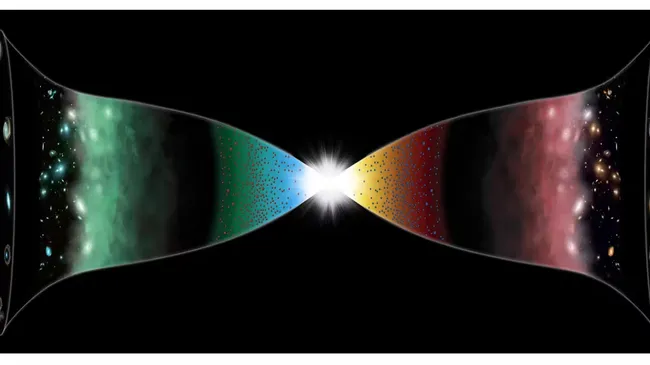
'Cosmic inflation:' did the early cosmos balloon in size? A mirror universe going backwards in time may be a simpler explanation
https://www.space.com/the-universe/cosm ... xplanationpublished 8 hours ago
We live in a golden age for learning about the universe. Our most powerful telescopes have revealed that the cosmos is surprisingly simple on the largest visible scales. Likewise, our most powerful “microscope”, the Large Hadron Collider, has found no deviations from known physics on the tiniest scales.
These findings were not what most theorists expected. Today, the dominant theoretical approach combines string theory, a powerful mathematical framework with no successful physical predictions as yet, and “cosmic inflation” – the idea that, at a very early stage, the universe ballooned wildly in size. In combination, string theory and inflation predict the cosmos to be incredibly complex on tiny scales and completely chaotic on very large scales.
The nature of the expected complexity could take a bewildering variety of forms. On this basis, and despite the absence of observational evidence, many theorists promote the idea of a “multiverse”: an uncontrolled and unpredictable cosmos consisting of many universes, each with totally different physical properties and laws.
So far, the observations indicate exactly the opposite. What should we make of the discrepancy? One possibility is that the apparent simplicity of the universe is merely an accident of the limited range of scales we can probe today, and that when observations and experiments reach small enough or large enough scales, the asserted complexity will be revealed.
The other possibility is that the universe really is very simple and predictable on both the largest and smallest scales. I believe this possibility should be taken far more seriously. For, if it is true, we may be closer than we imagined to understanding the universe’s most basic puzzles. And some of the answers may already be staring us in the face.
“In the quantum multiverse, every choice, every decision you've ever and never made exists in an unimaginably vast ensemble of parallel universes.”
-
weatheriscool
- Posts: 26097
- Joined: Sun May 16, 2021 6:16 pm
- Contact:
Re: Physics News and Discussions
Scientists decipher two-photon vision
https://phys.org/news/2024-11-scientist ... ision.html
by Polish Academy of Sciences
https://phys.org/news/2024-11-scientist ... ision.html
by Polish Academy of Sciences
Two-photon vision is a novel method with great potential for the future of ophthalmic diagnostics. Although it has many advantages, it requires improvement in key areas. International Centre for Eye Research (ICTER) scientists have taken a step forward by improving this technology and opening up new perspectives in ocular medicine.
Imagine that instead of viewing an image through a lens, you look through a kaleidoscope that focuses invisible light to obtain a new range of colors. The photon, the ephemeral messenger of light, usually appears alone, but here it appears in a duet, which is the basis of two-photon vision. This is an extraordinary phenomenon in which the human eye, instead of perceiving traditional light, receives pulses of infrared lasers, the gateway to the invisible world.
-
weatheriscool
- Posts: 26097
- Joined: Sun May 16, 2021 6:16 pm
- Contact:
Re: Physics News and Discussions
New theory reveals the shape of a single photon
https://phys.org/news/2024-11-theory-re ... hoton.html
by University of Birmingham
https://phys.org/news/2024-11-theory-re ... hoton.html
by University of Birmingham
At the same time, they were able to use their calculations to produce a visualization of the photon itself.A new theory that explains how light and matter interact at the quantum level has enabled researchers to define for the first time the precise shape of a single photon.
Research at the University of Birmingham, published in Physical Review Letters, explores the nature of photons (individual particles of light) in unprecedented detail to show how they are emitted by atoms or molecules and shaped by their environment.
The nature of this interaction leads to infinite possibilities for light to exist and propagate, or travel, through its surrounding environment. This limitless possibility, however, makes the interactions exceptionally hard to model, and is a challenge that quantum physicists have been working to address for several decades.
By grouping these possibilities into distinct sets, the Birmingham team were able to produce a model that describes not only the interactions between the photon and the emitter, but also how the energy from that interaction travels into the distant "far field."
Re: Physics News and Discussions
weatheriscool wrote: ↑Wed Nov 20, 2024 1:02 am New theory reveals the shape of a single photon
https://phys.org/news/2024-11-theory-re ... hoton.html
by University of BirminghamAt the same time, they were able to use their calculations to produce a visualization of the photon itself.A new theory that explains how light and matter interact at the quantum level has enabled researchers to define for the first time the precise shape of a single photon.
Research at the University of Birmingham, published in Physical Review Letters, explores the nature of photons (individual particles of light) in unprecedented detail to show how they are emitted by atoms or molecules and shaped by their environment.
The nature of this interaction leads to infinite possibilities for light to exist and propagate, or travel, through its surrounding environment. This limitless possibility, however, makes the interactions exceptionally hard to model, and is a challenge that quantum physicists have been working to address for several decades.
By grouping these possibilities into distinct sets, the Birmingham team were able to produce a model that describes not only the interactions between the photon and the emitter, but also how the energy from that interaction travels into the distant "far field."

Credit: Dr. Benjamin Yuen
-
Time_Traveller
- Posts: 3025
- Joined: Sun May 16, 2021 4:49 pm
- Location: New York City, USA, November 5th 2032 C.E.
Re: Physics News and Discussions
Somewhere in the multiverse, dark energy is helping stars and life form
https://www.space.com/the-universe/some ... -life-formpublished 4 hours ago
Somewhere in the multiverse, there could be universes more predisposed to forming stars, and possibly life, than our own universe —- and a new study has shown that it's all thanks to the most unlikely of suspects: dark energy.
A team of scientists has explored how the strength of dark energy directly affects how easily stars form, and it turns out that the strength of dark energy in our universe doesn't lead to the most efficient star factories. In fact, the researchers say that if you select a random observer from anywhere in the multiverse, chances are they'd come from a universe where the strength of dark energy is much greater than it is in our universe.
"That was quite surprising to me!" Daniele Sorini of Durham University, who led the study, told Space.com.
Dark energy is the mysterious force that is accelerating the expansion of the cosmos. The most popular model for dark energy suggests it is the cosmological constant, which describes the intrinsic energy of empty space that is powering the acceleration of the expanding universe. We say that it is "constant" because we think the strength of dark energy has remained the same throughout history.
Suppose, though, that dark energy had a different strength, making the universe's expansion accelerate either faster or slower. Sorini, along with John Peacock of the University of Edinburgh and Lucas Lombriser of the University of Geneva, have modeled how changing dark energy in this way would affect star formation, and because stars are essential for life, how it would affect the habitability of the universe.
“In the quantum multiverse, every choice, every decision you've ever and never made exists in an unimaginably vast ensemble of parallel universes.”
-
Time_Traveller
- Posts: 3025
- Joined: Sun May 16, 2021 4:49 pm
- Location: New York City, USA, November 5th 2032 C.E.
Re: Physics News and Discussions
'Mind-blowing' dark energy instrument results show Einstein was right about gravity — again
https://www.space.com/desi-einstein-gravity-dark-energypublished 20 hours ago
General relativity has passed one of its most precise tests ever thanks to observations of the past 11 billion years of cosmic evolution collected by the Dark Energy Spectroscopic Instrument, or DESI.
Albert Einstein's 1915 theory, general relativity, has remained humanity's best description of gravity for the past 100 years. Cosmologists have used general relativity to model how the cosmos has evolved — from its earliest moments to its current state — and shown how gravity brought together tiny clumps of matter to form vast galaxies as well as clusters of those galaxies. Yet, while general relativity has passed every test applied to it on relatively small scales, few tests have challenged it on very large scales.
Scientists have now performed one such large-scale test by using DESI. They observed almost 6 million galaxies and quasars, which are bright hearts of galaxies powered by feeding supermassive black holes. Perhaps unsurprisingly, this test, which has traced the evolution of the universe since it was around 3 billion years old, has once again shown general relativity to be the right "recipe" for gravity.
"General relativity has been very well tested at the scale of solar systems, but we also needed to test that our assumption works at much larger scales," study co-leader and the French National Center for Scientific Research (CNRS) cosmologist Pauline Zarrouk said in a statement. "Studying the rate at which galaxies formed lets us directly test our theories and, so far, we're lining up with what general relativity predicts at cosmological scales."
“In the quantum multiverse, every choice, every decision you've ever and never made exists in an unimaginably vast ensemble of parallel universes.”
-
firestar464
- Posts: 8408
- Joined: Wed Oct 12, 2022 7:45 am
Re: Physics News and Discussions
I suppose this universe is therefore not necessarily fine-tuned, as there are more optimal conditions.Time_Traveller wrote: ↑Wed Nov 20, 2024 8:38 pm Somewhere in the multiverse, dark energy is helping stars and life form
https://www.space.com/the-universe/some ... -life-formpublished 4 hours ago
Somewhere in the multiverse, there could be universes more predisposed to forming stars, and possibly life, than our own universe —- and a new study has shown that it's all thanks to the most unlikely of suspects: dark energy.
A team of scientists has explored how the strength of dark energy directly affects how easily stars form, and it turns out that the strength of dark energy in our universe doesn't lead to the most efficient star factories. In fact, the researchers say that if you select a random observer from anywhere in the multiverse, chances are they'd come from a universe where the strength of dark energy is much greater than it is in our universe.
"That was quite surprising to me!" Daniele Sorini of Durham University, who led the study, told Space.com.
Dark energy is the mysterious force that is accelerating the expansion of the cosmos. The most popular model for dark energy suggests it is the cosmological constant, which describes the intrinsic energy of empty space that is powering the acceleration of the expanding universe. We say that it is "constant" because we think the strength of dark energy has remained the same throughout history.
Suppose, though, that dark energy had a different strength, making the universe's expansion accelerate either faster or slower. Sorini, along with John Peacock of the University of Edinburgh and Lucas Lombriser of the University of Geneva, have modeled how changing dark energy in this way would affect star formation, and because stars are essential for life, how it would affect the habitability of the universe.