Christopher Columbus was … Jewish? by Mark Wingfield
October 14, 2024
Introduction:
(Baptist News Global) Although Christopher Columbus is remembered as much today for unleashing destruction on native peoples as for discovering new lands, one thing about him has remained a mystery: What is his own lineage?
Now, Spanish scientists believe he was born into a Sephardic Jewish family from Western Europe and converted to Catholicism to avoid religious persecution.
On this Columbus Day, news of the explorer’s lineage has made news with the BBC, Reuters and Fox News, among others.
Born in 1450 or 1451, Columbus hailed from Genoa, Italy, according to the conventional story. But scholars and tour guides alike have questioned that story since the 19th century. Now, new DNA research tells a different story.
José Antonio Lorente, professor of forensic medicine at Granada University, and the historian Marcial Castro led the 22-year investigation that tested tiny samples of remains buried in Seville Cathedral, said to be the final burial place of Columbus.
Many people assume that before the days of factory farming, livestock lived in peace and happiness — with pristine, spacious surroundings, fresh grass to consume and kind treatment from good-natured family farmers, at least until the moment of slaughter. Sadly, the reality of how farm animals lived in the pre-industrial and early industrial age was often far removed from this image. Consider the plight of the unfortunate creatures that provided our ancestors with beef and milk.
I'm warning beforehand that descriptions in the article are displeasing, nasty and gruesome. Bad old past. At least it's over now?
caltrek wrote: ↑Mon Oct 14, 2024 5:45 pm
Warning: reading the information provided below may result in you becoming woke.
The thing is that it was not only white Christian people from Europe. All prehistory and history was horrible beyond my wildest imaginings (and I feel terrible because of this fact). It used to be like that almost everywhere almost all the time. The Aztecs were just as bad as the invaders and they would had done the same given a chance. Europeans were certainly more civilised by the 2nd half of the 19th century than black Africans for example. It was not just one group which was very nasty. Most people were. And those who were not were taken advantage of. All because of the underlying cruelty of life on Earth.
It's kinda like we are born into some kind of a horror show for someone's entertainment (which fortunately seems to slowly be going towards a relatively happy ending).
In any human settlement of the past you would find lots of cruelty, injustice, extreme poverty, suffering, illness, stench, hideousness, unsightliness and offensiveness.
However, after you average things out, in the 11th century the situation was better than in the 6th century, in the 15th century better than in the 11th century, in the 18th century better than in the 15th century, in the 19th century better than in the 18th century, in the 20th century better than in the 19th century and in the 21st century better than in the 20th century. Unfortunately for us, there is no single group of people who are responsible for all the evils of the past that we can blame. Most people were bad. Some groups are described in more details than other groups. People have very skewed knowledge about the past. Actually, hardly anyone knows much about the past.
caltrek wrote: ↑Mon Oct 14, 2024 5:45 pm
Warning: reading the information provided below may result in you becoming woke.
The thing is that it was not only white Christian people from Europe. All prehistory and history was horrible beyond my wildest imaginings (and I feel terrible because of this fact). It used to be like that almost everywhere almost all the time. The Aztecs were just as bad as the invaders and they would had done the same given a chance. Europeans were certainly more civilised by the 2nd half of the 19th century than black Africans for example. It was not just one group which was very nasty. Most people were. And those who were not were taken advantage of. All because of the underlying cruelty of life on Earth.
It's kinda like we are born into some kind of a horror show for someone's entertainment (which fortunately seems to slowly be going towards a relatively happy ending).
It's not as if the Aztecs were the only pre-colonization civilization. Also not every civilization was expansionist/evangelist in the same way. For example, the Chinese were uninterested in converting foreign peoples to Confucianism during the Treasure Voyages, which meant that they had less of an incentive to colonize faraway lands.
Europeans were certainly more civilised by the 2nd half of the 19th century than black Africans for example.
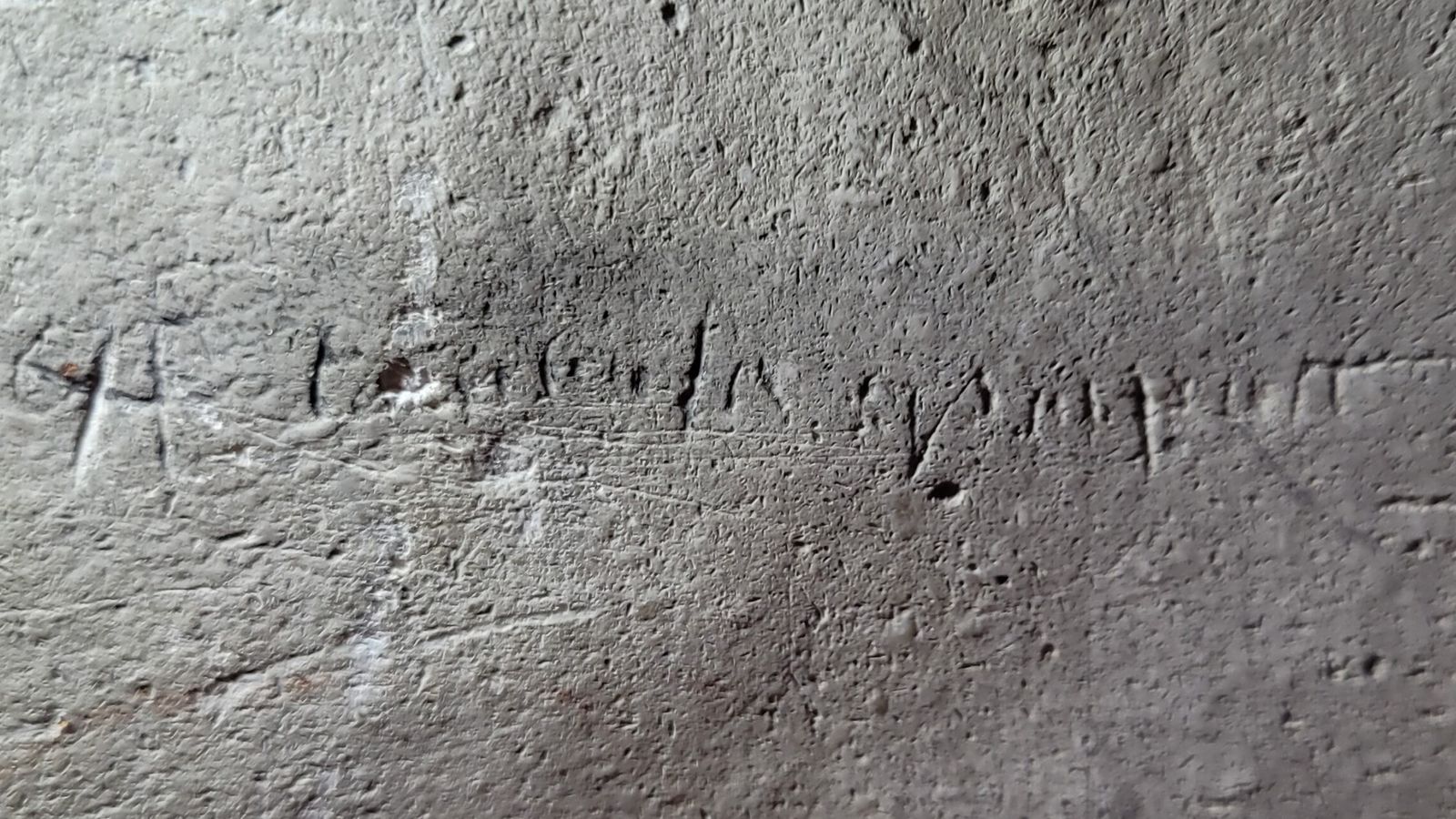
'Astonishing' witches' marks discovered at heritage site - including curses
Tuesday 29 October 2024 14:36, UK
A "staggering array" of witches' marks have been found at Gainsborough Old Hall, including "curse" inscriptions aimed at its old owner.
A volunteer for English Heritage, which looks after the Lincolnshire site, has discovered and mapped about 20 carvings at the Tudor property over the past two years - among the most found at any of the charity's 400 sites.
The witches' marks, also known as carved ritual protection or apotropaic marks, include rare curse inscriptions, which the charity said must have been made around the time that merchant William Hickman owned the property, from 1596.
In one inscription, Hickman's name is written upside down. The practice of defacing a name was widely believed to curse the named person and is something not seen before at an English Heritage site, the charity revealed.
Ricky Berry, the English Heritage volunteer who made the discoveries, also found simple circles that were believed to trap demons.
Thanksgiving and the Whitewashing of History by Lawrence Ware
November 28, 2024
Introduction:
(Counterpunch) It’s Thanksgiving once again. That day, every year, when we are all gluttonous to celebrate the fact that ‘Pilgrims and Indians’ had a harmonious meal — at least that is how it has been framed historically.
Let’s be honest. Every year on the last Thursday of November, we celebrate the beginning of a European invasion that ends with the death, land dispossession, and relocation of millions of native people. While many (Christians) have tried to redefine the meaning of Thanksgiving into a time wherein we cultivate a sense of gratitude, the undeniable truth is that the blood of natives stain the genesis of the holiday.
The colonial origins of Thanksgiving (or what many natives often refer to as Thankskilling or Thankstaking) is not something to celebrate. While we cannot pinpoint the original “Thanksgiving” celebration, President Abraham Lincoln made it a national holiday in 1863. The now ubiquitous “Pilgrims and Indians” weren’t included in the tradition until 1890. The national mythos surrounding this holiday does not take into consideration the long and violent history of contact between European settlers (in this case English pilgrims – puritans) and the Indigenous populations that already inhabited the land (the Wampanoag people.) It is in these forgotten histories that we see the history of this holiday for what it truly is: English pilgrims, unprepared to survive on the land, stranded on Turtle Island. Yet, those who did survive those early winters would ultimately engage in a brutal campaign of colonialism and genocidal activity.
It is important that we think clearly and honestly about how the beatified pilgrims saw the natives. Five-time Plymouth County Governor William Bradford said the natives were “savage people, who are cruel, barbarous, and most treacherous.” Clearly not the people you would like to feast with; however, the national narrative surrounding this holiday celebrates the first Thanksgiving as a moment of harmonious bridge building.
Oldest Firearms Ever Found in U.S. Were Abandoned by Spanish in 16th-century Battle Against Native Americans by Owen Jarus
December 15, 2024
Introduction:
(Live Science)Two 16th-century cannons unearthed in Arizona may be the oldest firearms ever found in the United States, new research finds.
Archaeologists found the cannons while excavating a site called San Geronimo III (also known as Suya), a small town established by the Spanish more than 480 years ago. Both firearms, or weapons that use gunpowder to discharge a shot, arrived at the site during a Spanish expedition led by Francisco Vázquez de Coronado.
During the expedition, Coronado and his party traveled up from what is now Mexico into the modern-day U.S. states of Arizona, New Mexico, Texas and Kansas from 1539 to 1542. By this time, Spanish conquistadors had conquered much of Mesoamerica and Peru, destroying the Aztec and Inca civilizations.
The expedition hoped to find riches, a faster route to East Asia and, eventually, planned to enslave the local population, the researchers wrote in a study published Nov. 21 in the International Journal of Historical Archaeology. The expedition set up San Geronimo III in 1541, but the group encountered Native American resistance, which led to a battle at the town that resulted in the Spanish fleeing, abandoning both of the cannons at the site.
One of the cannons, discovered by archaeologists in 2020 and described in the journal article, was in excellent shape and does not appear to have been fired during the battle. There was no gunpowder residue that indicates that it was fired, said study co-author Deni Seymour, an independent scholar who leads research at the site. "It looks like the battle in that area unfolded so quickly that [the cannon operators] could not access, load, and fire the cannon," Seymour told Live Science in an email.
Treasure Found: Spanish Shipwreck With 22 Tons of Gold Uncovered Near Portugal January 24, 2025
Introduction:
(MSN) A groundbreaking discovery has been made off the coast of Portugal, where a Spanish shipwreck loaded with an astonishing 22 tons of gold has been uncovered.
The wreck, identified as the Nossa Senhora do Rosário, a famed Spanish galleon, has captivated the world with its historical significance and immense wealth.
This treasure find is not just about gold—it’s a window into the past, revealing stories of exploration, colonial riches, and maritime prowess.
Marine archaeologist Alexandre Monteiro, a renowned expert in Portuguese and Spanish maritime history, led the team that discovered the Nossa Senhora do Rosário. Monteiro, known for his groundbreaking work on submerged heritage sites, has called this one of the most significant underwater finds of the century.
Additional Extract:
The shipwreck’s contents are extraordinary, with experts estimating the gold alone to be worth billions in today’s currency. The cargo includes:
Gold coins minted in colonial Spanish territories like Peru and Mexico.
Jewelry and religious artifacts, likely intended for nobility and the Catholic Church.
Gold ingots stamped with the marks of 17th-century Spanish mints.
"Land Of The White Jaguar": 327-Year-Old Letter Leads Researchers to Lost Ancient Maya City By James Felton
August 14, 2025
Introduction:
(IFL Science) Researchers in Mexico have uncovered the lost ancient Maya city of Sak-Bahlán, locating it using information outlined in a letter written in 1698 CE.
After the Maya people known as Lakandon-Ch'ol were forced out of their capital, Lakam Tun ("Great Rock") in 1586, they moved further into the jungle, creating the city of Sak-Bahlán, or the "land of the white jaguar". There, they managed to live free from Spanish colonist interference for a century.
But in 1695, the Lakandon-Ch'ol's luck ran out, as Friar Pedro de la Concepción discovered the city. Soon afterwards, the city was taken by the Spanish and renamed to a much less attractive Nuestra Señora de los Dolores (or "Our Lady of Sorrows"). Soon after that, by 1721, the city was abandoned, and lost to the jungle. Ever since then, nobody had been able to locate it.
But now, according to Mexico’s National Institute of Anthropology and History (INAH), it appears that the city's remains have been identified. Using information about the city's location from the time, including instructions on how to get there from Friar Diego de Rivas, a team of archaeologists were able to piece together the journey that they took and replicate it.
"I took information from the chronicle of Friar De Rivas, from 1698; for example, it tells how, that year, he and a troop of soldiers left Nuestra Señora de los Dolores (formerly Sak-Bahlán) and walked four days to the Lacantún River. They sailed for two days and arrived at El Encuentro de Cristo, where the tributary joins the Pasión River, and left their canoes and then walked to Lake Petén Itzá, in Guatemala," Lozada Toledo, a researcher from INAH, explained in a translated INAH statement.
Escaped Slaves on St. Croix Hid Their Settlements So Well, They Still Haven’t Been Found – Archaeologists Using New Mapping Technology are on the Hunt By Justin Dunnavant
August 28, 2025
Introduction:
(The Conversation) For a long time now, a large number of [escaped slaves] have established themselves on lofty Maroon Hill in the mountains toward the west end of the island [of St. Croix]. … They are there protected by the impenetrable bush and by their own wariness.”
Those are the words of Christian Oldendorp, a Danish missionary who visited the Caribbean island of St. Croix in 1767. His account is one of the few Danish historical records of Maronberg, a community of escaped slaves, known as Maroons, in the northwest mountain ranges of the island.
In 1733, the Danish West India-Guinea Company purchased St. Croix from France and quickly expanded the island’s sugar and cotton production. This also meant expanding the slave population to harvest lucrative plantations. But the Danes were never able to fully control the island – or the enslaved. By the end of the 1700s, nearly 1,400 people – more than 10% of the enslaved population – successfully escaped captivity. But where did they escape to? Only recently have researchers started to shed more light on this centuries-old mystery.
As an archaeologist specializing in slavery and resistance, I’ve excavated plantations in the Americas and used geographic information systems to model Maroon escape routes by sea. Recently, I turned my attention to Maroon settlements on land, working with a team of archaeologists to locate Maronberg.
Honoring a legacy
I first learned about Maronberg on a nature tour of St. Croix given by local activist and University of the Virgin Islands professor Olasee Davis in 2016. At that time, I was on the island to excavate a sugar plantation, a project that gave my colleagues and me a unique perspective on the enslaved experience in the Danish-controlled Caribbean.
Published 250 Years Ago Today, Thomas Paine’s Common Sense Must Inspire Us Again By Harvey J. Kaye and Alan Minsky
January 10, 2026
Introduction:
(Common Dreams) Common Sense by Thomas Paine is the most influential work of political literature in American history.
Self-published on January 10, 1776, Common Sense instantly became a sensation, spreading like wildfire across the colonies. Within a few weeks, it had sold more copies than any book in the history of the colonies.
Paine’s arguments persuaded thousands-upon-thousands of people throughout the 13 colonies to demand more than reform, to support complete independence from England and join the revolutionary cause.
Less than six months after Common Sense was first published in Philadelphia, the Declaration of Independence was signed in the same city, establishing a new country defined, in contrast to its European predecessors, by its commitment to equality, liberty and the consent of the governed—just as Paine advocated in Common Sense (and, unlike the founding fathers, Paine did not hesitate to advocate for democracy).
Thomas Paine arrived in Philadelphia from England in late 1774. Paine quickly fell in love with America and its people. Struck by the country’s startling contradictions, magnificent possibilities, and wonderful energies, and moved by the spirit and determination of its people to resist British authority, he committed himself to the American cause. In the Spring of 1775, he called for the abolition of slavery, a position he saw as consistent with—and central to—the rebellion.
Muslims Were Part of America’s Story Long Before the Republic Began By Iqbal Akhtar
June 30, 2026
Introduction:
(The Conversation) In the 1520s and 1530s, a man named Esteban de Dorantes, known as Estevanico, walked across the deserts of what is now Texas, New Mexico and Arizona – decades before the English founded Jamestown in 1607 and a full century before the Pilgrims reached Plymouth in 1620.
Born in Azemmour, on the Atlantic coast of Morocco, he had been enslaved and taken to Spain and then across the ocean. In an ill-fated journey in which most people perished, Estevanico survived. He learned various Native American languages and became one of the first people from the Old World to cross the southern interior of the future United States.
By the evidence of his birth in Morocco and the biographical information we have, he was a Muslim. His presence puts a question to the familiar account of Muslims in America as outsiders, particularly after 9/11.
As a scholar of religion, I focus my research on identity and belonging, in places ranging from East Africa and the Western Indian Ocean to Islamic communities in the U.S. South. In my 2026 book on the history and future of American Islam, and a companion volume on the future of religious pluralism in the U.S., I argue that Muslims who were present at the nation’s founding helped shape its music, its laws and its civil society.
Quran recitation and American music
The largest number of Muslims came in as enslaved labor. Among them were Muslims from the Senegambian and Sahelian belt of West Africa, a region shaped by centuries of Islamic learning. By some estimates they numbered in the tens of thousands, and many were literate in Arabic and schooled in the Quran and in Islamic law before they were ever captured.