I am sure the Martians will appreciate Musk's efforts.
Oh wait...
I am sure the Martians will appreciate Musk's efforts.
https://www.linkedin.com/signup/cold-jo ... 5743077378In a feat that can only be described as legendary, and after many months and a catastrophic setback, Polaris Spaceplanes has finally accomplished something that's never been done before: lit the fuse of an aerospike rocket in flight.
On October 29, 2024, over the Baltic Sea, Polaris Spaceplanes conducted a test flight of its MIRA II aircraft. The rocket-equipped plane followed a predetermined flight path on autopilot, powered by its four kerosene jet turbines, before successfully igniting its AS-1 LOX (liquid oxygen)/kerosene linear aerospike rocket engine for three seconds in flight, marking the very first ever test of an aerospike rocket in flight.
This is the first of more test flights to come. Polaris reported an acceleration of 4 m/s² and 900 newtons of thrust from the 16.4 ft (5 m), 505 lb (229 kg) airframe.

https://www.space.com/space-exploration ... g-chickenspublished 4 hours ago
The commander of SpaceX's Crew-8 astronaut mission says that NASA continues to prioritize safety while co-managing an aging space station.
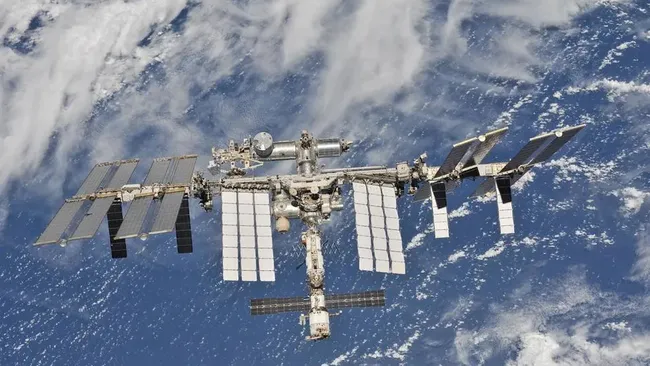
The International Space Station (ISS) and the spacesuit that spacewalking NASA astronauts wear, known as the extravehicular mobility unit (EMU), are both decades old. And it's the age of this hardware that has led to issues with both recently, NASA astronaut and Crew-8 commander Matthew Dominick told reporters on Friday (Nov. 8).
"None of our spacesuits are spring chickens, as we would say, and so we will expect to see some hardware issues with repeated use," Dominick said at a press conference about Crew-8 livestreamed from NASA's Johnson Space Center in Houston. The four Crew-8 astronauts returned to Earth on Oct. 25.
The ISS, parts of which date to 1998, is experiencing a leak on its Russian side that was pegged as the top "safety risk" in a NASA audit published on Sept. 26. NASA and Russian partner Roscosmos have a plan to continue safely managing the leak, U.S. officials have emphasized.
Meanwhile, Crew-8 canceled a planned spacewalk June 24 after coolant briefly erupted from an umbilical connecting NASA astronaut Tracy Dyson's spacesuit to the ISS. No one was in any danger, NASA officials emphasized, and the affected part has been fixed for future spacewalks that will take place in 2025.
https://www.nextbigfuture.com/2024/11/l ... e-faa.htmlRep. Kiley has introduced legislation to make the Office of Commercial Space Transportation report directly to the Secretary of Transportation. This comes after Rep. Kiley questioned Federal Aviation Administration (FAA) Administrator Michael Whitaker before the Aviation Subcommittee with respect to the FAA’s decisions with SpaceX launches in September.
The bill streamlines the oversight process by moving the Office of Commercial Space Transportation (AST) out from under the FAA and requiring AST to report directly to the Secretary of Transportation. This eliminates the middleman in the reporting process and enables AST to keep pace with a rapidly growing industry.
https://www.extremetech.com/science/web ... mic-theory
We have known for almost a century that the universe is expanding, but it's been surprisingly hard to nail down the rate of expansion. The availability of the James Webb Space Telescope is finally giving astronomers the tools they need to measure this aspect of space more accurately. A new study led by Nobel laureate Adam Reiss at Johns Hopkins University offers the most accurate assessment yet, employing both Webb and Hubble to show that the so-called Hubble Tension may be real. If that's true, the missing piece of the puzzle could be profound indeed.
For decades after astronomers came to terms with the expansion of the universe, they were able to point to calculations based on the standard model of cosmology to tell us how fast it was expanding. Running the numbers, scientists found the universe should expand at a rate of 67-68 kilometers per second per megaparsec. Things got hairy for astronomers in the 1990s when we finally had instruments sophisticated enough to measure the expansion of the universe. These instruments, like the Hubble Space Telescope, reported a value of around 73 km/s/Mpc. The difference between these numbers is known as the Hubble Tension.
https://www.extremetech.com/aerospace/n ... arth-orbitNASA is planning for the future. With the International Space Station (ISS) slated to be deorbited in 2030, the agency has spent the last year formulating a framework to support operations in low Earth orbit (LEO). The strategy has now been finalized, stressing the importance of a "continuous heartbeat" of human presence in orbit of Earth. Whereas previous efforts have relied on NASA itself, the next step will lean on commercial interests to keep space accessible.
Work on the strategy began in early 2024. In the intervening months, the agency solicited feedback from NASA employees, government partners, industry, academia, international space agencies, and the public. In all, there were more than 1,800 comments and two group workshops. The result is a set of 13 goals and 44 individual objectives across key areas, including commercial infrastructure, operations, science, research and development for exploration, international cooperation, workforce development, technology, engineering, STEM engagement, and public engagement.
It's happeningcaltrek wrote: ↑Wed Jan 03, 2024 9:54 pm NASA Is On a Mission to 'Touch the Sun' In Milestone Moment for Space Exploration
by Nathann Rennolds
December 31 , 2023
Introduction:Read more here: https://www.businessinsider.com/nasa-o ... -2023-12(Business Insider) NASA's Parker Solar Probe is set to pass the Sun next year in a milestone moment for space exploration.
The probe, launched on Aug 12, 2018, is due to fly past the sun at 195 km/s, or 435,000 mph on 24 December 2024, the BBC reported.
NASA describes it as a mission to ""touch the Sun" on its website, aiming to get our "first-ever sampling of a star's atmosphere."
"We are basically almost landing on a star," Nour Raouafi, a scientist on the project, told the BBC.
"This will be a monumental achievement for all humanity. This is equivalent to the Moon landing of 1969," he said.
e.
https://phys.org/news/2024-12-nasa-prob ... t-sun.html
NASA's pioneering Parker Solar Probe made history Tuesday, flying closer to the sun than any other spacecraft with its heat shield exposed to scorching temperatures of more than 1,700 degrees Fahrenheit (930 degrees Celsius).
Launched in August 2018, the spaceship is on a seven-year mission to deepen scientific understanding of our star and help forecast space-weather events that can affect life on Earth.
Tuesday's historic fly-by should have occurred at precisely 6:53am (1153 GMT), although mission scientists will have to wait until Friday for confirmation as they lose contact with the craft for several days due to its proximity to the sun.
If the distance between Earth and the sun is the equivalent to the length of an American football field, the spacecraft should have been about four yards (meters) from the end zone at the moment of closest approach—known as perihelion.
"This is one example of NASA's bold missions, doing something that no one else has ever done before to answer longstanding questions about our universe," Arik Posner, Parker Solar Probe program scientist said in a statement on Monday.
"We can't wait to receive that first status update from the spacecraft and start receiving the science data in the coming weeks."
Here is an update:weatheriscool wrote: ↑Tue Dec 24, 2024 7:52 pm NASA probe makes closest ever pass by the Sune.
https://phys.org/news/2024-12-nasa-prob ... t-sun.html
NASA's pioneering Parker Solar Probe made history Tuesday, flying closer to the sun than any other spacecraft with its heat shield exposed to scorching temperatures of more than 1,700 degrees Fahrenheit (930 degrees Celsius).
Launched in August 2018, the spaceship is on a seven-year mission to deepen scientific understanding of our star and help forecast space-weather events that can affect life on Earth.
Tuesday's historic fly-by should have occurred at precisely 6:53am (1153 GMT), although mission scientists will have to wait until Friday for confirmation as they lose contact with the craft for several days due to its proximity to the sun.
If the distance between Earth and the sun is the equivalent to the length of an American football field, the spacecraft should have been about four yards (meters) from the end zone at the moment of closest approach—known as perihelion.
"This is one example of NASA's bold missions, doing something that no one else has ever done before to answer longstanding questions about our universe," Arik Posner, Parker Solar Probe program scientist said in a statement on Monday.
"We can't wait to receive that first status update from the spacecraft and start receiving the science data in the coming weeks."
Source: https://www.iflscience.com/parker-solar ... sun-77399NASA wasn’t expecting to hear from it (the Parker Solar Probe) until December 27, but has now confirmed it received a transmitted beacon signal back to Earth just before midnight EST on December 26, indicating the probe is “in good health and operating normally.”
India launched a rocket Monday carrying two small spacecraft to test docking in space, a critical step for the country's dreams of a space station and a manned Moon mission.
The mission is "vital for India's future space ambitions", Jitendra Singh, the country's science and technology minister, said in a statement ahead of the launch, which was broadcast live by the Indian Space Research Organisation (ISRO).
Prime Minister Narendra Modi announced plans last year to send a man to the Moon by 2040.
The PSLV-C60 rocket, which blasted off Monday evening at the Sriharikota launch site with shooting flames as it soared into the night sky, included two 220-kilogramme (485-pound) satellites.
ISRO has dubbed the mission SpaDeX, or Space Docking Experiment.
Read more here: https://www.iflscience.com/power-compa ... es-77576(IFL Science) The Atacama Desert in Chile is home to some of the most pristine dark skies on the planet. Among the astronomical sites, Cerro Paranal has the darkest and clearest skies – it is no accident that some of the most advanced observatories are located there. Now, all of them are being threatened by a new industrial project located just a handful of kilometers away.
AES Andes – a subsidiary of the US energy conglomerate AES Corporation – is planning to build hydrogen and ammonia production plants, an industrial port, and thousands of generators over an area of 3,000 hectares. That’s about one-third of the area of Manhattan.
The project’s environmental impact assessment was submitted by AES Chile on Christmas Eve, but the company has yet to make an investment decision. The possible locations of the megaproject are between 5 and 11 kilometers (3 and 7 miles) from the observatory, incredibly close to the European Southern Observatory sites and their pristine skies.
“The proximity of the AES Andes industrial megaproject to Paranal poses a critical risk to the most pristine night skies on the planet,” ESO Director General, Xavier Barcons said in a statement. “Dust emissions during construction, increased atmospheric turbulence, and especially light pollution will irreparably impact the capabilities for astronomical observation, which have thus far attracted multi-billion-Euro investments by the governments of the ESO Member States.”
Atmospheric stability – thanks to a region with limited air pollution, plus the lack of any nearby sources of light pollution – makes the region ideal for astronomy. The Very Large Telescope and several other telescopes are at Paranal, and the Extremely Large Telescope is being built not too far away.