https://www.theguardian.com/science/202 ... ole-fossilWed 30 Oct 2024 16.59 GMT
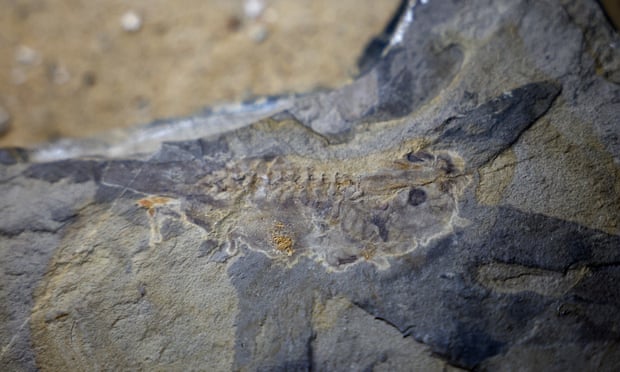
Scientists have discovered the oldest-known fossil of a giant tadpole that wriggled around over 160m years ago.
The new fossil, found in Argentina, surpasses the previous ancient record holder by about 20m years.
Imprinted in a slab of sandstone are parts of the tadpole’s skull and backbone, along with impressions of its eyes and nerves.
“It’s not only the oldest tadpole known, but also the most exquisitely preserved,” said study author Mariana Chuliver, a biologist at Buenos Aires’s Maimonides University.
Researchers know frogs were hopping around as far back as 217m years ago. But exactly how and when they evolved to begin as tadpoles remains unclear.
Natural History (13.8 billion years BC – 3.3 million BC)
-
Time_Traveller

- Posts: 3025
- Joined: Sun May 16, 2021 4:49 pm
- Location: New York City, USA, November 5th 2032 C.E.
Re: Natural History (13.8 billion years BC – 3.3 million BC)
Scientists discover oldest ever giant tadpole fossil in Argentina
“In the quantum multiverse, every choice, every decision you've ever and never made exists in an unimaginably vast ensemble of parallel universes.”
-
Powers

- Posts: 1183
- Joined: Fri Apr 07, 2023 7:32 pm
- Location: a.k.a Lurking, Member, Lorem Ipsum, ..., --- and ººº.
Re: Natural History (13.8 billion years BC – 3.3 million BC)
I cannot unsee the bunny/mammal face.
-
weatheriscool
- Posts: 26094
- Joined: Sun May 16, 2021 6:16 pm
- Contact:
Re: Natural History (13.8 billion years BC – 3.3 million BC)
Himalayas formation may have destroyed at least 30% of continental crust in collision zone
https://phys.org/news/2024-11-himalayas ... crust.html
by Hannah Bird , Phys.org
https://phys.org/news/2024-11-himalayas ... crust.html
by Hannah Bird , Phys.org
Earth's continents are slowly moving across the planet's surface due to plate tectonics, culminating in regions of crustal expansion and collision. In the latter case, high temperatures and pressures lead to the reworking of the crust, affecting its composition, as well as that of the underlying mantle. Furthermore, when two continental plates collide, distinct topographic features are produced, namely mountain ranges, which are surficial manifests of Earth's thickened crust.
Three such collision zones form the Himalaya-Tibetan Plateau, the European Alps and the Zagros Mountains in Iran, Iraq and Turkey, originating during the Cenozoic (last 66 million years). New research, published in Earth and Planetary Science Letters, has attempted to quantify the amount of continental crust lost to the mantle when two plates collide at each of these boundaries.



-
weatheriscool
- Posts: 26094
- Joined: Sun May 16, 2021 6:16 pm
- Contact:

Re: Natural History (13.8 billion years BC – 3.3 million BC)
According to New Analysis of the Oldest North American Fossils Dinosaurs Roamed the Northern Hemisphere Millions of Years Earlier than Previously Thought
January 7, 2025
Introduction:
January 7, 2025
Introduction:
Read more here: https://www.eurekalert.org/news-releases/1069755(Eurekalert) MADISON — How and when did dinosaurs first emerge and spread across the planet more than 200 million years ago? That question has for decades been a source of debate among paleontologists faced with fragmented fossil records. The mainstream view has held that the reptiles emerged on the southern portion of the ancient supercontinent Pangea called Gondwana millions of years before spreading to the northern half named Laurasia.
But now, a newly described dinosaur whose fossils were uncovered by University of Wisconsin–Madison paleontologists is challenging that narrative, with evidence that the reptiles were present in the northern hemisphere millions of years earlier than previously known.
The UW–Madison team has been analyzing the fossil remains since they were first discovered in 2013 in present-day Wyoming, an area that was near the equator on Laurasia. The creature, named Ahvaytum bahndooiveche, is now the oldest known Laurasian dinosaur, and with fossils estimated to be around 230 million years old, it's comparable in age to the earliest known Gondwanan dinosaurs.
Don't mourn, organize.
-Joe Hill
-Joe Hill
Re: Natural History (13.8 billion years BC – 3.3 million BC)
DNA Adds New Chapter to Indonesia’s Layered Human History
January 7, 2025
Introduction:
January 7, 2025
Introduction:
Read more here: https://www.eurekalert.org/news-releases/1069775(Eurekalert) A new study from the University of Adelaide and The Australian National University (ANU) has outlined the first genomic evidence of early migration from New Guinea into the Wallacea, an archipelago containing Timor-Leste and hundreds of inhabited eastern Indonesian islands.
The study, published in PNAS, addresses major gaps in the human genetic history of the Wallacean Archipelago and West Papuan regions of Indonesia – a region with abundant genetic and linguistic diversity that is comparable to the Eurasian continent – including the analysis of 254 newly sequenced genomes.
In combination with linguistic and archaeological evidence, the study shows that Wallacean societies were transformed by the spread of genes and languages from West Papua in the past 3,500 years – the same period that Austronesian seafarers were actively mixing with Wallacean and Papuan groups.
“My colleagues at the Indonesian Genome Diversity Project have been studying Indonesia’s complex genetic structure for more than a decade, but this comprehensive study provides confirmation that Papuan ancestry is widespread across Wallacea, pointing to historical migrations from New Guinea,” says lead author Dr Gludhug Ariyo Purnomo, from the University of Adelaide’s School of Biological Sciences.
“By connecting the dots between genetics, linguistics, and archaeology, we now recognise West Papua as an important bio-cultural hub and the launching place of historical Papuan seafarers that now contribute up to 60% of modern Wallacean ancestry.”
Don't mourn, organize.
-Joe Hill
-Joe Hill
-
weatheriscool
- Posts: 26094
- Joined: Sun May 16, 2021 6:16 pm
- Contact:
Re: Natural History (13.8 billion years BC – 3.3 million BC)
New Australian dinosaurs and the oldest megaraptorid fossils in the world
https://phys.org/news/2025-02-australia ... ssils.html
by Museum Victoria
https://phys.org/news/2025-02-australia ... ssils.html
by Museum Victoria
Research published today in the Journal of Vertebrate Paleontology has unveiled a landmark discovery—fossils of the world's oldest known megaraptorid and the first evidence of carcharodontosaurs in Australia. These finds rewrite the evolutionary history of theropod dinosaurs, uncovering a predator hierarchy unique to Cretaceous Australia.
The research, led by Museums Victoria Research Institute and Monash University Ph.D. student Jake Kotevski, describes five theropod fossils discovered along Victoria's coastline. The fossils were unearthed in the upper Strzelecki Group (Bunurong/Boonwurrung Country, Bass Coast, ~121.4–118 million years ago) and the Eumeralla Formation (Eastern Marr Country, Otway Coast, ~113–108 million years ago).
-
firestar464
- Posts: 8408
- Joined: Wed Oct 12, 2022 7:45 am
Re: Natural History (13.8 billion years BC – 3.3 million BC)
Update:weatheriscool wrote: ↑Sun Jul 18, 2021 5:05 pm Megaripples may be evidence of giant tsunami resulting from Chicxulub impact
https://phys.org/news/2021-07-megarippl ... lting.html
by Bob Yirka , Phys.orgA pair of geophysicists from the University of Louisiana at Lafayette working with two independent researchers has found what they believe might be evidence of a massive tsunami created by the Chicxulub asteroid impact. In their paper published in the journal Earth and Planetary Science Letters, the group describes their study of seismic data for a site in Louisiana and what they found.
Most scientists agree that approximately 66 million years ago, a large asteroid struck the Earth near what is now the Yucatan peninsula. It is also believed that the impact was so violent that it covered the globe with dust for several years, leading to the demise of the dinosaurs. Some in the field have suggested that the collision also resulted in the creation of a massive tsunami. In this new effort, the researchers reasoned that this tsunami would have made its way across what is now the Gulf of Mexico to the shores of North America. They suggest such a massive collision would have created a wave up to a mile high as it made its way onshore. If so, they further reasoned, there should be evidence of unique geographical formations—the kind that are known to be created by modern tsunamis.
To search for evidence of possible formations, the researchers studied the terrain at a place where the tsunami would have struck and then chose what they believed to be a good place to look more closely: inland Louisiana. To find the evidence they were looking for, the team obtained seismic data from a petroleum firm that allowed them to look at soil at depths up to 1,500 meters below the surface. They found evidence of what they describe as megaripples—huge fossilized ripples that would have been created by a massive influx of water, which then receded. The researchers then studied the ripples to learn more about the direction of the flow of water that had created them, and found they pointed straight to the Chicxulub asteroid impact site. The researchers suggest their find adds yet another piece to the emerging picture of the Chicxulub asteroid impact event.
https://www.livescience.com/planet-eart ... iana-in-3d
Re: Natural History (13.8 billion years BC – 3.3 million BC)
Ten Exceptional Ancient Elephants, From Small Swimming Creatures to Shovel-Tusked Beasts
April 3, 2025
A wide variety of the exotic animals evolved on Earth over the past 60 million years
https://www.smithsonianmag.com/science- ... 180986270/

DiBgd via Wikipedia under CC By-SA 4.0
April 3, 2025
A wide variety of the exotic animals evolved on Earth over the past 60 million years
https://www.smithsonianmag.com/science- ... 180986270/
DiBgd via Wikipedia under CC By-SA 4.0
-
firestar464
- Posts: 8408
- Joined: Wed Oct 12, 2022 7:45 am
Re: Natural History (13.8 billion years BC – 3.3 million BC)
New evidence moves early giant crocodile further from modern alligator on family tree
https://phys.org/news/2025-04-evidence- ... odern.html
https://phys.org/news/2025-04-evidence- ... odern.html
-
weatheriscool
- Posts: 26094
- Joined: Sun May 16, 2021 6:16 pm
- Contact:
Re: Natural History (13.8 billion years BC – 3.3 million BC)
Giant croc-like carnivore fossils found in the Caribbean
https://phys.org/news/2025-04-giant-cro ... bbean.html
by Florida Museum of Natural History
https://phys.org/news/2025-04-giant-cro ... bbean.html
by Florida Museum of Natural History
Imagine a crocodile built like a greyhound—that's a sebecid. Standing tall, with some species reaching 20 feet in length, they dominated South American landscapes after the extinction of dinosaurs until about 11 million years ago. Or at least, that's what paleontologists thought, until they began finding strange, fossilized teeth in the Caribbean.
"The first question that we had when these teeth were found in the Dominican Republic and on other islands in the Caribbean was: What are they?" said Jonathan Bloch, curator of vertebrate paleontology at the Florida Museum of Natural History.
This initial confusion was warranted. Three decades ago, researchers uncovered two roughly 18 million-year-old teeth in Cuba. With a tapered shape and small, sharp serrations specialized for tearing into meat, it unmistakably belonged to a predator at the top of the food chain. But for the longest time, scientists didn't think such large, land-based predators ever existed in the Caribbean.

Re: Natural History (13.8 billion years BC – 3.3 million BC)
A Meteorite Struck Scotland More Recently Than We Thought
by Chris Kirkland
April 30, 2025
Introduction:
by Chris Kirkland
April 30, 2025
Introduction:
Read more here: https://www.sciencealert.com/a-meteori ... -thought(Science Alert) We've discovered that a meteorite struck northwest Scotland 1 billion years ago, 200 million years later than previously thought. Our results are published today in the journal Geology.
This impact now aligns with some of Earth's earliest known, land based, non-marine microbial fossils, and offers new insights into how meteorite strikes may have shaped our planet's environment and life.
A rocky treasure trove
The Torridonian rocks of northwest Scotland are treasured by geologists as some of the finest archives of the ancient lakes and river systems that existed a billion years ago.
Those water bodies were home to microbial ecosystems consisting of eukaryotes. Eukaryotes are single-celled organisms with complex internal structures that are the ancestors of all plants and animals.
But the Torridonian environments and their associated microbial communities were dramatically disrupted when a meteor slammed into the planet.
Don't mourn, organize.
-Joe Hill
-Joe Hill
-
weatheriscool
- Posts: 26094
- Joined: Sun May 16, 2021 6:16 pm
- Contact:
-
weatheriscool
- Posts: 26094
- Joined: Sun May 16, 2021 6:16 pm
- Contact:
Re: Natural History (13.8 billion years BC – 3.3 million BC)
Paleontologists discover 506-million-year-old predator

by Royal Ontario Museum
by Royal Ontario Museum
https://phys.org/news/2025-05-paleontol ... dator.html
Paleontologists at the Manitoba Museum and Royal Ontario Museum (ROM) have discovered a remarkable new 506-million-year-old predator from the Burgess Shale of Canada. The results are announced in a paper in the journal Royal Society Open Science.
Mosura fentoni was about the size of an index finger and had three eyes, spiny jointed claws, a circular mouth lined with teeth and a body with swimming flaps along its sides. These traits show it to be part of an extinct group known as the radiodonts, which also included the famous Anomalocaris canadensis, a meter-long predator that shared the waters with Mosura.
However, Mosura also possessed a feature not seen in any other radiodont: an abdomen-like body region made up of multiple segments at its back end.
"Mosura has 16 tightly packed segments lined with gills at the rear end of its body. This is a neat example of evolutionary convergence with modern groups, like horseshoe crabs, woodlice, and insects, which share a batch of segments bearing respiratory organs at the rear of the body," says Joe Moysiuk, Curator of Paleontology and Geology at the Manitoba Museum, who led the study.