
Neuromorphic Computing news and discussions

Post Reply
User avatar
wjfox
Site Admin
Posts: 13578
Joined: Sat May 15, 2021 6:09 pm
Location: Essex, UK
Contact:

Neuromorphic Computing news and discussions

Post by wjfox »

An oft-overlooked, but increasingly important field that combines:

– AI
– Computing
– Energy efficiency
– Exponential progress!

Reposting the below in full, since I wrote it myself. :)


-----


https://www.futuretimeline.net/blog/202 ... mputer.htm

Neuromorphic supercomputer aims for human brain scale

16th December 2023

Western Sydney University is developing a neuromorphic supercomputer. The machine will mimic biological processes to emulate large networks of spiking neurons at 228 trillion synaptic operations per second – potentially rivalling the human brain.


Image
Credit: Western Sydney University


Neuromorphic computing is a highly promising approach to artificial intelligence (AI). By processing information more efficiently, it seeks to bridge the gap between traditional computer architectures and the far more complex neural networks found in living, biological brains.

American scientist Carver Mead popularised the term Moore's Law, but he is also known for pioneering the field of neuromorphic engineering. He and colleagues at the California Institute of Technology designed the first known examples of neuromorphic chips in the 1980s. During that time, Mead also developed the first silicon retinas and silicon cochleas, able to emulate the processing of visual and auditory information. His work paved the way to more advanced chips in the 1990s and beyond, featuring orders of magnitude improvements in capability.

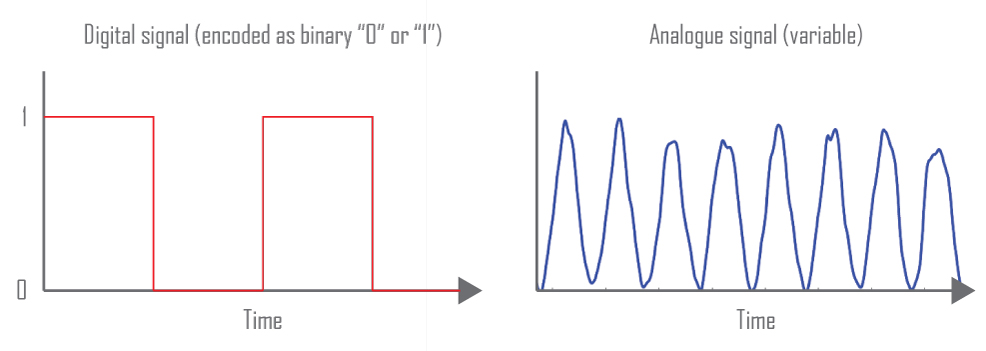
Essentially, neuromorphic chips work by mimicking the layout and physical actions of biological neural networks. Traditional computers are limited to the sending and receiving of binary data (0s and 1s) through a centralised processing unit (CPU). By contrast, neuromorphic computers are much more dynamic – able to work with information in a parallel, decentralised manner – and combining both analogue and digital circuits. This means they can handle data of varying states and time ranges. The so-called Spiking Neural Networks generated by these systems are able to model complex spatio-temporal patterns, providing an additional dimension to the data, beyond mere binary states.

Image


Because their architecture is so similar to neurons and synapses, neuromorphic computers are extremely well-suited for tasks such as pattern recognition, decision making, and sensory data processing. They can learn and adapt in real-time, rearranging their synaptic connections based on new input patterns.

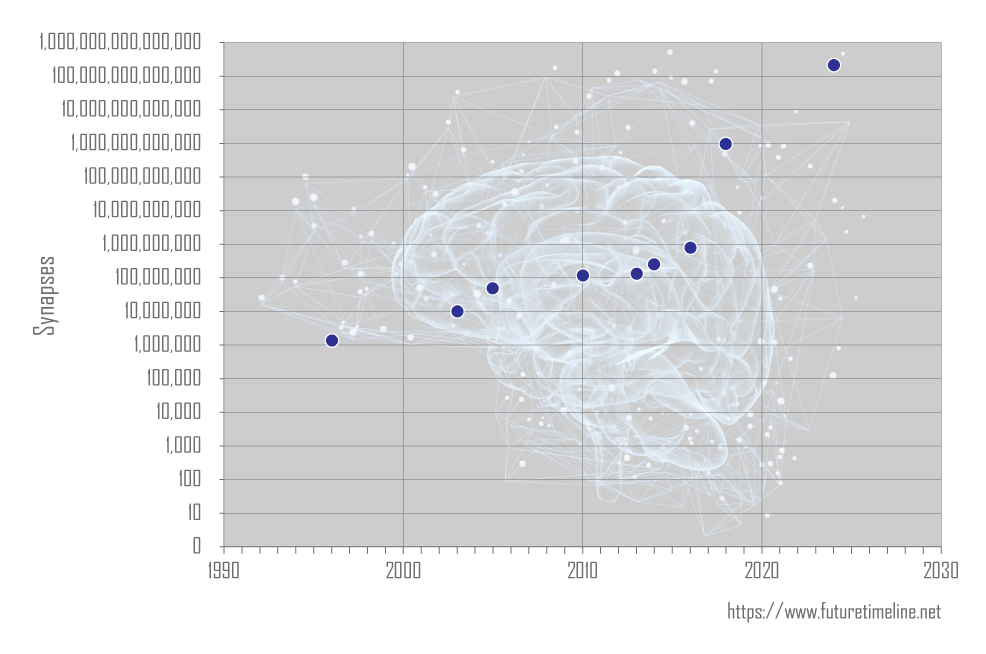
In recent years, the number of synapses available in these systems has crept rapidly upwards, matching animal species such as the common mouse (125 billion) and rat (500 billion). A major advance occurred in 2018, as UK researchers developed SpiNNaker, which could replicate the equivalent of 1% of the human brain.

As is often the case with exponential technologies (the graph below uses a logarithmic scale for its y-axis), another orders-of-magnitude jump in capability has now been reported. This week, engineers at the Western Sydney University, Australia, revealed plans for a neuromorphic supercomputer called DeepSouth that will feature an almost unimaginable 228 trillion synaptic operations per second. In other words, it could be the first system of its kind to match the number of synapses in the human brain.

Image


"Progress in our understanding of how brains compute using neurons is hampered by our inability to simulate brain-like networks at scale," said Professor of Electrical Engineering, André van Schaik, in a news release from Western Sydney University. "Simulating spiking neural networks on standard computers using Graphics Processing Units (GPUs) and multicore Central Processing Units (CPUs) is just too slow and power intensive. Our system will change that.

"This platform will progress our understanding of the brain and develop brain-scale computing applications in diverse fields including sensing, biomedical, robotics, space, and large-scale AI applications."

Energy efficiency will be a key focus of the DeepSouth project, according to its creators. Although matching the human brain's miniscule power consumption of just 20 watts – barely enough for a typical lightbulb – won't be possible anytime soon, the team at Western hopes to demonstrate a significant improvement compared to previous efforts. It will also be much smaller than other supercomputers. They plan to make it operational by April 2024.

However, there is ongoing debate among scientists over the actual number of synapses in the human brain, so the university's claim of a "brain-scale" machine is somewhat unclear. Current estimates range from 100 trillion to 1 quadrillion, illustrating the vast complexity and variability of neural connections. Rather like attempting to count the number of stars in a galaxy, or the galaxies in our universe, these figures can be subject to revision as new imaging technologies and research methodologies emerge.

Regardless of the precise number, DeepSouth's capabilities will arguably fall within the ballpark of "brain scale", the first time a neuromorphic computer has been able to mimic such biological complexity. Whether achieved by DeepSouth, or a competing system in the next few years, this milestone roughly aligns with our timeline prediction for 2025.
User avatar
wjfox
Site Admin
Posts: 13578
Joined: Sat May 15, 2021 6:09 pm
Location: Essex, UK
Contact:

Re: Neuromorphic Computing news and discussions

Post by wjfox »

User avatar
wjfox
Site Admin
Posts: 13578
Joined: Sat May 15, 2021 6:09 pm
Location: Essex, UK
Contact:

Re: Neuromorphic Computing news and discussions

Post by wjfox »

I wonder how long it will be before 1 exaFLOP of computing power can be achieved with 20 watts or less.

At that point, human-like androids would be pretty much indistinguishable from real people.

I will try to extrapolate a future trend for this...


weatheriscool
Posts: 24486
Joined: Sun May 16, 2021 6:16 pm
Contact:

Re: Neuromorphic Computing news and discussions

Post by weatheriscool »

Ultra-small neuromorphic chip learns and corrects errors autonomously
https://techxplore.com/news/2025-01-ult ... rrors.html
by The Korea Advanced Institute of Science and Technology (KAIST)
Existing computer systems have separate data processing and storage devices, making them inefficient for processing complex data like AI. A KAIST research team has developed a memristor-based integrated system similar to the way our brain processes information. It is now ready for application in various devices, including smart security cameras, allowing them to recognize suspicious activity immediately without having to rely on remote cloud servers, and medical devices with which it can help analyze health data in real time.

The joint research team of Professor Shinhyun Choi and Professor Young-Gyu Yoon of the School of Electrical Engineering has developed the next-generation neuromorphic semiconductor-based ultra-small computing chip that can learn and correct errors on its own. The research is published in the journal Nature Electronics.Image
What is special about this computing chip is that it can learn and correct errors that occur due to non-ideal characteristics that were difficult to solve in existing neuromorphic devices. For example, when processing a video stream, the chip learns to automatically separate a moving object from the background, and it becomes better at this task over time.
Tadasuke

Re: Neuromorphic Computing news and discussions

Post by Tadasuke »

wjfox wrote: Thu Aug 29, 2024 9:39 am I wonder how long it will be before 1 exaFLOP of computing power can be achieved with 20 watts or less.

At that point, human-like androids would be pretty much indistinguishable from real people.

I will try to extrapolate a future trend for this...
I think that no human really knows the computing speed of the brain in flops. This is all just speculation. My "gut feeling" tells me it's nowhere near 1 exaflop. It's much lower probably. People are generally so dumb that it has to be lower.
Vakanai
Posts: 534
Joined: Thu Apr 28, 2022 10:23 pm

Re: Neuromorphic Computing news and discussions

Post by Vakanai »

Tadasuke wrote: Sat Jan 18, 2025 2:41 pm
wjfox wrote: Thu Aug 29, 2024 9:39 am I wonder how long it will be before 1 exaFLOP of computing power can be achieved with 20 watts or less.

At that point, human-like androids would be pretty much indistinguishable from real people.

I will try to extrapolate a future trend for this...
I think that no human really knows the computing speed of the brain in flops. This is all just speculation. My "gut feeling" tells me it's nowhere near 1 exaflop. It's much lower probably. People are generally so dumb that it has to be lower.
The compute power of the brain doesn't necessarily have to do with higher intelligence - it's doubtful that Einstein's brain has more flops than your average Fox "News" viewer. It's more how our brains are used, the personalities and wills behind it, that determines if someone is going to act rational and think, or act a fool because it's easy...
Tadasuke

Re: Neuromorphic Computing news and discussions

Post by Tadasuke »

maybe

Kurzweil for example estimated brain processing in ops at 2*10¹⁶ in his 1999 book, at 10¹⁶ in his 2005 book and at 10¹⁴ in his 2017 talk. His estimations seem more probable to me. There is 10⁴ gap in ops between 10¹⁴ and 10¹⁸. It could take 20 years to close that gap. 10¹⁴ is how much you can already have at home and 10¹⁸ is definitely not achievable at home today (but is achievable in a large supercomputer).
Vakanai
Posts: 534
Joined: Thu Apr 28, 2022 10:23 pm

Re: Neuromorphic Computing news and discussions

Post by Vakanai »

Tadasuke wrote: Mon Jan 20, 2025 1:30 pm maybe

Kurzweil for example estimated brain processing in ops at 2*10¹⁶ in his 1999 book, at 10¹⁶ in his 2005 book and at 10¹⁴ in his 2017 talk. His estimations seem more probable to me. There is 10⁴ gap in ops between 10¹⁴ and 10¹⁸. It could take 20 years to close that gap. 10¹⁴ is how much you can already have at home and 10¹⁸ is definitely not achievable at home today (but is achievable in a large supercomputer).
I was more addressing your assumption that humans must not have much compute power because you personally feel most of the species is stupid...
weatheriscool
Posts: 24486
Joined: Sun May 16, 2021 6:16 pm
Contact:

Re: Neuromorphic Computing news and discussions

Post by weatheriscool »


User avatar
wjfox
Site Admin
Posts: 13578
Joined: Sat May 15, 2021 6:09 pm
Location: Essex, UK
Contact:

Re: Neuromorphic Computing news and discussions

Post by wjfox »

Scientists Built an Artificial Tongue That Tastes and Learns Like the Real Thing

August 12, 2025, 2:40pm

Scientists have built something nature perfected millions of years ago—a tongue that can taste and remember flavors. The world’s first artificial tongue works entirely in liquid, processing information the way your own taste buds and brain do.

The breakthrough, from the National Center for Nanoscience and Technology in China and published in PNAS, uses graphene oxide membranes—ultra-thin carbon sheets with microscopic channels that slow the movement of ions. That slowdown is critical, extending the tongue’s “memory” of a flavor from milliseconds to about 140 seconds. Like tasting a sip of wine versus rolling it around on your tongue.

In lab tests, the tongue identified sweet, sour, salty, and bitter flavors with 72.5% to 87.5% accuracy. For complex drinks like coffee or Coca-Cola, it reached 96%, thanks to the richer chemical patterns those liquids carry. “Our devices can work in liquid and can sense their environment and process information—just like our nervous system does,” said Professor Yong Yan, co-author of the study, to Live Science.

Most electronic tasting systems rely on an external computer to process the data. This one handles its sensing and much of its processing inside the liquid itself, edging closer to neuromorphic computing—technology that mimics the brain’s ability to learn and adapt while immersed in its environment.

https://www.vice.com/en/article/scienti ... eal-thing/
firestar464
Posts: 7202
Joined: Wed Oct 12, 2022 7:45 am

Re: Neuromorphic Computing news and discussions

Post by firestar464 »

Artificial neuron can mimic different parts of the brain—a major step toward human-like robotics

https://techxplore.com/news/2025-11-art ... major.html
Post Reply