Biology & Medicine News and Discussions

firestar464
Posts: 7202
Joined: Wed Oct 12, 2022 7:45 am

Re: Biology & Medicine News and Discussions

Post by firestar464 »

firestar464
Posts: 7202
Joined: Wed Oct 12, 2022 7:45 am

Re: Biology & Medicine News and Discussions

Post by firestar464 »

weatheriscool
Posts: 24486
Joined: Sun May 16, 2021 6:16 pm
Contact:

Re: Biology & Medicine News and Discussions

Post by weatheriscool »

This Powerful New Antibiotic Has Been 'Hiding in Plain Sight'
Scientists have discovered an intermediate molecule that seems to fight off even the most antibiotic-resistant strains.
By Graham Templeton October 29, 2025
A new study from researchers at the University of Warwick and Monash University has exciting implications for public health: a new antibiotic candidate that shows great promise for fighting the most virulent pathogens. It's so powerful that the researchers believe it could hold real promise for fighting oncoming, antibiotic-resistant threats.

The new molecule is called pre-methylenomycin C lactone, and, as the name suggests, it's actually a precursor to a much more well-known antibiotic already in wide use in laboratories. Called methylenomycin A, it has wide applications against multiple types of bacterial threats; this newly discovered intermediate molecule, which naturally occurs for only a short time before being modified into the final antibiotic, shows significantly more aggressive results.

https://www.extremetech.com/science/thi ... lain-sight
User avatar
caltrek
Posts: 9280
Joined: Mon May 17, 2021 1:17 pm

Re: Biology & Medicine News and Discussions

Post by caltrek »

Brainwave Study Sheds Light on Cause of ‘Hearing Voices’
October 21, 2025

Introduction:
(Eurekalert) A new study led by psychologists from UNSW Sydney has provided the strongest evidence yet that auditory verbal hallucinations – or hearing voices – in schizophrenia may stem from a disruption in the brain’s ability to recognise its own inner voice.

In a paper published today in the journal Schizophrenia Bulletin, the researchers say the finding could also be an important step towards finding biological indicators that point to the presence of schizophrenia. This is significant as there are currently no blood tests, brain scans, or lab-based biomarkers – signs in the body that can tell us something about our health – that are uniquely characteristic of schizophrenia.
Read more of the Eurekalert article here: https://www.eurekalert.org/news-releases/1102501

For a technical presentation of study results as published in the journal Schizophrenia Bulletin,: https://academic.oup.com/schizophrenia ... gin=false
Don't mourn, organize.

-Joe Hill
weatheriscool
Posts: 24486
Joined: Sun May 16, 2021 6:16 pm
Contact:

Re: Biology & Medicine News and Discussions

Post by weatheriscool »

Designer drug targets both heart disease and diabetes
By Paul McClure
November 03, 2025
https://newatlas.com/disease/ic7fc-expe ... -diabetes/
A promising “two-in-one” experimental drug could tackle both type 2 diabetes and heart disease by slashing cholesterol and inflammation, potentially offering a powerful new way to protect the heart and improve metabolism.

Globally, the number of new cases of type 2 diabetes (T2D) is rising rapidly; it’s projected that by 2050 the condition will affect 1.31 billion people. Meanwhile, cardiovascular disease is the leading cause of death worldwide. Commonly, the two go together.

New research, a collaboration between Monash University in Australia and Leiden University Medical Center (LUMC) in the Netherlands, has tested the effectiveness of an experimental drug called IC7Fc in treating mouse models of cardiovascular disease. The drug has already proven effective at improving glucose metabolism and preventing weight gain.
weatheriscool
Posts: 24486
Joined: Sun May 16, 2021 6:16 pm
Contact:

Re: Biology & Medicine News and Discussions

Post by weatheriscool »

Biomaterial vaccines could make implanted orthopedic devices safer
https://medicalxpress.com/news/2025-11- ... vices.html
by Benjamin Boettner, Harvard University

Patients with implanted medical devices like orthopedic joint replacements, pacemakers, and artificial heart valves run a small but significant risk that these devices get infected with bacterial pathogens. This starts them on a burdensome path requiring "redo" (revision) surgeries, prolonged antibiotic treatments, or, in severe cases, amputation. If the infections spread in the patients' bodies, they can even become fatal.

"In the U.S. alone, about 790,000 total knee replacements and more than 450,000 hip replacements are currently performed by orthopedic surgeons, and up to 2–4% of those implanted devices will become infected," said Alexander Tatara, M.D., Ph.D., an Assistant Professor at The University of Texas Southwestern Medical Center in Dallas and first-author of a new study that creates hope for the future prevention of such device infections.

"These numbers alone highlight the urgency of finding effective countermeasures and bringing them to patients fast."
User avatar
wjfox
Site Admin
Posts: 13577
Joined: Sat May 15, 2021 6:09 pm
Location: Essex, UK
Contact:

Re: Biology & Medicine News and Discussions

Post by wjfox »

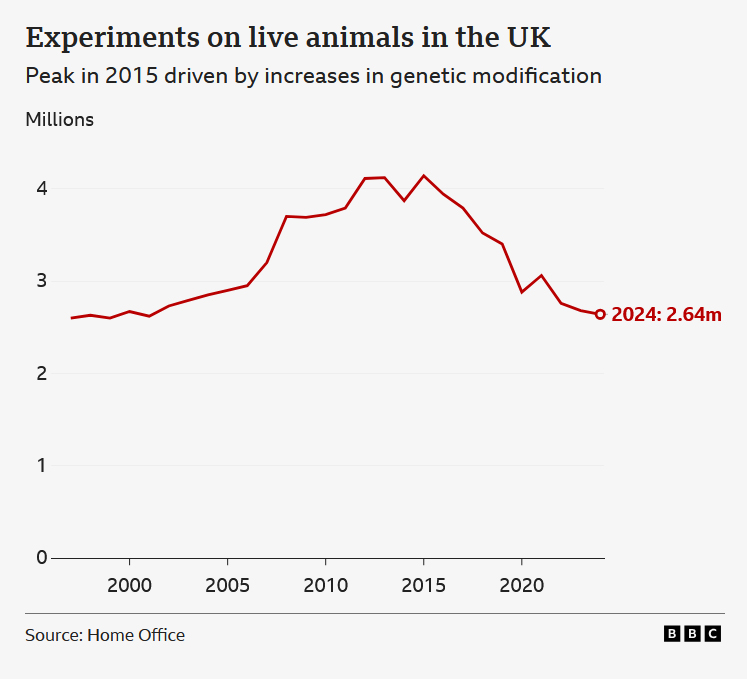
Government sets out plan to phase out animal experiments

1 hour ago

The government has detailed for the first time how it aims to fulfil its manifesto pledge to work toward phasing out animal testing.

The new plans include replacing animal testing for some major safety tests by the end of this year and cutting the use of dogs and non-human primates in tests for human medicines by at least 35% by 2030.

The Labour Party said in its manifesto that it would "partner with scientists, industry, and civil society as we work towards the phasing out of animal testing".

Science Minister Lord Vallance told BBC News that he could imagine a day where the use of animals in science was almost completely phased out but acknowledged that it would take time.

Animal experiments in the UK peaked at 4.14 million in 2015 driven mainly by a big increase then in genetic modification experiments – mostly on mice and fish.

https://www.bbc.co.uk/news/articles/cm2lpekjeg9o


Image
User avatar
caltrek
Posts: 9280
Joined: Mon May 17, 2021 1:17 pm

Re: Biology & Medicine News and Discussions

Post by caltrek »

New Research Shows that a Small Area of the Brain May Be Associated with Schizophrenia Risk
November 3, 2025

Introduction:
(Eurekalert) WASHINGTON, D.C., Nov. 3, 2025 — New research published online in the American Journal of Psychiatry provides new molecular insights into the role of the habenula, a pea-sized brain region that helps regulate motivation and mood, in contributing to the risk of schizophrenia. A team of researchers at Lieber Institute for Brain Development and Johns Hopkins found that many schizophrenia-related molecular changes appear to be specific to this region, suggesting the habenula could be a potential target for future treatments.

Schizophrenia is a heritable disorder, and a combination of multiple genetic variants contributes to it. This study sought to understand how molecular changes in the habenula region of the brain contribute to development of schizophrenia. The authors note that they focused on the habenula because of its “emerging role in psychiatric disorders and functional influence on neurotransmitter systems impacted in schizophrenia.”

The study team, led by Ege A. Yalcinbas, Ph.D., used cutting-edge molecular techniques to analyze postmortem human brains, resulting in the creation of the first cell-by-cell and within cell gene expression map of the human habenula (Hb). They then compared brain tissue from 35 individuals with schizophrenia and 33 nonpsychiatric donors. Their analyses identified numerous genes that demonstrated schizophrenia-related alterations in expression and many of these appeared to be unique to the habenula region. Additionally, 16 of the genes that had altered expression patterns overlapped with genes demonstrated to be associated with the risk to develop schizophrenia. The authors suggest the results “provide evidence that the Hb contributes to the causative genetic architecture of schizophrenia.”

They also found genes associated with nicotine dependence in the habenula, which is significant because of the greatly increased risk of smoking among people with schizophrenia.

“This work is important as it has uncovered alterations in the expression of specific genes in the habenula, a relatively under-investigated brain region, that may be related to the pathophysiology and/or etiology of schizophrenia,” said AJP Editor in Chief Ned Kalin, M.D.
Read more of the Eurekalert article here: https://www.eurekalert.org/news-releases/1104420

For a technical presentation of study results as published in Psychiatry Online:
https://www.psychiatryonline.org/doi/1 ... 20240776
Don't mourn, organize.

-Joe Hill
weatheriscool
Posts: 24486
Joined: Sun May 16, 2021 6:16 pm
Contact:

Re: Biology & Medicine News and Discussions

Post by weatheriscool »

Smart health-tracking earrings measure blood flow to your head
By Maryna Holovnova
November 18, 2025
In recent years, there has been a growing trend in wearable technology: trackers that look like a fashion accessory and yet are smart enough to help us understand our bodies better. If you’ve ever wondered what comes next after watches and rings, Lumia, an engineering firm from Boston, has just announced its new product – Lumia 2 smart earrings. It took six years to develop, and the result is a tracker that looks like a piece of fine jewellery and provides health data no other wearable has offered before.

Does the feeling of standing up too fast and suddenly getting lightheaded sound familiar? Tracking your blood flow can explain why this is happening, and that’s what sets Lumia 2 apart from other similar devices. With its infrared light sensor, an electronics platform in the back of the left earring measures arterial blood flow in a shallow ear artery – the closest one to the brain.
https://newatlas.com/medical-devices/lu ... w-to-head/
weatheriscool
Posts: 24486
Joined: Sun May 16, 2021 6:16 pm
Contact:

Re: Biology & Medicine News and Discussions

Post by weatheriscool »

Two first-in-class antibodies can inhibit inflammation in autoimmune diseases
https://medicalxpress.com/news/2025-11- ... mmune.html
by University Medical Center Utrecht

An international research group directed by UMC Utrecht has developed and characterized two first-in-class antibodies that specifically block the high-affinity IgG receptor FcγRI. Their findings open new perspectives for therapeutic modulation of FcγRI-driven inflammation in autoimmune diseases such as rheumatoid arthritis (RA), systemic lupus erythematosus (SLE) and immune thrombocytopenia (ITP).

The work has been published in Nature Communications.

FcγRI, also known as CD64, is a high-affinity receptor on myeloid cells that binds to the Fc region of immunoglobulin G (IgG) antibodies. It plays a key role in the immune defense by triggering cellular functions such as phagocytosis and cytokine production.
weatheriscool
Posts: 24486
Joined: Sun May 16, 2021 6:16 pm
Contact:

Re: Biology & Medicine News and Discussions

Post by weatheriscool »

firestar464
Posts: 7202
Joined: Wed Oct 12, 2022 7:45 am

Re: Biology & Medicine News and Discussions

Post by firestar464 »

Fluoridated water linked to better adolescent school achievement

https://medicalxpress.com/news/2025-11- ... chool.html
weatheriscool
Posts: 24486
Joined: Sun May 16, 2021 6:16 pm
Contact:

Re: Biology & Medicine News and Discussions

Post by weatheriscool »

weatheriscool
Posts: 24486
Joined: Sun May 16, 2021 6:16 pm
Contact:

Re: Biology & Medicine News and Discussions

Post by weatheriscool »

A newly discovered 'pain switch' in our brains could unlock safer medications
By Abhimanyu Ghoshal
November 25, 2025

https://newatlas.com/medical/brain-pain ... dications/
In a major brain science breakthrough, New Orleans-based researchers and collaborators have discovered a nerve signaling mechanism that takes place outside the cell, flipping on a 'pain switch.' This significantly updates the way we understand how pain receptors work in the brain, and it could shed light on a path to safer pain medication that can effectively provide relief without the usual side effects.

The scientists acknowledged that phosphorylation – a key process by which proteins are regulated – was generally understood when it occurred inside a cell, but its function outside the cell was less clear. They wanted to know if this modification, which occurs on the exterior parts of many synaptic proteins, actually changes how nerve connections (synapses) signal or affects behavior in a living animal.

They found that nerve cells communicate outside the cell with an enzyme called vertebrate lonesome kinase (VLK); this enzyme alters proteins in the space between neurons. When active neurons release VLK, it boosts the function of a pain receptor. This finding "opens up an entirely new way of thinking about how to influence cell behavior and potentially a simpler way to design drugs that act from the outside rather than having to penetrate the cell," noted Matthew Dalva, a brain scientist at Tulane University who led the study on this mechanism that appeared in the journal Science last week.
weatheriscool
Posts: 24486
Joined: Sun May 16, 2021 6:16 pm
Contact:

Re: Biology & Medicine News and Discussions

Post by weatheriscool »

User avatar
caltrek
Posts: 9280
Joined: Mon May 17, 2021 1:17 pm

Re: Biology & Medicine News and Discussions

Post by caltrek »

Chernobyl Fungus Appears to Have Evolved an Incredible Ability
By Michele Starr
November 30, 2025

Introduction:
(Science Alert) The Chernobyl exclusion zone may be off-limits to humans, but ever since the Unit Four reactor at the Chernobyl Nuclear Power Plant exploded nearly 40 years ago, other forms of life have not only moved in but survived, adapted, and appeared to thrive.

Part of that may be the lack of humans… but for one organism, at least, the ionizing radiation lingering inside the reactor's surrounding structures may be an advantage.

There, clinging to the interior walls of one of the most radioactive buildings on Earth, scientists have found a strange black fungus curiously living its best life.

That fungus is called Cladosporium sphaerospermum, and some scientists think its dark pigment – melanin – may allow it to harness ionizing radiation through a process similar to the way plants harness light for photosynthesis. This proposed mechanism is even referred to as radiosynthesis.

But here's the really funky thing about C. sphaerospermum: Although scientists have shown that the fungus flourishes in the presence of ionizing radiation, no one has been able to pin down how or why. Radiosynthesis is a theory, one that's difficult to prove.
[/quote]
Read more here: https://www.sciencealert.com/chernobyl ... e-ability
Don't mourn, organize.

-Joe Hill
User avatar
caltrek
Posts: 9280
Joined: Mon May 17, 2021 1:17 pm

Re: Biology & Medicine News and Discussions

Post by caltrek »

RFK Jr.’s Deepening Threat to Public Health
By Elizabeth Jacobs and James Alwine
December 8, 2025

Introduction:
(The Progressive) Here we go again. Health and Human Services (HHS) Secretary Robert F. Kennedy Jr. has again broken promises and betrayed his responsibilities as a public health official, this time by altering the Centers for Disease Control and Prevention (CDC) webpage on vaccines and autism. And that’s not all.

It originally contained the scientifically supported statement that there is “no link between receiving vaccines and developing autism spectrum disorder” and cited several rigorous scientific studies to back this up. Under Kennedy’s command, it has been altered to voice anti-vaccination disinformation, now stating, “The claim ‘vaccines do not cause autism’ is not an evidence-based claim because studies have not ruled out the possibility that infant vaccines cause autism.”

In his zeal to dismantle vital research and science-based policy, Kennedy has now all but destroyed the CDC. Having dismantled its ability to track and report disease outbreaks, he’s now making it a megaphone for anti-vaccine disinformation. Many dedicated scientists and public health professionals still work at the CDC and remain devoted to evidence-based science. But their efforts are sabotaged daily by Kennedy, who disdains science and embraces wild conspiracy theories.

Kennedy’s claims about a link between autism and vaccination are purposely misleading. Scientific research can never prove a negative—all that we as scientists can do is weigh all the evidence, which unequivocally indicates no link between vaccines and autism. In particular, a 2019 Danish study of 657,461 children concluded that vaccination “does not increase the risk for autism, does not trigger autism in susceptible children, and is not associated with clustering of autism cases after vaccination.”

Another study from Denmark that observed at least one million children over twenty years showed no link between aluminum in vaccines and autism. Kennedy tried desperately to have this article retracted, but solid science prevailed. In contrast, Andrew Wakefield’s infamous 1998 study that claimed to connect vaccines with autism, igniting anti-vaccine sentiment, was so bogus that it was retracted by the journal that published it.
Read more here: https://progressive.org/latest/rfk-jr- ... 20251208/
Don't mourn, organize.

-Joe Hill
weatheriscool
Posts: 24486
Joined: Sun May 16, 2021 6:16 pm
Contact:

Re: Biology & Medicine News and Discussions

Post by weatheriscool »

firestar464
Posts: 7202
Joined: Wed Oct 12, 2022 7:45 am

Re: Biology & Medicine News and Discussions

Post by firestar464 »

Misinformation is an inevitable biological reality across nature, researchers argue

https://phys.org/news/2025-12-misinform ... ature.html
weatheriscool
Posts: 24486
Joined: Sun May 16, 2021 6:16 pm
Contact:

Re: Biology & Medicine News and Discussions

Post by weatheriscool »

15-minute hep-C test makes same-day treatment possible
By Pranjal Malewar
December 19, 2025
Hepatitis C is a tiny virus with a significant impact. It's a small RNA virus that spreads through the blood and infects the liver. Even though today's medicines can cure it, hepatitis C remains a major global health challenge. Around 50 million people worldwide live with this infection, and every year, about 242,000 people die, mostly because long‑term infection can scar the liver or lead to liver cancer.

Right now, there's only one quick, FDA‑approved test for detecting the hepatitis C virus (HCV). But there's a catch: if the result is negative, the machine can take up to an hour to confirm it. That's longer than most routine visits at a doctor's office or at substance‑use treatment centers, where people often can't wait around. Because the final confirmatory test has to be done in a lab, many people never make it through the full process. That delay keeps them from starting treatment quickly, especially those who already face hurdles getting care.
https://newatlas.com/infectious-disease ... is-c-test/
Post Reply