AI & Robotics News and Discussions
Re: AI & Robotics News and Discussions
And remember my friend, future events such as these will affect you in the future
Re: AI & Robotics News and Discussions
Artificial intelligence’s role in the pandemic
When the COVID-19 pandemic first hit the U.S., many states tried to control the spread of the virus by issuing mask mandates, lockdown restrictions and encouraging work from home for industries who could manage it. However, essential workers in healthcare, food production, transportation, manufacturing and logistics had to continue operating for society to function.
The primary means of detection for affected individuals during the first half of 2020 was temperature scanning to assess for fever. Businesses and communities quickly implemented contactless thermometers in an effort to mitigate the spread of the virus along with social distancing protocols and enforcing proper mask use. Despite all of these efforts, the disease continued to spread across the country and the world, partly due to two main factors with the temperature monitoring solutions: potential calibration issues and human error.
That’s one area where artificial intelligence (AI) has had a significant impact by replacing error-prone human enforcement with advanced AI models capable of autonomously measuring the temperatures of thousands of people per hour. The ability to quickly detect individuals who present a fever and alert authorities in one or more departments almost instantaneously is invaluable when reducing the risk of contagion in areas with high traffic like malls, hospitals and offices. Delegating this process to machines has enabled companies and governments to assign more personnel to respond to positive cases and improve the efficiency of their response.
And remember my friend, future events such as these will affect you in the future
Re: AI & Robotics News and Discussions
Starspawn0 on Facebook's language model:
And remember my friend, future events such as these will affect you in the future
-
weatheriscool
- Posts: 25737
- Joined: Sun May 16, 2021 6:16 pm
- Contact:
Re: AI & Robotics News and Discussions
AugLimb: A compact robotic limb to support humans during everyday activities
https://techxplore.com/news/2021-09-aug ... umans.html
by Ingrid Fadelli , Tech Xplore
https://techxplore.com/news/2021-09-aug ... umans.html
by Ingrid Fadelli , Tech Xplore
Researchers at Japan Advanced Institute of Science and Technology and University of Tokyo recently developed AugLimb, a compact robotic limb that could support humans as they complete a variety of tasks. This new limb, presented in a paper pre-published on arXiv, can extend up to 250 mm and grasp different objects in a user's vicinity.
"We are interested in human augmentation technologies, which aim to enhance human capabilities with information and robotics approaches," Haoran Xie, one of the researchers who carried out the study, told Tech Xplore. "We particularly focus on the physical augmentation of human bodies."
Most existing wearable robotic arms are designed to be mounted on a human user's upper body (e.g., on the upper arm, waist or shoulders). While some of these systems have achieved promising results, they are typically based on bulky hardware and wearing them can be uncomfortable for users.
"Most previously developed supernumerary robotic limb devices are heavy and occupy large space," Xie said. "Instead, we proposed a compact robotic limb that can fold into small volume without the interrupt to the wears' daily activities, especially for long-time usage."
-
weatheriscool
- Posts: 25737
- Joined: Sun May 16, 2021 6:16 pm
- Contact:
Re: AI & Robotics News and Discussions
Deep learning helps predict new drug combinations to fight COVID-19
https://medicalxpress.com/news/2021-09- ... ovid-.html
by Rachel Gordon, MIT Computer Science & Artificial Intelligence Lab
https://medicalxpress.com/news/2021-09- ... ovid-.html
by Rachel Gordon, MIT Computer Science & Artificial Intelligence Lab
The existential threat of COVID-19 has highlighted an acute need to develop working therapeutics against emerging health threats. One of the luxuries deep learning has afforded us is the ability to modify the landscape as it unfolds—so long as we can keep up with the viral threat, and access the right data.
As with all new medical maladies, oftentimes the data needs time to catch up, and the virus takes no time to slow down, posing a difficult challenge as it can quickly mutate and become resistant to existing drugs. This led scientists from MIT's Computer Science and Artificial Intelligence Laboratory (CSAIL) to ask: how can we identify the right synergistic drug combinations for the rapidly spreading SARS-CoV-2?
Typically, data scientists use deep learning to pick out drug combinations with large existing datasets for things like cancer and cardiovascular disease, but, understandably, they can't be used for new illnesses with limited data.
Without the necessary facts and figures, the team needed a new approach: a neural network that wears two hats. Since drug synergy often occurs through inhibition of biological targets, (like proteins or nucleic acids), the model jointly learns drug-target interaction and drug-drug synergy to mine new combinations. The drug-target predictor models the interaction between a drug and a set of known biological targets that are related to the chosen disease. The target-disease association predictor learns to understand a drug's antiviral activity, which means determining the virus yield in infected tissue cultures. Together, they can predict the synergy of two drugs.
-
weatheriscool
- Posts: 25737
- Joined: Sun May 16, 2021 6:16 pm
- Contact:
Re: AI & Robotics News and Discussions
Researchers developing fully autonomous robot chef
https://techxplore.com/news/2021-09-ful ... -chef.html
by Columbia University
https://techxplore.com/news/2021-09-ful ... -chef.html
by Columbia University
Concept rendering of a digital cooking appliance that boasts dozens of ingredients and a precise cooking laser to assemble and cook meals using digital recipes. Credit: Columbia University
Imagine having your own digital personal chef; ready to cook up whatever you want; able to tailor the shape, texture, and flavor just for you; and it's all at the push of a button. Columbia engineers have been working on doing just that, using lasers for cooking and 3D printing technology for assembling foods.
Under the guidance of Mechanical Engineering Professor Hod Lipson, the "Digital Food" team of his Creative Machines Lab has been building a fully autonomous digital personal chef. Lipson's group has been developing 3D-printed foods since 2007. Since then, food printing has progressed to multi-ingredient prints and has been explored by researchers and a few commercial companies.
"We noted that, while printers can produce ingredients to a millimeter-precision, there is no heating method with this same degree of resolution," said Jonathan Blutinger, a Ph.D. in Lipson's lab who led the project. "Cooking is essential for nutrition, flavor, and texture development in many foods, and we wondered if we could develop a method with lasers to precisely control these attributes."

Re: AI & Robotics News and Discussions
Robotics Investment in China Reviewed
by Brian Heater
September 23, 2021
https://techcrunch.com/2021/09/23/attac ... ic-raises/
Introduction: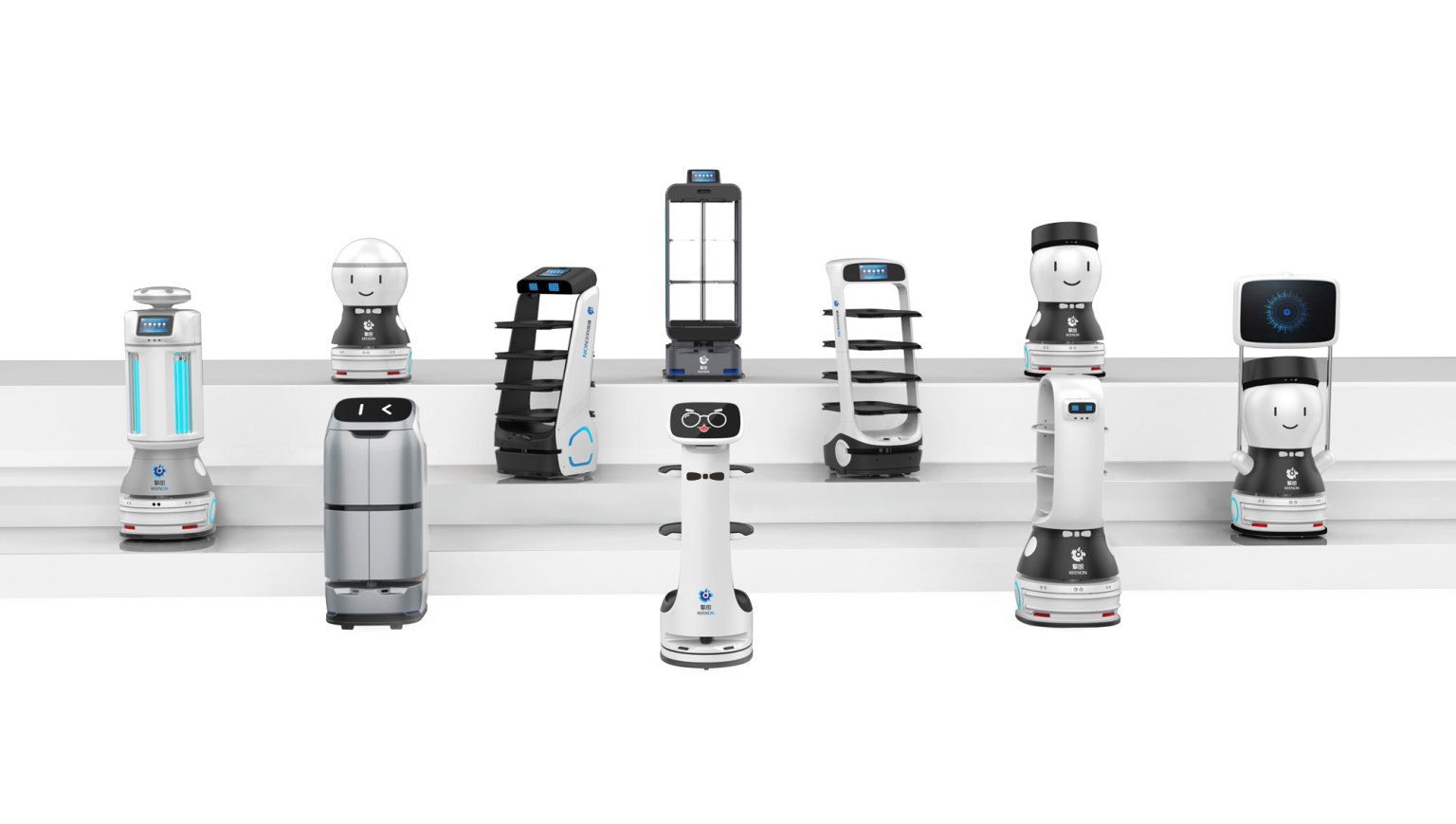
Image Credits: Keenon Robotics
by Brian Heater
September 23, 2021
https://techcrunch.com/2021/09/23/attac ... ic-raises/
Introduction:
(TechCrunch) How’s this for a bit of regional synchronicity? This week, a pair of Chinese robotics firms secured $200 million rounds. It’s all part of a booming ecosystem that we get some insight into every so often. There are so many players in China’s robotics space it can be hard to keep track of some of the innovation over there, but these sorts of large funding rounds are a surefire way to make some waves.
The COVID-19 pandemic is anticipated to be a major acceleration point for the country, on the tail of some major manufacturing shortages that brought the world’s supply chains to a standstill. But this week’s pair of big raises point toward an adoption of automation that moves beyond manufacturing.
Hai Robotics grabbed the bigger headlines of the two with the announcement of a joint Series C and D that amount to $200 million. The company’s Shenzhen location puts it smack in the heart of China’s manufacturing zone, but the company’s specialty is warehouse/fulfillment robotics. It already has a decent-sized international footprint with deployment in 30 countries, including a recent deal with Booktopia, a large Australian online book retailer.
5Y Capital and Capital Today led the C and D, respectively. The rounds also featured Sequoia Capital China, Source Code Capital, VMS, Walden International and Scheme Capital. The funding will be used to further Hai’s international expansion and build out its existing presence in China.
Image Credits: Keenon Robotics
Don't mourn, organize.
-Joe Hill
-Joe Hill
Re: AI & Robotics News and Discussions
Meet Gary: The personal Israeli robot assistant for your home or office
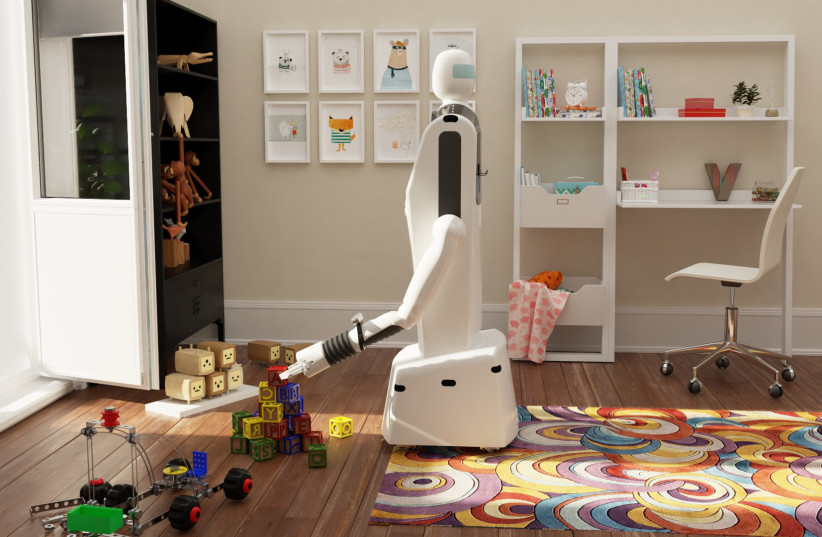
Gary the autonomous robot assistant doing some chores around the house.
(photo credit: Unlimited Robotics)
Israel-based Unlimited Robotics revealed its new service robot, Gary, geared and manufactured to perform any home, business or office chore, the company announced in a statement.
Alongside the big reveal, the 20-team member Israeli start-up also announced its new developer's platform, Ra-Ya, which "makes it easier for any software engineer to build robotic applications even without prior experience in hard-coded environments."
"The process of programming a robotic application is challenging, and it is not that simple for most software developers," said Unlimited Robotics CEO Guy Altagar. "Unlimited Robotics is democratizing the way people can build applications for robots with the company’s groundbreaking technology.
"We are empowering software engineers who do not have prior experience in robot programming, especially if they have experience in JavaScript and Python, to actually create pragmatic solutions for people’s homes, businesses, and offices."
Gary the autonomous robot assistant doing some chores around the house.
(photo credit: Unlimited Robotics)
And remember my friend, future events such as these will affect you in the future
Re: AI & Robotics News and Discussions
And remember my friend, future events such as these will affect you in the future
Re: AI & Robotics News and Discussions
Delivery robots set to roll out in Bloomfield, Lawrenceville this week
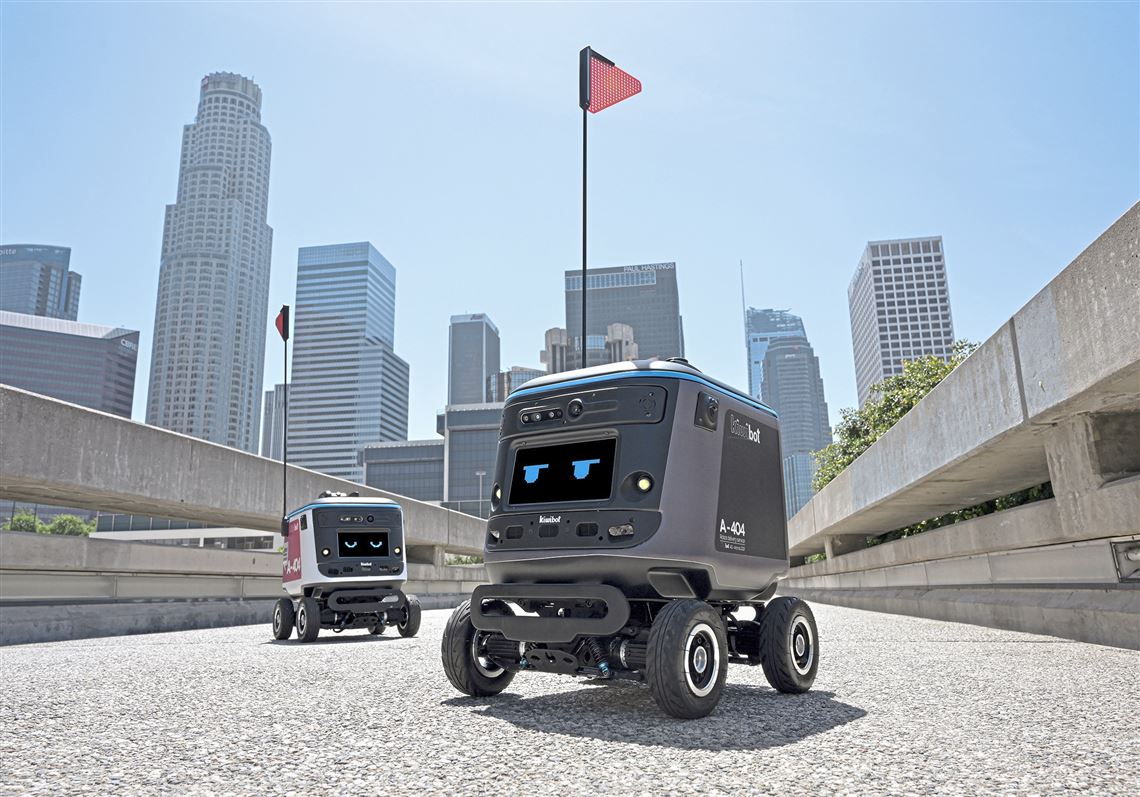
First came electric scooters, now come the robots.
The Pittsburgh Department of Mobility and Infrastructure announced Tuesday the next phase of a pilot program that would see delivery robots, or personal delivery devices (PDDs), on the streets of Bloomfield, Garfield and Lawrenceville delivering books, medicine and food to residents as early as this week.
Kiwibot, a Los Angeles-based sidewalk delivery startup, is sending 10 of their robots to Pittsburgh in a partnership funded by the Knight Foundation’s Autonomous Vehicle Initiative. According to a statement from the city, the pilot “will focus on bringing residents to the center of the conversation about this emerging technology.”
The city said the pilot will also help explore affordable delivery options for “last mile deliveries” to businesses, pharmacies and libraries. In supply chain management, last mile deliveries are the movement of goods from a transportation hub to their final destination.
And remember my friend, future events such as these will affect you in the future
Re: AI & Robotics News and Discussions
UK publishes 10-year plan to become ‘A.I. superpower’, seeking to rival U.S. and China
The U.K. government on Wednesday released its 10-year plan to make the country a global “artificial intelligence superpower”, seeking to rival the likes of the U.S. and China.
The so-called “National Artificial Intelligence Strategy” is designed to boost the use of AI among the nation’s businesses, attract international investment into British AI companies and develop the next generation of homegrown tech talent.
“Today we’re laying the foundations for the next ten years’ growth with a strategy to help us seize the potential of artificial intelligence and play a leading role in shaping the way the world governs it,” Chris Philp, a minister of the Department for Digital, Culture, Media and Sport, said in a statement.
And remember my friend, future events such as these will affect you in the future

Re: AI & Robotics News and Discussions
I like the increased competition but dare I say I think the UK is delusional if they believe they can compete with the US or China. XDYuli Ban wrote: ↑Thu Sep 23, 2021 10:44 pm UK publishes 10-year plan to become ‘A.I. superpower’, seeking to rival U.S. and ChinaThe U.K. government on Wednesday released its 10-year plan to make the country a global “artificial intelligence superpower”, seeking to rival the likes of the U.S. and China.
The so-called “National Artificial Intelligence Strategy” is designed to boost the use of AI among the nation’s businesses, attract international investment into British AI companies and develop the next generation of homegrown tech talent.
“Today we’re laying the foundations for the next ten years’ growth with a strategy to help us seize the potential of artificial intelligence and play a leading role in shaping the way the world governs it,” Chris Philp, a minister of the Department for Digital, Culture, Media and Sport, said in a statement.
Re: AI & Robotics News and Discussions
And remember my friend, future events such as these will affect you in the future
Re: AI & Robotics News and Discussions

Neuroactivity of one million mouse brain neurons. (Alipasha Vaziri)
And remember my friend, future events such as these will affect you in the future
Re: AI & Robotics News and Discussions
A recent New York Times article concludes that new AI-powered automation tools such as Codex for software developers will not eliminate jobs but simply be a welcome aid to augment programmer productivity. This is consistent with the argument we’re increasingly hearing that people and AI have different strengths and there will be appropriate roles for each.
As discussed in a Harvard Business Review story: “AI-based machines are fast, more accurate, and consistently rational, but they aren’t intuitive, emotional, or culturally sensitive.” The belief is that “AI plus humans” is something of a centaur, greater than either one operating alone.
This idea of humans plus AI producing better outcomes has become a tenant of faith in technology. Everyone talks about humans being freed up to perform higher-level functions, but no one seems to know just what those high-level functions are, how they translate into real work and jobs, or the number of people needed to perform them.
A corollary of this augmented-workforce narrative is that not only will AI-augmented work enable people to pursue a higher level of abstract thinking, it will — according to some — also lift all of society to a higher standard of living. This is certainly an optimistic vision, and we can hope for that. However, this could also be a story imbued with magical thinking, with the true end-game being fully automated work.
Gonna make a long post about how I feel the near future of labor is going to go down. Basically up to 2029, and focusing more on the American reaction to what's coming. It's been a while since I made an extended post.
And remember my friend, future events such as these will affect you in the future
Re: AI & Robotics News and Discussions
Deep Learning’s Diminishing Returns
My comment: this is a rehash of that MIT Arxiv paper which was circulating a while ago. The paper in question uses a very dumb methodology where instead of doing actual scaling law research (where you directly measure how much compute it takes to increase a specific model's performance on some error metric), they just dump a bunch of random Arxiv papers (all by different researchers, model architectures, goals etc) into a blender and try to deduce some sort of trend between compute and error rates. Unsurprisingly, because people are always publishing very disparate papers examining many different topics or aspects of something (many quite bad), this implies you need ~∞ compute to do much better. They do not recover known scaling laws and at least in the version I read, completely ignore the entire scaling literature. Garbage. (That Marcus is cheering on Twitter tells you everything you need to know.)
starspawn0
Seems like I've been reading this worry for years now, but the limits haven't yet been reached. And systems are doing pretty well, so far. Speech recognition is pretty good, for example; so is machine translation and image recognition. How much more improvement do we really need on these tasks??
Regarding systems built on "expert knowledge" that use less compute, that hides the amount of effort it took for humans to discover the rules used in those models. No fair to leave that out! Human effort + compute cycles may be greater than for a system trained from scratch using much less human effort, even though it learns inefficiently.
Quote:
I would need to look at this article again, but I don't recall seeing mention of transfer learning. Mention is made of meta-learning, but I don't recall seeing transfer learning (I read it yesterday and may have forgotten). Transfer learning could severely reduce the amount of compute needed to learn new tasks.
I don't think shrinking the neural nets is the answer. That will just make them less robust -- and adding symbolic processing also won't help. The human brain still uses far more compute than any of these neural net models, and if we want to make AI that emulates it, we probably are going to have to use at least as much in AI models.
gwernDEEP LEARNING IS NOW being used to translate between languages, predict how proteins fold, analyze medical scans, and play games as complex as Go, to name just a few applications of a technique that is now becoming pervasive. Success in those and other realms has brought this machine-learning technique from obscurity in the early 2000s to dominance today.
Although deep learning's rise to fame is relatively recent, its origins are not. In 1958, back when mainframe computers filled rooms and ran on vacuum tubes, knowledge of the interconnections between neurons in the brain inspired Frank Rosenblatt at Cornell to design the first artificial neural network, which he presciently described as a "pattern-recognizing device." But Rosenblatt's ambitions outpaced the capabilities of his era—and he knew it. Even his inaugural paper was forced to acknowledge the voracious appetite of neural networks for computational power, bemoaning that "as the number of connections in the network increases...the burden on a conventional digital computer soon becomes excessive."
My comment: this is a rehash of that MIT Arxiv paper which was circulating a while ago. The paper in question uses a very dumb methodology where instead of doing actual scaling law research (where you directly measure how much compute it takes to increase a specific model's performance on some error metric), they just dump a bunch of random Arxiv papers (all by different researchers, model architectures, goals etc) into a blender and try to deduce some sort of trend between compute and error rates. Unsurprisingly, because people are always publishing very disparate papers examining many different topics or aspects of something (many quite bad), this implies you need ~∞ compute to do much better. They do not recover known scaling laws and at least in the version I read, completely ignore the entire scaling literature. Garbage. (That Marcus is cheering on Twitter tells you everything you need to know.)
starspawn0
Seems like I've been reading this worry for years now, but the limits haven't yet been reached. And systems are doing pretty well, so far. Speech recognition is pretty good, for example; so is machine translation and image recognition. How much more improvement do we really need on these tasks??
Regarding systems built on "expert knowledge" that use less compute, that hides the amount of effort it took for humans to discover the rules used in those models. No fair to leave that out! Human effort + compute cycles may be greater than for a system trained from scratch using much less human effort, even though it learns inefficiently.
Quote:
It's heavily dependent on the type of data being used, though; and probably also depends heavily on the choice of loss function. I seem to recall some people from OpenAI giving a talk, where they said that scaling curves for image processing changed as you change the resolution of the images. Also, if the data has less noise, learning is usually quicker. Finally, there's possibility of new datasets arriving with the coming boom in BCIs -- these may produce even better scaling curves, still.Our analysis of this phenomenon also allowed us to compare what's actually happened with theoretical expectations. Theory tells us that computing needs to scale with at least the fourth power of the improvement in performance. In practice, the actual requirements have scaled with at least the ninth power.
This ninth power means that to halve the error rate, you can expect to need more than 500 times the computational resources.
I would need to look at this article again, but I don't recall seeing mention of transfer learning. Mention is made of meta-learning, but I don't recall seeing transfer learning (I read it yesterday and may have forgotten). Transfer learning could severely reduce the amount of compute needed to learn new tasks.
I don't think shrinking the neural nets is the answer. That will just make them less robust -- and adding symbolic processing also won't help. The human brain still uses far more compute than any of these neural net models, and if we want to make AI that emulates it, we probably are going to have to use at least as much in AI models.
And remember my friend, future events such as these will affect you in the future
Re: AI & Robotics News and Discussions
The rumors were true. Amazon is working on an Alexa-powered robot on wheels. At its fall hardware event, the company showed off Astro. Set to initially cost $1,000 when it becomes available later this year, it's essentially an Alexa display that can roam around your home.
The robot features a periscope camera that allows it to expand its field of view beyond floor level. It can extend that camera to check on things like stovetops and sleeping pets. With Ring's Protect Pro subscription service, you can also program Astro to patrol your home while you're away. It can detect the sound of a smoke alarm, carbon monoxide detector or breaking glass. It will send you notifications when it notices something usual, and you can save what it records to your Ring account.
If only it could do something that useful.
And remember my friend, future events such as these will affect you in the future
Re: AI & Robotics News and Discussions
And remember my friend, future events such as these will affect you in the future
Re: AI & Robotics News and Discussions
How Google plans to improve web searches with multimodal AI
During a livestreamed event today, Google detailed the ways it’s using AI techniques — specifically a machine learning algorithm called multitask unified model (MUM) — to enhance web search experiences across different languages and devices. Beginning early next year, Google Lens, the company’s image recognition technology, will gain the ability to find objects like apparel based on photos and high-level descriptions. Around the same time, Google Search users will begin seeing an AI-curated list of things they should know about certain topics, like acrylic paint materials. They’ll also see suggestions to refine or broaden searches based on the topic in question, as well as related topics in videos discovered through Search.
The upgrades are the fruit of a multiyear effort at Google to improve Search and Lens’ understanding of how language relates to visuals from the web. According to Google VP of Search Pandu Nayak, MUM, which Google detailed at a developer conference last June, could help better connect users to businesses by surfacing products and reviews and improving “all kinds” of language understanding, whether at the customer service level or in a research setting.
“The power of MUM is its ability to understand information on a broad level. It’s intrinsically multimodal — that is, it can handle text, images, and videos all at the same time,” Nayak told VentureBeat in a phone interview. “It holds out the promise that we can ask very complex queries and break them down into a set of simpler components, where you can get results for the different, simpler queries and then stitch them together to understand what you really want.”
And remember my friend, future events such as these will affect you in the future
Re: AI & Robotics News and Discussions
And remember my friend, future events such as these will affect you in the future