Quantum Computing News and Discussions

weatheriscool
Posts: 24495
Joined: Sun May 16, 2021 6:16 pm
Contact:

Re: Quantum Computing News and Discussions

Post by weatheriscool »

Researchers use gold film to enhance quantum sensing with qubits in a 2D material
https://phys.org/news/2021-09-gold-quan ... erial.html
by Cheryl Pierce, Purdue University
Quantum sensing is being used to outpace modern sensing processes by applying quantum mechanics to design and engineering. These optimized processes will help beat the current limits in processes like studying magnetic materials or studying biological samples. In short, quantum is the next frontier in sensing technology.

As recently as 2019, spin defects known as qubits were discovered in 2D materials (hexagonal boron nitride) which could amplify the field of ultrathin quantum sensing. These scientists hit a snag in their discovery which has unleashed a scientific race to resolve the issues. Their sensitivity was limited by their low brightness and the low contrast of their magnetic resonance signal. As recently as two weeks ago on August 9, 2021, Nature Physics published an article titled "quantum sensors go flat," where they highlighted the benefits and also outlined current shortfalls of this new and exciting means of sensing via qubits in 2D materials.
weatheriscool
Posts: 24495
Joined: Sun May 16, 2021 6:16 pm
Contact:

Re: Quantum Computing News and Discussions

Post by weatheriscool »

Graphene valleytronics: Paving the way to small-sized room-temperature quantum computers
https://phys.org/news/2021-09-graphene- ... ature.html
by Indian Institute of Technology Bombay, Mumbai
Valleytronics is an emerging field in which valleys—local minima in the energy band structure of solids—are used to encode, process, and store quantum information. Though graphene was thought to be unsuitable for valleytronics due to its symmetrical structure, researchers from the Indian Institute of Technology Bombay, India, have recently shown that this is not the case. Their findings may pave the way to small-sized quantum computers that can operate at room temperature.

From the consumer's side, it's pretty easy to notice the giant strides that the field of electronics has made over the past few decades; with wearable gadgets, smart cities, self-driving cars, improved space missions, robots, holography, and supercomputers, the possibilities of technological advancement seem infinite. However, unbeknownst to most people, this accelerated trend of technological advancement fueled by electronics is rapidly coming to a halt as electronic components reach their practical limits. If we are to keep improving our computing power and capacity, we will need to find new ways to store and process data beyond the simple flow and charge of electrons, which is how modern electronics operates.
weatheriscool
Posts: 24495
Joined: Sun May 16, 2021 6:16 pm
Contact:

Re: Quantum Computing News and Discussions

Post by weatheriscool »

IonQ Ramping to Over 100 Qubits
September 18, 2021 by Brian Wang
https://www.nextbigfuture.com/2021/09/i ... ubits.html
IonQ unveiled the first Reconfigurable Multicore Quantum Architecture (RMQA) technology, a breakthrough in quantum computing. It is starting with the demonstration of 4 chains of 16 ions each that can be dynamically configured into quantum computing cores. IonQ believes this can scale qubit count into the triple digits on a single chip, as well as future Parallel Multicore Quantum Processing Units.


This demonstration was achieved on a technological platform recently added to IonQ’s intellectual property warchest, called Evaporated Glass Traps (EGTs). Developed by an IonQ team led by UC Berkeley Physics PhD and ex-GTRI and -NIST researcher Jason Amini, the EGT platform offers an unprecedented level of performance and is a crucial part of IonQ’s roadmap to rapid scalability and increased computing power.

“The Reconfigurable Multicore Quantum Architecture marks a key milestone for IonQ and for the quantum computing industry in general,” remarked IonQ President and CEO Peter Chapman. “RMQA is a critical enabler of our ability to scale qubit density and deliver the computational power projected in our roadmap. We’re very proud of the team at IonQ that has achieved a powerful platform for scalability and control in a single technical breakthrough.”
weatheriscool
Posts: 24495
Joined: Sun May 16, 2021 6:16 pm
Contact:

Re: Quantum Computing News and Discussions

Post by weatheriscool »

Supercomputer probes the limits of Google's quantum processor
https://techxplore.com/news/2021-09-sup ... antum.html
by Skolkovo Institute of Science and Technology

CPQM's Laboratory for Quantum Information Processing has collaborated with the CDISE supercomputing team "Zhores" to emulate Google's quantum processor. Reproducing noiseless data following the same statistics as Google's recent experiments, the team was able to point to a subtle effect lurking in Google's data. This effect, called a reachability deficit, was discovered by the Skoltech team in its past work. The numerics confirmed that Google's data was on the edge of a so-called, density-dependent avalanche, which implies that future experiments will require significantly more quantum resources to perform quantum approximate optimization. The results are published in the field's leading journal Quantum.

From the early days of numerical computing, quantum systems have appeared exceedingly difficult to emulate, though the precise reasons for this remain a subject of active research. Still, this apparently inherent difficulty of a classical computer to emulate a quantum system prompted several researchers to flip the narrative.

Scientists such as Richard Feynman and Yuri Manin speculated in the early 1980s that the unknown ingredients which seem to make quantum computers hard to emulate using a classical computer could themselves be used as a computational resource. For example, a quantum processor should be good at simulating quantum systems, since they are governed by the same underlying principles.

Such early ideas eventually led to Google and other tech giants creating prototype versions of the long-anticipated quantum processors. These modern devices are error-prone, they can only execute the simplest of quantum programs and each calculation must be repeated multiple times to average out the errors in order to eventually form an approximation.
weatheriscool
Posts: 24495
Joined: Sun May 16, 2021 6:16 pm
Contact:

Re: Quantum Computing News and Discussions

Post by weatheriscool »

A new way to control qubits

by Tim Christie, University of Oregon
https://phys.org/news/2021-09-qubits.html
A research team that includes two UO physicists have outlined new techniques for controlling the building blocks of quantum computing, a potentially significant step toward making such computers more accurate and useful.

Physicists David Allcock and David Wineland are founders of the new Oregon Ions Laboratory, which was recently set up in the basement of Willamette Hall. They are among 12 authors of a new paper, which is based on an experiment at the National Institute for Standards and Technology in Boulder, Colorado. Both scientists previously worked at the Colorado lab and continued to collaborate on the project after coming to the UO in 2018.

The techniques, described in the journal Nature, involve the use of trapped-ion quantum bits, or qubits, in quantum computing and simulations. They could lead to improvements in the operation of quantum computers, which still make too many computation errors to be effective tools, the physicists said.

The problem with quantum computers is that their logic gates—the tools used to perform basic logic functions in computing—"are really bad," Allcock said.
User avatar
raklian
Posts: 1981
Joined: Sun May 16, 2021 4:46 pm
Location: North Carolina

Re: Quantum Computing News and Discussions

Post by raklian »

This is pretty significant.

To know is essentially the same as not knowing. The only thing that occurs is the rearrangement of atoms in your brain.
weatheriscool
Posts: 24495
Joined: Sun May 16, 2021 6:16 pm
Contact:

Re: Quantum Computing News and Discussions

Post by weatheriscool »

Study demonstrates the potential of a quantum computer comprised of a small processor and a storage unit
https://phys.org/news/2021-10-potential ... essor.html
by Ingrid Fadelli , Phys.org
Quantum computing systems, computer systems that are based on the key principles of quantum theory, could significantly outperform conventional computing systems, both in terms of speed and performance. Over the past decade or so, many physicists worldwide have thus been trying to develop these systems and assess their potential.

Instead of encoding information in bits, units of information with binary values (i.e., either 1 or 0), quantum computers use quantum bits or qubits. Qubits are quantum mechanical analogs of bits that can exist in more than one state (i.e., 1 and 0 simultaneously).

Most quantum computing systems developed so far consist in a series of qubits placed on a 2D chip, which directly compute information. Classical computers, on the other hand, are made up of a processor, which processes information, and a memory, which stores information.

Researchers at Université Paris–Saclay, CNRS, CEA, have recently carried out a study evaluating the performance of a quantum computer with a structure that resembles that of conventional computers. Their results, published in Physical Review Letters, suggest that incorporating quantum information storage units into quantum computing systems could enable the creation of devices that contain significantly fewer qubits in their processors.
weatheriscool
Posts: 24495
Joined: Sun May 16, 2021 6:16 pm
Contact:

Re: Quantum Computing News and Discussions

Post by weatheriscool »

Cutting through the noise: AI enables high-fidelity quantum computing
https://phys.org/news/2021-10-noise-ai- ... antum.html
by Osaka University

Researchers led by the Institute of Scientific and Industrial Research (SANKEN) at Osaka University have trained a deep neural network to correctly determine the output state of quantum bits, despite environmental noise. The team's novel approach may allow quantum computers to become much more widely used.

Modern computers are based on binary logic, in which each bit is constrained to be either a 1 or a 0. But thanks to the weird rules of quantum mechanics, new experimental systems can achieve increased computing power by allowing quantum bits, also called qubits, to be in "superpositions" of 1 and 0. For example, the spins of electrons confined to tiny islands called quantum dots can be oriented both up and down simultaneously. However, when the final state of a bit is read out, it reverts to the classical behavior of being one orientation or the other. To make quantum computing reliable enough for consumer use, new systems will need to be created that can accurately record the output of each qubit even if there is a lot of noise in the signal.

Now, a team of scientists led by SANKEN used a machine learning method called a deep neural network to discern the signal created by the spin orientation of electrons on quantum dots. "We developed a classifier based on deep neural network to precisely measure a qubit state even with noisy signals," co-author Takafumi Fujita explains.
User avatar
wjfox
Site Admin
Posts: 13587
Joined: Sat May 15, 2021 6:09 pm
Location: Essex, UK
Contact:

Re: Quantum Computing News and Discussions

Post by wjfox »

Chinese researchers achieve quantum advantage in two mainstream routes

Published: Oct 26, 2021 01:18 PM

Chinese research teams have made marked progress in superconducting quantum computing and photonics quantum computing technology, making China the only country to achieve quantum computational advantage in two mainstream technical routes, while the US has only achieved a "quantum advantage" in superconducting quantum computing, analysts say.

Quantum advantage is a scientific concept that states a quantum computer can do things in some fields beyond the capability of non-quantum or classical computers, but it will never replace classical computers, Yuan Lanfeng, a research fellow at the Hefei National Laboratory for Physical Sciences at the Microscale of the University of Science and Technology of China (USTC), told the Global Times on Tuesday.

The research team, headed by the renowned Chinese quantum physicist Pan Jianwei, designed a 66-qubit programmable superconducting quantum computing system, naming it "Zuchongzhi 2.1," after the noted 5th century Chinese mathematician and astronomer, significantly enhancing the quantum advantage, the Xinhua News Agency reported Tuesday.

"Zuchongzhi 2.1," is 10 million times faster than the current fastest supercomputer and its calculation complexity is more than 1 million times higher than Google's Sycamore processor. It's the first time that China has reached quantum advantage in a superconducting quantum computing system.

"Zuchognzhi 2.1" has achieved a quantum advantage for the first time compared with an earlier processor named "Zu Chongzhi", a 62-qubit programmable superconducting quantum prototype designed by a Chinese research team from the USTC in May, Lu Chaoyang, a professor of the USTC in Hefei, capital city of East China's Anhui Province, told the Global Times on Tuesday.

Pan's team also built a new light-based quantum computer prototype, "Jiuzhang 2.0," with 113 detected photons, which can implement large-scale Gaussian boson sampling (GBS) 1 septillion times faster than the world's fastest existing supercomputer, according to the Xinhua News Agency.

https://www.globaltimes.cn/page/202110/1237312.shtml


Image
Light-based quantum computer prototype 'Jiuzhang 2.0' Photo: Courtesy of University of Science and Technology of China

User avatar
Yuli Ban
Posts: 5194
Joined: Sun May 16, 2021 4:44 pm

Re: Quantum Computing News and Discussions

Post by Yuli Ban »

And remember my friend, future events such as these will affect you in the future
weatheriscool
Posts: 24495
Joined: Sun May 16, 2021 6:16 pm
Contact:

Re: Quantum Computing News and Discussions

Post by weatheriscool »

IBM announces development of 127-qubit quantum processor
https://phys.org/news/2021-11-ibm-qubit ... essor.html
by Bob Yirka , Phys.org
IBM has announced the development of a 127-qubit quantum processor, both on its IBM Quantum page and during IBM Quantum Summit 2021. As part of its announcement, IBM also announced that computers running the new processor will be made available to IBM Quantum Network members and that the company has plans for launching two other, presumably more powerful processors it has named Osprey and Condor over the next two years. The current processor has been named Eagle.

Over the past decade, several big-name technology companies have been working hard to develop a truly functional and useful quantum computer. Such efforts have fallen into two main camps—those attempting to create a quantum computer using entangled photons and those using superconducting materials. The processors announced by IBM are all based on superconducting materials.
User avatar
wjfox
Site Admin
Posts: 13587
Joined: Sat May 15, 2021 6:09 pm
Location: Essex, UK
Contact:

Re: Quantum Computing News and Discussions

Post by wjfox »

:o :shock: 8-)

----------

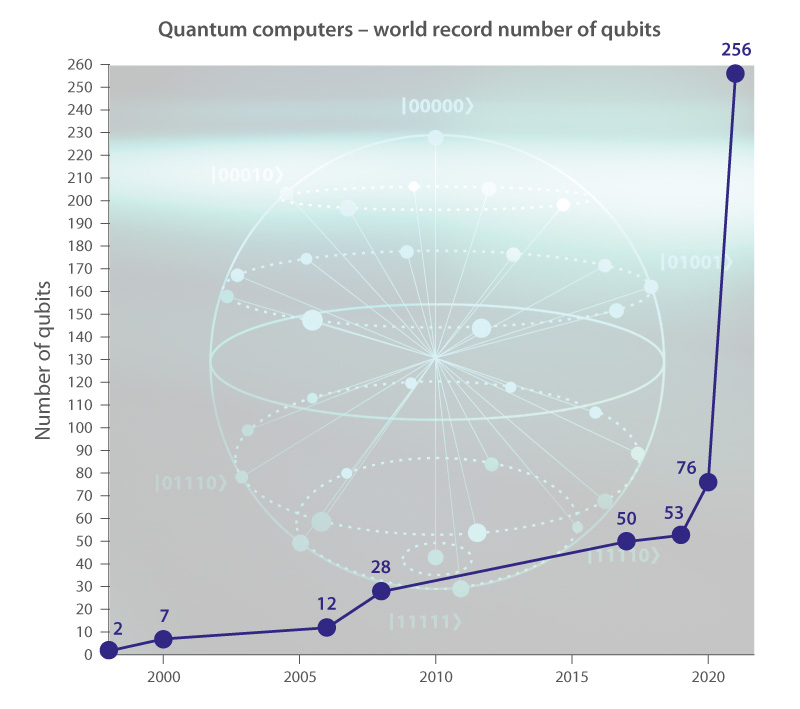
256-qubit quantum computer unveiled

24th November 2021

The first 256-qubit quantum computer has been announced by startup company QuEra, founded by MIT and Harvard scientists.

QuEra Computing Inc. – a new Boston, Massachusetts-based company – has emerged from stealth mode with $17 million in funding and has completed the assembly of a 256-qubit device. Its funders include Japanese e-commerce giant Rakuten, Day One Ventures, Frontiers Capital, and the leading tech investors Serguei Beloussov and Paul Maritz. The company recently received a DARPA award, and has already generated $11 million in revenue.

QuEra Computing recently achieved ground-breaking research on neutral atoms, developed at Harvard University and the Massachusetts Institute of Technology, which is being used as the basis for a highly scalable, programmable quantum computer solution. The QuEra team is aiming to build the world's most powerful quantum computers to take on computational tasks that are currently deemed impossibly hard.

Qubits are the quantum computer equivalent of the "bits" used in classical machines. Unlike the latter – which are limited to binary values – qubits can have multiple values simultaneously. This means that even a relatively small number of qubits can handle very, very, very large numbers. This has become apparent in recent years with qubit counts enabling quantum computers to exceed the capabilities of classical machines for the first time. In the future, quantum computers may be powerful enough to solve extraordinarily difficult and complex problems, accelerating the progress of science and technology.

Barely a week ago, IBM revealed a new 127-qubit processor called 'Eagle'. QuEra has more than doubled that number with its machine and already has plans for a 1,024-qubit, fully programmable device by 2024.

Read more: https://www.futuretimeline.net/blog/202 ... meline.htm


Image
weatheriscool
Posts: 24495
Joined: Sun May 16, 2021 6:16 pm
Contact:

Re: Quantum Computing News and Discussions

Post by weatheriscool »

Algorithm to increase the efficiency of quantum computers
https://phys.org/news/2021-12-algorithm ... antum.html
by University of Helsinki
Quantum computers have the potential to solve important problems that are beyond reach even for the most powerful supercomputers, but they require an entirely new way of programming and creating algorithms.

Universities and major tech companies are spearheading research on how to develop these new algorithms. In a recent collaboration between University of Helsinki, Aalto University, University of Turku, and IBM Research Europe-Zurich, a team of researchers have developed a new method to speed up calculations on quantum computers. The results are published in the journal PRX Quantum of the American Physical Society.

"Unlike classical computers, which use bits to store ones and zeros, information is stored in the qubits of a quantum processor in the form of a quantum state, or a wavefunction," says postdoctoral researcher Guillermo García-Pérez from the Department of Physics at the University of Helsinki, first author of the paper.

Special procedures are thus required to read out data from quantum computers. Quantum algorithms also require a set of inputs, provided for example as real numbers, and a list of operations to be performed on some reference initial state.

"The quantum state used is, in fact, generally impossible to reconstruct on conventional computers, so useful insights must be extracted by performing specific observations (which quantum physicists refer to as measurements)," says García-Pérez.

The problem with this is the large number of measurements required for many popular applications of quantum computers (like the so-called Variational Quantum Eigensolver, which can be used to overcome important limitations in the study of chemistry, for instance in drug discovery). The number of calculations required is known to grow very quickly with the size of the system one wants to simulate, even if only partial information is needed. This makes the process hard to scale up, slowing down the computation and consuming a lot of computational resources.
User avatar
wjfox
Site Admin
Posts: 13587
Joined: Sat May 15, 2021 6:09 pm
Location: Essex, UK
Contact:

Re: Quantum Computing News and Discussions

Post by wjfox »

Indian scientists devise technique for more efficient quantum computing

Published: 29th December 2021 11:34 am IST

New Delhi: Correlations between waves in atomic systems or spin coherences are long-lived at ultralow temperatures, says a new study by scientists who have developed a new technique to measure it as a system with long-lived spin coherences is a better resource as a quantum computer.

This is because it allows quantum operations and logic gates to be more efficiently implemented so that the system becomes a better quantum sensor compared to systems where coherence is short-lived, a Science and Technology Ministry release said.

This newly explored property of atomic systems at low temperature can be exploited for efficient quantum sensing and quantum information processing for application in quantum computation and secure communication, it said. “The newly discovered technique can help study the real-time dynamics of quantum phenomena such as quantum phase transitions in a non-invasive manner.”

[...]

Quantum properties dominate over everyday classical observations at this temperature — very near absolute zero temperature, and it is for the first time that spin dynamics have been detected at this temperature regime.

With the new technique, the scientists measured the properties of spins and lifetime of an atomic spin state with a million-fold improvement in detection sensitivity compared to the existing technology. They proved that spin coherence at this low temperature is long-lived.

Read more: https://www.siasat.com/indian-scientist ... g-2249602/
weatheriscool
Posts: 24495
Joined: Sun May 16, 2021 6:16 pm
Contact:

Re: Quantum Computing News and Discussions

Post by weatheriscool »

$3 billion IonQ Quantum Computers Making Barium Ion Qubits
https://www.nextbigfuture.com/2021/12/2 ... uters.html
December 27, 2021 by Brian Wang
IonQ went public and is currently valued at $3.4 billion and was briefly over $6 billion in market value.

IonQ plans to use barium ions as qubits in its systems, bringing about a wave of advantages it believes will enable advanced quantum computing architectures. IonQ has built its systems to date with ytterbium ions. Now, IonQ plans to use barium ions to build systems that are designed to be faster, more powerful, more easily interconnected, and that feature more uptime for customers.

The key benefits of quantum computers based on barium qubits to include:

* Lower error rates, higher gate fidelity, and better state detection. IonQ’s quantum computers already outperform industry peers, as demonstrated in an industry study by the Quantum Economic Development-Consortium in October. IonQ expects barium qubits to improve the performance of its quantum gates and qubit measurement, leading to even more useful quantum computers.
weatheriscool
Posts: 24495
Joined: Sun May 16, 2021 6:16 pm
Contact:

Re: Quantum Computing News and Discussions

Post by weatheriscool »

Making quantum computers even more powerful
https://techxplore.com/news/2022-01-qua ... erful.html
by Ecole Polytechnique Federale de Lausanne
Engineers at Ecole Polytechnique Federale de Lausanne (EPFL) have developed a method for reading several qubits—the smallest unit of quantum data—at the same time. Their method paves the way to a new generation of even more powerful quantum computers.

"IBM and Google currently have the world's most powerful quantum computers," says Prof. Edoardo Charbon, head of the Advanced Quantum Architecture Laboratory (AQUA Lab) in EPFL's School of Engineering. "IBM has just unveiled a 127-qubit machine, while Google's is 53 qubits." The scope for making quantum computers even faster is limited, however, due to an upper bound on the number of qubits. But a team of engineers led by Charbon, in collaboration with researchers in the U.K., has just developed a promising method for breaking through this technological barrier. Their approach can read qubits more efficiently, meaning more of them can be packed into quantum processors. Their findings appear in Nature Electronics.
User avatar
caltrek
Posts: 9280
Joined: Mon May 17, 2021 1:17 pm

Re: Quantum Computing News and Discussions

Post by caltrek »

Semiconductor Spin Qubits Gain Further Credibility as Leading Platform for Quantum Computing
January 19, 2022

https://www.eurekalert.org/news-releases/940564

Introduction:
(Delft University of Technology via EurekAlert) Researchers at QuTech—a collaboration between the Delft University of Technology and TNO—have taken an important step for semiconductor spin qubits by surpassing the 99% barrier for two-qubit gate fidelity. They report on their findings in Nature on 19 January 2021 and are featured on the issue's cover. Two independent works from groups at UNSW Sydney and at RIKEN report similar results in the same issue of Nature.*

Advantages

Semiconductor spin qubits are well positioned as the building block for a future quantum computer. Among all the candidate platforms, electron spins in semiconductor quantum dots have advantages for their long coherence times, small footprint, the potential for scaling up, and the compatibility with advanced semiconductor manufacturing technology. A major challenge however is to implement operations with sufficient accuracy to arrive at a reliable outcome. The higher the accuracy—or fidelity—of the operations, the higher the likelihood that near-term applications for quantum computers come in reach. And the higher the likelihood that errors can be corrected faster than they appear.

The central requirement for correcting errors is expressed in terms of an error threshold. Reaching two-qubit gate fidelities above 99% has been a long-standing major goal for semiconductor spin qubits. Single-qubit operations of spin qubits in quantum dots achieved fidelities of 99.9%, but the two-qubit gate fidelities reported, vary from 92% to 98%.

Important barrier

Researchers of QuTech have now realized a spin-based quantum processor in silicon with single- and two-qubit gate fidelities all above 99.5%. ‘Now that this important 99% barrier for the two-qubit gate fidelity has been surpassed, semiconductor qubits have gained cridibility as a leading platorm, not only for scaling but also for high-fidelity control’, says Xiao Xue, lead author of the publication in Nature.
*https://www.nature.com/articles/s41586-021-04182-y
Don't mourn, organize.

-Joe Hill
User avatar
caltrek
Posts: 9280
Joined: Mon May 17, 2021 1:17 pm

Re: Quantum Computing News and Discussions

Post by caltrek »

How Sandia Labs is Revealing the Inner Workings of Quantum Computer
January 19, 2022

https://www.eurekalert.org/news-releases/940446

Introduction:
(DOE/Sandia National Laboratories via EurekAlert) ALBUQUERQUE, N.M. — A precision diagnostic developed at the Department of Energy’s Sandia National Laboratories is emerging as a gold standard for detecting and describing problems inside quantum computing hardware.

Two papers published today in the scientific journal Nature describe how separate research teams — one including Sandia researchers — used a Sandia technique called gate set tomography to develop and validate highly reliable quantum processors. Sandia has been developing gate set tomography since 2012, with funding from the DOE Office of Science through the Advanced Scientific Computing Research program.

Sandia scientists collaborated with Australian researchers at the University of New South Wales in Sydney, led by Professor Andrea Morello, to publish one of today’s papers. Together, they used GST to show that a sophisticated, three-qubit system comprising two atomic nuclei and one electron in a silicon chip could be manipulated reliably with 99%-plus accuracy.

In another Nature article appearing today, a group led by Professor Lieven Vandersypen at Delft University of Technology in the Netherlands used gate set tomography, implemented using Sandia software, to demonstrate the important milestone of 99%-plus accuracy but with a different approach, controlling electrons trapped within quantum dots instead of isolated atomic nuclei.

“We want researchers everywhere to know they have access to a powerful, cutting-edge tool that will help them make their breakthroughs,” said Sandia scientist Robin Blume-Kohou
Don't mourn, organize.

-Joe Hill
weatheriscool
Posts: 24495
Joined: Sun May 16, 2021 6:16 pm
Contact:

Re: Quantum Computing News and Discussions

Post by weatheriscool »

Modular supercomputing makes new quantum computer available to neuroscientists
https://www.humanbrainproject.eu/en/fol ... cientists/
The first computer that is going to combine High-Performance and Quantum Computing was inaugurated in Jülich, Germany on 17 January. Its new capabilities will be made available to neuroscientists via the Human Brain Project’s FENIX computing infrastructure.

D-Wave Quantum Annealer. The new system at Jülich will work closely integrated with supercomputers, which support the Human Brain Project’s underlying supercomputing infrastructure. © Forschungszentrum Jülich / Sascha Kreklau


A quantum annealer with more than 5,000 qubits has started operation at Forschungszentrum Jülich in Germany this week. In a ceremony, representatives from politics and science officially put the company D-Wave’s first cloud-based quantum system outside North America into operation.

Annealing quantum computer systems like this one are particularly well suited for solving challenging optimization problems, like the efficient control of traffic flows and the training of neural networks for artificial intelligence applications.

Neuroscience as a user community for cutting- edge computing

Researchers of the Human Brain Project (HBP) have access to the modular system via the FENIX federated Infrastructure, which has been set up by Europe’s leading Supercomputing Centres as part of the HBP and its research infrastructure EBRAINS. Neuroscience poses a number of complex questions that could significantly benefit from the use of novel computing approaches, such as modeling and analyzing very large networks.
weatheriscool
Posts: 24495
Joined: Sun May 16, 2021 6:16 pm
Contact:

Re: Quantum Computing News and Discussions

Post by weatheriscool »

Quantum computing in silicon hits 99% accuracy
https://phys.org/news/2022-01-quantum-s ... uracy.html
by University of New South Wales

UNSW Sydney-led research paves the way for large silicon-based quantum processors for real-world manufacturing and application.

Australian researchers have proven that near error-free quantum computing is possible, paving the way to build silicon-based quantum devices compatible with current semiconductor manufacturing technology.

"Today's publication in Nature shows our operations were 99 percent error-free," says Professor Andrea Morello of UNSW, who led the work.

"When the errors are so rare, it becomes possible to detect them and correct them when they occur. This shows that it is possible to build quantum computers that have enough scale, and enough power, to handle meaningful computation."

This piece of research is an important milestone on the journey that will get us there," Prof. Morello says.
Post Reply