JOHANNESBURG (AP) — Former South African President Jacob Zuma’s effort to get a prosecutor removed from his corruption case has been dismissed by the Pietermaritzburg High Court.
Zuma filed a special application to have prosecutor Billy Downer taken off his case, accusing him of bias.
Judge Piet Koen on Tuesday dismissed Zuma’s application, paving the way for the corruption case against the former president to proceed. The trial will continue on April 11, 2022, said the judge.
“I conclude that Mr. Zuma’s complaints, even if taken at face value, do not affect the title of Mr. Downer to prosecute,” said Koen delivering the judgment.
Zuma’s legal representatives said they will study the ruling to determine whether or not they will appeal the judgment.
CAIRO (AP) — Sudan’s ruling general said Tuesday the prime minister he deposed in a coup was being held for his own safety and would likely be released soon. But he warned that other members of the dissolved government could face trial as protests against the putsch continued in the streets.
A day after the military seized power in a move widely denounced by the international community, pro-democracy demonstrators blocked roads in the capital of Khartoum with makeshift barricades and burning tires. Troops fired on crowds a day earlier, killing four protesters, according to doctors.
The takeover came after weeks of mounting tensions between military and civilian leaders over the course and the pace of Sudan’s transition to democracy. It threatened to derail that process, which has progressed in fits and starts since the overthrow of longtime autocrat Omar al-Bashir in a popular uprising two years ago.
The U.N. Security Council was to discuss the situation in Sudan, a nation in Africa linked by language and culture to the Arab world, at a closed-door meeting later Tuesday. U.N. Secretary-General Antonio Guterres urged world powers to come together to act decisively at the council, saying unity was needed to confront an “epidemic of coups d'état” recently.
In his second public appearance since seizing power, Gen. Abdel-Fattah Burhan said Tuesday the military was forced to step in to resolve a growing political crisis.
CAIRO (AP) — Sudanese security forces detained three prominent pro-democracy figures overnight, their relatives and other activists said Wednesday, as internal and international pressure mounted on the country's military following its coup.
(The Conversation) This week the head of Sudan’s Sovereign Council, General Abdel Fattah El Burhan, declared the dissolution of the transitional council, which has been in place since the overthrow of former president Omar el-Bashir in 2019. He also disbanded all the structures that had been set up as part of the transitional roadmap, and decreed a state of emergency.
In essence, he staged a palace coup against the transitional authority he chaired.
The general’s actions, which included the arrest of Prime Minister Abdalla Hamdok, are a culmination of a long period of tension between the civilian and military wings of the council. The tensions were punctuated by an alleged attempted coup only weeks earlier. The days leading to the palace coup were marked by street protests for and against the military.
Does this mark the end of the transition as envisaged by the protest movement?
The popular uprising against Bashir’s government was led by the Sudan Professional Association.* It ushered in the political transitional union of civilians and the military establishment. The interim arrangement was to lead to a return to civilian rule. But this cohabitation was tenuous from the start, given the oversized role of the military in the transition. Moreover, the military appeared to be reluctant to see the civilian leadership as an equal partner in shepherding through the transition.
(Al Jazeera) The African Union (AU) has said it suspended Sudan from all its activities after the country’s military overthrew the civilian-led transitional government in a coup.
The African Union Political Affairs Peace and Security on Wednesday tweeted the news of the suspension, an expected move typically taken in the wake of military coups.
In a communique, the pan-African body said the suspension would be in place until “the effective restoration” of the transitional authority steering the country towards elections.
It came as the World Bank also on Wednesday followed the United States in suspending aid to Sudan following the widely condemned military takeover.
Meanwhile, state oil company workers and doctors said they would join a growing campaign of civil disobedience called by a coalition of unions against the power grab.
(Vox) The “troika,” the team of the US, United Kingdom, and Norway that has traditionally engaged with Sudan, has condemned the coup, and has continued to recognize Prime Minister Hamdok…
The US is trying to put some pressure on the Gulf states, like Saudi Arabia, to get them to use their influence to avert a deeper crisis. Whether such international pressure will work is an open question — especially since the US Special Envoy to the Horn of Africa met with Sudanese officials in early October to tell them to stick to the democratic transition or risk losing US support. (And then, yeah, they went ahead and did the coup a few weeks later.)
But for now, the Sudanese pro-democracy and civil society groups are mobilizing to preserve the democratic experiment they’ve started.
(Al Jazeera) Anti-coup protesters have manned barricades in Sudan’s capital Khartoum, a day after a deadly crackdown on mass rallies, as a defiant civil disobedience campaign against the military takeover entered its seventh day.
Tens of thousands turned out across the country for Saturday’s demonstrations, marching against the army’s October 25 power grab.
(Common Dreams) China's relationship with Africa is multifaceted. The People's Republic of China (PRC) shares ideological bonds with many African countries because of early ties to anti-colonial struggles and through the Non-Aligned Movement. Every African country recognizes the PRC with the exception of eSwatini (Swaziland), which has diplomatic relations with Taiwan). Many African countries preserved trade relations with Beijing after the 1989 Tiananmen Square crackdown, and those commercial links have only grown stronger. China has been Africa's leading trading partner since surpassing the United States in 2009.
Many African governments seek Chinese assistance through the Belt and Road Initiative (BRI) to bridge the continent's infrastructure gap, while China in turn seeks access to a number of key strategic resources, including fossil fuels, minerals, and also access largely untapped markets. In addition to being rich in natural resources, some African countries attract Chinese interest because of relatively cheap labor, poor governance, and lax environmental standards. In 2017, McKinsey reported that more than 10,000 Chinese companies are likely operating throughout Africa.
The amount of money involved is staggering. According to a 2021 report from the Shanghai University of International Business and Economics, China has since 2000 invested a total of $47 billion throughout Africa (in 52 out of 54 countries), with new investments adding up to $2.96 billion in 2020 (an increase of over $200 million from the previous year). The vast majority of Chinese investment—87 percent—has been concentrated in four sectors: energy, transport, metals, and real estate. China's Export-Import Bank provides much of the financing for infrastructure projects in Africa, but a number of commercial banks have also established branches throughout the continent.
Yet, despite these numbers, Africa attracted only 2 percent of Chinese foreign investment in 2019.
The impact of Chinese economic interactions with Africa can also be measured at an individual level. "There are no individuals in Nigeria who don't have Chinese goods," reports Tijani Abdulkareem, the executive director of the Socio-Economic Research and Development Centre in Abuja. "It's the food that they eat, the wristwatches they own, the clothes that they wear."
(Vox) After a year of conflict, displacement, and growing humanitarian crises, Ethiopia’s civil war entered a new phase this week after a newly formed coalition of Tigrayan rebels and other minority groups began their advance on the federal capital of Addis Ababa.
The civil war, which began in November last year, has already killed thousands and displaced millions more; the UN says there have been brutal human rights violations on all sides, including a federal blockade of badly needed humanitarian aid into the northern Tigray region.
Now, the Tigrayan People’s Liberation Front, or TPLF, has responded by marching on the Ethiopian capital, Addis Ababa, along with a number of other rebel groups that have joined with the TPLF in opposition to Ethiopian Prime Minister Abiy Ahmed. While reports vary regarding their progress toward the capital, rebel forces may be as close as about 100 miles away, a spokesperson for the Oromo Liberation Army told CNN.
TPLF representatives in Washington, DC, announced the new coalition, called the United Front of Ethiopian Federalist and Confederalist Forces, on Friday, and made clear its intention to oust Abiy.
(TechCrunch) The global venture capital market is increasingly active, but few locales are seeing the sort of investment acceleration that African startups are enjoying this year.
New data indicates that African startups have already outraised all known prior years, meaning 2021 is sure to be a record. But, more importantly, the pace at which African startups are raising money in 2021 is accelerating, with September data indicating that it was perhaps the best month ever.
Given that venture capitalists are putting more money to work in Africa this year as the quarters tick along, it’s reasonable to anticipate that 2022 could bring even greater total venture investment to the continent.
Investors told The Exchange that their investment pace is picking up tempo and prices are rising. But it’s not all good news on the African front. There may be a dearth of late-stage checks despite a surfeit of early-stage deals, and the African startup economy remains weighted toward a single country (Nigeria) and category (fintech).
Any heating market won’t warm evenly, and the African startup scene is no exception to the rule. Still, the type of funding that the continent’s startups may need is in rich global supply, so perhaps this is a supply-chain issue that can be resolved?
(Axios) The Biden administration is warning Americans in Ethiopia to evacuate immediately or risk being trapped if the civil war spreads to the capital.
What they're saying: State Department spokesperson Ned Price said U.S. passport holders should not expect a Kabul-style airlift if the fighting reaches Ethiopia's capital, Addis Ababa. That's not going to happen, Price told Axios, calling the Afghanistan withdrawal a "unique and extraordinary situation."
"Right now, Addis is calm, and it has been calm since the conflict started to spread," Price said. There are flights leaving daily with excess capacity, and financing is available through the U.S. Embassy for Americans who can't afford tickets, Price added.
But there's a possibility the conflict could reach Addis Ababa and that commercial carriers wouldn't be able to get out, he said. There are a significant number of U.S. passport holders in the Ethiopian capital, most of whom are dual citizens.
Between the lines: The State Department's message is that U.S. citizens must get out now, or risk being trapped in a war zone.
Last edited by caltrek on Wed Apr 13, 2022 11:26 pm, edited 1 time in total.
International Religious Freedom Group Decries Biden Administration Letting Nigeria Escape Countries of Particular Concern List by Mark Wingfield
November 18, 2021
(Baptist News Global) The nation’s top bipartisan watchdog for international religious freedom praised one addition by the U.S. State Department to its 2021 list of Countries of Particular Concern for religious freedom violations but expressed astonishment that another country was dropped from the list.
U.S. Secretary of State Antony Blinken announced Nov. 17 this year’s list of the most egregious violators of religious liberty. Notably absent from this year’s list is Nigeria, where religious violence untamed by the government has left hundreds of people murdered this year. Nigeria had been added to the list last year, and the U.S. Commission on International Religious Freedom had urged the State Department to keep Nigeria on the list.
Meanwhile, Blinken announced the addition of Russia and Algeria to the list — welcome news to the USCIRF and other international religious liberty advocates.
U.S. ‘will not waver’ on cause of religious liberty
“The United States will not waver in its commitment to advocate for freedom of religion or belief for all and in every country,” Blinken said. “In far too many places around the world, we continue to see governments harass, arrest, threaten, jail and kill individuals simply for seeking to live their lives in accordance with their beliefs. This administration is committed to supporting every individual’s right to freedom of religion or belief, including by confronting and combating violators and abusers of this human right.”
He named 10 countries the State Department currently designates as Countries of Particular Concern for having engaged in or tolerated “systematic, ongoing, and egregious violations of religious freedom.” Those are Burma, China, Eritrea, Iran, North Korea, Pakistan, Russia, Saudi Arabia, Tajikistan, and Turkmenistan.
By the authority vested in me as President by the Constitution and the laws of the United States of America, including the International Emergency Economic Powers Act (50 U.S.C. 1701 et seq. ), the National Emergencies Act (50 U.S.C. 1601 et seq. ) (NEA), section 212(f) of the Immigration and Nationality Act of 1952 (8 U.S.C. 1182(f)), and section 301 of title 3, United States Code,
I, JOSEPH R. BIDEN JR., President of the United States of America, find that the situation that gave rise to the declaration of a national emergency in Executive Order 13712 of November 22, 2015 (Blocking Property of Certain Persons Contributing to the Situation in Burundi), with respect to the situation in Burundi, including the killing of and violence against civilians, unrest, incitement of imminent violence, and significant political repression, which threatened the peace, security, and stability of Burundi, has been significantly altered by events of the past year, including the transfer of power following elections in 2020, significantly decreased violence, and President Ndayishimiye's pursuit of reforms across multiple sectors. Accordingly, I hereby terminate the national emergency declared in Executive Order 13712, and revoke that order, and further order: (see full Executive Order by clicking link above quote box)
(The Conversation) How could all-out civil war affect the region?
A lengthy and bloody conflagration in Ethiopia would likely have ripple effects in neighboring Eritrea, Sudan and Kenya, with a steady flow of refugees, weapons and displaced population groups.
Any further instability is likely to embolden terrorist organizations such as Al-Shabab, which could spread westward into Ethiopia and even Sudan from its base in Somalia. This would shatter the effective containment model put in place by the previous and current Ethiopian governments.
More peaceful regions of the Horn – such as Djibouti and Somaliland – could attract terrorists seeking prisoners of war or forced recruits. A civil war could also worsen instability in Sudan, which itself is currently embroiled in a standoff between pro-democracy activists and the military.
As for Ethiopia itself, all-out civil war could be catastrophic, igniting tensions in a country that consists of more than 80 ethnic groups, and potentially leading to the breakup of the country into unviable political entities and enclaves.
...
As for the role of the U.S., the visit to the region by Secretary of State Blinken is long overdue. Rising anti-Americanism in Ethiopia resulting from the Biden administration’s stance on the Tigray conflict has helped push Ethiopia toward closer military and trade ties with Russia and Turkey.
(Common Dreams) Today, just over two years later, a military coup carried out on 25 October is threatening to roll back the gains of the 2019 revolution. What can we learn from the history of struggles against the previous regime in Sudan? And how are the groups that made the revolution possible two years ago, especially women’s groups, reacting to the coup?
Sudanese opposition against al-Bashir’s regime dates back to the first day of his rule in 1989. For 30 years, the regime met any dissent with brutal repression in efforts to prevent any organized resistance. It targeted trade and professional unions, and worked to weaken and divide political parties.
As a feminist who was part of the struggles against al-Bashir’s rule from the outset, I remember that women made their minds about the regime early on. It was their unity of purpose and experience from the long confrontation with the regime that helped prepare them to be among the most important factions that led the 2019 revolution.
If in 2019, women were already more organized and ready to topple the regime than many men, today, given the coup and the threat to the revolutionary gains in Sudan, we can say that the last two years of ‘transition’ have helped all revolutionary factions, including women’s groups, become more organized and able to network.
Leading the masses
The path towards the 2019 revolution was long. In order to understand it, we need to look back decades.
(Al Jazeera) The Ugandan military has launched air and artillery raids against the Allied Democratic Forces (ADF) armed group in eastern Democratic Republic of the Congo (DRC), in an operation agreed with Congolese forces.
“This morning, we have launched joint air and artillery strikes against ADF camps with our Congolese allies,” a spokesperson for the Uganda People’s Defence Force said in a Twitter post on Tuesday.
For his part, Patrick Muyaya, the DRC’s government spokesman and communications minister said “targeted and concerted action with the Ugandan army started today with air strikes and artillery fire from Uganda against positions of the terrorist ADF in the DRC”.
Ugandan authorities have blamed the ADF for deadly suicide bombings in the capital, Kampala, earlier this month. The armed group has been accused of carrying out dozens of attacks in the eastern DRC.
‘Concerted actions’
The DRC’s government on Monday had said the two armies have been exchanging information for many months, and that no Ugandan troops were currently in the country.
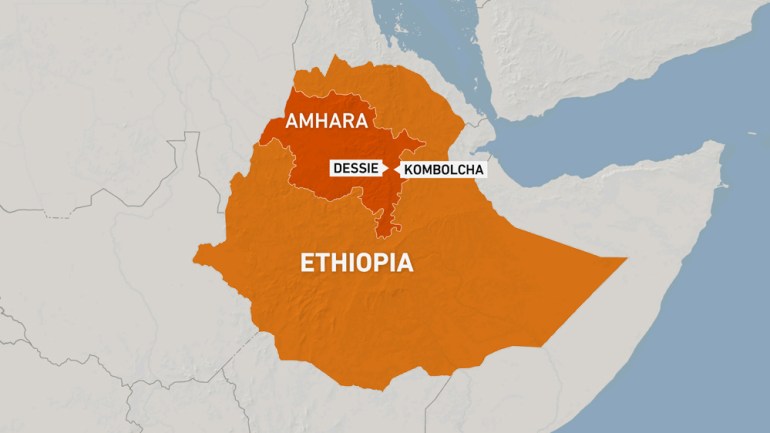
(Al Jazeera) Ethiopian forces have recaptured the strategic towns of Dessie and Kombolcha from Tigrayan fighters, the government said, the latest sign of the government retaking territory it recently lost.
Forces aligned with the Tigray People’s Liberation Front (TPLF) had taken control of the towns, in the Amhara region, just more than a month ago.
“The historic Dessie city and the trade and industry corridor city, Kombolcha have been freed by the joint gallant security forces,” the government communications service said on Twitter, the latest in a round of territorial gains claimed by Prime Minister Abiy Ahmed’s administration.
The state-run Ethiopian Broadcasting Corporation quoted Abiy as saying the rebels had sustained “heavy losses and (were) unable to cope with the strike by allied forces”, AFP news agency reported. “The enemy will be hit and the victory will continue,” he said.
TPLF spokesman Getachew Reda did not immediately respond to a request for comment.