Microscopy & Imaging News and Discussions

User avatar
wjfox
Site Admin
Posts: 13578
Joined: Sat May 15, 2021 6:09 pm
Location: Essex, UK
Contact:

Microscopy & Imaging News and Discussions

Post by wjfox »

Pretty cool breakthrough to start with.

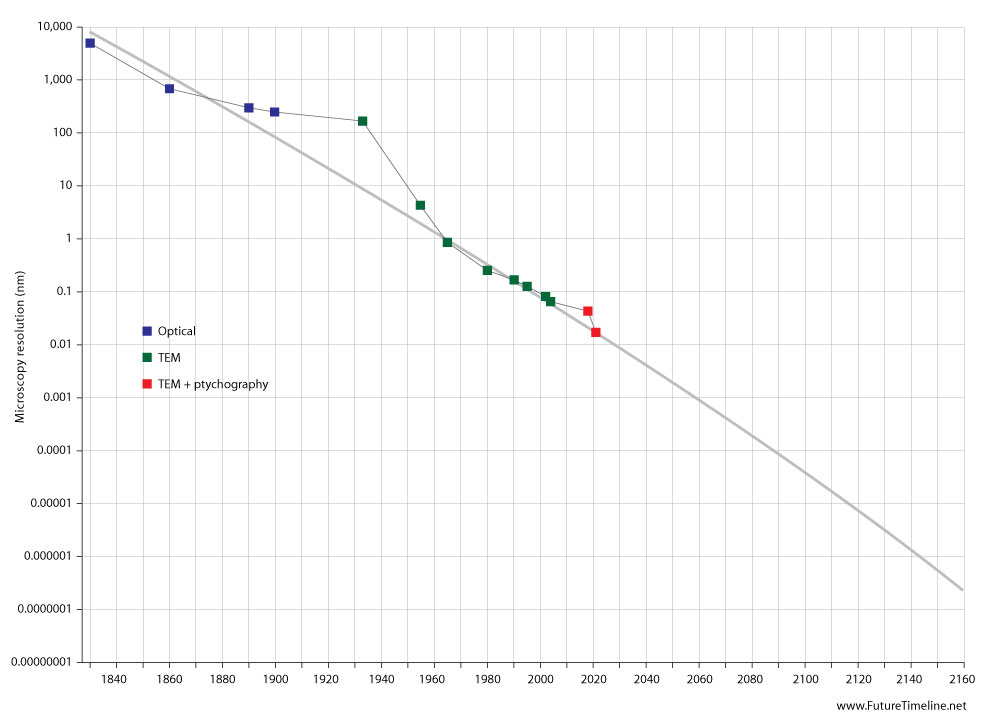
Check out my graph at the end of the blog. :)

-----

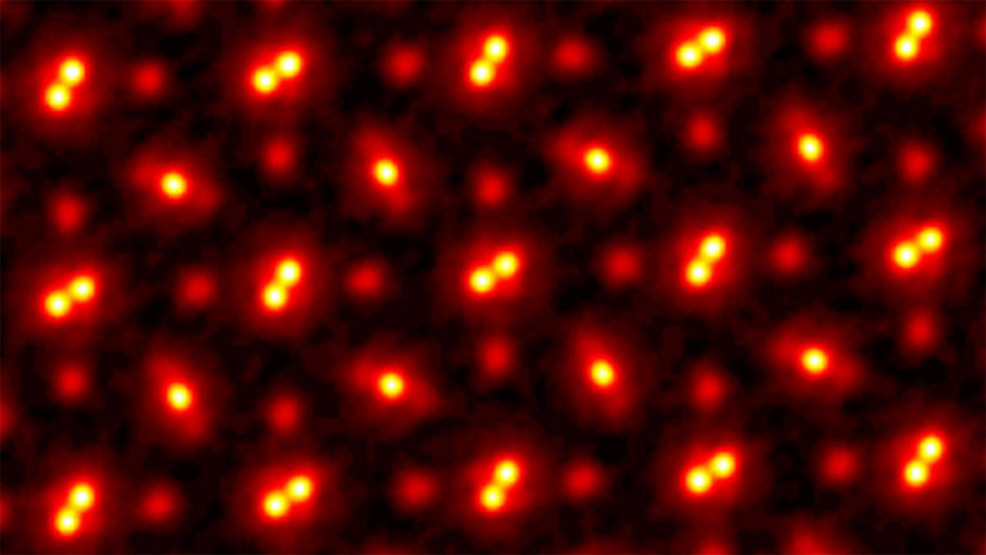
Atoms viewed at highest ever resolution

23rd May 2021

Researchers at Cornell University have developed a new microscopy technique that can shrink spatial resolution to less than 20 picometres.

https://www.futuretimeline.net/blog/202 ... nology.htm


Image


Image
User avatar
wjfox
Site Admin
Posts: 13578
Joined: Sat May 15, 2021 6:09 pm
Location: Essex, UK
Contact:

Re: Microscopy & Imaging News and Discussions

Post by wjfox »

Light-shrinking material lets ordinary microscope see in super resolution

June 1, 2021

Electrical engineers at the University of California San Diego developed a technology that improves the resolution of an ordinary light microscope so that it can be used to directly observe finer structures and details in living cells.

The technology turns a conventional light microscope into what’s called a super-resolution microscope. It involves a specially engineered material that shortens the wavelength of light as it illuminates the sample—this shrunken light is what essentially enables the microscope to image in higher resolution.

“This material converts low resolution light to high resolution light,” said Zhaowei Liu, a professor of electrical and computer engineering at UC San Diego.

[...]

“The major challenge is finding one technology that has very high resolution and is also safe for live cells,” said Liu.

The technology that Liu’s team developed combines both features. With it, a conventional light microscope can be used to image live subcellular structures with a resolution of up to 40 nanometers.

https://jacobsschool.ucsd.edu/news/release/3287


Image
User avatar
wjfox
Site Admin
Posts: 13578
Joined: Sat May 15, 2021 6:09 pm
Location: Essex, UK
Contact:

Re: Microscopy & Imaging News and Discussions

Post by wjfox »

Quantum microscope can examine cells in unprecedented detail

9 June 2021

Powerful microscopes have made a quantum leap. Using a quantum trick with light has allowed researchers to examine living cells in unprecedented detail without destroying them, a technique that could improve medical diagnoses and microbiology research.

The microscopes that are generally used to examine living biological systems shine one or two bright lights on their targets, and more powerful light sources allow researchers to see the cells in greater detail. But these devices have a fundamental limit to the precision they can achieve: at some point, a bright enough light will destroy a living cell.

“Our understanding of life as it is now has relied almost entirely on the quality of our microscopes,” says Warwick Bowen at the University of Queensland in Australia. “We’re really limited by technology, and it’s not obvious how to break the existing limits because we’ve already pushed the intensity as high as we can without destroying the cell.”

Bowen and his colleagues have found a way to overcome this limit. They used a type of microscope with two laser light sources, but sent one of the beams through a specially designed crystal that “squeezes” the light. It does so by introducing quantum correlations in the photons – the particles of light in the laser.

[...]

When the researchers tested their system, they found that they were able to make measurements that were 35 per cent sharper than a similar device that did not use squeezed light.

Read more: https://www.newscientist.com/article/22 ... z6xJ4rS3qx


Image
User avatar
wjfox
Site Admin
Posts: 13578
Joined: Sat May 15, 2021 6:09 pm
Location: Essex, UK
Contact:

Re: Microscopy & Imaging News and Discussions

Post by wjfox »

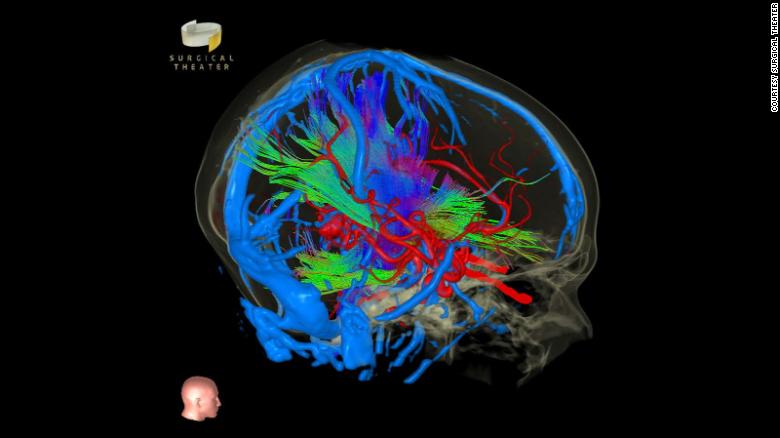
This tech uses augmented reality to give surgeons 'superpowers'

Updated 1304 GMT (2104 HKT) June 17, 2021

A new medical device collaboration is giving surgeons "x-ray vision," by fusing digitally enhanced images directly into the microscope of a surgical device.

The tech, called SyncAR, is a partnership between Los Angeles-based health tech innovators Surgical Theater, and Irish medical device company Medtronic.

While surgeons typically need to look up at screens in order to access patient data or enhanced visuals -- adding time and hindering surgical flow -- this system enables access to all that information in one place.

"When you have your hands on something delicate, such as the brain, every minute and second matters. Every small movement matters," says Moty Avisar, CEO and co-founder of Surgical Theater. "If you have to pull your head away from the microscope to look at a display and then go backwards, it disturbs the continuity of the surgery."

[...]

By having all the necessary information within the microscope display, he says the technology "improves our confidence" -- ultimately better for surgeons as well as patients.

Read more: https://edition.cnn.com/2021/06/17/heal ... index.html


Image
weatheriscool
Posts: 24486
Joined: Sun May 16, 2021 6:16 pm
Contact:

Re: Microscopy & Imaging News and Discussions

Post by weatheriscool »

Magneto-thermal imaging brings synchrotron capabilities to the lab
https://phys.org/news/2021-06-magneto-t ... s-lab.html
by David Nutt, Cornell University
Coming soon to a lab tabletop near you: a method of magneto-thermal imaging that offers nanoscale and picosecond resolution previously available only in synchrotron facilities.

This innovation in spatial and temporal resolution will give researchers extraordinary views into the magnetic properties of a range of materials, from metals to insulators, all from the comfort of their labs, potentially boosting the development of magnetic storage devices.

"Magnetic X-ray microscopy is a relatively rare bird," said Greg Fuchs, associate professor of applied and engineering physics, who led the project. "The magnetic microscopies that can do this sort of spatial and temporal resolution are very few and far between. Normally, you have to pick either spatial or temporal. You can't get them both. There's only about four or five places in the world that have that capability. So having the ability to do it on a tabletop is really enabling spin dynamics at nanoscale for research."
weatheriscool
Posts: 24486
Joined: Sun May 16, 2021 6:16 pm
Contact:

Re: Microscopy & Imaging News and Discussions

Post by weatheriscool »

An X-ray vision-like camera to rapidly retrieve 3D images
https://phys.org/news/2021-07-x-ray-vis ... ly-3d.html
by University of California, Irvine
It's not exactly X-ray vision, but it's close. In research published in the journal Optica, University of California, Irvine researchers describe a new type of camera technology that, when aimed at an object, can rapidly retrieve 3D images, displaying its chemical content down to the micrometer scale. The new tech promises to help companies inspect things like the insides of computer chips without having to pry them open—an advancement the researchers say could accelerate the production time of such goods by more than a hundred times.

"This is a paper about a way to visualize things in 3D very fast, even at video rate," said Dmitry Fishman—director of laser spectroscopy labs in the UCI Department of Chemistry—who, along with Eric Potma, professor of chemistry, spearheaded the work. The novel imaging tech is based on a so-called nonlinear optical effect in silicon—a semiconductor material used in visible-light cameras and detectors.
User avatar
wjfox
Site Admin
Posts: 13578
Joined: Sat May 15, 2021 6:09 pm
Location: Essex, UK
Contact:

Re: Microscopy & Imaging News and Discussions

Post by wjfox »

Seeing ultrafast dynamics of matter via a compact electron camera

DESY team demonstrates the first Terahertz enhanced electron diffractometer.

August 17, 2021

Using a newly developed compact electron camera, scientists at DESY could capture the inner, ultrafast dynamics of matter. The camera captures short bunches of electrons at a sample to take snapshots of its current inner structure.

This compact electron camera is an electron diffractometer that uses Terahertz radiation for pulse compression. The THz-compressed electron beams produce high-quality diffraction patterns and observe the ultrafast structural dynamics with improved time resolution.

[...]

DESY scientists Dongfang Zhang said, “The shorter the bunch, the faster the exposure time. Typically, ultrafast electron diffraction (UED) uses bunch lengths, or exposure times, of some 100 femtoseconds, which is 0.1 trillionths of a second.”

Advance particle accelerators can produce high-quality short electron bunches. Although, such machines are large and bulky. Also, they use radiofrequency radiation to power themselves.

Scientists, in this study, using Terahertz radiation instead with roughly a hundred times shorter wavelengths.

Franz Kärtner from the Center for Free-Electron Laser Science CFEL said, “This means, the accelerator components, here a bunch compressor, can be a hundred times smaller, too.”

https://www.techexplorist.com/seeing-ul ... era/40668/


Image
User avatar
wjfox
Site Admin
Posts: 13578
Joined: Sat May 15, 2021 6:09 pm
Location: Essex, UK
Contact:

Re: Microscopy & Imaging News and Discussions

Post by wjfox »

Amazing 3D images show the coronavirus infecting human airway cells

19 August 2021

A team in the Netherlands has managed to capture 3D images of human airway cells infected by SARS-CoV-2 using an extraordinary microscopic technique. The images show how the coronavirus alters the structure of the cells it infects, and might help drug development.

Researchers at Utrecht University grew cells taken from the noses of healthy volunteers and infected some of the cells with the coronavirus. They then stained the cells with fluorescent dyes that bind to fatty membranes (the blue parts in the video above), proteins (magenta) and the spike protein of the coronavirus (pink).

Next, the cells were cut up by enzymes and embedded in a gel. When water is added to the gel, it swells, enlarging the embedded structures. The technique (called expansion microscopy) was developed by other groups, but these researchers improved on it, enabling them to enlarge samples tenfold in each dimension.

This means optical microscopes can effectively resolve structures just 20 nanometres wide – including the SARS-CoV-2 virus, which is around 100 nanometres in diameter – whereas normally they can’t resolve objects smaller than 200 nanometres across.

The resulting images show that large membrane-bound compartments involved in virus formation appear inside infected airway cells.

https://www.newscientist.com/article/22 ... way-cells/


User avatar
wjfox
Site Admin
Posts: 13578
Joined: Sat May 15, 2021 6:09 pm
Location: Essex, UK
Contact:

Re: Microscopy & Imaging News and Discussions

Post by wjfox »

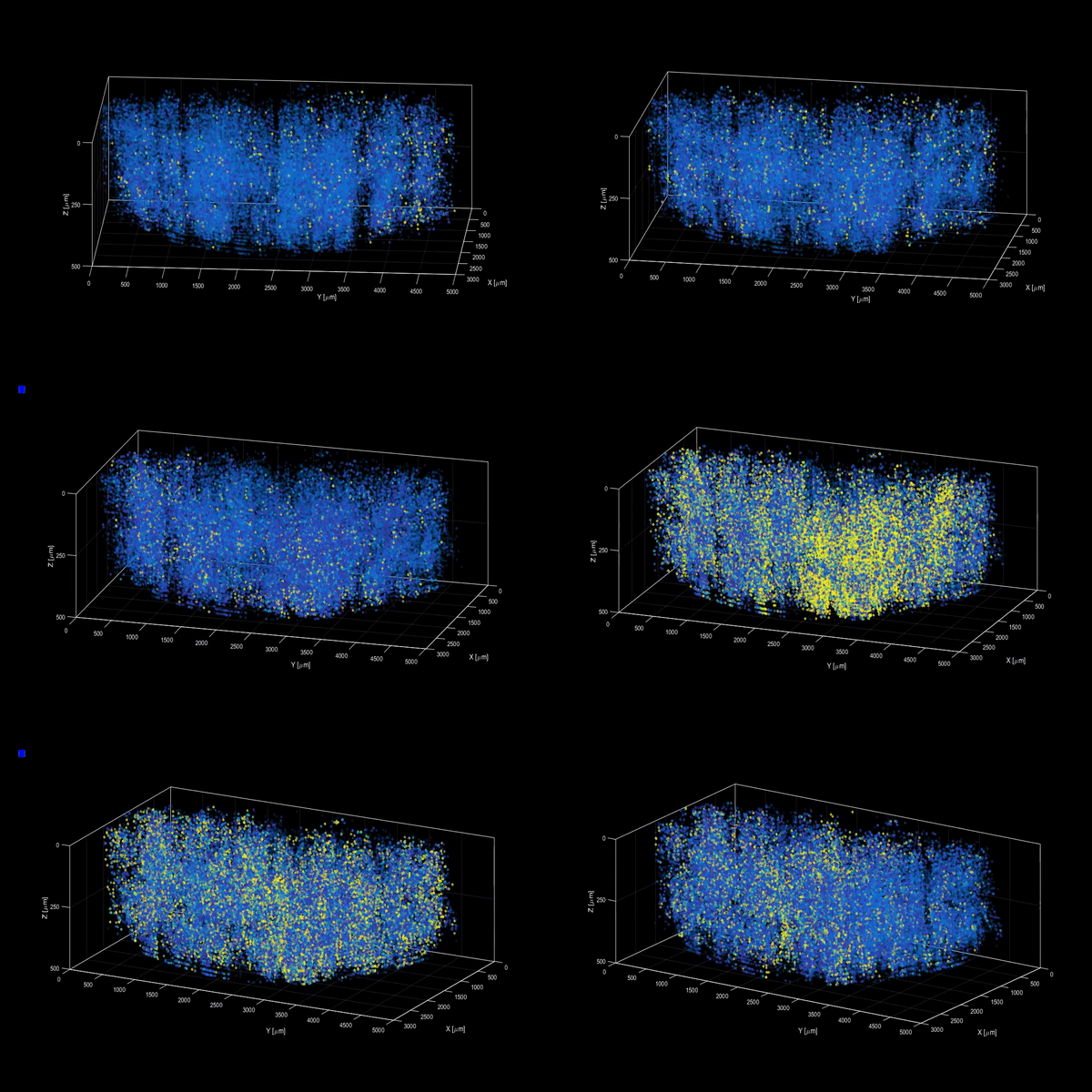
1 million neurons tracked in real time

7th October 2021

Scientists at Rockefeller University have developed a new technique for visualising the activity of a million neurons, near-simultaneously and with crystal clear resolution.

[...]

A decade ago, scientists had been limited to scanning a few thousand neurons in real time. The orders of magnitude improvement since then suggests it may be possible to observe a whole mouse brain (70 million neurons) in the near future. Larger brains, such as those of monkeys (6.3 billion for a macaque) could follow – and then perhaps humans (86 billion) a relatively short time after that.

In the coming decades, researchers might achieve "thought mapping" and psychological diagnosis at a near-real-time speed, making the treatment of both physical and mental illnesses much more targeted.

Read more: https://www.futuretimeline.net/blog/202 ... l-time.htm


Image
User avatar
wjfox
Site Admin
Posts: 13578
Joined: Sat May 15, 2021 6:09 pm
Location: Essex, UK
Contact:

Re: Microscopy & Imaging News and Discussions

Post by wjfox »

World’s most powerful MRI scanner delivers its first images - of the inside of a pumpkin

By Julie Gaubert • Updated: 08/10/2021 - 19:43

The world’s most powerful MRI scanner, which could have profound implications in diagnosing neurological diseases, has delivered its first images - of a pumpkin.

Called "Iseult," the machine is the fruit of more than 20 years of research and partnership between the French Atomic Energy Commission (CEA) and German manufacturer Siemens-Healthineers.

The machine will make it possible "to study the brain structure in a finer way," according to Cécile Lerman, engineer and project manager behind the new MRI scanner.

[...]

The machine aims for an image resolution of under half a millimetre, a leap forward in the medical field that will allow "to go much more finely in the resolution of the spatial structures" of the brain.

The results could help to better understand the brain’s anatomy but also how it functions during cognitive tasks.

https://www.euronews.com/next/2021/10/0 ... -a-pumpkin


Image
weatheriscool
Posts: 24486
Joined: Sun May 16, 2021 6:16 pm
Contact:

Re: Microscopy & Imaging News and Discussions

Post by weatheriscool »

3D imaging study reveals how atoms are packed in amorphous materials
https://phys.org/news/2021-10-3d-imagin ... phous.html
by California NanoSystems Institute

Many substances around us, from table salt and sugar to most metals, are arranged into crystals. Because their molecules are laid out in an orderly, repetitive pattern, much is understood about their structure.

However, a far greater number of substances—including rubber, glass and most liquids—lack that fundamental order throughout, making it difficult to determine their molecular structure. To date, understanding of these amorphous substances has been based almost entirely on theoretical models and indirect experiments.

A UCLA-led research team is changing that. Using a method they developed to map atomic structure in three dimensions, the scientists have directly observed how atoms are packed in samples of amorphous materials. The findings, published today in Nature Materials, may force a rewrite of the conventional model and inform the design of future materials and devices using these substances.

"We believe this study is going to have a very important impact on the future understanding of amorphous solids and liquids—which are among the most abundant substances on Earth," said the study's senior author, Jianwei "John" Miao, a UCLA professor of physics and astronomy and a member of the California NanoSystems Institute at UCLA. "Understanding the fundamental structures may lead to dramatic advances in technology."
weatheriscool
Posts: 24486
Joined: Sun May 16, 2021 6:16 pm
Contact:

Re: Microscopy & Imaging News and Discussions

Post by weatheriscool »

Novel advanced light design and fabrication process could revolutionize sensing technologies
https://phys.org/news/2021-10-advanced- ... ogies.html
by Vanderbilt University

Vanderbilt and Penn State engineers have developed a novel approach to design and fabricate thin-film infrared light sources with near-arbitrary spectral output driven by heat, along with a machine learning methodology called inverse design that reduced the optimization time for these devices from weeks or months on a multi-core computer to a few minutes on a consumer-grade desktop.

The ability to develop inexpensive, efficient, designer infrared light sources could revolutionize molecular sensing technologies. Additional applications include free-space communications, infrared beacons for search and rescue, molecular sensors for monitoring industrial gases, environmental pollutants and toxins.

The research team's approach, detailed today in Nature Materials, uses simple thin-film deposition, one of the most mature nano-fabrication techniques, aided by key advances in materials and machine learning.

Standard thermal emitters, such as incandescent lightbulbs, generate broadband thermal radiation that restricts their use to simple applications. In contrast, lasers and light emitting diodes offer the narrow frequency emission desired for many applications but are typically too inefficient and/or expensive. That has directed research toward wavelength-selective thermal emitters to provide the narrow bandwidth of a laser or LED, but with the simple design of a thermal emitter. However, to date most thermal emitters with user-defined output spectra have required patterned nanostructures fabricated with high-cost, low-throughput methods.

The research team led by Joshua Caldwell, Vanderbilt associate professor of mechanical engineering, and Jon-Paul Maria, professor of materials science and engineering at Penn State, set out to conquer long-standing challenges and create a more efficient process. Their approach leverages the broad spectral tunability of the semiconductor cadmium oxide in concert with a one-dimensional photonic crystal fabricated with alternating layers of dielectrics referred to as a distributed Bragg reflector.
weatheriscool
Posts: 24486
Joined: Sun May 16, 2021 6:16 pm
Contact:

Re: Microscopy & Imaging News and Discussions

Post by weatheriscool »

Tiny chip provides a big boost in precision optics
https://phys.org/news/2021-11-tiny-chip ... ision.html
by University of Rochester

By merging two or more sources of light, interferometers create interference patterns that can provide remarkably detailed information about everything they illuminate, from a tiny flaw on a mirror, to the dispersion of pollutants in the atmosphere, to gravitational patterns in far reaches of the Universe.

"If you want to measure something with very high precision, you almost always use an optical interferometer, because light makes for a very precise ruler," says Jaime Cardenas, assistant professor of optics at the University of Rochester.

Now, the Cardenas Lab has created a way to make these optical workhorses even more useful and sensitive. Meiting Song, a Ph.D. student, has for the first time packaged an experimental way of amplifying interferometric signals—without a corresponding increase in extraneous, unwanted input, or "noise"—on a 1 mm by 1 mm integrated photonic chip. The breakthrough, described in Nature Communications, is based on a theory of weak value amplification with waveguides that was developed by Andrew Jordan, a professor of physics at Rochester, and students in his lab.
User avatar
wjfox
Site Admin
Posts: 13578
Joined: Sat May 15, 2021 6:09 pm
Location: Essex, UK
Contact:

Re: Microscopy & Imaging News and Discussions

Post by wjfox »

Ultracompact camera is the size of a salt grain

29th November 2021

U.S. researchers have developed a new imaging device just 500 μm (0.5 mm) in diameter. The system can produce crisp, full-colour images on a par with conventional compound camera lenses 500,000 times larger in volume.

Read more: https://www.futuretimeline.net/blog/202 ... -grain.htm


Image
weatheriscool
Posts: 24486
Joined: Sun May 16, 2021 6:16 pm
Contact:

Re: Microscopy & Imaging News and Discussions

Post by weatheriscool »

Eye imaging technology breaks through skin by crossing beams
https://phys.org/news/2021-12-eye-imagi ... -skin.html
by Duke University
Biomedical engineers at Duke University have demonstrated a method for increasing the depth at which optical coherence tomography (OCT) can image structures beneath skin.

The gold standard for imaging and diagnosing diseases within the retina, OCT has yet to find widespread use as an imaging technique for other parts of the body due to its inability to return clear images from more than a millimeter beneath the skin's surface.

Duke researchers found that tilting the light source and detector used in the technique increases OCT's imaging depth by almost 50%, putting skin diagnoses within reach. The "dual-axis" approach opens new possibilities for OCT to be used in applications such as spotting skin cancer, assessing burn damage and healing progress, and guiding surgical procedures.

The results appear online on December 1 in the open access journal Biomedical Optics Express.

"It's actually a fairly simple technique that sounds like something out of Ghostbusters—you get more power when you cross the beams," said Adam Wax, professor of biomedical engineering at Duke. "Being able to use OCT even 2 or 3 millimeters into the skin is extremely useful because there are a lot of biological processes happening at that depth that can be indicative of diseases like skin cancer."
weatheriscool
Posts: 24486
Joined: Sun May 16, 2021 6:16 pm
Contact:

Re: Microscopy & Imaging News and Discussions

Post by weatheriscool »

Revolutionising imaging through an optical fiber the width of a human hair
https://phys.org/news/2021-12-revolutio ... width.html
by University of Glasgow

A new imaging technique, allowing 3D imaging at video rates through a fiber the width of a human hair, could transform imaging for a wide range of applications in industrial inspection and environmental monitoring. In the longer term the technique could be further developed for applications in medical imaging.

The system was developed by an international team of scientists led by the University of Glasgow's Optics Group. In a new paper published today in the journal Science, the team describe how they have been able to create video images from a single multimode optical fiber using a process known as time-of-flight 3D imaging.

Professor Miles Padgett, Royal Society research professor at the University of Glasgow and principal investigator for QuantIC, the UK Hub for Quantum Enhanced Imaging, said: "In applications like endoscopy and boroscopy imaging is traditionally achieved by using a bundle of optical fibers, one fiber for every pixel in the image, resulting in devices the thickness of a finger.

"As an alternative, we are developing a new technique for imaging through a single fiber the width of a human hair. Our ambition is to create a new generation of single-fiber imaging devices that can produce 3D images of remote scenes.
weatheriscool
Posts: 24486
Joined: Sun May 16, 2021 6:16 pm
Contact:

Re: Microscopy & Imaging News and Discussions

Post by weatheriscool »

Research team demonstrates angular-spectrum-dependent interference
https://phys.org/news/2021-12-team-angu ... ndent.html
by Chinese Academy of Sciences

Optical interference is not only a fundamental phenomenon that has enabled new theories of light to be derived, but it has also been used in interferometry for the measurement of small displacements, refractive index changes, and surface irregularities. The Michelson interferometer is a commonly used interferometer, by which the equal-inclination and equal-thickness interference fringes of light can be easily observed. Historically, this interferometer has been used in many famous physical experiments, such as the Michelson-Morey experiment and gravitational wave detection.

In a new paper published in Light Science & Application, a team of scientists led by Professor Bao-Sen Shi and associate professor Zhi-Yuan Zhou from CAS Key Laboratory of Quantum Information, University of Science and Technology of China, has demonstrated a special equal-inclination interference by using non-monochromatic photons in a Michelson interferometer, manifested as the number of ring-like fringes increasing much more rapidly with increasing optical-path-difference (OPD) than the corresponding fringes for equal-inclination interference.
weatheriscool
Posts: 24486
Joined: Sun May 16, 2021 6:16 pm
Contact:

Re: Microscopy & Imaging News and Discussions

Post by weatheriscool »

Researchers use electrically responsive fluid to make eye-like adaptive lens
https://phys.org/news/2022-01-electrica ... -lens.html
by The Optical Society
Researchers have developed an adaptive liquid lens based on a new electrically responsive fluid called dibutyl adipate (DBA) that changes focal length when a voltage is applied. The lens is lightweight, compact and simple to fabricate, which makes it ideal for mobile phone cameras, endoscopes, eyeglasses and machine vision applications.

"The human eye can arbitrarily focus on objects at different distances at incredibly fast speeds," said research team leader Miao Xu from Hefei University of Technology in China. "Inspired by this functionality, we developed an eye-like adaptive liquid lens that can be used to diverge or converge light by changing the shape of the DBA liquid."

In the Optica Publishing Group journal Optics Letters, the researchers describe their new DBA-based adaptive liquid lens, which weighs just a few grams, and show that it exhibits high optical performance with good stability. DBA's electronegative molecular structure allows an applied voltage to be used to rapidly change the lens's shape to modify its focal length. DBA is also transparent, non-volatile and inexpensive, making it ideal for use in adaptive liquid lenses.
User avatar
wjfox
Site Admin
Posts: 13578
Joined: Sat May 15, 2021 6:09 pm
Location: Essex, UK
Contact:

Re: Microscopy & Imaging News and Discussions

Post by wjfox »

Ultralow-field MRI scanner could improve global access to neuroimaging

18 Jan 2022

A compact ultralow-field (ULF) brain MRI scanner that does not require magnetic or radiofrequency shielding and is acoustically quiet during scanning has been developed at the University of Hong Kong. The scanner’s low manufacturing and operating costs reinforce the potential of ULF MRI technology to meet the clinical needs of hospitals in low- and middle-income countries, as well as point-of-care medical facilities such as surgical suites and emergency rooms.

https://physicsworld.com/a/ultralow-fie ... roimaging/


Image
User avatar
wjfox
Site Admin
Posts: 13578
Joined: Sat May 15, 2021 6:09 pm
Location: Essex, UK
Contact:

Re: Microscopy & Imaging News and Discussions

Post by wjfox »

Post Reply