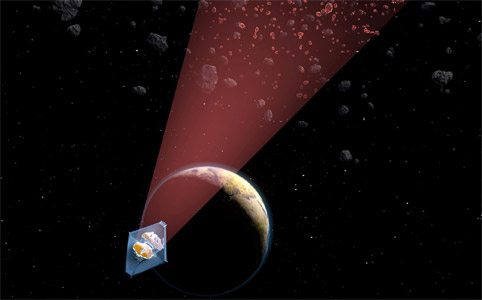
NASA's first mission to sample an asteroid is moving ahead into development and testing in preparation for its launch in 2016.
The Origins-Spectral Interpretation Resource Identification Security Regolith Explorer (OSIRIS-REx) has passed a confirmation review called Key Decision Point C (KDP-C). Officials reviewed a series of detailed project assessments and authorised the spacecraft's continuation into the development phase.
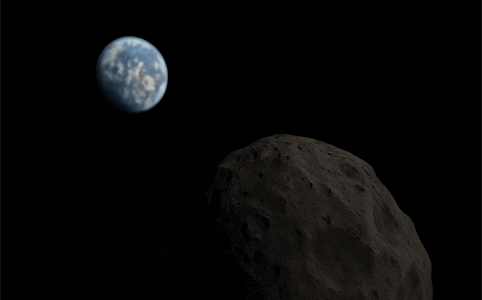
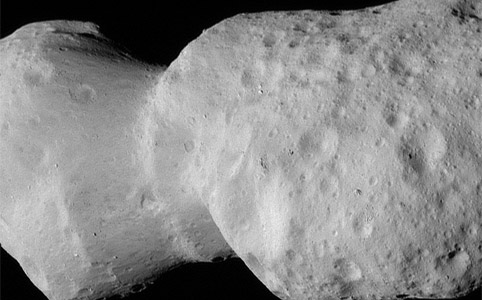
OSIRIS-REx will rendezvous with the asteroid Bennu (formerly known as 1999 RQ36) in 2018 and return a sample of it to Earth in 2023. Bennu is a carbonaceous rock measuring 580m (1,900 ft) in diameter, with an Earth-crossing orbit. It has a small chance of colliding with Earth between the years 2169 and 2199.
"Successfully passing KDP-C is a major milestone for the project," said Mike Donnelly, OSIRIS-REx project manager at NASA's Goddard Space Flight Center in Greenbelt, Md. "This means NASA believes we have an executable plan to return a sample from Bennu. It now falls on the project and its development team members to execute that plan."
Bennu could hold clues to the origin of the solar system. OSIRIS-REx will map the asteroid's global properties, measure non-gravitational forces and provide observations that can be compared with data obtained by telescope observations from Earth. The probe will collect a minimum of 2 ounces (60 grams) of surface material.
"The entire OSIRIS-REx team has worked very hard to get to this point," said Dante Lauretta, OSIRIS-REx principal investigator at the University of Arizona in Tucson. "We have a long way to go before we arrive at Bennu, but I have every confidence when we do, we will have built a supremely capable system to return a sample of this primitive asteroid."
The mission will be a vital part of NASA's plans to find, study, capture and relocate an asteroid for exploration by astronauts. NASA recently announced an asteroid initiative proposing a strategy to leverage human and robotic activities for the first human mission to an asteroid while also accelerating efforts to improve the detection and characterisation of asteroids.
As featured on our timeline, NASA has plans for a manned mission to Mars by 2033. In this video, CNN's Brooke Baldwin discusses space travel to Mars with astronaut Buzz Aldrin, the second man to walk on the Moon's surface. His new book, Mission to Mars: My Vision for Space Exploration, was published this month.
A new company plans to deliver the first 3D printer into space, enabling astronauts to use this revolutionary new manufacturing process.
Made in Space was established in 2010 by alumni of the Singularity University, a non-profit institution whose founders include Ray Kurzweil and Peter Diamandis. For the past three years, they have been working to perfect 3D printers capable of functioning in microgravity. According to Chief Technology Officer, Jason Dunn, the company has flown more than 400 reduced gravity aircraft flights to test the machines.
Having recently been awarded a contract with NASA, the team will be sending their first 3D printer into space next year aboard a SpaceX Dragon freighter, for use on board the International Space Station (ISS). This will enable astronauts to print parts and replacement components in orbit instead of having to ship them up from Earth, saving time and money. Experiments will also demonstrate the long-term effects of microgravity on 3D printing, as well as providing a valuable scientific foundation for future additive manufacturing in space.
Aaron Kemmer, CEO: "The future of space exploration will change forever when everything we need for space is built in space. In this future, parts, habitats and structures are not launched and assembled, but instead 3D-printed, layer-by-layer in outer space with additive manufacturing."
In a separate development, Washington State University researchers last year demonstrated a way of using Moon rock to print objects. Perhaps in the not-too-distant future, spacecraft really will have "replicator"-style devices like those featured in Star Trek...
Just two weeks into the 19 week application period, more than 78,000 people have applied to the Mars One astronaut selection program in the hope of becoming a settler in 2023.
Mars One has received applications from over 120 countries. Most come from the United States (17324), followed by China (10241), the United Kingdom (3581), Russia, Mexico, Brazil, Canada, Colombia, Argentina and India.
Bas Lansdorp, Mars One Co-Founder and CEO: "With seventy-eight thousand applications in two weeks, this is turning out to be the most desired job in history. These numbers put us right on track for our goal of half a million applicants."
"Mars One is a mission representing all humanity and its true spirit will be justified only if people from the entire world are represented. I'm proud that this is exactly what we see happening," he said.
As part of the application, every candidate is required to explain his/her motivation behind their decision go to Mars in a one minute video. Many applicants are choosing to publish this video on the Mars One website. These are openly accessible on applicants.mars-one.com.
"Applicants we have received come from a very wide range of personalities, professions and ages. This is significant because what we are looking for is not restricted to a particular background. From Round 1, we will take forward the most committed, creative, resilient and motivated applicants," said Dr. Norbert Kraft, Mars One Chief Medical Officer.
Mars One will continue to receive online applications until 31st August 2013. From all the applicants in Round 1, regional reviewers will select around 50-100 candidates for Round 2 in each of the 300 geographic regions in the world that have been identified.
Four rounds make the selection process, which will come to an end in 2015; Mars One will then employ 28-40 candidates, who will train for around 7 years. Finally, an audience vote will elect one of the groups in training to become the envoys of humanity to Mars.