11th May 2026 Tiny world beyond Pluto reveals a surprise atmosphere Astronomers in Japan have detected an extremely thin atmosphere around a small icy world beyond Neptune, challenging theories about how small bodies hold on to gases.
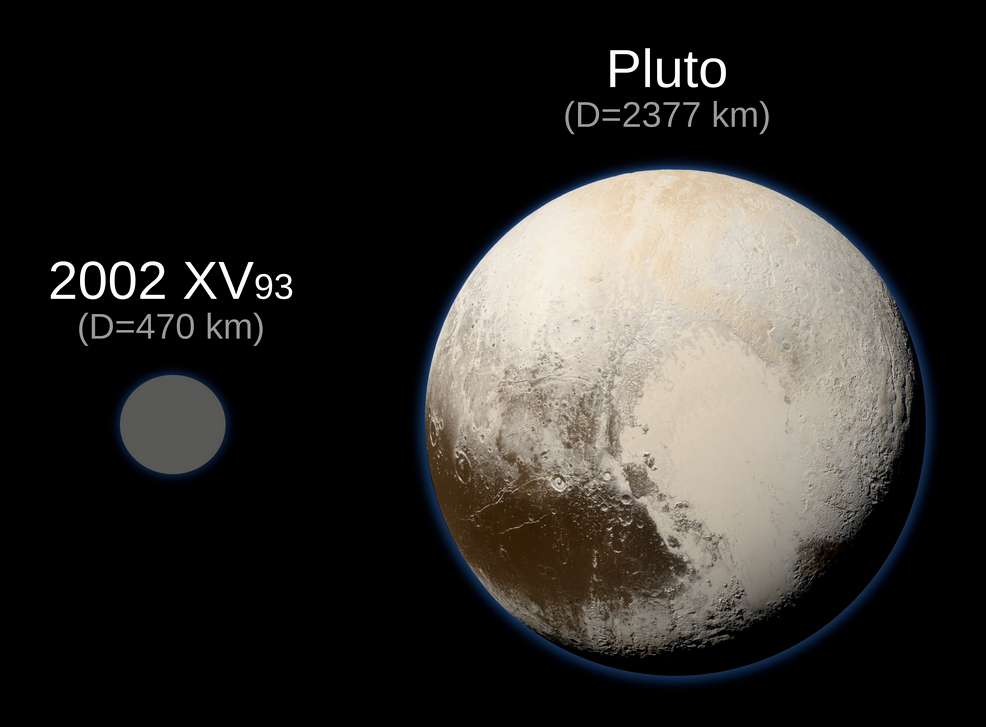
A small, distant world in the Kuiper Belt has delivered one of the more unexpected Solar System discoveries of recent years. Astronomers have found evidence for an atmosphere around (612533) 2002 XV93, an icy object first spotted at Palomar Observatory in December 2002. The object, often shortened to 2002 XV93, belongs to a class known as plutinos. Like Pluto, it follows a 2:3 orbital resonance with Neptune, completing two orbits around the Sun for every three made by the giant planet. It measures roughly 470 km across, about one-fifth the diameter of Pluto and one-seventh that of Earth's Moon. Its orbit carries it between 34.4 and 44.2 astronomical units from the Sun, with one full circuit taking about 246 years. This new discovery came from a stellar occultation on 10th January 2024. From Earth's perspective, 2002 XV93 passed in front of a distant star in the constellation Auriga, causing the star to dim for around 20 seconds. If the object had no atmosphere, the star should have vanished and reappeared sharply. Instead, telescopes in Japan recorded a gradual fading and recovery at the object's edge, lasting about 1.5 seconds. A team led by Ko Arimatsu at the National Astronomical Observatory of Japan analysed this signal and concluded that a very thin atmosphere had bent and dimmed the light.
Although very thin, the atmosphere makes 2002 XV93 a remarkable outlier among small icy worlds. The team estimates a surface pressure of 100–200 nanobars (0.0001–0.0002 millibars). Earth's atmosphere measures about 1,013 millibars at sea level, Mars averages around 6 millibars, Pluto sits near 0.01 millibars, and Venus reaches a crushing 92,000 millibars. Titan, Saturn's largest moon, even has a denser atmosphere than Earth. By comparison, 2002 XV93 barely has a whisper of gas, but that whisper still appears tens of millions of times denser than the Moon's exosphere. It also marks the first confirmed atmosphere detected around a trans-Neptunian object other than Pluto. The finding matters because gravity should struggle to hold gases around such a small body. Its surface gravity is only about 1% of Earth's. Models suggest that 2002 XV93 should lose its atmosphere within 1,000 years, unless something replenishes it. That points to a recent or ongoing source. One possibility is a recent impact by a small comet or similar object, which may have released trapped gases and created a temporary atmosphere. Another is cryovolcanic activity, with volatile gases or ices seeping from the interior through cracks in the frozen surface. The atmosphere's composition remains unknown, though methane, nitrogen or carbon monoxide are among the most plausible candidates. "If the atmosphere was impact-generated, it may decline over the next several years or decades," said Arimatsu. "If it persists or varies seasonally, that would favour ongoing internal supply." Either result would make 2002 XV93 more than just a frozen relic. It could show that even small, remote worlds retain surprising dynamism billions of years after their formation. A paper on the discovery appears this month in Nature Astronomy.
Comments »
If you enjoyed this article, please consider sharing it:
|