19th May 2026 Temperate super-Earth found orbiting nearby red dwarf A team of astronomers from Italy and Brazil has reported a temperate super-Earth within the habitable zone of Ross 318, a nearby red dwarf just 28 light-years away.
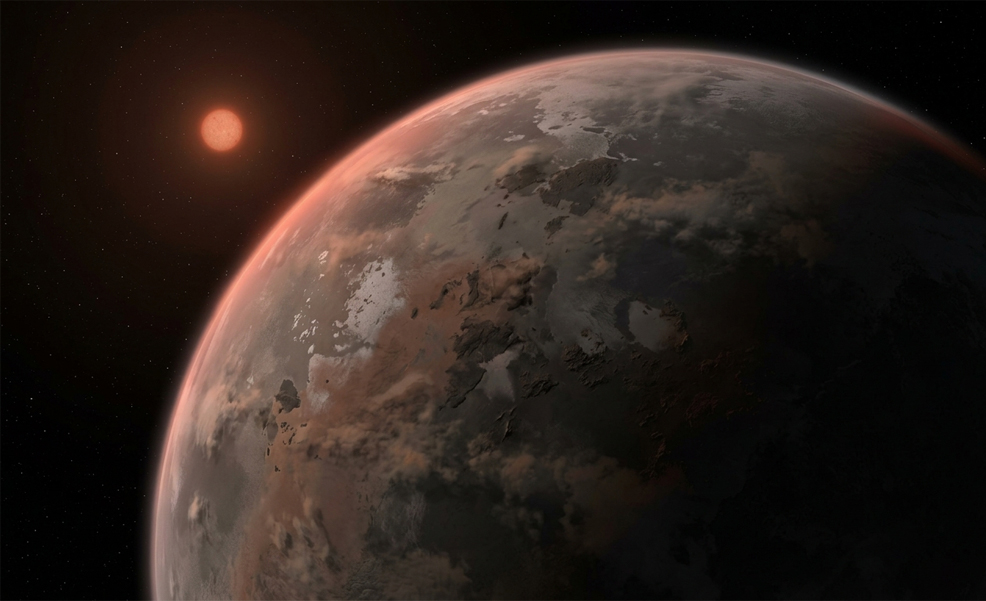
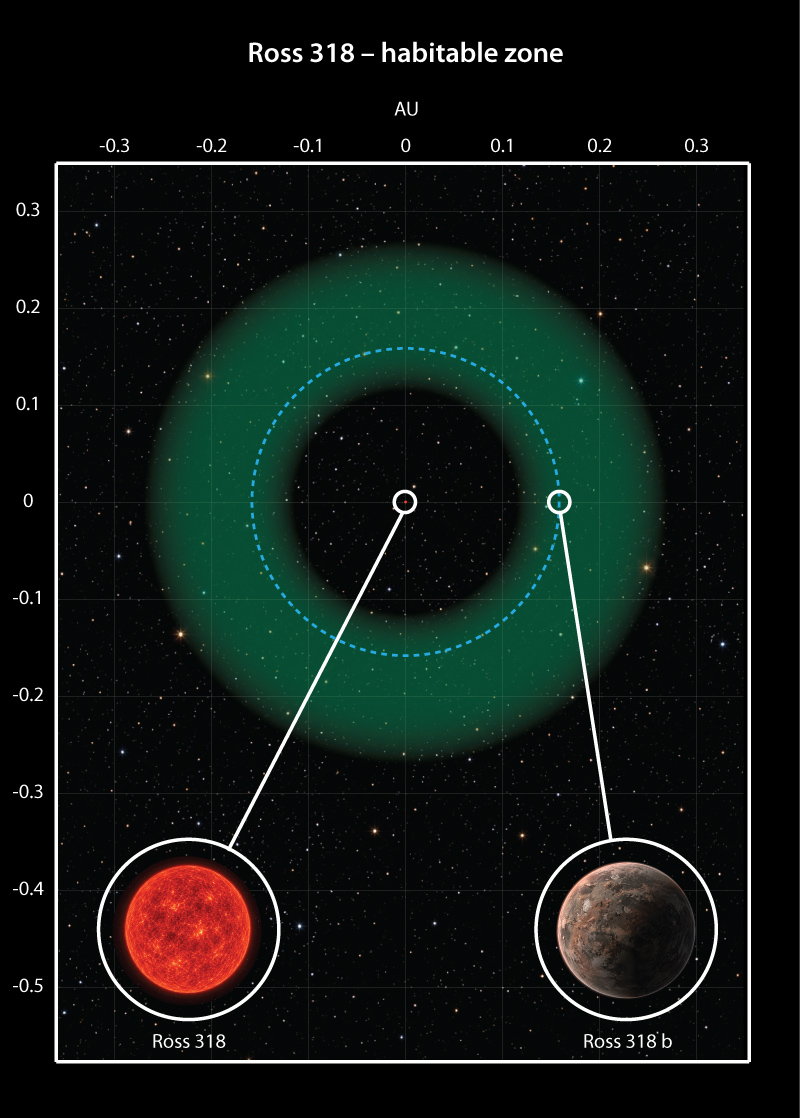
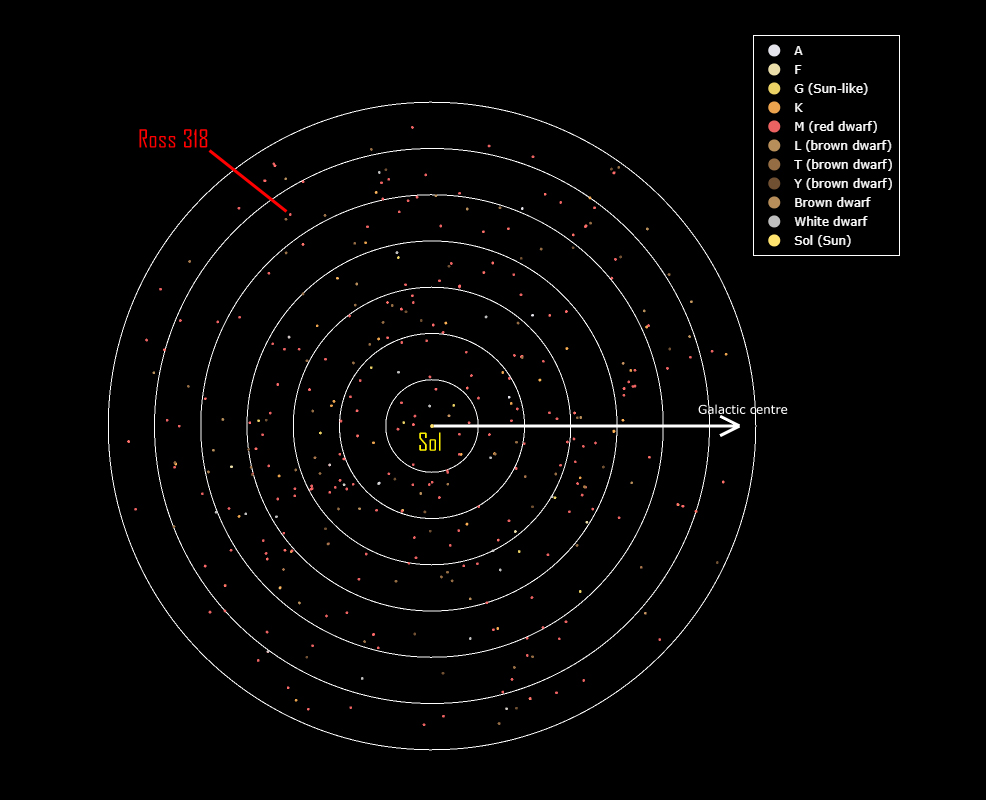
A temperate super-Earth has been reported around Ross 318, a small red dwarf star located 8.58 parsecs, or 28 light-years, from the Solar System. The planet, named Ross 318 b, appears to orbit its star every 39.6 days and has a minimum mass of 6.21 Earth masses. The finding appears in a preprint submitted to the Open European Journal on Variable Stars and available on arXiv. While the results are promising, the study has not yet undergone peer review, meaning further verification will be needed before Ross 318 b can be confirmed. The researchers used radial velocity measurements from CARMENES, a planet-hunting spectrograph on the 3.5-metre telescope at Calar Alto Observatory, Spain, and HIRES, installed on the 10-metre Keck I telescope in Hawaii. Both instruments can detect the tiny "wobbles" of a star caused by the gravitational influence of an orbiting planet. Their analysis combined data covering a 15-year baseline, helping to distinguish the planet-like signal from the star's own magnetic activity. Ross 318 is an M3.5V red dwarf – a relatively cool, low-mass, M-class star – with significant magnetic activity and a rotation period of around 51.5 days. This can complicate exoplanet searches, because starspots and magnetic regions may mimic the signal of an orbiting planet. Red dwarfs are nevertheless common targets in the search for habitable planets, since their small size makes orbiting worlds easier to detect. For Ross 318 b, the study concludes that the 39.6-day signal is separate from the star's 51.5-day rotation. The authors point to the signal's long-term stability, its presence in multiple instruments, and its behaviour across both visible and near-infrared wavelengths as evidence that it comes from a real planet, rather than starspots or other magnetic effects.
NASA's Transiting Exoplanet Survey Satellite (TESS) also observed Ross 318, but found no transit. This suggests that Ross 318 b does not pass directly in front of its star from our point of view. As a result, astronomers cannot yet measure its radius directly. However, the study estimates that a rocky planet of this mass would have a radius of around 1.7 times that of Earth, equivalent to a diameter of about 22,000 km. Ross 318 b receives about 58% as much stellar energy as Earth receives from the Sun, placing it within the conservative habitable zone – the narrower region around a star where surface liquid water is considered plausible under standard climate assumptions. Its estimated equilibrium temperature, meaning the theoretical temperature it would have without the warming effect of an atmosphere, is around 237 K (-36°C). This is cold by Earth standards, but potentially compatible with liquid water if the planet has a sufficiently thick atmosphere. Whether Ross 318 b has retained an atmosphere is unknown. Like many habitable-zone planets around red dwarfs, it may be tidally locked, with one hemisphere permanently facing its star. Climate models in previous research have demonstrated that a sufficiently thick atmosphere can transport heat from the day side to the night side, reducing temperature extremes and potentially allowing habitable conditions across broad regions. However, stellar flares, high-energy radiation, and atmospheric escape remain major uncertainties. If confirmed, Ross 318 b could become a valuable nearby target for future observations. The study authors describe it as "one of the most interesting temperate Super-Earths orbiting an M-dwarf." Because the planet does not appear to transit its star, atmospheric studies may prove challenging, but the Webb Telescope and next-generation observatories could help constrain the properties of similar worlds. Later missions, using advanced high-contrast techniques, may eventually be able to probe nearby non-transiting worlds like Ross 318 b for atmospheric signatures such as water vapour, carbon dioxide, methane, or oxygen. At 28 light-years away, Ross 318 b is far beyond the reach of present-day spacecraft. Yet it lies within the local stellar neighbourhood. If it proves to harbour a stable atmosphere, surface water, or other useful conditions, it could one day be studied in detail by interstellar probes – and perhaps, in the more distant future, considered as a destination for settlement.
Comments »
If you enjoyed this article, please consider sharing it:
|