|
|
|
|
|
|
|
2250
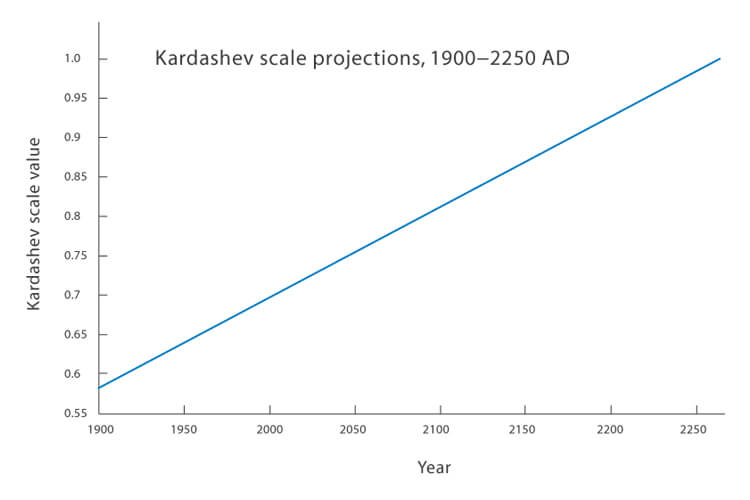
Humanity is a Type 1 civilisation on the Kardashev scale
By this date, virtually all of the Earth's natural energy is being captured and harnessed in some way.* Vast swathes of land, sea and atmosphere have been transformed into a series of enormous power grids using wind, solar, hydroelectric and geothermal technologies. These are supplemented by fusion and antimatter, along with wholly new forms of energy production that were unknown to scientists in previous centuries.
In Earth orbit, a comprehensive network of stations is now in place. This cluster is organised in such a way that it harvests every ounce of incoming solar radiation being reflected back into space. In terms of raw electrical power, the total converted energy is equivalent to 52 petawatts (PW).* Each vessel acts as a node within a gigantic web, completely encircling the planet. The nodes produce attractive forces between each other, forming an invisible "shield" absorbing solar radiation from literally the entire globe.

This technology has the added benefit of stabilising the Earth's climate, since the network can be adjusted at certain points to control the amount of heat getting through. These variations allow rain to fall whenever and wherever necessary, while hurricanes and other such phenomena are easily controlled.
The vast amount of energy now available to humanity is creating enormous wealth and prosperity. Earth's physical infrastructure is revolutionised - with teleporters available for civilian use, gargantuan skyscrapers reaching miles into the sky, and material needs practically eliminated.
However, even greater breakthroughs have been occurring in cyberspace, which has supplanted physical reality completely, for many people. Virtual worlds are now of such grandeur and ingenuity that they far surpass anything in the real world. These digital environments run at speeds considerably greater than real time - further accelerating the pace of innovation.
From this point onwards, the only way for civilisation to gain more energy is to expand outward into space.* Massive colonisation efforts are now underway. Asteroid mining dominates the economy of the inner Solar System, while hydrogen and helium are being siphoned from the gas giants. Meanwhile, terraforming of Mars has passed a critical stage, with bacteria and lichen beginning to appear on the surface.
Interstellar travel increases greatly during this time. The settlements on Alpha Centauri, Barnard's Star and Wolf 359 are inhabited by thousands of humans and machines by now, while the most distant exploratory craft have reached over 50 light years from Earth. Faster-than-light travel is proving to be more difficult to achieve than previously thought, however, with maximum velocity still limited to 0.99c.
2257
Eris reaches perihelion
Eris is the second largest dwarf planet in the Solar System. Discovered in 2005 by the Palomar Observatory in California, it was found to be 2,326 km (1,445 mi) in diameter, making it only slightly smaller than Pluto. Although Pluto is larger by volume, Eris has a greater mass, the ninth greatest in the Solar System. Subsequent observations revealed that Eris had a small moon, later named Dysnomia.
The albedo of Eris was measured at 0.96, making it brighter than any other solid body in the Solar System except Enceladus. It was speculated that its high albedo was due to surface ices being replenished by temperature fluctuations as Eris's orbit took it closer and farther from the Sun.
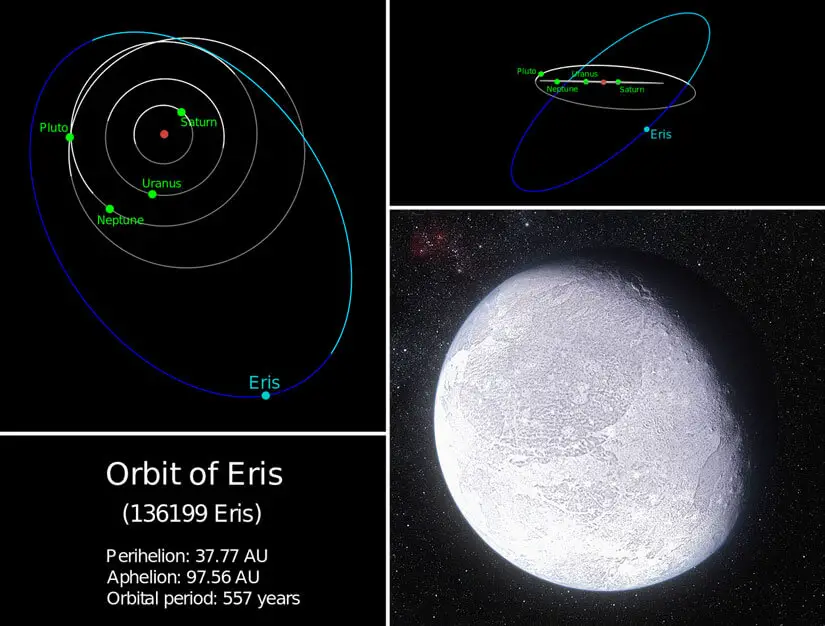
As a trans-Neptunian object (TNO), and a member of the scattered disk, the orbit of Eris is highly eccentric – ranging from 97.56 astronomical units (AU) at its furthest point, to 37.77 AU during its closest approach to the Sun. It last reached perihelion in 1699 and aphelion in 1977. With the exception of some comets, Eris and Dysnomia were the most distant known natural objects in the Solar System during the early 21st century, at roughly three times the distance to Pluto.
Eris has an orbital period of 558 years. It returns to perihelion in 2257.* Models of internal heating via radioactive decay suggested that Eris could have an internal ocean of liquid water at the mantle–core boundary. This was confirmed by robotic exploration missions during the mid-21st century. With its relatively closer distance to the Sun, Eris gains importance in the 23rd century – as both a source of water extraction, and a staging post to more remote destinations like the Oort Cloud, Alpha Centauri and beyond.
Credits: Orionist [CC BY-SA 3.0] and ESO/L. Calçada and Nick Risinger (skysurvey.org) [CC BY 4.0]
2260
Accelerated development of the Solar System
With humanity shifting its focus beyond Earth, a veritable gold rush is taking place throughout the Solar System. Countless technological and engineering marvels are now possible in space, aided by the vast growth of AI which is dominating planetary and interplanetary government.
On Mercury, colonies roll around the equator on giant train tracks – keeping pace with the planet's rotation so that they are always kept in the "terminator" zone. This ensures that the Sun never rises fully above the horizon, maintaining the optimum temperature and brightness.*
On Venus, a massive terraforming effort is underway. Automated craft are being sent to water-rich comets, redirecting them into the planet's upper atmosphere, while genetically-engineered extremophile bacteria are being seeded on the ground. Due to the much denser and more hostile atmosphere, this process is slower than the efforts on Mars. However, with many people achieving practical immortality, human endeavors are becoming increasingly focussed on the long term. Already, there are citizens buying up land and real estate on the surface in preparation for the centuries and millenia ahead.
Earth's own moon is the most heavily populated of all the space colonies. It now has millions of permanent inhabitants. Entire cities have grown up around the original Apollo landing sites. Huge numbers of citizens are involved in the expansion of infrastructure and technological research.
In the previous century, Mars had declared its independence from Earth. Its surface is now dotted with large tent cities and criss-crossed with a hyperfast, automated rail network. The terraforming operation is proceeding on schedule, with a number of giant orbital mirrors now in place.
Thousands of asteroids are now being mined – both in the main-belt and the Trojan region. Advances in nanotechnology and related fields enable these rocky bodies to be stripped literally atom-by-atom, so that nothing goes to waste. Precious metals are harvested for use in hi-tech industries, while volatiles such as water can be supplied wherever needed. Some of these minor planets are being hollowed out, their interiors converted into enormous power plants, scientific stations, or utopian habitats.
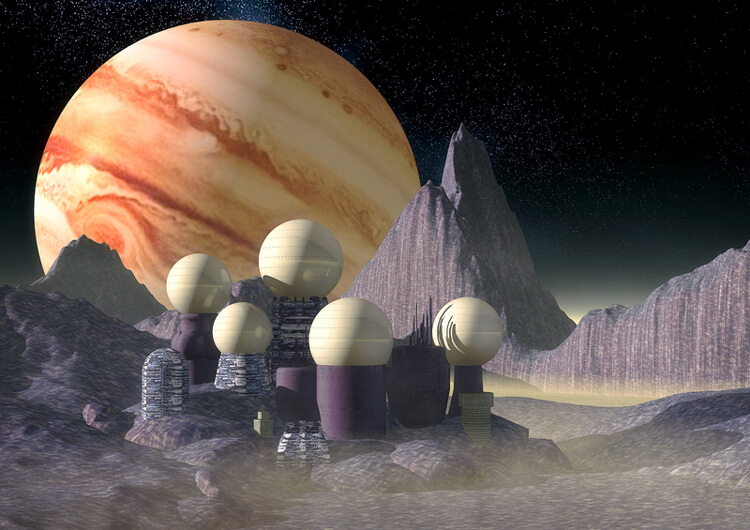
Meanwhile, Jupiter is gaining a steady influx of prospectors – led by cyborgs and non-biologicals. These individuals are better adapted to the radiation belts and harsh environmental conditions on Ganymede, Io, Europa et al.* Whilst the moons are being exploited for their metals, minerals and water ice, Jupiter itself is being mined for its rich gas resources. A number of floating cities and gigantic refineries are beginning to appear in the upper atmosphere.
A similar situation is occurring in the Saturnian system. Its largest moon Titan is now home to entire cities, while Enceladus is showing great potential as a water source for the outer Solar System.* The rings of Saturn now have luxurious hotels orbiting around them, offering spectacular views of the planet. Guests can venture outside and drift among the slowly moving ice fragments.
Even the distant planets of Uranus and Neptune have gas miners now. Pluto and the Kuiper Belt, too, are being exploited and developed after being fully probed and catalogued in detail. The number of citizens making the journey to neighbouring star systems is growing exponentially during this time.
© Luca
Oleastri | Dreamstime.com
2280
Microbial life is confirmed on an exoplanet
Antimatter propulsion has allowed much of the local stellar neighbourhood to be explored. By the end of the 23rd century, the first direct confirmation of alien life is obtained.
After surveying thousands of worlds, automated probes uncover a unicellular organism within 100 light years of our Solar System. This lifeform reproduces via binary fission. It has an internal chemical structure that is remarkably similar to DNA, suggesting that this form of replication may be quite common throughout the Universe. It exists on a warm, wet planet with a G-type star as its parent.** This system includes gas giants in the outer regions, offering some protection from comets and other incoming bodies.
The impact of this discovery is less profound than it might have been in previous centuries. Religion has already vanished from many societies, for example. Science and technology in general have advanced so far – and in so many new ways – that previous "wonders" of the Universe are beginning to diminish in significance: even the possibility of alien life. Though still hailed as a landmark discovery, the emotional aspect of this and other breakthroughs has waned considerably, as human thought and endeavour become ever more computerised, logical and machine-like. Transhumans and robots now make up the bulk of the mainstream population.
Efforts are now underway to uncover more advanced and complex life. The potential for contact with intelligent alien races is now being given considerable attention.

© Arbi
Babakhanaians | Dreamstime.com
« 2249 |
⇡ Back to top ⇡ |
2300 » |
If you enjoy our content, please consider sharing it:
References
1 Kardashev
scale, Wikipedia:
http://en.wikipedia.org/wiki/Kardashev_scale.
Accessed 5th July 2009.
2 Solar energy, Wikipedia:
http://en.wikipedia.org/wiki/Solar_energy#Energy_from_the_Sun
Accessed 5th July 2009.
3 The Singularity is Near, by Ray Kurzweil (2005)
Accessed 5th July 2009.
4 Eris (dwarf planet), Wikipedia:
https://en.wikipedia.org/wiki/Eris_%28dwarf_planet%29
Accessed 22nd July 2015.
5 This concept appears in Blue Mars, by Kim Stanley Robinson.
http://www.amazon.com/Blue-Mars-Kim-Stanley-Robinson/
6 The Jovian system could pose significant problems for biological humans, due to its extreme radiation and gravity well. It would deliver about 3,600 rems per day to unshielded colonists at Io, and about 540 rems per day to unshielded colonists at Europa. Exposure of approximately 75 rems over a few days is enough to cause radiation poisoning, while 500 rems over a few days is usually fatal.
7 Colonization of the outer Solar System, Wikipedia:
http://en.wikipedia.org/wiki/Colonization_of_the_outer_Solar_System#Enceladus
Accessed 18th April 2010.
8 Top 10 List of Habitable Stars to Guide Search, Space.com:
http://www.space.com/scienceastronomy/060221_habstars.html
Accessed 7th July 2010.
9 Stellar classification, Wikipedia:
http://en.wikipedia.org/wiki/Spectral_classification#Class_G
Accessed 7th July 2010.