Future Timeline Blog | Future Blog | Technology Trends Blog | Tech Trends Blog | 2012 | 2013 | 2014 | 2015 | 2020 | 2050 | Singularity Blog

Home | Latest predictions | Blog | Forum | Links | Contact

Future Timeline Blog | Future Blog | Technology Trends Blog | Tech Trends Blog | 2012 | 2013 | 2014 | 2015 | 2020 | 2050 | Singularity Blog  Future Timeline Blog | Future Blog | Technology Trends Blog | Tech Trends Blog | 2012 | 2013 | 2014 | 2015 | 2020 | 2050 | Singularity Blog  Future Timeline Blog | Future Blog | Technology Trends Blog | Tech Trends Blog | 2012 | 2013 | 2014 | 2015 | 2020 | 2050 | Singularity Blog


Blog


IBM supercomputer becomes the world's fastest

18th June 2012

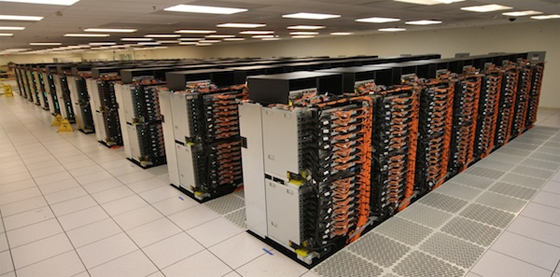
"Sequoia" - built by US computing giant IBM - has overtaken Fujitsu's "K Computer" to become the fastest supercomputer in the world. Installed at the Department of Energy's Lawrence Livermore National Laboratory, it achieved an impressive 16.32 petaflop/s (compared with 10.51 petaflops/s for the K Computer), using 1,572,864 cores and 1.6 PB of memory, in 96 racks covering 3,000 sq ft (280m2).

This is equivalent to calculating in one hour what otherwise would take 7 billion people using hand calculators 320 years to complete if they worked non-stop.


sequoia


Sequoia is also one of the most energy efficient computer systems. It draws about 8 MW of power, with an unprecedented performance of 2000 Mflops/watt, about 5 times as efficient as the Blue Gene/P design it is replacing. Sequoia will be used primarily for nuclear weapons simulation, astronomy, energy, studying of the human genome, and climate change.

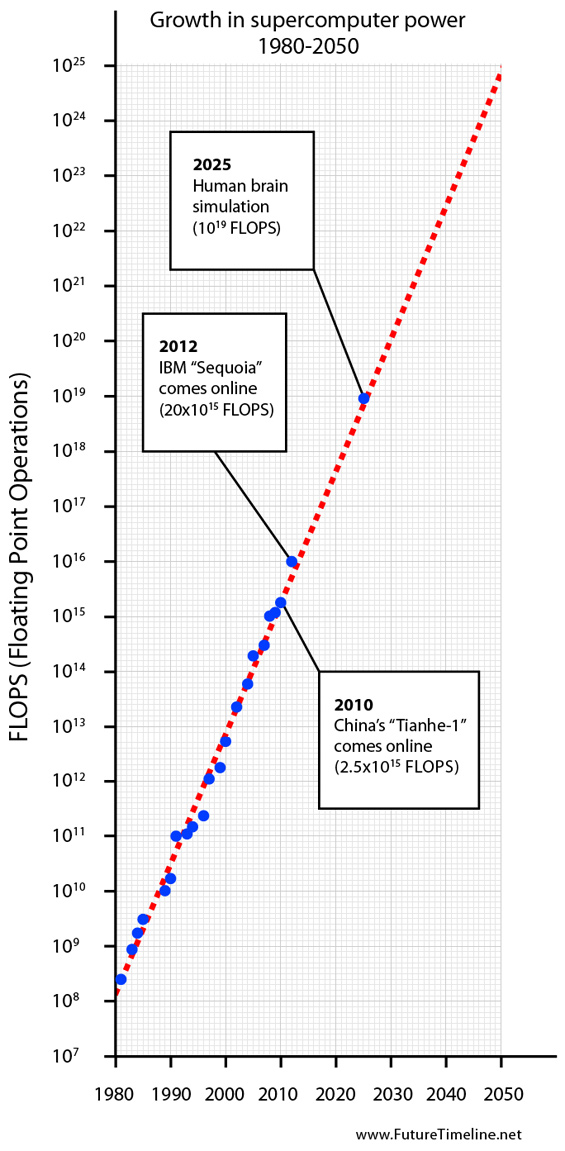
Like many forms of information technology, supercomputers have been growing exponentially in power for decades with a smooth and highly predictable long-term trend. At current rates of progress, it should be possible to simulate an entire human brain and all of its neurons in real time by the mid-2020s.

You can view a full list of the fastest supercomputers at top500.org


supercomputers trend


speech bubble Comments »


comments powered by Disqus


« Previous Next »


Subject

AI & Robots
Biology & Medicine
Business & Politics
Computers & the Internet
Energy & the Environment
FutureTimeline.net
Home & Leisure
Military & War
Nanotechnology
Society & Demographics
Space
Transport & Infrastructure


Archive

October 2012
September 2012
August 2012
July 2012
June 2012
May 2012
April 2012
March 2012
February 2012
January 2012
December 2011
November 2011
October 2011
September 2011
March 2011
February 2011
December 2010
September 2010


Home | Latest predictions | Blog | Forum | Links | Contact
Future Timeline Blog | Future Blog | Technology Trends Blog | Tech Trends Blog | 2012 | 2013 | 2014 | 2015 | 2020 | 2050 | Singularity Blog  Future Timeline Blog | Future Blog | Technology Trends Blog | Tech Trends Blog | 2012 | 2013 | 2014 | 2015 | 2020 | 2050 | Singularity Blog  Future Timeline Blog | Future Blog | Technology Trends Blog | Tech Trends Blog | 2012 | 2013 | 2014 | 2015 | 2020 | 2050 | Singularity Blog

Future Timeline Blog | Future Blog | Technology Trends Blog | Tech Trends Blog | 2012 | 2013 | 2014 | 2015 | 2020 | 2050 | Singularity Blog