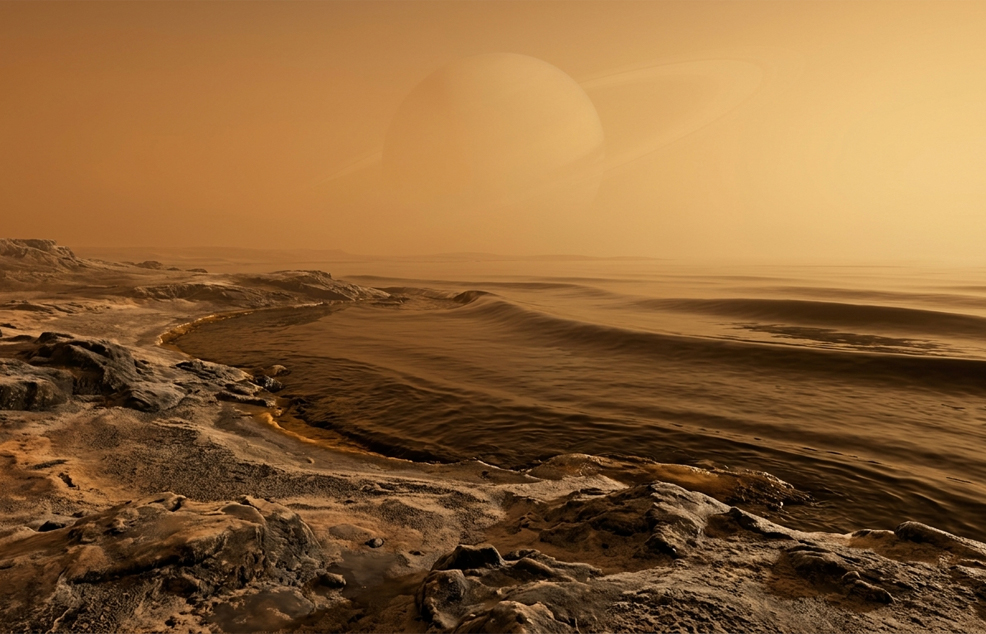
18th April 2026 Waves on Titan could reach five metres in height From gentle ripples to towering alien seas, a new model reveals how waves on other worlds could vary dramatically, shaped by exotic liquids, gravity, and atmospheric pressure.
Waves are a familiar sight on Earth, driven by wind transferring energy into oceans and lakes. But beyond our planet, this seemingly simple process becomes far more complex. A new study by scientists at MIT and collaborators introduces a physics-based model capable of predicting how waves form and evolve under radically different planetary conditions – from ancient Mars to Saturn's moon Titan and even distant exoplanets. Unlike earlier approaches, which relied heavily on Earth-based assumptions, the new "PlanetWaves" model adapts to any combination of gravity, atmosphere, and liquid composition. This allows researchers to simulate environments where oceans may consist not of water, but of methane, nitrogen, sulfuric acid, or even molten rock. Titan, the largest of Saturn's moons, is one of the most striking examples. With its dense atmosphere about 1.5 times Earth's and gravity just 14% as strong, waves can begin forming under extremely light winds of 0.5 metres per second (1 mph). Under modest winds of 5 m/s (11 mph), the study predicts waves reaching around five metres in height, far exceeding those produced under similar conditions on Earth. These dark, oily waves would also move more slowly, shaped by the moon's weak gravity and the unusual properties of its methane and ethane seas. "Anywhere there's a liquid surface with wind moving over it, there's potential to make waves," explains Taylor Perron, Professor of Earth, Atmospheric and Planetary Sciences at MIT. "For Titan, the tantalising thing is that we don't have any direct observation of what these lakes look like. So we don't know for sure what kind of waves might exist there. Now this model gives us an idea."
Ancient Mars would also have been capable of sustaining waves, particularly in crater lakes such as Jezero, which is still being explored by NASA's Perseverance rover mission. The study suggests that even relatively gentle winds could have generated noticeable wave activity. At higher wind speeds of 10 m/s, waves could have reached 1.5 metres in height along the downwind edges of lakes under thinner atmospheric conditions, rising closer to 2.5 metres in a denser atmosphere, depending on their size and shape. This raises the intriguing possibility that some sedimentary features observed today may have been shaped by wind-driven water movement. As Mars's atmosphere gradually disappeared, reducing pressure over time, it would have required stronger winds to make the same waves. By contrast, more extreme worlds present harsher conditions. On exoplanets such as Kepler-1649 b, a Venus-like planet with gravity similar to Earth's but lakes of sulfuric acid nearly twice as dense as water, waves would require far stronger winds to form and would remain comparatively small. In the case of 55 Cancri e, a super-Earth where oceans may consist of molten rock, thresholds for wave generation become so high that surface motion is minimal even under intense atmospheric winds. These differences are not merely academic. Waves play a key role in shaping coastlines, redistributing sediment, and mixing liquids, all of which influence climate and long-term planetary evolution. They may also affect how we detect oceans remotely, since surface roughness alters the way light reflects from a planet. For Titan in particular, the findings arrive at a timely moment. Despite strong theoretical predictions, direct evidence of waves has remained elusive, with past observations showing only subtle surface disturbances. Future missions may finally resolve this mystery. NASA's Dragonfly mission, set to explore Titan in 2034, will focus primarily on land, but its broader study of the moon's environment could help refine our understanding of its methane cycle. More ambitious concepts, such as floating probes or landers on Titan's lakes, could one day observe waves directly, helping confirm whether these alien seas behave as models predict. "You would want to build something that can withstand the energy of the waves," says lead author Una Schneck, a graduate student in MIT's Department of Earth, Atmospheric and Planetary Sciences. "So it's important to know what kind of waves these instruments would be up against." "There have been attempts in the past to predict how gravity will affect waves on other planets," Schneck adds. "But they don't quantify other factors such as the composition of the liquid that is making waves. That was the big leap with this project." Looking further ahead, as exploration extends to ocean worlds and distant exoplanets, models like PlanetWaves will become essential tools. They offer a glimpse of dynamic, ever-changing surfaces far beyond Earth – places where familiar physics plays out in unfamiliar ways, and where even a gentle breeze might stir vast and otherworldly oceans. In the more distant future, entirely alien environments may yet be discovered, shaped by extreme gravity and atmospheric conditions unlike anything we know today. Worlds reminiscent of those imagined in Interstellar (mild spoiler) may one day blur the line between science fiction and reality.
Comments »
If you enjoyed this article, please consider sharing it:
|