26th April 2026 Red squirrels in England could vanish by 2050 Once a familiar symbol of British wildlife, red squirrels have retreated to isolated strongholds. Now, new projections warn that without action, they could disappear from mainland England within 25 years.
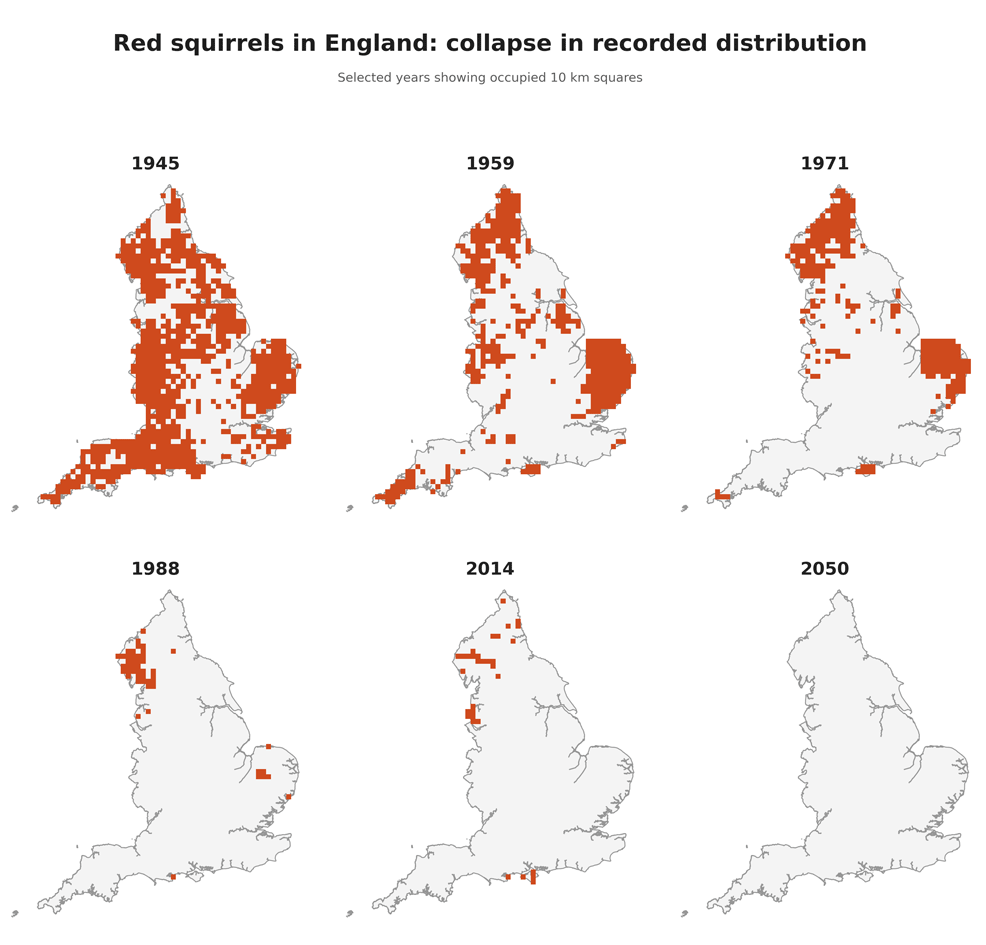
Red squirrels have long held a special place in England's cultural imagination. From woodland scenes on Christmas cards to children's stories like Beatrix Potter's Squirrel Nutkin, they are among the most recognisable and cherished symbols of native wildlife. Yet behind this familiar image lies a sadder reality: over the past hundred years, the species has all but vanished from much of the country. Once widespread across England's forests and hedgerows, red squirrels are now confined to a handful of fragmented populations. A major new study, led by the Zoological Society of London on behalf of Natural England, warns that this decline may be approaching its final stage. Under a "do nothing" scenario, the species is projected to disappear entirely from mainland England within the next 25 years. The roots of this collapse stretch back to the late 19th century. In 1876, grey squirrels were first introduced to England from North America as ornamental additions to the grounds of stately homes. Over the following decades, around 30 separate introductions took place, before their ecological impact became increasingly clear. Legislative action led to a 1937 order banning the importation and keeping of grey squirrels. By this point, a steady and irreversible shift had already begun. Grey squirrels spread rapidly across mainland England, outcompeting the native species and fundamentally reshaping the country's woodland ecosystems. The scale of the long-term decline becomes clear when viewing historical distribution data. Records of occupied 10 km grid squares show a dramatic contraction over time, with the species retreating from southern and central England during the 20th century and becoming increasingly restricted to northern regions and isolated refuges. Today, red squirrels have disappeared from the vast majority of their former range. The remaining populations are concentrated in northern England, mainly in parts of Northumberland and Cumbria, along with a few protected locations such as the Isle of Wight and Brownsea Island. Across the UK, there are thought to be around 250,000 red squirrels, the bulk of them in Scotland. In England, the total population is estimated at roughly 38,900 individuals, compared with more than 2.5 million grey squirrels. Without significant intervention, projections suggest that red squirrels could disappear entirely from mainland England by the middle of this century.
The primary driver of this decline is the ecological advantage held by grey squirrels. Larger and more adaptable, they outcompete reds for both food and habitat. They also carry the squirrelpox virus, which is harmless to greys but usually fatal to red squirrels. Researchers first identified the disease in a red squirrel in Norfolk, East Anglia, in 1980, although it had likely circulated undetected for some years beforehand. Other diseases, including adenovirus, have also been noted in some populations, including those on the Isle of Wight, though their impact is less well understood. Beyond their impact on native wildlife, grey squirrels also cause significant economic damage. Bark stripping can weaken trees, reduce timber value, and increase vulnerability to disease, with the overall cost to forestry estimated at £37 million per year across England and Wales. Habitat loss and fragmentation have further weakened red populations, leaving them small, isolated, and vulnerable. The newly published England Red Squirrel Recovery Strategy sets out a detailed assessment of the situation. Drawing on input from more than 60 experts and organisations, the study evaluated 18 potential conservation approaches. Its conclusions are stark: current efforts are likely to be inadequate, and continuing with the status quo is highly likely to result in extinction across mainland England within the next few decades. Among the options considered, large-scale suppression of grey squirrels offers the greatest chance of restoring red squirrel populations. However, this approach comes with significant financial cost (upwards of £500 million per year), potential impacts on animal welfare, and uncertain public support. Alternative strategies, such as combining red squirrel translocations with more targeted regional management – particularly in northern England – may offer a more practical and politically viable path forward. Other potential solutions remain at an earlier stage of development. These include fertility control for grey squirrels and experimental vaccines to protect red squirrels from squirrelpox. At present, the report estimates only a 34% chance that an effective vaccine will be developed. Natural predators such as pine martens have also been suggested as a potential means of controlling grey squirrel populations, but their impact remains uncertain and they are not considered a primary solution within the current strategies. Interestingly, more recent (post-2014) data suggests a modest increase in the number of locations where red squirrels are recorded. However, this does not necessarily indicate a recovery and is more likely the result of improved monitoring, increased reporting through citizen science, and focused conservation efforts in key areas. The broader picture remains one of long-term decline, with the species occupying only a small fraction of its historical range. Red squirrels have not yet disappeared, and in some regions continue to persist thanks to sustained conservation work. But the overall trend is unmistakable. Without coordinated national action, the species risks following a path already seen across much of England – from widespread presence to scattered remnants, and ultimately to local extinction. The coming decades will determine whether red squirrels remain a living part of England's ecosystems or become a species remembered primarily through stories, illustrations, and the landscapes they once inhabited.
Comments »
If you enjoyed this article, please consider sharing it:
|