19th June 2026 Light-driven memory could slash AI energy use A new magnetic memory material could allow data to be rewritten up to 1,000 times faster than conventional electrically driven memory, offering a potential route to cooler, lower-power AI hardware and data centres.
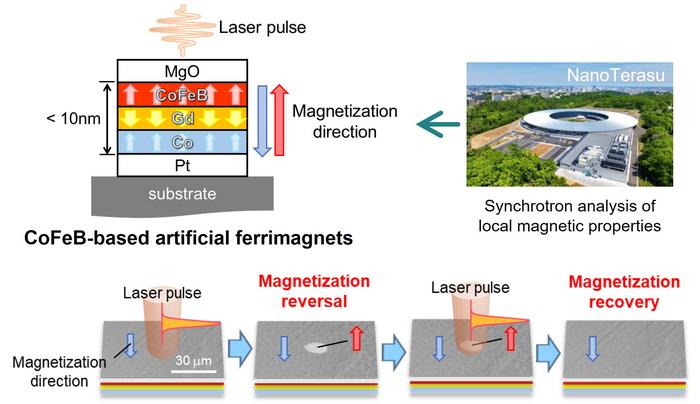
As artificial intelligence, cloud computing and digital services continue to expand, the world is facing a growing need for faster and more energy-efficient ways to store and process information. A team led by Japan's National Institutes for Quantum Science and Technology (QST) has now developed a new magnetic memory material that can be rewritten using laser light instead of electric current, which could slash power consumption in data centres and support future high-speed information systems. A study on the breakthrough is published this month in Applied Physics Letters. The new material allows magnetic information to be switched by a single ultrashort laser pulse. Because light can reverse magnetic states much faster than electric current, the approach could deliver switching speeds about 1,000 times higher than those of conventional electrically driven magnetic memory, while also reducing heat generation and energy loss. The researchers say this advance points to a new class of low-power magnetic memory for AI hardware, edge devices and future optoelectronic platforms. "Today's digital society needs memory technologies that are both faster and more sustainable," said Dr. Seiji Sakai, Group Leader at the Quantum Materials and Applications Research Center, Takasaki Institute for Advanced Quantum Science, QST. "By showing that a practical memory material can be switched using light, we believe this work opens a realistic path toward ultrafast, low-power devices for future information systems." Magnetic memory stores information by changing the direction of magnetisation inside a material. Existing magnetic memory technologies typically use electric current to write data. That approach is attractive because it can retain information even when power is turned off, but it also faces major limitations: the writing speed is constrained, and current generates heat, which increases energy consumption. Those challenges are becoming more serious as AI and large-scale digital infrastructure continue to push power demand upward. To address this problem, the team focused on all-optical switching, a phenomenon in which light reverses magnetic orientation without the need for a current. This effect had previously been observed in ferrimagnetic materials, but those were not suitable for practical memory because their magnetic readout properties were too weak for stable digital operation. By contrast, cobalt-iron-boron alloy (CoFeB) is already widely used in magnetic memory because it offers nearly complete spin polarisation and excellent readout performance, yet it had not been considered suitable for optical switching. The researchers overcame that barrier by designing a new artificial ferrimagnet built from antiferromagnetically exchange-coupled layers of cobalt, gadolinium and CoFeB. By tuning the thickness of each layer with atomic-scale precision and optimising the full multilayer structure, they created a material in which magnetic states can be reversed reproducibly with a single femtosecond laser pulse, lasting just one millionth of a nanosecond. The team also showed that the write-and-rewrite operation could be repeated stably, demonstrating the basic functionality required for memory applications.
Credit: National Institutes for Quantum Science and Technology
"One of the most important aspects of this work is that we achieved optical switching in a CoFeB-based system, which is already highly compatible with magnetic tunnel junction technology," Dr. Sakai explained. "That compatibility makes this result much more relevant for future devices than earlier demonstrations limited to model materials." A key part of the study was the use of NanoTerasu, Japan's fourth-generation synchrotron radiation facility, where the team analysed spin arrangements and interlayer interactions in the material using X-ray magnetic circular dichroism spectroscopy. These measurements provided atomic-level insight into the multilayer structure and played an essential role in guiding the design of the new material. The research is still at an early stage. But if this technology moves from laboratory prototype to practical devices, a new generation of faster, lower-power memory could help tackle one of the major hidden costs of the AI era: the rapidly increasing electricity demand of data centres and advanced computing systems. According to the study's authors, it may also serve in the longer term as a photoelectric conversion interface linking optical interconnects and electronic circuits, eventually contributing to integrated chips that combine photonics and electronics on the same platform. Practical use of such materials in optoelectronic interfaces could begin within the next decade.
Comments »
If you enjoyed this article, please consider sharing it:
|