18th June 2026 California fault stress hits 1,000-year high New modelling suggests that Cajon Pass, a fault junction east of Los Angeles, could shape the path of a future Southern California earthquake, potentially allowing the "Big One" to spread across multiple fault systems.
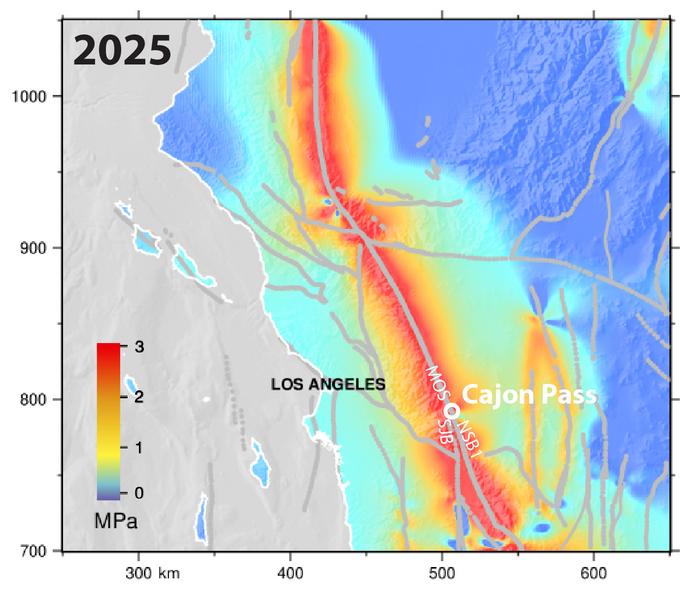
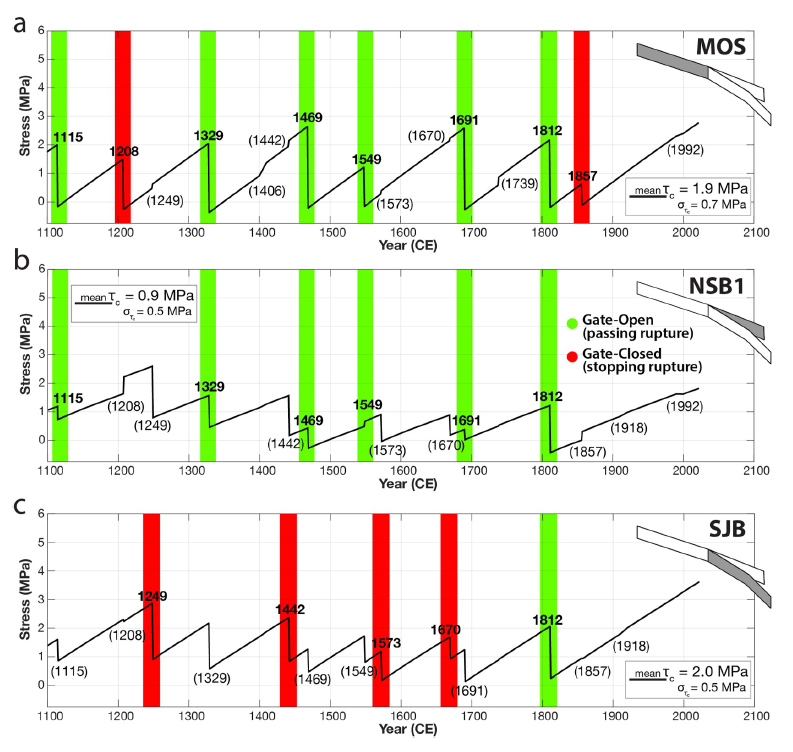
California's earthquake risk has gained fresh attention, after a new study in the Journal of Geophysical Research: Solid Earth modelled how stress has built up over the past 1,000 years along the southern San Andreas and San Jacinto fault systems. Geophysicist and planetary scientist Liliane M. L. Burkhard and her colleagues focused on Cajon Pass, east of Los Angeles, where the Mojave South, North San Bernardino and San Jacinto Bernardino fault segments converge. The authors describe this junction as an "earthquake gate", because it can either stop a rupture or allow it to continue across both fault systems. This matters because a rupture that crosses the junction could grow larger and more complex than one confined to a single fault strand. The area also contains major highways, railways and energy corridors that support Southern California's infrastructure. The study does not predict when an earthquake will happen. Instead, it reconstructs how Coulomb stress may have evolved through time, using a 1,000-year earthquake record based on geological evidence such as radiocarbon dating, tree-ring anomalies and historical documentation of ground ruptures. Burkhard and her team fed this data into a 4D physics-based earthquake-cycle model. By 2025, the model gives mean Coulomb stress values of 2.8 MPa on Mojave South, 1.8 MPa on North San Bernardino and 3.6 MPa on San Jacinto Bernardino. Mojave South and San Jacinto Bernardino are now at or above their previous modelled peaks, while North San Bernardino remains below its highest past level, but is still at its highest modelled stress in centuries.
Modelled stress changes over the past 1,000 years on three fault segments near Cajon Pass: Mojave South (MOS), North San Bernardino (NSB1), and San Jacinto Bernardino (SJB). The black lines show stress building between earthquakes and falling after ruptures, while the coloured bars mark events that either passed through (green) or stopped (red) at the fault junction. Credit: Burkhard et al. / Journal of Geophysical Research: Solid Earth.
The authors find that when the stress difference between neighbouring segments narrows, faults may become more likely to rupture together. This alignment could help explain why Cajon Pass sometimes behaves as a barrier, but at other times allows a rupture to pass through. "So not only is it concerning that the stresses are reaching historic highs, but also that the relative stress conditions between the two fault systems are approaching the range we associate with major ruptures crossing both faults simultaneously," says Burkhard. She adds that this would be "a scenario with much larger consequences for the region." These results still need cautious interpretation. The stress values depend on assumptions about slip rates, locking depths, friction, viscosity, elastic structure, stress-drop behaviour and the timing and extent of past ruptures. Researchers should therefore view them as modelled estimates, not direct measurements or a deterministic forecast. Nevertheless, the findings point to a fault system that now appears "critically stressed", according to Burkhard, with several plausible rupture scenarios that planners and emergency services cannot afford to ignore. "The model tracks how each earthquake changes stress on neighboring fault segments, how stress accumulates during the quiet intervals between events, and how the deeper layers of the crust slowly relax following large ruptures," explains Burkhard. "This simulation allows us to understand how stresses in the fault system build up over centuries," she continues. "By running the earthquake history of Southern California as a simulation, we can estimate the extent to which the fault system is already under stress today." The Big One This new work adds useful context to earlier warnings about California's future "Big One". In 2008, the United States Geological Survey (USGS) estimated a greater than 99% chance that California would experience at least one magnitude 6.7 or larger earthquake by 2037, with a 46% chance of at least one event at magnitude 7.5 or greater, most likely in the southern half of the state. A separate "ShakeOut" scenario, based on a southern San Andreas earthquake of magnitude 7.8, estimated around 1,800 deaths and $213 billion in economic losses. Southern California's last comparable event came in 1857, when the magnitude 7.9 Fort Tejon earthquake ruptured around 350 km of the San Andreas Fault, stopping just north of Cajon Pass. At the time, only a small population occupied the region. Today, a similar rupture would threaten one of the most heavily developed and infrastructure-dependent corridors in the United States. "The question of when and how the next major earthquake will occur in this region is one of the most pressing problems in applied geoscience," adds Burkhard. "Our results provide a clearer, physics-based picture of the current stress state of the fault system, and the framework we developed is not just applicable to California, but also for other complex fault junctions worldwide." The timing remains uncertain. The medium- to long-term direction, however, looks clearer: California must prepare for a major earthquake, because geology continues to load the system whether humans pay attention or not.
Comments »
If you enjoyed this article, please consider sharing it:
|