10th June 2026 Cloning study reveals the limits of genetic copying After 20 years and more than 1,200 cloned mice, researchers have found that repeated mammalian cloning eventually breaks down as harmful mutations accumulate.
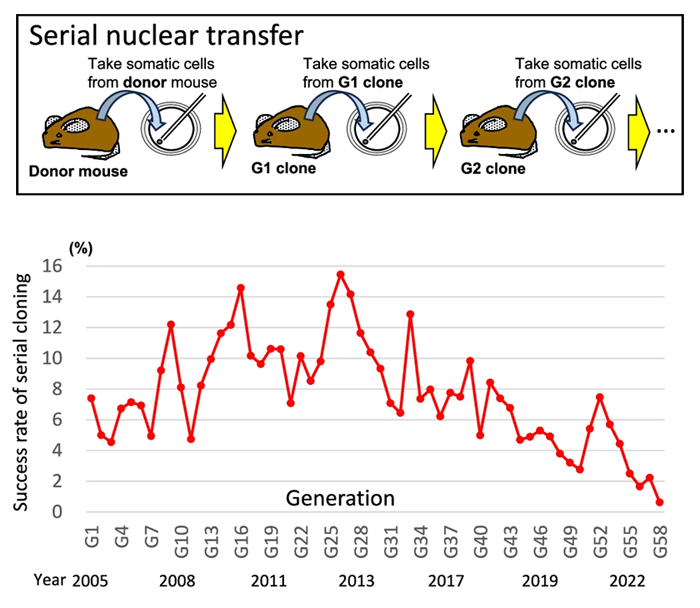
A recently published study has revealed a fundamental limit to repeated cloning in mammals, after scientists in Japan created more than 1,200 cloned mice over a 20-year period. The experiment began with a single female mouse. Using somatic cell nuclear transfer, the same technique used to create Dolly the sheep, researchers repeatedly cloned each new generation from the previous one. This allowed them to test whether a mammal could, in theory, continue through generation after generation without sexual reproduction. For many years, the answer seemed to be yes. The cloned mice appeared normal, lived ordinary lifespans, and showed no obvious signs of decline. But over time, hidden genetic damage began to build up. Birth rates started to fall after the 27th generation, while large structural mutations and other harmful changes accumulated in the animals' DNA. By the 58th generation, the process had reached its limit. The final cloned mice died within days, showing that serial cloning could not continue indefinitely. The findings challenge the idea of cloning as a perfect biological copy-and-paste system. Although each cloned animal may appear outwardly healthy, the process does not simply preserve an unchanged genome forever. Instead, errors can creep in and compound over successive generations. A simple analogy is the repeated copying of an old VHS tape, or more generally, making a copy of a copy. The first duplicate may look almost identical to the original, but each subsequent version introduces small distortions. After enough rounds, the flaws become impossible to ignore. Serial cloning appears to face a biological version of this problem, with genetic errors accumulating until the process can no longer produce viable animals.
Credit: Sayaka Wakayama et al. / Nature Communications (2026), CC BY-NC-ND 4.0.
In normal sexual reproduction, offspring inherit DNA from two parents, and the mixing of genetic material through recombination can help mask or eliminate some harmful mutations. Cloning skips that reshuffling, so certain defects can persist and build up over time. The Japanese study suggests that this can eventually cause a genetic decline, limiting how long a cloned lineage can be sustained. "No one has ever continued re-cloning for this long before," said Teruhiko Wakayama, a developmental biologist from the University of Yamanashi, and senior author of the study. "As a result, this is the first time we've discovered that repeated re-cloning eventually reaches its limits." "It was once believed that clones were identical to the original," he added. "But it has become clear through this study that mutations occur at a rate three times higher than in offspring born through natural mating. Because all these mutations continue to accumulate, mammals cannot sustain their species through cloning. This study has revealed one of the reasons why mammals, unlike plants and lower animals, cannot maintain their species through cloning." The work has implications beyond laboratory mice. Cloning already has roles in animal research, selective livestock breeding, and conservation efforts for endangered species. Some scientists have also proposed cloning as part of future de-extinction efforts, potentially bringing back lost animals or strengthening populations with very few surviving individuals. However, the new findings highlight a major constraint. Cloning may help reproduce individual animals, but it cannot easily replace the long-term genetic health provided by sexual reproduction. For endangered species with tiny populations, repeated cloning alone would not solve problems caused by low diversity, inbreeding, or accumulated mutations. The study also adds context to debates about reproductive human cloning. This long-standing futuristic concept is prohibited in many countries and remains widely regarded as ethically unacceptable and medically unsafe. Even setting aside those objections, the results show why cloning across multiple generations poses serious biological risks. A cloned human would not necessarily be a flawless duplicate, while repeated cloning could magnify hidden genetic problems rather than preserve a perfect line. In the longer term, advances in genome sequencing, embryo screening, gene editing, and artificial reproduction may reduce some of these risks. But the latest evidence suggests that biology places real limits on simple replication. Life is not merely copied from one generation to the next; it relies on variation, repair, selection, and renewal. For futurists, the study offers a useful corrective to more simplistic visions of cloning. The technology can create genetic copies, but it cannot yet reproduce the full resilience of natural reproduction. Even in an age of advanced biotechnology, copying life may prove far harder than copying code.
Comments »
If you enjoyed this article, please consider sharing it:
|