1st June 2026 Atom-by-atom manufacturing takes a step forward Researchers have demonstrated a new way to place carbon atoms with extreme precision, offering a glimpse of future nanoscale manufacturing.
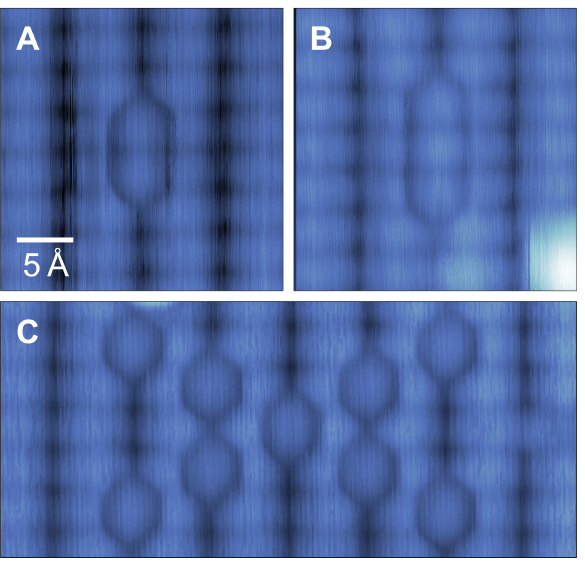
In his 1986 book Engines of Creation, Eric Drexler popularised a bold vision of nanotechnology: machines and materials built with atomic precision. Forty years after its publication, that dream remains far from reality. But a new preprint suggests that one of its basic requirements – placing tiny building blocks exactly where they are needed – is becoming more practical in the laboratory. Researchers at CBN Nano Technologies in Canada used a scanning tunnelling microscope to move carbon fragments onto a silicon surface. Each fragment contained two carbon atoms, known as a C₂ unit. During this process, the team adjusted the microscope's approach depth in 50-picometre increments, or 50 trillionths of a metre. For comparison, the bond between two carbon atoms in a C₂ unit is about 120 picometres long, while a nanometre is 1,000 picometres. The team showed that carbon units could be placed onto pre-prepared sites, then added repeatedly to form simple patterns and tiny chain-like structures with extraordinary precision. In one of the experiments, nine C₂ units, comprising 18 carbon atoms, were arranged into an 'X' shape (see picture below). In another, the team extended existing carbon structures by forming new carbon–carbon bonds.
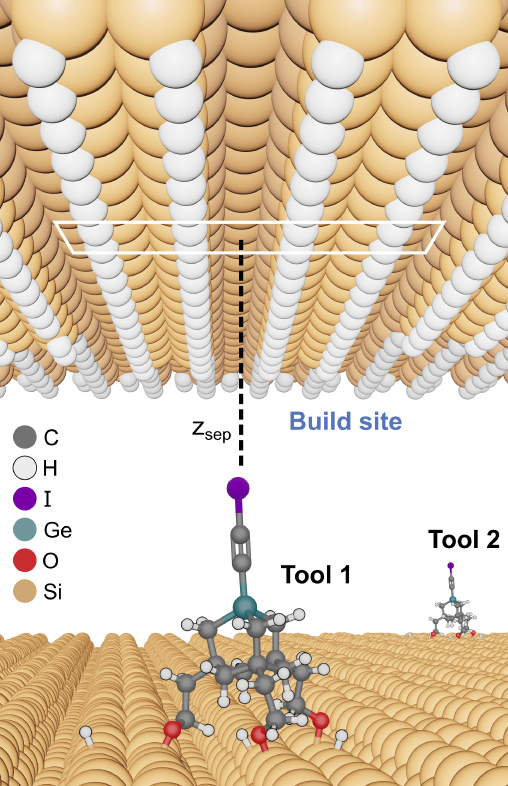
This represents a substantial advance over earlier approaches, which could create related carbon structures but depended on molecules landing and reacting at random. Here, the researchers prepared specific sites in advance and then placed the carbon units precisely where they wanted them. The study also reports the formation of IR-C₄ – a previously unreported four-carbon structure – showing that the method isn't just limited to moving atoms around on a surface but can also create new bonded arrangements. This process is known as mechanosynthesis. Rather than relying on heat, light, or random chemical reactions, it uses mechanical positioning to guide bond formation at the atomic scale. In this case, the team used molecular tools that could donate carbon fragments to prepared sites on the silicon surface. This may help overcome a long-running obstacle in nanotechnology known as the "sticky fingers" problem. At atomic scales, a tool used to move a building block can hold on too strongly, causing the atom or molecule to stick to the tool instead of transferring cleanly. For a simple analogy, imagine trying to place a grain of sand with a wet fingertip: the sand clings to your finger, making precise release difficult. In the past, skeptics of nanotechnology argued that this would make a true molecular assembler impossible. The new approach appears to get around that problem by avoiding the simple tweezer-like idea of picking up an atom and dropping it somewhere else. Instead, the molecular tool carries a two-carbon fragment as part of its own structure. When the tool reaches a prepared site on the silicon surface, the C₂ is "donated" and forms a new bond there. As the tool pulls away, its link to the carbon fragment breaks, leaving the carbon behind in the intended position.
"Together, these results establish controlled mechanosynthetic donation as a foundational capability for programmable atomically precise fabrication," the researchers write. "Achieving control over matter at the level of individual atoms is a defining vision of nanotechnology, underpinning the development of molecular-scale electronics, artificial lattices, and semiconductor quantum devices, with the potential for order of magnitude improvements in speed and energy efficiency over current devices." For now, those future applications remain a distant goal. The experiments took place under highly controlled laboratory conditions, at the extremely low temperature of 4 K (–269°C), and the paper has yet to undergo peer review. Even so, these results suggest that programmable atom-by-atom fabrication is now moving from theory toward practical laboratory demonstration. Damian Allis, PhD, co-author of the study and a computational chemist at CBN Nano Technologies, described the result as an experimental advance he had been waiting more than two decades to see: "I've been working on the theory side for over 22 years for such a pair of announcements, and it is beyond gratifying to be able to finally report on experimental advances," he posted on social media. "From 1986, when it was first formally proposed by K. Eric Drexler, to 2026, when its first instances as envisioned by many in the community (to a fundamental extent) have now been experimentally demonstrated in first forms with molecular tools and chemical reactions. "Hypothetical" on Wikipedia until this morning. The controversy over its feasibility was never to be settled until it was done in a lab. I am pleased to report, thanks to the efforts of the great team at CBN Nano Technologies, Inc., that the #hypothoversy may have found its end."
Comments »
If you enjoyed this article, please consider sharing it:
|