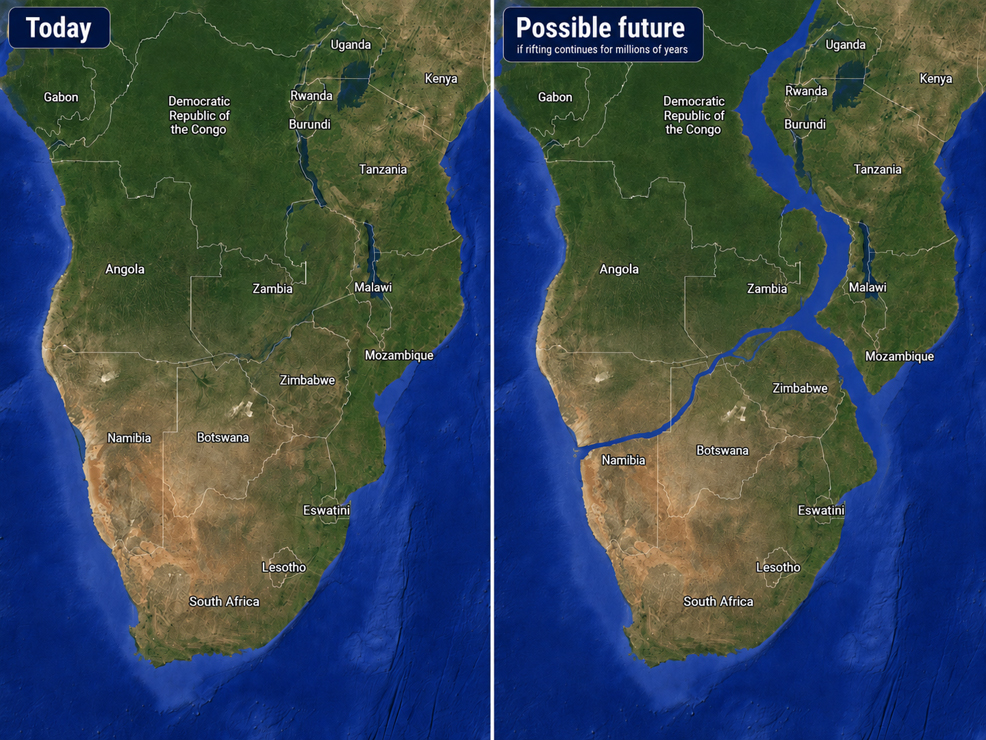
28th May 2026 New plate boundary may be forming in Africa A little-studied rift system in Zambia could mark the early stages of a future continental split, while also revealing potential opportunities for geothermal energy, helium and hydrogen exploration.
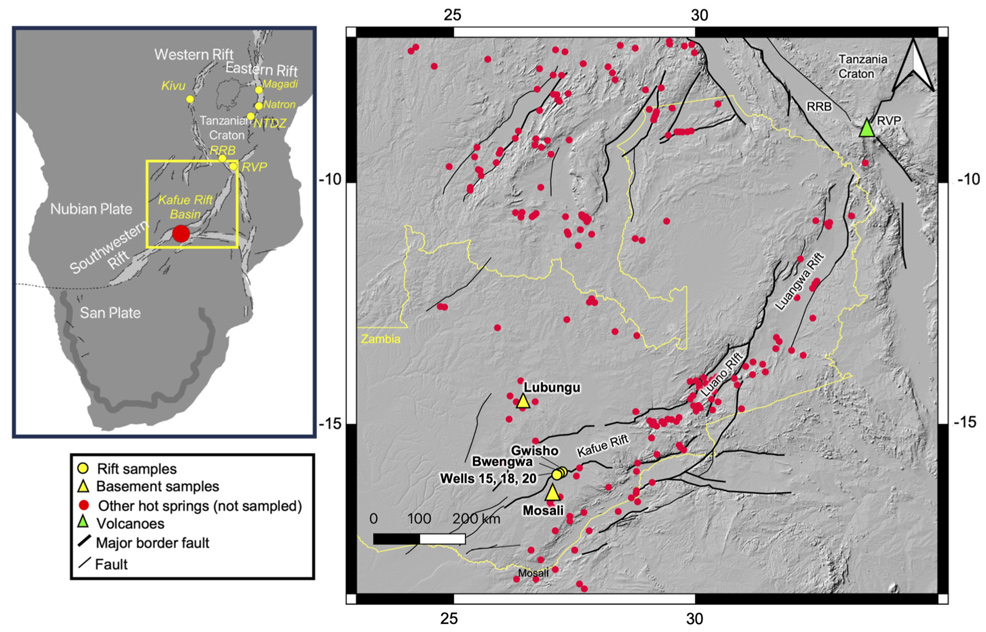
Scientists have found evidence that a new tectonic plate boundary may be forming beneath southern Africa. Their study, published in Frontiers in Earth Science, focuses on the Kafue Rift in Zambia. This feature forms part of a much longer zone of faults and rifts stretching for about 2,500 km, from Tanzania through Zambia, Botswana and Namibia. Researchers call this the Southwestern Rift of Africa. If it continues to develop, it may one day link the African Rift System with the Mid-Atlantic Ridge. Rifts form as the Earth's crust stretches, fractures and begins to sink. In some cases, this process stops before a continent breaks apart. In others, it continues until a new plate boundary and ocean basin form. The East African Rift System already shows this process in a more advanced state. To assess whether the Kafue Rift is active, researchers collected gas from eight geothermal wells and hot springs in Zambia. Six samples came from within the suspected rift zone, while two came from nearby basement rocks just outside it.
The rift samples contained unusually high ratios of helium isotopes, along with carbon dioxide signatures close to those expected from the mantle. These gases could not have come from the atmosphere alone, and the nearby off-rift springs lacked the same mantle signal. This suggests that faults beneath the Kafue Rift now provide a pathway from deep inside the Earth to the surface. "The hot springs along the Kafue rift of Zambia have helium isotope signatures which indicate that the springs have a direct connection with the Earth's mantle, which lies between 40 and 160 km below the Earth's surface," explained Prof Mike Daly of the University of Oxford, study co-author. "This fluid connection is evidence that the fault boundary of the Kafue Rift is active and therefore the Southwest African Rift Zone is too – and may be an early indication of the break-up of sub-Saharan Africa." The discovery that the Kafue Rift is active could have important economic implications. Early-stage rifts can provide geothermal energy and access to helium and hydrogen where they are not diluted by volcanic gases. In the more distant future, however, continued rifting could have much larger consequences. If similar mantle signals appear along the wider fault zone, southern Africa may contain the first traces of a new plate boundary – one capable of reshaping the continent over millions of years. "Many of the features of the Great Rift Valley of Kenya offer compelling reasons why East Africa should ultimately become a line of major continental break-up," said Daly. "But the rate of rifting of the East African Rift System is slow. On almost all sides of Africa, there are mid-ocean ridges tending to inhibit east-west or north-south extension, so break-up and spreading does seem to struggle to establish itself. The Southwestern African Rift System could be an alternative. It has the required rift-related features, and regional basement fabrics – inherent weaknesses in the crust – favourably aligned to the surrounding mid-ocean ridges and continental geomorphology. This relationship may offer a much lower strength threshold for continental break-up. "However, this study is based on helium analyses from one general area in the Southwest African Rift System, which is thousands of kilometres long," cautioned Daly. "This early study is being followed by more extensive studies, the next step of which will be completed this year."
Comments »
If you enjoyed this article, please consider sharing it:
|