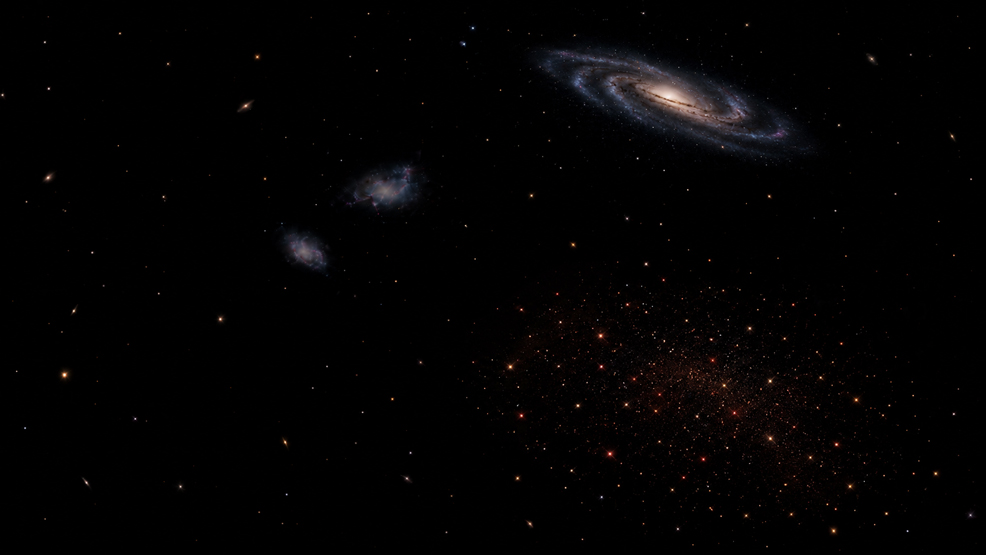
10th October 2026 New satellite dwarf galaxy found orbiting Milky Way Aquarius IV lies 355,000 light-years from Earth and is the first Milky Way satellite discovered using data from the Vera C. Rubin Observatory.
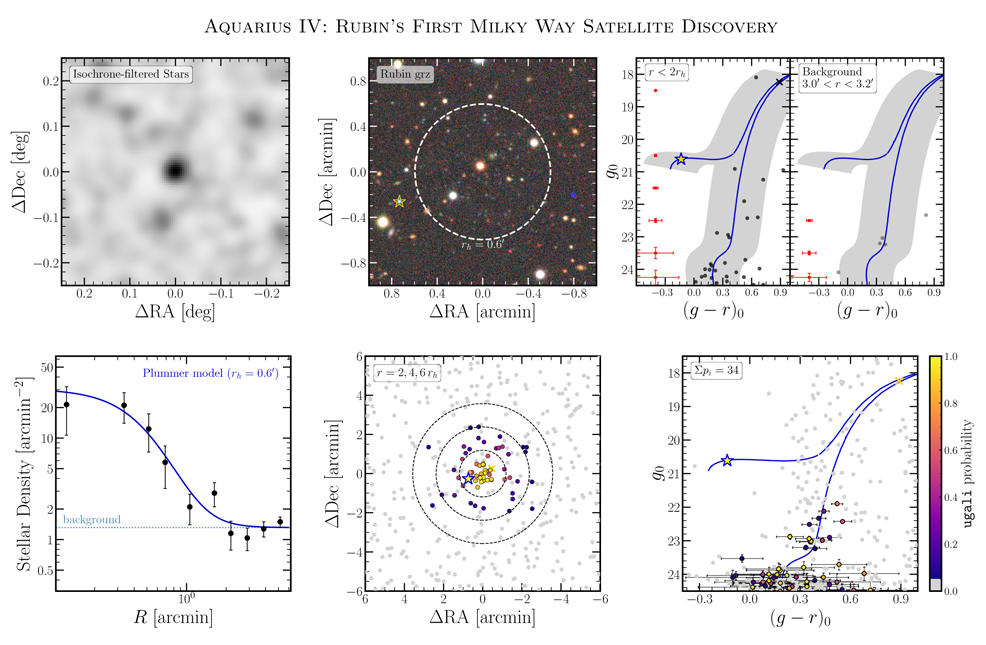
Beyond the luminous disk of the Milky Way lies an immense and forbidding darkness, where stars become sparse and the emptiness of intergalactic space begins to take over. Farther out, densities can fall below one atom per cubic metre, compared with millions of particles per cubic metre in the solar wind throughout the inner Solar System. But this remote frontier is not entirely empty. Dozens of smaller satellite galaxies orbit our own – ranging from prominent objects such as the Large and Small Magellanic Clouds to ultra-faint dwarf galaxies (UFDs), tiny collections of ancient stars that emit so little light that astronomers can struggle to distinguish them from foreground stars in the Milky Way. A powerful new tool for detecting the most elusive of these objects recently came online. The Vera C. Rubin Observatory in Chile began its 10-year Legacy Survey of Space and Time (LSST) in June 2026. Its 8.4-metre Simonyi Survey Telescope carries the world's largest digital camera, containing 3.2 billion pixels and covering 9.6 square degrees of sky in a single field of view. Rubin's main survey will repeatedly photograph around 18,000 square degrees of the southern sky, revisiting each region roughly every three days and providing increasingly deep views of the Universe. Using early data from Rubin, a team of astronomers from Yale University, the University of Chicago and other institutions looked for concentrations of faint stars that could reveal previously unknown dwarf galaxies. Their strongest new detection appeared in the constellation Aquarius. The researchers found the object – now called Aquarius IV – at a statistical significance of eight sigma. They then analysed older, archived observations from the Dark Energy Camera (also in Chile) and independently recovered the same stellar grouping at six sigma, strengthening the evidence for its existence. If confirmed, this makes Aquarius IV the first Milky Way satellite discovered using Rubin data. Aquarius IV lies about 355,000 light-years away in the Milky Way's outer halo. Its stellar population appears to be very ancient, dating back 13 billion years, meaning that its stars formed relatively soon after the Big Bang. They are also metal-poor, containing very few elements heavier than hydrogen and helium, another characteristic of extremely old stellar systems.
Credit: William Cerny et al 2026 Res. Notes AAS 10 239 (CC BY 4.0)
With an absolute magnitude of -1.9, Aquarius IV ranks among the faintest known Milky Way satellites. The new object is also relatively tiny, with a half-light diameter of about 124 light-years. The term "half-light" refers to the region containing half of its total starlight, so its actual boundaries likely extend beyond this. Its size nevertheless supports a galactic interpretation. "Its radius is larger than nearly all Milky Way globular clusters, and we tentatively classify the system as a dwarf galaxy," the study authors write. Study co-author Aashay Pai, from the University of Chicago, estimates that Aquarius IV contains roughly 1,500 solar masses of stars, describing it as "one of the faintest and most compact UFDGs at a large distance". Such a low stellar mass would correspond to perhaps a few thousand stars, most of them extremely faint and low-mass objects like red dwarfs and similar long-lived stars. But if Aquarius IV proves to be a genuine dwarf galaxy, its overall mass could be far greater because ultra-faint dwarfs can contain enormous proportions of dark matter. Deeper imaging and spectroscopy may reveal more about its chemical composition and the motions of individual stars, helping to determine whether dark matter dominates the system. The great age of Aquarius IV could also make it a surviving relic of a much earlier phase of cosmic history, serving as a valuable target for studies of how the first galaxies formed and evolved. The discovery has parallels with Ursa Major III, another Milky Way satellite covered by Future Timeline in April 2024. That object is only 20 light-years across and contains around 60 known mature stars, but astronomers have faced the same fundamental question over whether it represents a tiny dark-matter-dominated galaxy or a star cluster. William Cerny and Marla Geha contributed to research on both systems. Aquarius IV may prove to be an early example of many similar discoveries. Pai estimates that the Rubin telescope could uncover as many as 100 additional ultra-faint dwarf galaxies by the time its LSST survey is completed in 2036. This would greatly expand the known population around the Milky Way, helping to map our local galactic neighbourhood in much greater detail and providing new opportunities to investigate dark matter and some of the earliest galaxies that formed after the Big Bang. You can explore the position of Aquarius IV relative to the Sun/Earth, Milky Way, and the Magellanic Clouds in our interactive 3D visual below. Click and drag to rotate the view, and use the scroll wheel to zoom in or out.
Comments »
If you enjoyed this article, please consider sharing it:
|