8th October 2026 A new AI model for general-purpose humanoid robots California-based company Figure's latest AI system tackles the "holy grail" of robotics, allowing humanoids to generalise learned skills across unfamiliar homes and objects.
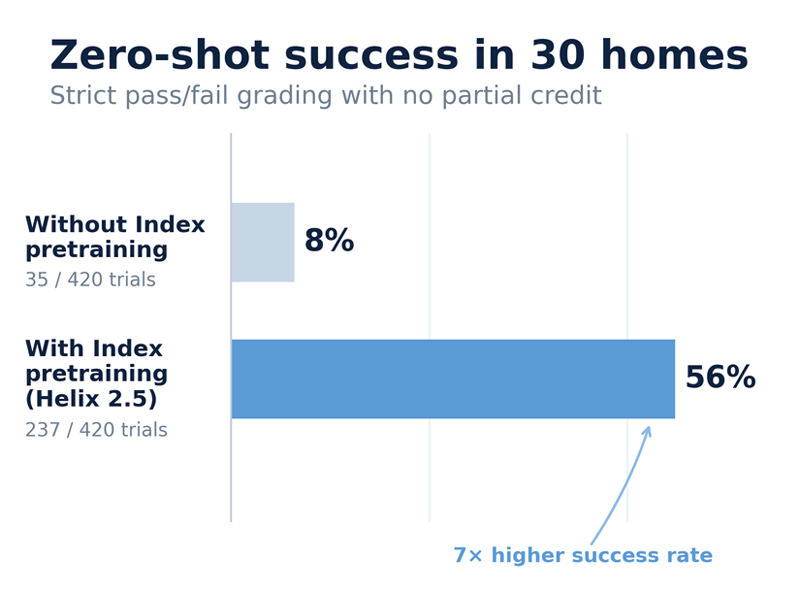
Humanoid robots have progressed rapidly in recent years, as improvements in artificial intelligence, computer vision, batteries and mechanical engineering bring increasingly capable machines out of laboratories and into workplaces and homes. Among the companies pushing this trend is Figure, a start-up founded in 2022 by entrepreneur Brett Adcock and based in San Jose, California. Its first humanoid, Figure 01, debuted in 2023, while Figure 02 later worked at BMW's Spartanburg car factory, handling more than 90,000 components and contributing to over 30,000 vehicles. Figure 03, unveiled in 2025, shifted the design further towards domestic use. Figure has now revealed Helix 2.5, a major upgrade to the AI model controlling Figure 03, designed to enable generalisation. The company describes generalisation as the "holy grail" of robotics. Rather than training a robot for one particular room, layout or collection of objects, Helix 2.5 aims to let it carry learned skills into places it has never encountered before. Researchers call this "zero-shot" generalisation. Earlier versions of Helix could unload dishwashers, tidy rooms and perform factory logistics, but Figure trained those systems using data from the environments where they would operate. Helix 2.5 goes further. Figure tested it in 30 unfamiliar homes around the San Francisco Bay Area, where Figure 03 tidied living rooms, made beds and folded towels without collecting training data in those homes. It encountered unfamiliar furniture, objects and layouts while combining vision, walking, balance and two-handed manipulation. Under Figure's strict criteria – which required completion of an entire task – Helix 2.5 achieved a 56% zero-shot success rate. An otherwise identical system without the new pretraining achieved only 8%. Helix 2.5 also needed only half as much task-specific training data as a comparable Helix 02 behaviour.
Much of the improvement comes from Index, Figure's growing dataset of human activity, which the company describes as "the world's largest and most diverse physical dataset" for robot training. More than 90,000 people contribute each week, adding about 35 minutes of human experience every second. Figure uses this material to train Helix 2.5, allowing human movements and interactions to transfer into robot behaviour. Its experiments found that the model's performance improved consistently as the amount of Index data increased, suggesting that robotic learning may begin to follow scaling laws similar to large language models. Figure 03 stands 173 cm (5 ft 8 in) tall, weighs 61 kg (134 lbs) and can carry up to 20 kg. It can operate for five hours and has a top walking speed of 1.2 m/s. Its vision system offers twice the frame rate, one-quarter the latency and a 60% wider field of view per camera than Figure 02. Cameras in each palm assist close-up manipulation, while fingertip sensors detect forces as small as three grams. Soft, washable coverings, improved audio hardware for real-time speech and 2 kW wireless charging make it better suited to homes. In a dramatic footnote, Figure recently decommissioned most of its Figure 02 fleet by having the robots autonomously jump into a 75-ton electric arc furnace containing molten steel. Figure says the extraordinary footage is genuine. The company says the method protected its proprietary hardware while avoiding the lengthy process of dismantling each machine. Following a suggestion from Arnold Schwarzenegger, who famously played the Terminator cyborg in the film series, Figure used movements from stunt performers as references to train a new AI model for the jump. In a nod to the famous molten-metal scene in Terminator 2: Judgment Day, the robots then carried out the stunt at a foundry in Imatra, Finland. A small number of Figure 02 units remain in storage. Figure now plans to scale the data and computing power behind the Helix model, with an initial $3.5 billion commitment to AI infrastructure that could grow to more than $6 billion. Its partnership with Nscale will provide access to as many as 100,000 NVIDIA GPUs, with deployment beginning in the second half of 2027. As Figure expands production of Figure 03 and continues work on Figure 04, the company hopes generalisation will eventually allow humanoids to arrive in ordinary homes and begin useful work with little or no additional training.
Comments »
If you enjoyed this article, please consider sharing it:
|