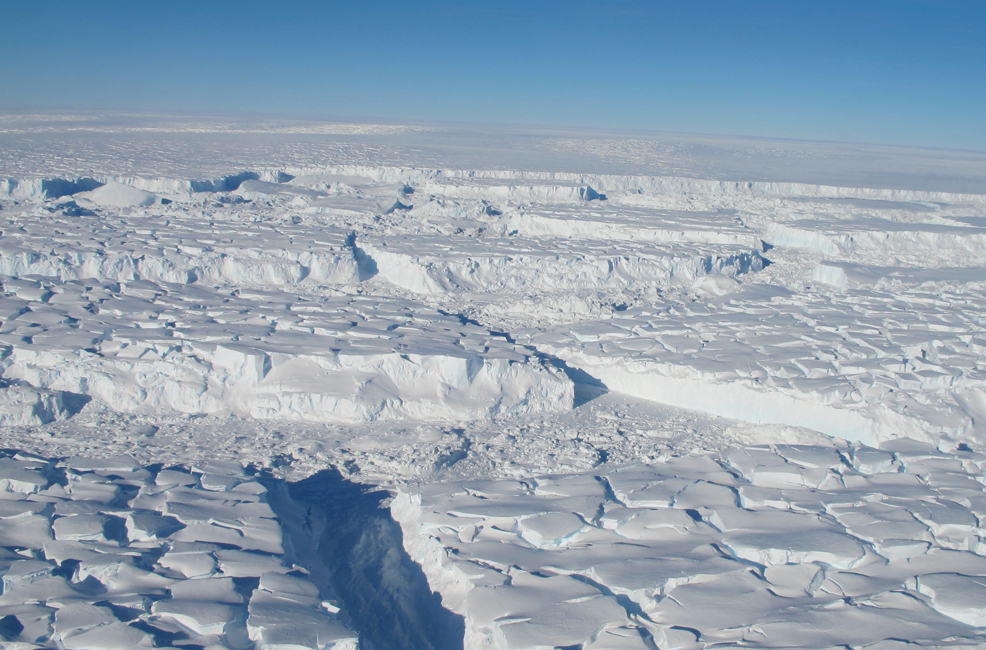
15th October 2026 Antarctic glacier's sea-level impact is twice previous estimate A new study finds that Thwaites Glacier in West Antarctica could contribute up to 30 mm to global sea-level rise by 2100, even without additional climate warming. The revised projection accounts for warm seawater penetrating several kilometres beneath the glacier, a process omitted from many earlier ice-sheet models.
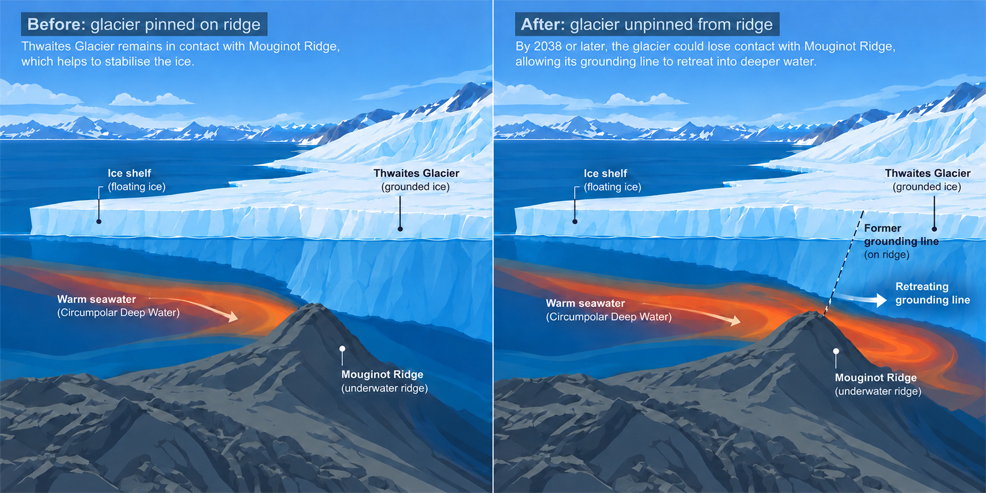
Thwaites Glacier in West Antarctica is the widest glacier on Earth, measuring 120 km (75 miles) across. Its drainage basin covers approximately 192,000 sq km (74,000 sq miles), almost the size of Great Britain. It holds enough ice to raise global sea levels by 65 cm (26 in) if it melted completely, although scientists do not expect this to happen during the 21st century. Over recent decades, it has experienced rapid thinning, retreat and acceleration as relatively warm ocean water erodes its underside. A new study, published in Nature Communications, suggests that its future impact could be significantly greater than previously estimated. Researchers from the University of California, NASA's Jet Propulsion Laboratory and other institutions project a contribution of around 30 mm (1.2 in) to global sea-level rise by 2100, compared with an average of 15 mm (0.6 in) in earlier modelling. Crucially, their simulations assume no additional climate warming. The difference comes from a previously underrepresented process occurring beneath the glacier. Traditional models treat the boundary between grounded and floating ice as a relatively narrow line. However, satellite observations reveal that warm seawater penetrates several kilometres inland beneath the ice, creating a wider "grounding zone". This allows melting to occur over a much larger area, weakening the glacier's connection to the seabed and accelerating its retreat. The researchers incorporated this process into a model that successfully reproduced almost three decades of observed changes, using supercomputing resources provided by NASA. Their simulations suggest that as early as 2038, Thwaites could lose contact with an important stabilising underwater ridge, causing its grounding line to retreat further inland, where the seabed lies deeper below sea level. This is the earliest year projected in the simulations, however, with other scenarios predicting retreat decades later, or even no loss of contact with the ridge before 2100, depending on how far seawater penetrates beneath the glacier. Future studies could help constrain this timeline.
An extra 15 mm of sea-level rise might sound trivial. However, even modest increases in sea level can significantly worsen coastal flooding, allowing high tides and storm surges to reach further inland. In particularly vulnerable locations, a few extra centimetres can increase the frequency of damaging floods. Perhaps more importantly, the findings may have implications for other glaciers. Scientists have observed similar seawater intrusions elsewhere in Antarctica and Greenland. A separate study, published in September 2026, also found that incorporating these processes into Antarctic ice-sheet models could produce greater ice loss over the coming centuries. This does not necessarily mean that every glacier's contribution will double. However, it suggests that existing projections may underestimate certain mechanisms of ice loss, with potentially significant consequences for global sea levels in the future. "We have documented and quantified the impacts of climate change on our planet's sensitive ice sheets for decades, but a mounting realisation gained in recent years of what is happening on the undersides of glaciers like Thwaites is leading to an even greater sense of alarm," said co-author Eric Rignot, UC Irvine professor of Earth system science. "Most projections up-to-present have struggled to match the rapidity of the mass loss because of missing physics; our new model with more complete physics is able to match the record and then produces projections that are twice larger than before. These results predict greater risk of and exposure for coastal flooding than anticipated in the coming decades."
Credit: NASA
Comments »
If you enjoyed this article, please consider sharing it:
|