24th October 2026 Personalised cancer vaccine cuts recurrence risk by 42% Moderna and Merck's personalised mRNA therapy has reduced the risk of recurrence or death by 42% in patients with high-risk melanoma in a Phase III clinical trial, potentially opening the door to similar treatments for other cancers.
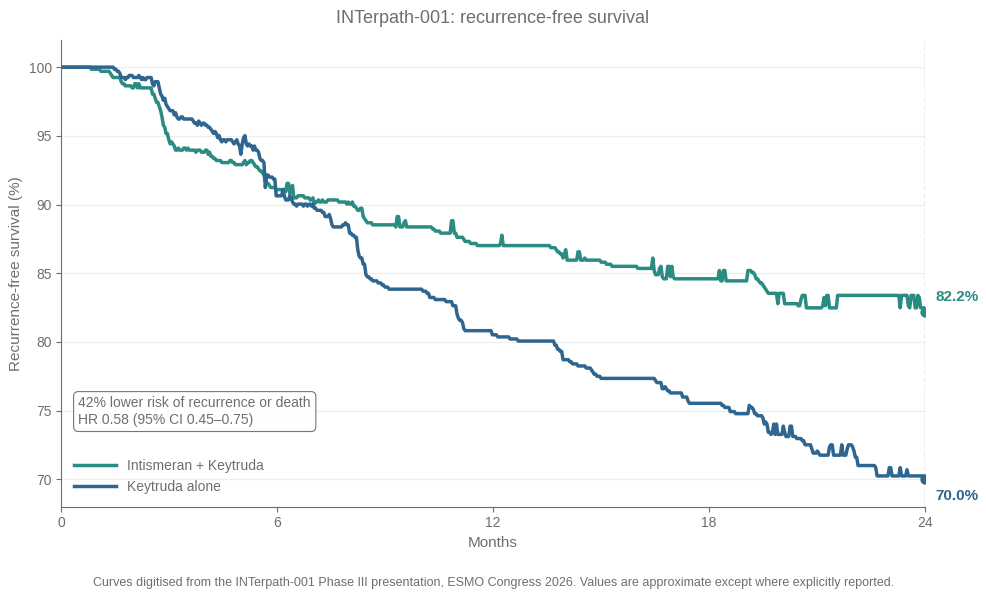
Moderna and Merck have revealed detailed results from a landmark Phase III trial of their personalised mRNA cancer vaccine, intismeran autogene, showing a substantial benefit for people with high-risk melanoma. The companies first announced in August that the INTerpath-001 trial had met its main goals, but withheld the actual figures. The study involved 1,137 patients with stage IIB to IV melanoma whose tumours had undergone complete surgical removal. After a median 25-month follow-up, those receiving intismeran alongside the immunotherapy drug Keytruda had a 42% lower risk of cancer recurrence or death than those receiving Keytruda alone. At two years, 82.2% remained alive without recurrence, compared with 70.0% in the control group. The combination also reduced the risk of distant metastasis or death by 38%, with two-year rates of 88.5% versus 80.2%.
Unlike a conventional vaccine, doctors tailor intismeran to each patient's tumour. They analyse its unique mutations and use an algorithm to select up to 34 predicted neoantigens – protein fragments produced by tumour-specific mutations and absent from healthy cells – as immune targets. Messenger RNA, or mRNA, carries temporary genetic instructions that tell cells which proteins to make. Intismeran instructs cells to produce the selected neoantigens, which are then processed and displayed on cell surfaces to the immune system. This trains T cells to recognise and attack cancer cells carrying the same molecular targets. Keytruda complements intismeran by blocking a pathway that cancer cells can exploit to suppress T-cell activity, helping the immune system sustain its attack on the tumour. These results mark the first successful Phase III trial of an individualised neoantigen therapy and of any mRNA-based cancer treatment. Researchers presented the findings today at the European Society for Medical Oncology Congress, while The New England Journal of Medicine has accepted the full study for publication. Moderna and Merck are now holding discussions with regulatory authorities over potential submissions. Researchers will also continue tracking overall survival as longer-term data mature, while a total of nine Phase II and III trials are evaluating intismeran across multiple tumour types and stages – including melanoma, non-small cell lung cancer, bladder cancer and kidney cancer. If regulators approve intismeran, the treatment could mark an important step towards a future in which doctors design cancer therapies around the unique genetic fingerprint of each patient's disease. "The transformative INTerpath-001 results have the potential to make a foundational shift in how we treat patients with earlier-stage melanoma..." said Professor Georgina Long, the study's principal investigator and medical director of Melanoma Institute Australia. "For decades, cancer treatment has largely been defined by where a tumor originates in the body. The INTerpath-001 findings support a fundamentally new and individualized approach to treating resected melanoma in the adjuvant setting, one that tailors treatment to the unique mutational signature of a patient's tumor." "From the beginning, we believed mRNA technology could make it possible to develop cancer treatments uniquely matched to each patient's tumor. The INTerpath-001 results mark a defining moment for that vision and show what's possible when we rethink how medicines are made," said Stéphane Bancel, Moderna CEO. "These results reinforce our conviction that mRNA has the potential to fundamentally change how we treat cancer."
Comments »
If you enjoyed this article, please consider sharing it:
|