3rd November 2026 New solar cell design could break 33% efficiency barrier Scientists in Spain have developed a novel optical cavity design that could enable single-junction solar cells to achieve efficiencies approaching 43%, far exceeding a theoretical limit established more than 60 years ago.
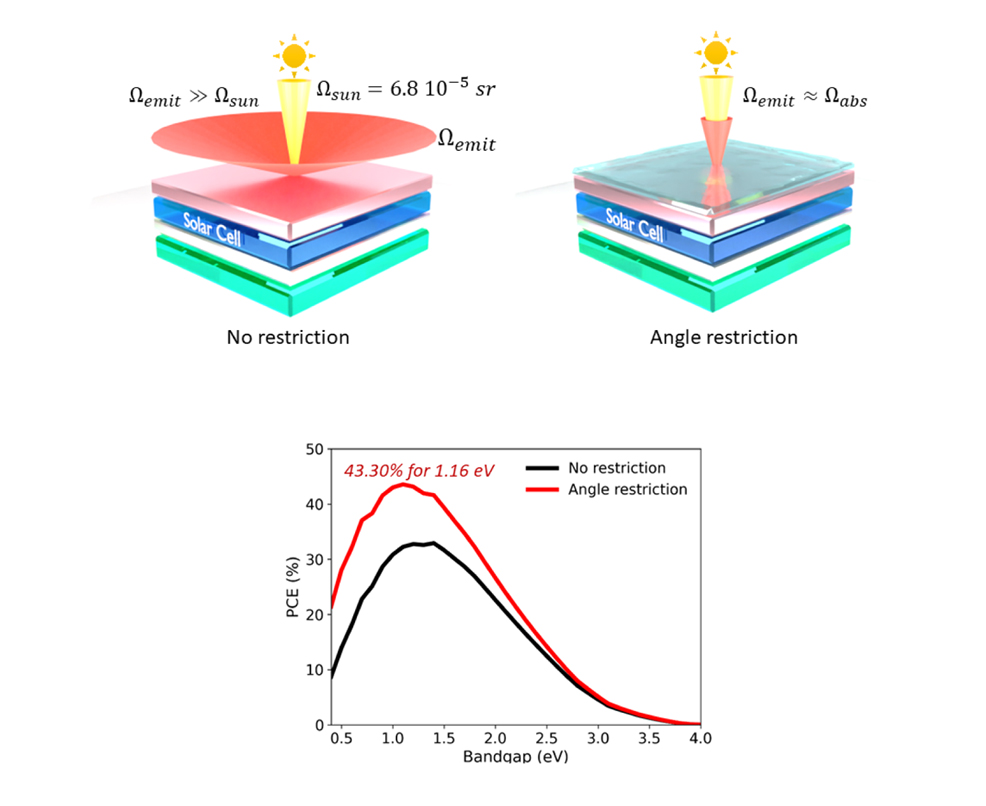
Over the past 15 years, solar power has undergone an extraordinary transformation. Once a relatively expensive, niche technology, it now represents the world's fastest-growing source of electricity, with manufacturing costs having plummeted and installations continuing to surge worldwide. Yet solar still has plenty of room to grow. Its potential to reshape the global energy system remains enormous. One of the most promising ways to unlock that potential is through greater efficiency, allowing solar cells to generate more electricity from the same amount of sunlight. Researchers have made remarkable progress in recent years, but conventional single-junction solar cells face a fundamental physical constraint: the Shockley–Queisser limit, which places their maximum theoretical efficiency at approximately 33.7%. Now, researchers in Spain have demonstrated a promising new approach that could overcome this longstanding barrier. A team led by Professor Jordi Martorell at the Institute of Photonic Sciences (ICFO) in Barcelona has shown that restricting the angles at which solar cells emit light can reduce a largely overlooked source of energy loss. Their findings, published in the journal Energy & Environmental Science, suggest that future single-junction solar cells could, in principle, achieve efficiencies approaching 43%. When sunlight hits a solar cell, the device converts some of that energy into electricity, but also loses energy as heat and emitted light. Although sunlight arrives from a relatively narrow range of angles, the cell emits light in almost every direction, creating a mismatch that reduces its overall efficiency. To tackle this underlying problem, the ICFO team developed a special "optical cavity" that uses reflective metal layers to direct the photons that the cell emits. This allows sunlight to enter the cell easily while restricting the angles at which the cell emits light, reducing energy losses and boosting electricity output.
Restricting the angles at which solar cells emit light could raise their theoretical maximum efficiency from 33% (black) to 43.3% (red).
Silver plays a central role in the optical cavity. The researchers achieved their best results by using a semi-transparent silver electrode just 6 nanometres (nm) thick at the front, paired with a 100 nm silver reflector at the back. A 40-nanometre coating of tungsten trioxide helped control incoming light, while a 100 nm layer of organic semiconductor material converted sunlight into electricity. This configuration achieved a maximum efficiency of 19.08%, compared with 18.23% for reference cells. Crucially, the researchers believe the same approach could work with other types of solar cells, not just the organic materials used during their experiments. "Although the path towards achieving such gains is demonstrated here in an organic solar cell, the underlying principle is not specific to organic materials and is, in principle, applicable across photovoltaic technologies," explains Professor Jordi Martorell, who led the research. Although silicon and perovskite technologies continue to improve, the best single-junction solar cells remain in the 28–29% efficiency range, according to records maintained by the US National Laboratory of the Rockies (formerly NREL). The new optical cavity approach could unlock a fresh wave of further improvements, helping future solar cells to break through the longstanding 33% barrier. "Our study is a significant step forward in the solar energy conversion field as it opens a completely unexplored route to surpass the Shockley–Queisser limit," says Dr. Francisco Bernal Texca, first author of the study. "If the emission cone can be narrowed to more closely match the absorption cone of incoming sunlight – which is exactly what our work demonstrates experimentally – solar cells will, in principle, be able to approach efficiencies close to 43%." "Achieving higher efficiencies is essential," adds Martorell, "because they directly translate into a lower cost per watt and more efficient use of land and materials for solar energy deployment."
Comments »
If you enjoyed this article, please consider sharing it:
|