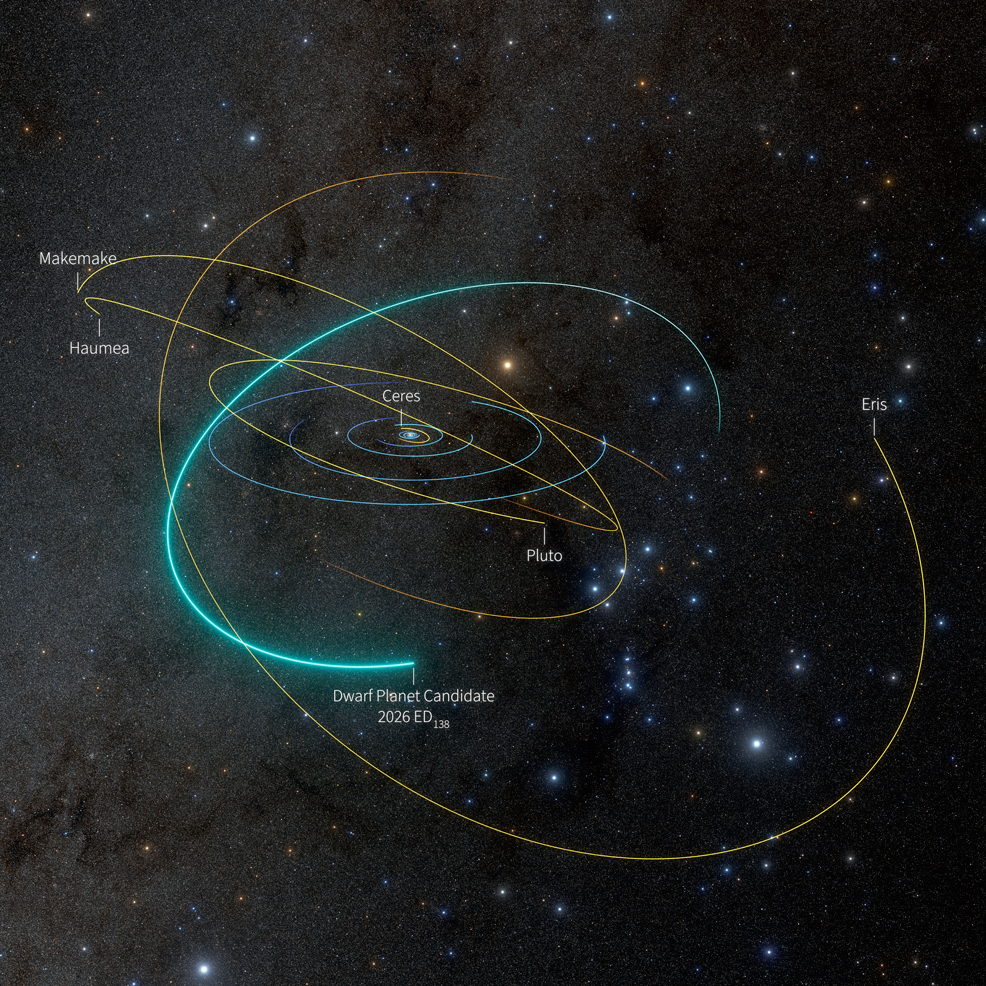
5th November 2026 New dwarf planet candidate discovered beyond Pluto The Vera C. Rubin Observatory in Chile has identified a potentially large new world approximately 46 astronomical units (AU) from the Sun. Designated 2026 ED138, it could have a diameter of up to 1,600 km.
In 1930, American astronomer Clyde Tombaugh discovered Pluto, which became the ninth planet of our Solar System. It retained this status for 76 years, until a series of discoveries in the early 2000s challenged the traditional definition of a planet. Astronomers identified several other large, icy worlds beyond Neptune, including Eris, Haumea and Makemake. In 2006, the International Astronomical Union (IAU) reclassified Pluto as a "dwarf planet", a category for objects large enough for their own gravity to pull them into a round shape, but which have not cleared their orbital neighbourhood of other bodies. The IAU currently recognises five dwarf planets: Pluto, Eris, Haumea, Makemake and Ceres, although astronomers have identified many more potential candidates. Two decades later, a new generation of telescopes is opening up fresh opportunities to explore these distant regions. Among the most powerful is the Vera C. Rubin Observatory, located on Cerro Pachón in northern Chile. The facility released its first images in June 2025 and began its main scientific survey in June 2026. Combining an 8.4-metre primary mirror with the world's largest digital camera, containing 3.2 billion pixels, Rubin can capture enormous areas of the sky in exceptional detail. Its ten-year Legacy Survey of Space and Time (LSST) will repeatedly scan the southern sky, tracking billions of stars and galaxies while searching for previously unseen objects and changes in their positions or brightness. On 13th October 2026, astronomer Matthew Holman of the Harvard & Smithsonian Center for Astrophysics identified a particularly promising object while analysing observations that Rubin had collected earlier in the year. Using specialised software developed with colleague Kevin Napier, he searched through billions of detections to identify previously unknown objects moving across the background stars. One stood out because of its unusual brightness and distance. "My first reaction was one of excited disbelief," Holman recalled. The object has now received the provisional designation 2026 ED138 from the IAU's Minor Planet Center. Holman and his colleagues have also detailed the discovery in a study posted on arXiv and submitted to The Astronomical Journal.
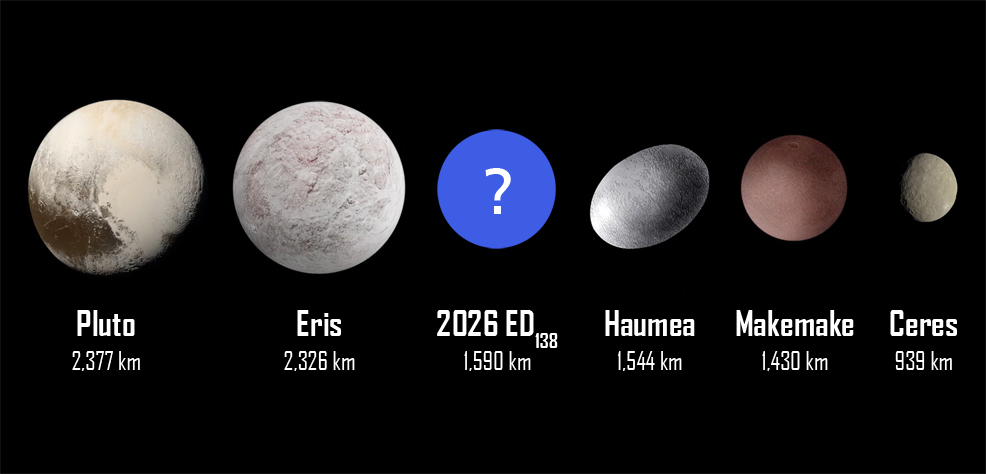
Further analysis revealed that Rubin had photographed 2026 ED138 on 30 separate occasions across 20 nights between March and July 2026. Researchers also located the object in older images from other telescopes, extending its observational history back to 2016. Remarkably, a separate follow-up study posted on arXiv this week identified yet more photographic records dating back to 1954, along with a possible detection from 1937, just seven years after Pluto's discovery. The object had escaped earlier surveys largely because of its position in the far southern sky, near the crowded star fields of the Milky Way, making its slow movement difficult to distinguish from background stars. 2026 ED138 is currently at a distance of around 46 astronomical units (AU), where 1 AU is the average distance between Earth and the Sun. This places it about 10 AU farther away than Pluto, currently at 36 AU. The object follows a slightly elongated orbit, ranging from 37 to 49 AU, and completes one revolution around the Sun every 283 years. Its orbital plane also tilts by about 24° relative to the plane of Earth's orbit, suggesting that gravitational interactions with Neptune may have altered its original trajectory. The object belongs to a wider population of icy bodies beyond Neptune, collectively known as trans-Neptunian objects. Perhaps the most exciting aspect of the discovery is the object's potential size. Based on its brightness, distance and assumed surface reflectivity, it had initially been estimated at 600 to 1,500 km in diameter. However, the follow-up study has now revised this to between 635 and 1,590 km. At the upper end of this range, 2026 ED138 would exceed the diameter of Makemake and could even surpass Haumea, potentially ranking as the third-largest officially recognised dwarf planet if confirmed by the IAU. It would also be considerably larger than Ceres, which is 940 km across. Even at the lower size estimate, 2026 ED138 would represent a substantial addition to our knowledge of the outer Solar System.
The uncertainty over its true size stems largely from its unknown surface reflectivity, or albedo. A relatively dark surface would imply a larger object, while a brighter and more reflective surface would suggest something smaller. Astronomers will therefore need further observations, particularly at infrared wavelengths, to establish its physical characteristics and determine whether gravity has pulled it into a sufficiently rounded shape. Until then, 2026 ED138 remains a dwarf planet candidate rather than a confirmed member of this group. The discovery also demonstrates the remarkable potential of Rubin so early in its scientific programme. Even before its main survey began, the observatory had identified more than 11,000 previously unknown asteroids, including around 380 beyond the orbit of Neptune. Its combination of sensitivity, wide-field imaging and advanced data processing will allow astronomers to search regions of the sky that earlier surveys struggled to explore. Researchers already suspect that several more large, distant worlds remain undiscovered, particularly against the crowded background of the Milky Way. With nearly a decade of observations still ahead, Rubin could significantly expand the known population of dwarf planets and provide new insights into how the Solar System formed and evolved. "Rubin will image the whole southern sky again and again for ten years," said Holman, "so any others hiding in the places earlier surveys skipped are now within reach." "Rubin is giving us an unprecedented capacity to explore the sky through a combination of speed, depth, and precision," says Mario Jurić, Professor and Senior Data Science Fellow at the University of Washington. "And the discovery is just the beginning: once we identify a new object, we can search back months, and sometimes even decades, finding it in images where nobody knew to look. This ability to both discover and 'precover' objects is transforming how quickly and accurately we can determine their orbits and understand the distant Solar System."
Comments »
If you enjoyed this article, please consider sharing it:
|