17th March 2026 Astronomers may have witnessed two planets colliding Astronomers report evidence of a likely collision between two planets orbiting the star Gaia20ehk, about 11,000 light years away in the constellation Puppis. Erratic dimming and strong infrared emission are attributed to hot debris from the impact passing in front of the star.
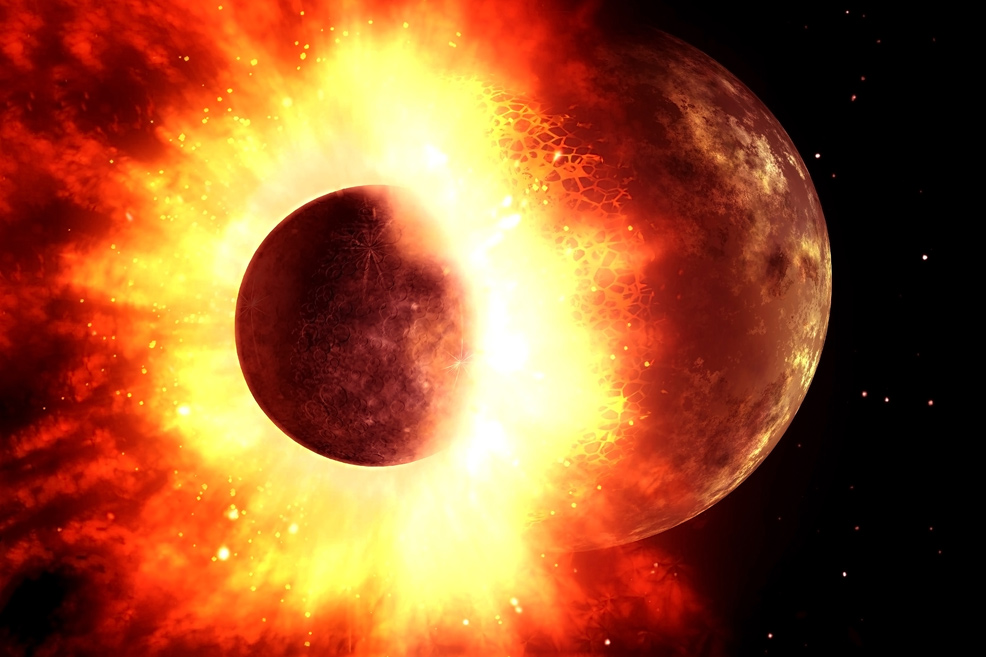
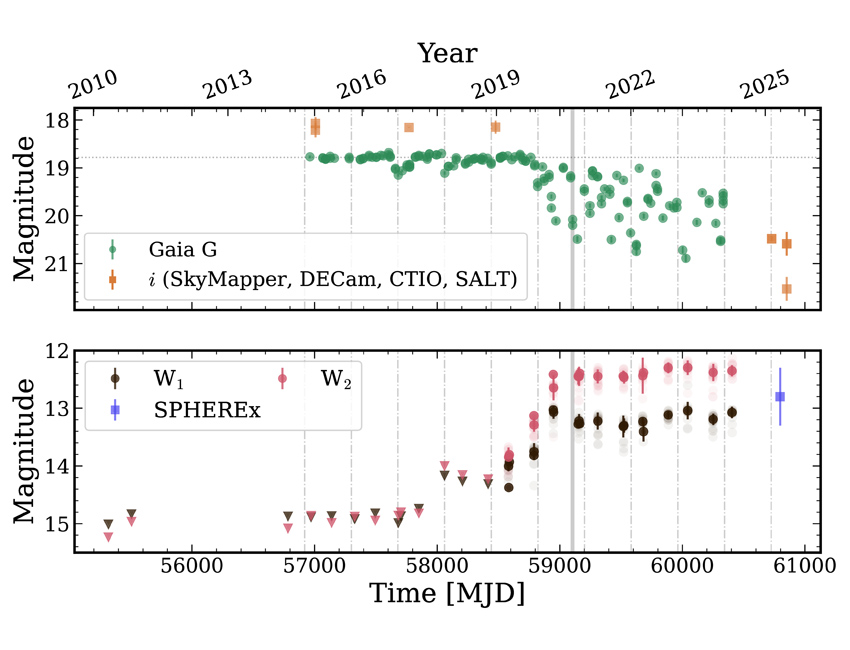
Four and a half billion years ago, the young Earth endured a catastrophic event that reshaped the world forever. A Mars-sized object known as Theia struck the proto-Earth in a titanic, slow-motion collision, unleashing unimaginable energy and melting much of the planet's outer layers. Vast quantities of molten and vaporised rock were blasted into space, forming a glowing cloud of debris that encircled the battered world. Over time, this material gathered together to form the Moon. Such giant impacts are thought to be common during the chaotic birth of planetary systems, but witnessing one beyond our own Solar System has proved extraordinarily difficult. Astronomers may now have observed a similar event unfolding around a distant star. A system known as Gaia20ehk, located 11,000 light years away in the constellation Puppis, began displaying unusual behaviour several years ago. The star itself is an otherwise ordinary main sequence object comparable to our Sun, which would normally exhibit a stable and predictable brightness. Instead, observations revealed irregular dips in its light output beginning in 2016, followed by increasingly chaotic fluctuations by 2021. The most likely explanation is a massive collision between two planetary bodies in the system. According to the study, huge quantities of dust and other debris were thrown into space during the impact, which most likely occurred around 2019 or 2020, as seen from Earth – though the collision itself took place roughly 11,000 years ago due to the vast distance of the system. As this gradually expanding cloud passed between the star and Earth, it partially blocked the starlight, producing the unusual brightness variations detected by telescopes. Researchers reconstructed the event using data from multiple observatories, including the European Space Agency's Gaia mission, NASA's WISE and NEOWISE, and follow-up observations from ground-based facilities such as the 9.2 m Southern African Large Telescope and 4.1 m SOAR telescope in Chile. A comparison of visible and infrared observations provided further clues about the nature of the event. Visible light from the system became erratic and dimmer, while infrared observations showed a strong increase in brightness. This indicated that the surrounding material was extremely hot, consistent with freshly generated debris from a violent planetary impact.
Earlier dips in brightness may represent a series of smaller "grazing" encounters between the two bodies before the final catastrophic collision occurred, says the research team. They estimate that the debris cloud orbits the star at roughly one astronomical unit – approximately the same distance that separates Earth from the Sun. Over time, this material could cool and eventually merge into new planetary bodies. Astronomers note that such giant impacts typically occur within the first 100 million years of a planetary system's formation, suggesting that Gaia20ehk may be relatively young. "It's incredible that various telescopes caught this impact in real time," said Anastasios Tzanidakis, a doctoral candidate in astronomy at the University of Washington. "There are only a few other planetary collisions of any kind on record, and none that bear so many similarities to the impact that created the Earth and Moon. If we can observe more moments like this elsewhere in the galaxy, it will teach us lots about the formation of our world." The findings appear this month in The Astrophysical Journal Letters. Although planetary collisions are believed to be common during the formation of solar systems, detecting them directly from Earth is extremely rare. The debris must pass in front of the host star for its effects to be visible in the star's light curve, and the resulting signals can unfold slowly over several years. Future surveys may soon reveal many more such events. When the Vera C. Rubin Observatory begins its Legacy Survey of Space and Time later in 2026, it will repeatedly scan the entire southern sky, creating 30 petabytes of data. Researchers estimate that this project alone could detect around 100 planetary collisions over the next decade, offering new insight into how rocky worlds form and evolve across the galaxy – and potentially shedding further light on the violent processes that shaped the early Earth and led to the formation of our Moon.
Computer simulation of planetary collision. Credit: NASA
Comments »
If you enjoyed this article, please consider sharing it:
|