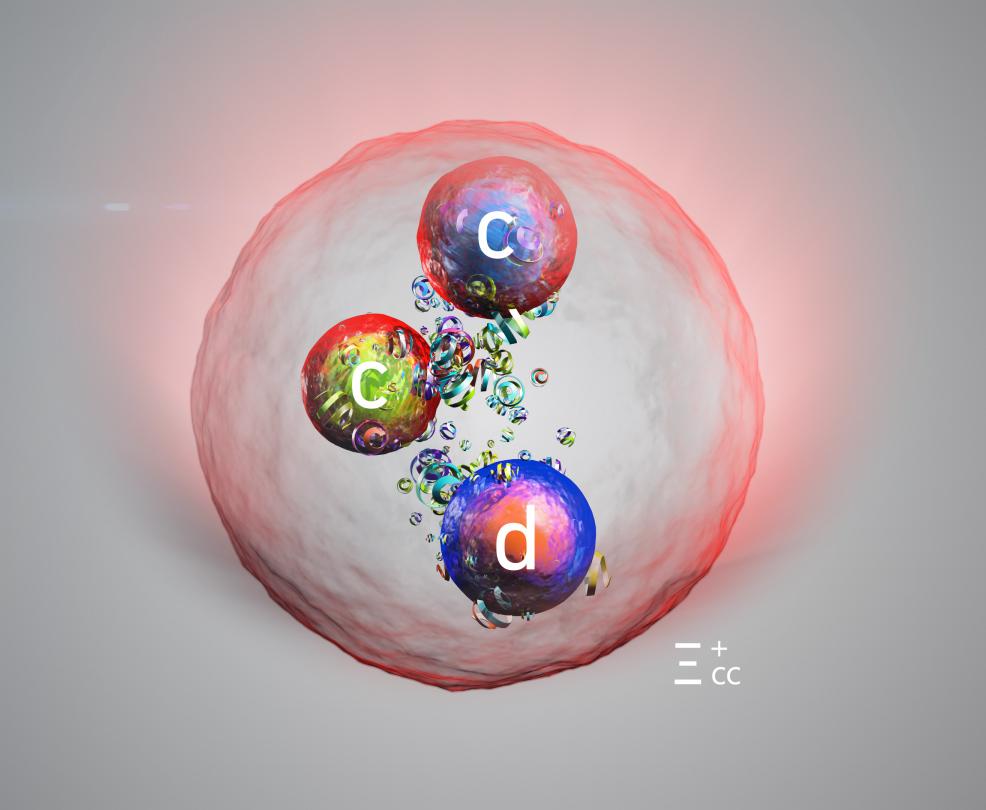
19th March 2026 New particle detected by Large Hadron Collider Physicists at CERN's LHCb experiment report the discovery of the doubly charmed baryon Ξcc⁺. This particle, containing two charm quarks and one down quark, has been detected with high statistical significance and resolves a long-standing discrepancy from earlier experimental results.
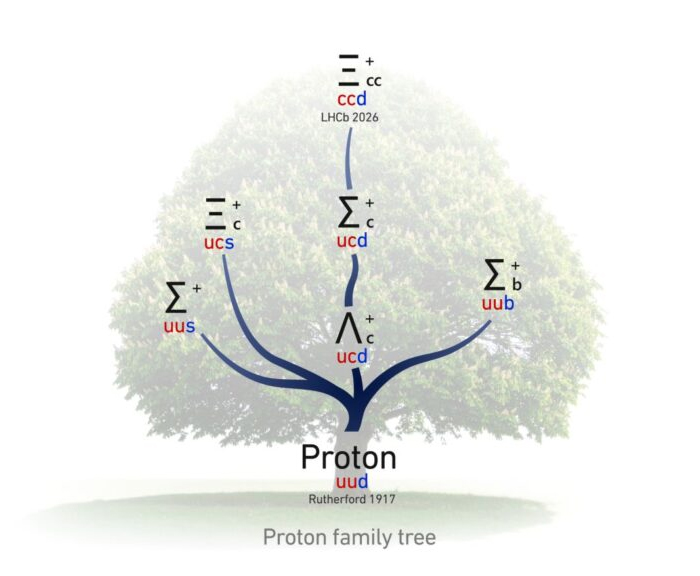
The Large Hadron Collider (LHC) at CERN has been probing the fundamental structure of matter since it began operations in 2010. By smashing protons together at close to the speed of light, it recreates conditions similar to those just after the Big Bang. Among its four main detectors is LHCb, a specialised experiment designed to study how quarks combine and decay. Over the years, LHCb has revealed a growing "zoo" of short-lived particles, offering new insights into the forces that bind matter together. At the heart of this research are quarks, the tiny building blocks that make up protons and neutrons. These come in six "flavours": up, down, charm, strange, top and bottom. The proton, first identified in 1917, consists of two up quarks and one down quark. However, by replacing these with heavier quarks, physicists can produce more exotic relatives known as baryons. These are usually highly unstable, existing for only a fraction of a second before decaying into lighter particles. The latest discovery is one such exotic particle, known as the Ξcc⁺ (pronounced "Xi-cc-plus"). It is built from two charm quarks and one down quark, giving it a structure similar to a proton but with much heavier components. As a result, it has a mass of 3,620 MeV/c², roughly four times that of a proton. This places it at the top of the "proton family tree", where heavier quark combinations produce more massive and typically shorter-lived particles.
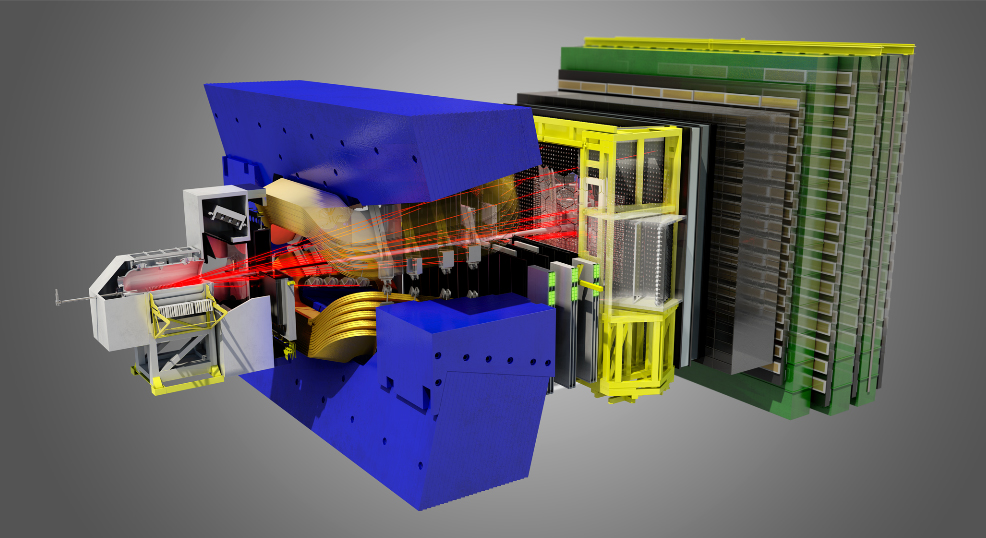
Detecting something so fleeting is no easy task. The Ξcc⁺ exists for only an incredibly brief moment before decaying into lighter particles. Scientists at CERN identified it indirectly by reconstructing its decay products and tracing them back to a common origin. In this case, the signal was strong enough to reach a statistical significance of 7 sigma, well above the threshold required to confirm a genuine discovery. "This is the first new particle identified after the upgrades to the LHCb detector that were completed in 2023," said LHCb spokesperson Vincenzo Vagnoni. "The result will help theorists test models of quantum chromodynamics, the theory of the strong force that binds quarks." The finding also resolves a long-standing mystery. More than 20 years ago, an experiment in the United States reported hints of a similar particle, but at a much lower mass than theory predicted. That result was never confirmed, leaving physicists uncertain. The new measurement places the Ξcc⁺ at almost exactly the mass expected, and very close to its previously discovered "sibling", the Ξcc⁺⁺, found at the LHC in 2017. Despite their similarity, the Ξcc⁺ appears to decay up to six times faster, making it even harder to detect. Discoveries like this may not capture headlines in the same way as the Higgs boson, but they play a crucial role in refining our understanding of the strong nuclear force, one of the four fundamental forces of nature. Each new particle adds another piece to the puzzle of how matter is assembled at the smallest scales. Looking ahead, the LHC is set to become even more powerful. The upcoming High-Luminosity upgrade, expected to be complete by 2030, will increase the number of particle collisions dramatically. This could allow experiments like LHCb to uncover even rarer particles and probe deeper into the structure of matter, potentially revealing new physics beyond current theories.
Comments »
If you enjoyed this article, please consider sharing it:
|