18th July 2026 Enzyme removes 70% of age-linked damage from a 75-year-old artery In tests on human tissue, an engineered enzyme reversed age-related protein damage that scientists once considered irreversible, cutting levels by over 70% in arterial tissue from a 75-year-old and lowering them in treated elderly skin below those found in a 31-year-old.
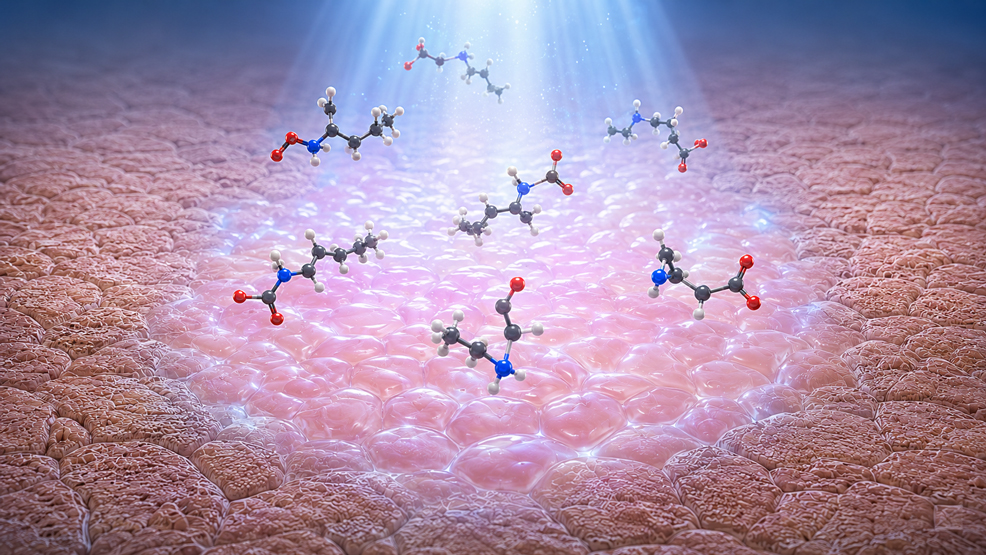
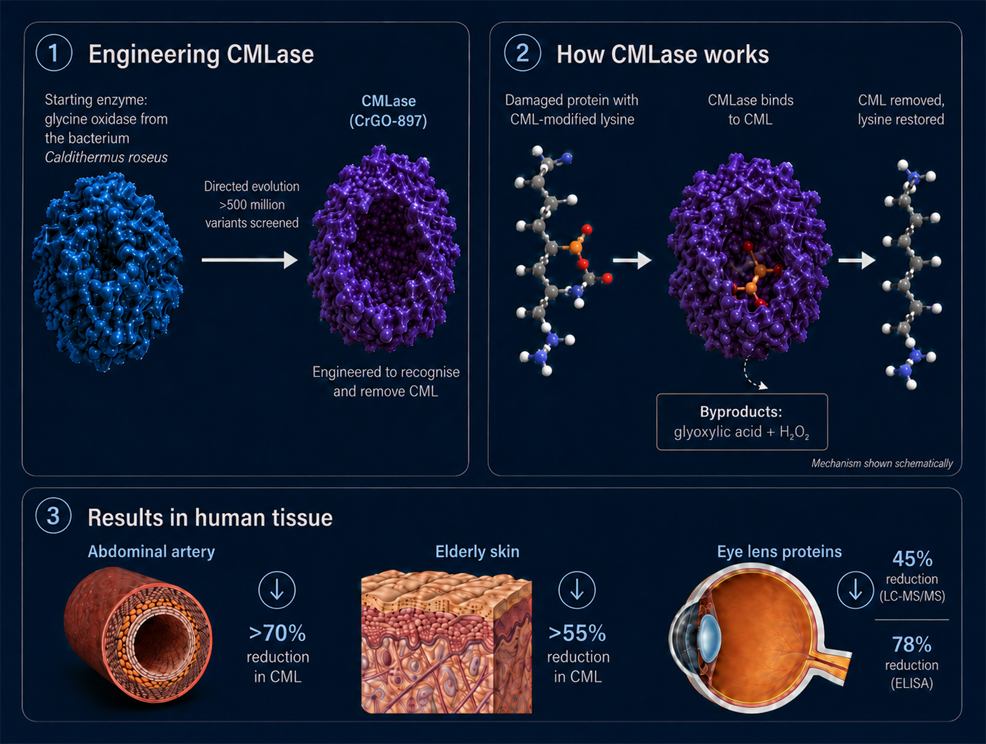
Scientists have found a way to strip away a stubborn form of molecular damage from old human tissue, something researchers have tried to achieve for decades. Published in Nature Communications, the study involved Revel Pharmaceuticals, Calico Life Sciences, and the University of Colorado Anschutz Medical Campus. The target is Nε-carboxymethyl-lysine, or CML, one of a group of compounds known as advanced glycation end products, or AGEs. These form when sugars and other reactive molecules stick to proteins. Much of this damage builds up in the extracellular matrix, the supporting network of collagen and other long-lived proteins that holds the body's tissues together. Over many years, it accumulates in blood vessels, skin, and the lens of the eye. CML can alter the structure of these proteins and may lead to chronic inflammation. Until now, researchers have mainly attempted to stop new glycation damage from forming. Damage that had already built up was considered irreversible. The team first turned to AlphaFold DB, a vast public database of protein structures predicted by Google DeepMind's AlphaFold AI system. It allows scientists to search more than 200 million predicted 3D structures, since a protein's shape largely determines how it works and which molecules can reach it. From nearly 45,000 candidates, the researchers identified a weakly active bacterial enzyme with a suitably open structure. They then moved into the laboratory, putting it through five rounds of so-called "directed evolution" and experimentally screening more than 500 million genetic variants. This process boosted the enzyme's efficiency on short chains of amino acids (the building blocks of proteins) by more than tenfold. More importantly, the enzyme gained the ability to remove CML from full-length proteins. The final version, which they named CMLase, acts like a molecular repair tool: it removes unwanted CML modifications and restores the original lysine building block underneath.
In laboratory-modified proteins, CMLase removed between 52% and 97% of detectable CML, depending on the substrate. A detailed analysis of one test protein found it reduced CML at 30 of 33 mapped sites, with seven showing falls of more than 90%. Importantly, the test protein itself remained intact. The most striking results came from human tissue. In sections of abdominal aorta from a 75-year-old donor, CML levels fell by more than 70%. In elderly skin, they dropped by more than 55%, reaching below the level measured in skin from a 31-year-old. Lens proteins also showed reductions of either 45% or 78%, depending on the measurement method. This is not the same as reversing aging in a living person. The tests used extracted lens proteins and thin, preserved sections of artery and skin, where the enzyme could reach its targets more easily. Researchers still need to show that removing CML restores elasticity, improves tissue function or reduces harmful inflammatory signalling inside the body. Before clinical trials, CMLase will need further work on delivery, tissue penetration, dosage, immune reactions and safety. Because the enzyme originated in a bacterium, researchers may also need to modify it so that the human immune system can tolerate it. Early trials would probably focus on specific conditions linked to heavy glycation damage, such as complications of diabetes or diseases affecting blood vessels, skin, or the eyes. A "huge breakthrough" Although still at the preclinical stage, its ability to remove large amounts of supposedly irreversible damage from aged human tissue makes it an unusually promising proof of concept. Aubrey de Grey, a prominent longevity researcher who was not involved in the study, described it on social media as a "huge breakthrough" in "arguably the single most neglected aspect of aging, extracellular matrix damage". He added that top researchers had "tried and failed for decades" to achieve it. CML is only one part of aging, but according to the researchers, the same engineering approach could eventually target other forms of damage, including tougher glucosepane crosslinks. They describe their work as "a foundation for developing regenerative therapies that repair damaged tissues". A practical treatment remains some distance away, but the study suggests that some forms of molecular damage accumulated over a lifetime may ultimately prove repairable.
Comments »
If you enjoyed this article, please consider sharing it:
|