21st July 2026 First confirmed atmosphere on a rocky habitable-zone exoplanet Astronomers have detected helium escaping from LHS 1140 b, a rocky super-Earth around 48 light-years away in its star's habitable zone, providing the first observational confirmation of an atmosphere on such a world.
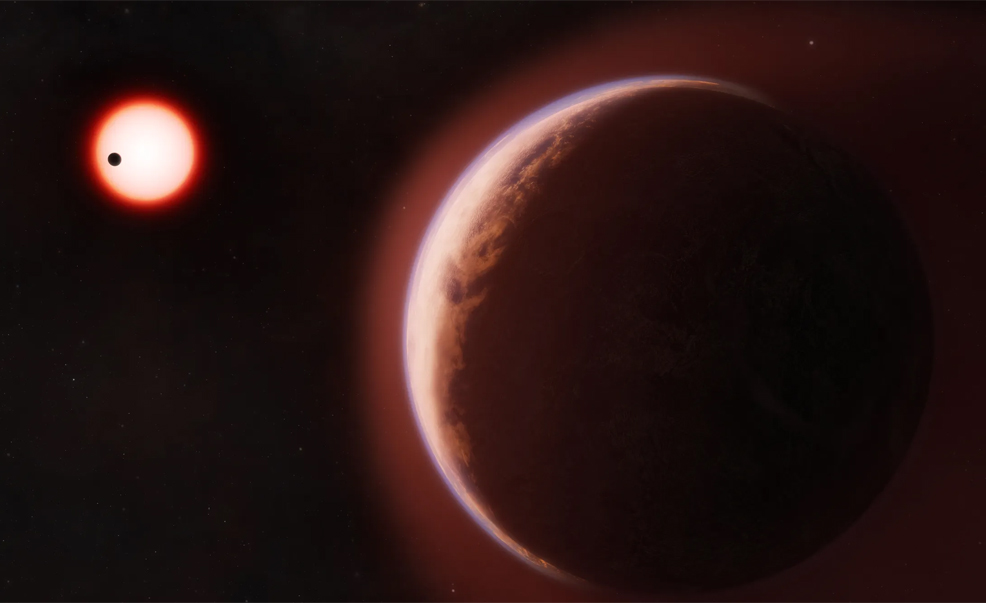
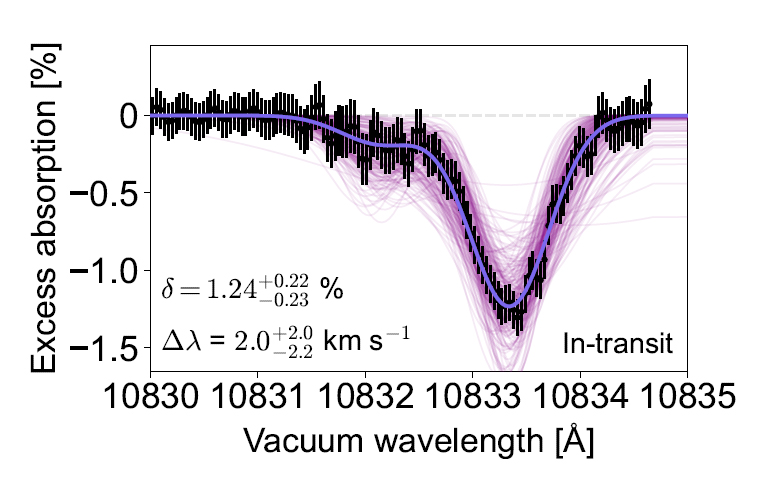
Exoplanet research has made remarkable progress since astronomers began confirming planets beyond our Solar System in the early 1990s. Thousands of these distant worlds have now been catalogued, including a growing number of rocky planets within their stars' habitable zones. More powerful telescopes and increasingly sensitive techniques now allow researchers to move beyond measuring sizes and orbits and begin probing atmospheres, whose gases can reveal composition, climate, and potential habitability. A multi-institutional team led by Harvard and the Smithsonian has now reached a major milestone in this effort. Scientists from Carnegie Science, MIT, the Space Telescope Science Institute and other institutions also contributed. Using the WINERED spectrograph on the 6.5-metre Magellan Clay telescope at Las Campanas Observatory in Chile, they detected helium escaping from the upper atmosphere of LHS 1140 b, a rocky exoplanet that lies squarely within the habitable zone of its parent star. Using the transit method, the team watched the system closely for six and a half hours as both known planets (b and c) crossed their star only 39 minutes apart. As LHS 1140 b passed in front, some of the starlight filtered through the gas surrounding it. Helium absorbed starlight at three closely spaced wavelengths near 1,083 nanometres, leaving a distinctive fingerprint. The signal appeared before the planet entered the stellar disc and possibly lingered after it left, suggesting extended tails of escaping gas.
Helium detected in the atmosphere of LHS 1140 b. The pronounced dip near 10,833 angstroms shows starlight absorbed by helium as the planet crossed its star. Cropped from Figure 3b of Cherubim et al. (2026), CC BY 4.0.
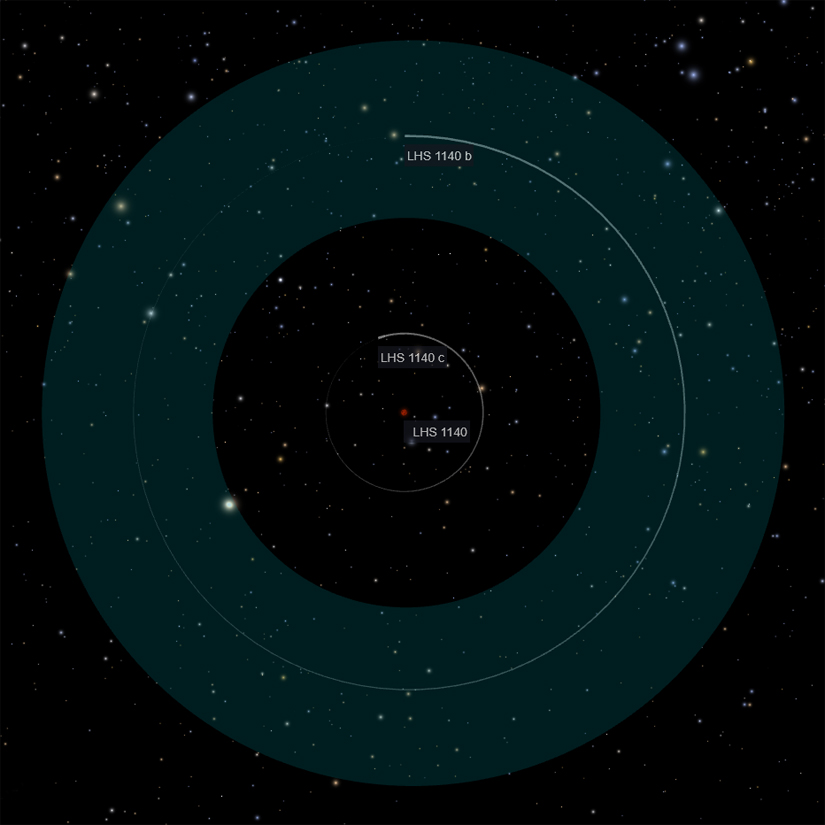
Because the Magellan Clay is a ground-based telescope, one problem was that Earth's atmosphere absorbs light at nearby wavelengths, while changes in the star itself and noise in the observations could create a false helium signal. The team removed contaminated sections of the data, modelled the remaining noise, checked for signs of stellar flares, and repeated the analysis with separate software. LHS 1140 c, the smaller of the two exoplanets, provided a useful comparison because the team found no helium signal during its transit. Astronomers first identified LHS 1140 b in 2017. Its diameter is about 1.73 times Earth's, and its mass reaches 5.6 Earths. It circles its star every 24.7 days and receives 42% as much energy as Earth, giving it an equilibrium temperature of 226 kelvin, or about −47°C. An atmosphere could warm the surface, however, while its measured density may point to a water-rich interior containing between 9% and 19% water by mass. Liquid water is therefore possible, but scientists have not established whether any ocean or habitable surface exists. The parent star LHS 1140 belongs to the M4.5V class of red dwarfs. It has roughly one-fifth the Sun's radius and only 0.38% of its luminosity, but its old age and low activity may help planets retain atmospheres. LHS 1140 c, meanwhile, is a hotter rocky world with 1.91 Earth masses, a diameter 1.27 times Earth's and a 3.78-day orbit. It receives about five times Earth's irradiation and likely has little or no atmosphere.
The models suggest that helium dominates the planet's upper atmosphere, with very little hydrogen present. X-rays and ultraviolet radiation from the star heat this gas and slowly drive it away into space. Heavier elements like oxygen, carbon and nitrogen are too heavy for the observed outflow to remove, so if present, they should remain behind in the atmosphere. The study did not measure methane directly. Earlier observations had tentatively ruled out high-altitude hazes made from methane or hydrogen sulphide, while the new models suggest that methane gas itself may have become scarce over time. The confirmation of an atmosphere now makes LHS 1140 b a more credible target for habitability research. The joint Hubble and James Webb Rocky Worlds programme will study the planet and its star over the next several years, helping astronomers test whether the atmosphere persists and redistributes heat around the world. Further observations could search for water, carbon dioxide and other gases, while repeated ground-based measurements may reveal how the escape of helium changes over time. "Twenty years ago, we wondered whether other terrestrial-type planets even existed," said Robin Wordsworth, Professor of Earth and Planetary Sciences at Harvard. "Then we learned they're common, and found some in the habitable zone. The next question was whether any of them had managed to keep an atmosphere. Now we know at least one has."
Comments »
If you enjoyed this article, please consider sharing it:
|