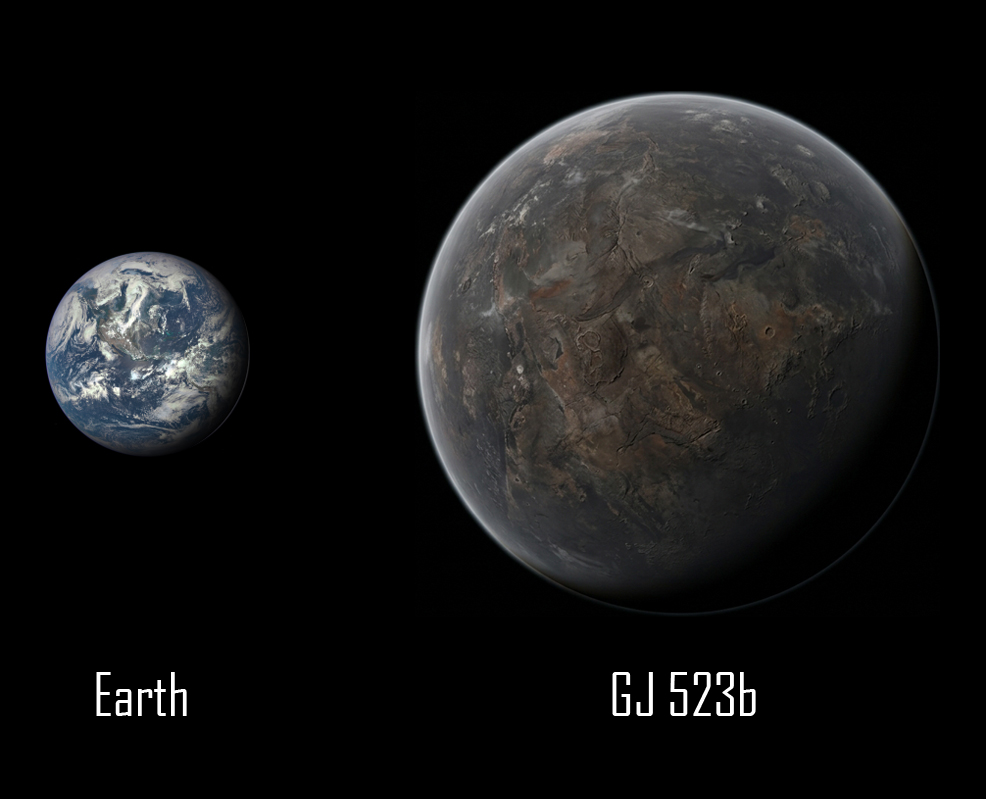
25th August 2026 "Mega-Earth" is 23 times as massive as our planet A remarkably dense exoplanet called GJ 523b is 2.6 times as wide as Earth, yet contains 23.5 times its mass, prompting researchers to propose mega-Earths as a newly defined class of exoplanets.
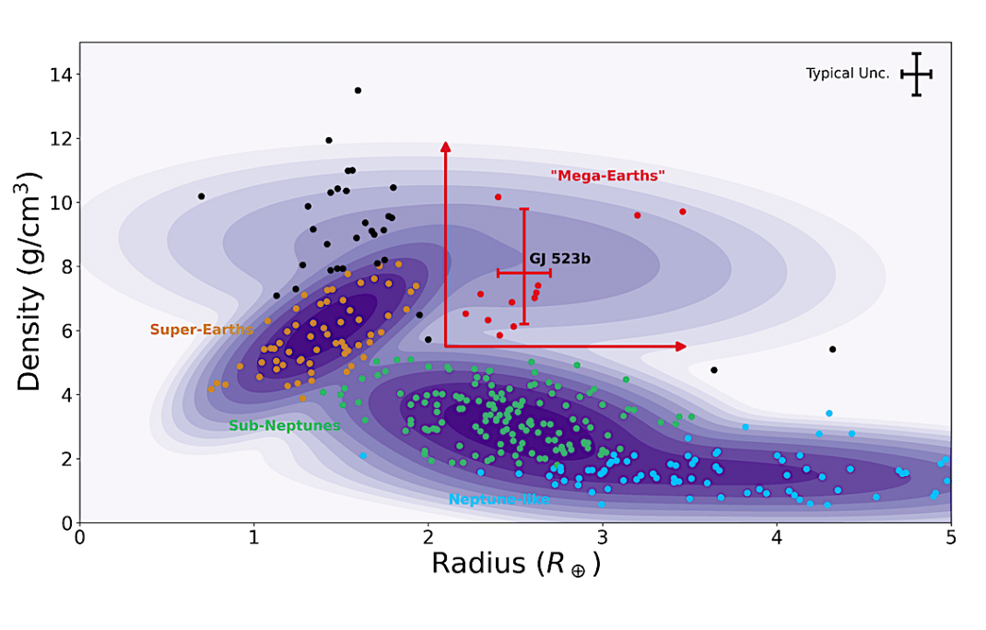
Among the several thousand exoplanets discovered beyond our Solar System, super-Earths have emerged as one of the most common types. The term generally describes planets larger or more massive than Earth, but smaller than Neptune, and does not imply an Earth-like climate or surface. Most are thought to be rocky, while somewhat larger worlds tend to be lower-density "sub-Neptunes" wrapped in substantial layers of hydrogen, helium or other volatile material. A newly characterised exoplanet called GJ 523b sits well outside these expectations. The planet has a radius of 2.55 Earths, making it roughly 32,500 km across, but a mass of 23.5 Earths. It therefore outweighs Neptune despite spanning only about two-thirds of Neptune's diameter. Its average density reaches 7.8 grams per cubic centimetre, compared with 5.5 for Earth, placing it among the densest planets known at its radius. By size alone it resembles a sub-Neptune, but its enormous density points instead to a world dominated by much heavier material with little hydrogen or helium. "This isn't what we expected at all," said lead author Maxwell Kroft of the University of Wisconsin-Madison. "Dense planets like this aren't uncommon, but they're usually small rocky planets similar to Earth or Mercury." This unusual combination has prompted researchers to describe GJ 523b as a "mega-Earth". Kroft and his team propose a more precise definition for the term: planets between 2.1 and 5 Earth radii, with densities of at least 5.5 grams per cubic centimetre. GJ 523b is also the first exoplanet discovered and catalogued by researchers at the university's Wisconsin Center for Origins Research (WiCOR). Their study, currently under review by The Astronomical Journal and available as a preprint on arXiv, identifies 13 well-characterised planets that meet these criteria, suggesting a small but distinct group of unusually dense worlds.
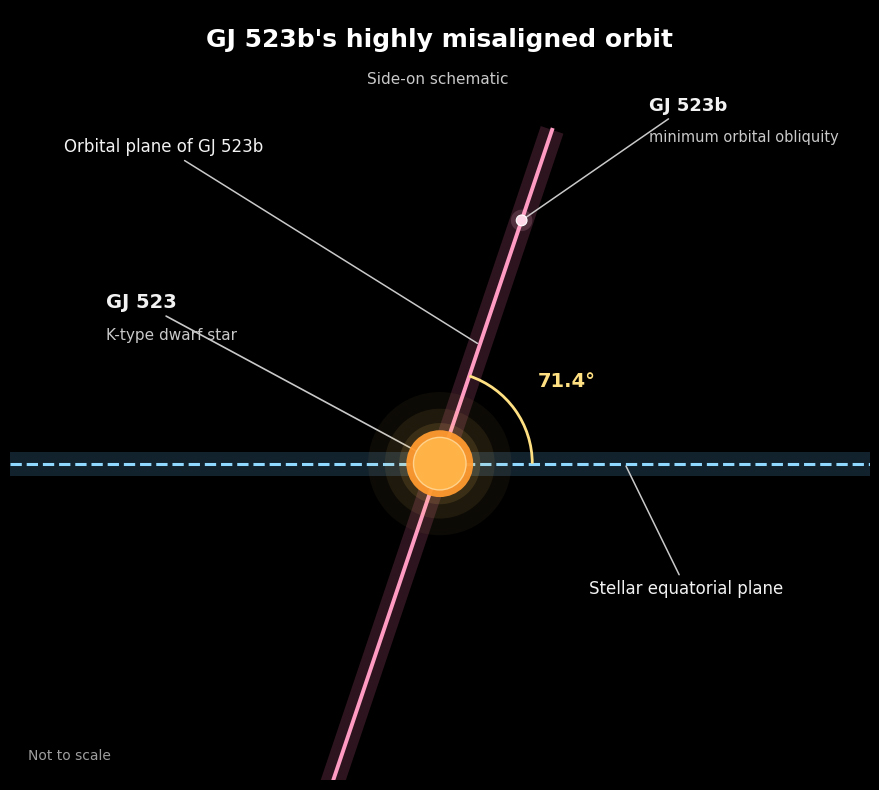
"People have been using the phrase 'Mega-Earth' for more than a decade, but we've never had a planet that let us say concretely what one is. GJ 523b finally does," said Thomas Beatty, an astronomer at the University of Wisconsin-Madison and co-author of the paper. NASA's Transiting Exoplanet Survey Satellite (TESS) first identified GJ 523b through the transit method, detecting tiny drops in the brightness of its star every 17.75 days. Researchers then obtained 30 radial velocity measurements using NEID, an ultra-precise spectrograph on the 3.5-metre WIYN Telescope at Kitt Peak National Observatory in Arizona. These measurements detected the star's gravitational "wobble" and allowed the team to determine the planet's mass. GJ 523 itself is a K-type dwarf star about 87 light-years from Earth, with roughly 78% of the Sun's mass and 21% of its luminosity. The system appears to be remarkably young, at around 169 million years old (compared with 4.6 billion years for our own Solar System), making GJ 523b likely the youngest known of the 13 well-characterised mega-Earths identified by the team. It orbits just 0.123 astronomical units (AU) from its star, or about one-third of the distance between Mercury and the Sun, receiving about 14 times as much radiation as Earth. Its estimated equilibrium temperature is 538 K, or 265°C (509°F). Another surprise comes from its orbit. The data indicate that GJ 523b travels at least 71 degrees out of alignment with its star's equator, potentially placing it on a near-polar trajectory. Planets forming in a flat protoplanetary disk are normally expected to remain broadly in the same plane, making such an extreme tilt difficult to explain and hinting at a turbulent past.
Interior models suggest that GJ 523b consists mostly of dense rock with a massive core and little or no primordial hydrogen-helium atmosphere. This is difficult to explain because a growing planetary core of about 20 Earth masses should normally begin attracting large quantities of gas from the surrounding disk. GJ 523b appears to have somehow bypassed that transition without becoming a Neptune-like world. Its large mass and relatively young age also make it unlikely that stellar radiation simply stripped away a once-massive atmosphere. The researchers suggest several possibilities. Giant collisions early in the planet's history may have increased its core mass and blasted away its atmosphere, or a combination of pebble and planetesimal accretion could have kept the growing planet hot long enough to delay the capture of gas until the surrounding protoplanetary disk had dissipated. The planet may also have formed in the cold outer reaches of the system before migrating inward. Future observations could help determine the most likely of these scenarios. Further radial velocity measurements and upcoming Gaia data releases may reveal an unseen outer companion that could have disturbed the planet's orbit. The James Webb Space Telescope could also observe GJ 523b during secondary eclipses (when the planet passes behind its star, rather than in front) to test whether it retains any significant atmosphere. Studying this and other mega-Earths may ultimately help bridge the gap in our understanding between rocky planets, sub-Neptunes and gas giants.
Comments »
If you enjoyed this article, please consider sharing it:
|