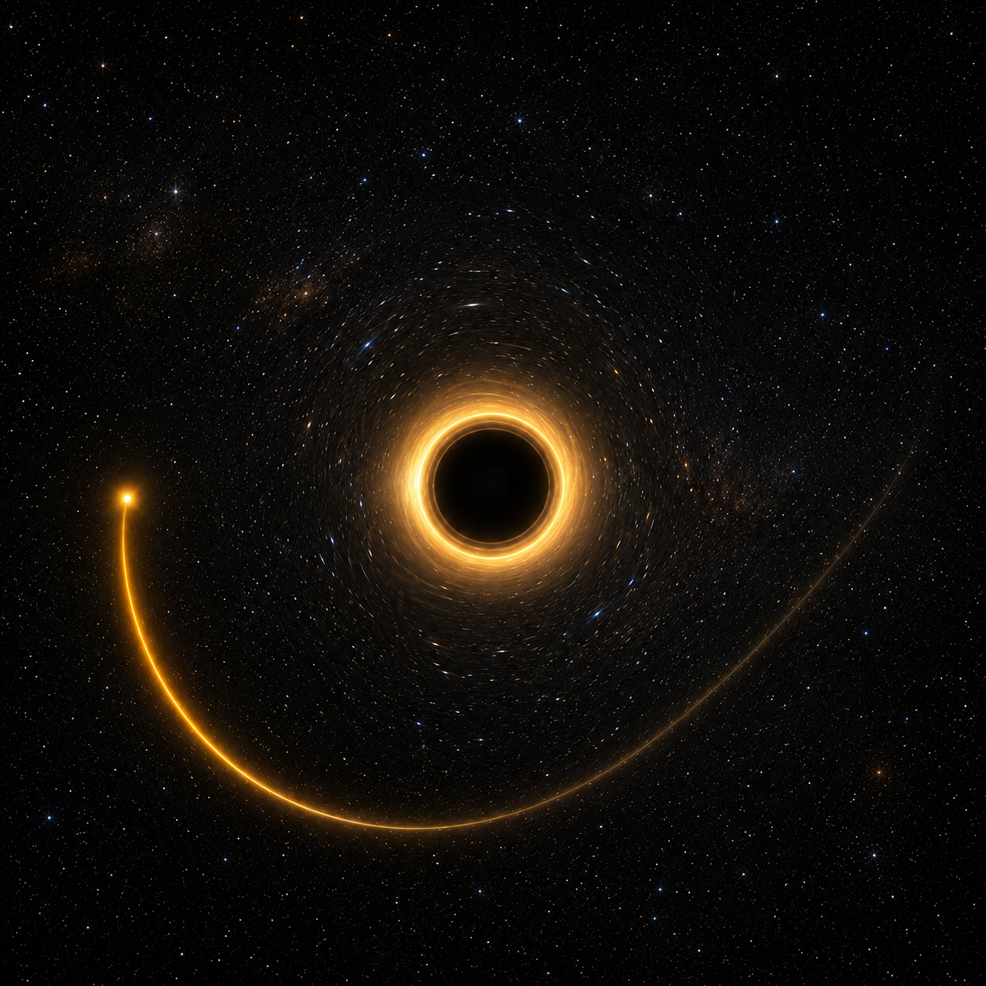
24th August 2026 Milky Way's fastest star moves at 8.5% of light speed A newly discovered star called S301 is the closest and fastest yet observed around Sagittarius A*, and could help astronomers measure the supermassive black hole's spin within the next decade.
When you think of fast objects, you might imagine a cheetah, a racing car, or a fighter jet. An adult cheetah can reach around 120 km/h, a Formula One car can exceed 350 km/h, while some high-performance military jets can surpass 3,000 km/h. But those speeds look pedestrian next to NASA's Parker Solar Probe. During its closest approaches to the Sun, the spacecraft has reached about 687,000 km/h, or 191 km/s, making it the fastest human-made object in history. Parker, which remains operational, achieved this while skimming through the Sun's outer atmosphere just 6.1 million km above its surface. Yet even the Parker Solar Probe would appear slow beside some of the stars that whip around Sagittarius A*, the supermassive black hole that lurks at the centre of the Milky Way. Astronomers have studied one of these, called S2, in extraordinary detail for decades. During its closest approach to Sagittarius A*, S2 reaches about 7,650 km/s, or roughly 40 times the peak speed of the Parker Solar Probe. It completes an orbit every 16 years and has provided some of the strongest tests yet of Einstein's general theory of relativity around a supermassive black hole. Now astronomers have found something faster still. A faint, newly observed star called S301 is estimated to hit a peak speed of 25,600 km/s during its closest approach to Sagittarius A*. That is 8.5% of the speed of light, more than triple the peak speed of S2 and 7% faster than the reported peak speed of S4714, previously cited as the fastest known star in our galaxy. At that velocity, it could cross the average distance from Earth to the Moon in only 15 seconds, as shown in our interactive animation below (click start):
S301 also holds another remarkable record. No other star with a firmly established orbit comes closer to Sagittarius A*. It follows an extremely elongated orbit with an eccentricity of 0.98 and takes just 8.7 years to complete each circuit. At its closest point, it swoops to within roughly 1.78 billion km of the black hole, equivalent to about 12 astronomical units, or only slightly farther than Saturn lies from the Sun. Its pericentre – the point of closest approach – sits 10 times closer to Sagittarius A* than that of S2. This combination of a compact orbit and extreme eccentricity produces the tremendous acceleration that sends S301 hurtling past the black hole at its record-breaking speed. The GRAVITY+ Collaboration is an international consortium led by the Max Planck Institute for Extraterrestrial Physics (MPE) in Germany, working closely with the European Southern Observatory (ESO) and research institutions across Europe. Its researchers found S301 through a long-running observing campaign at ESO's Paranal Observatory in Chile. Since 2017, the team has regularly monitored the innermost region around Sagittarius A* with GRAVITY, an instrument on ESO's Very Large Telescope Interferometer (VLTI). The VLTI combines light from four 8-metre telescopes, giving astronomers around 15 times the spatial resolution of a single 8-metre telescope and allowing them to distinguish extremely faint stars in the crowded Galactic Centre. The team first spotted S301 in spring 2023, only 15 milliarcseconds northwest of Sagittarius A*. Pinpointing such a faint object presented an enormous challenge: in our night sky, S301 appears about two billion times fainter than Betelgeuse, the familiar orange star in the constellation Orion. The team tracked S301 as it moved rapidly outwards over the following months, then targeted it again during dedicated observations in 2024 and 2025. They also searched older observations and found convincing evidence for the star in 2021, along with a weaker trace from 2017. In total, 19 measured positions allowed the researchers to reconstruct its highly eccentric orbit. That extreme orbit also offers a clue to how S301 ended up so close to Sagittarius A*. Star formation is unlikely under the intense conditions immediately surrounding a supermassive black hole, while S301's unusually high eccentricity points towards something called the Hills mechanism. This occurs when a binary star system ventures too close to a massive black hole. Powerful tidal forces tear the pair apart, allowing the black hole to capture one star while flinging the other away at enormous speed.
The researchers believe S301 became the captured member of such a pair, while its former companion may have been flung away as a hypervelocity star, potentially escaping our galaxy altogether. That violent encounter left S301 on precisely the kind of tight, extreme orbit that could now help astronomers measure the spin of Sagittarius A*. According to Einstein's general theory of relativity, a rotating black hole should drag the surrounding fabric of spacetime around with it, an effect known as frame-dragging or Lense-Thirring precession. This produces tiny changes in the orbits of nearby objects, but astronomers have struggled to measure the effect around Sagittarius A* because the previously known stars remain too far away from it. S301 ventures so much closer that its orbit should reveal these distortions on a far shorter timescale. "For the first time, we would actually be able to measure very directly the spin of a massive black hole, which would be a key test of Einstein's theory," explained Stefan Gillessen, a researcher at MPE and co-author of a paper that appears this month in Nature. "Without this star, we would need to measure the motion of other stars for several more decades to get anywhere close to measuring the spin of the black hole," added Juan Osorno, an astronomer at LIRA Observatoire de Paris–PSL, France, and study co-author. S301 will make its next closest approach to the black hole in 2031. The team plans to track it again with GRAVITY+ and, in the future, a powerful new instrument called MICADO on ESO's 39-metre (128 ft) Extremely Large Telescope, with observations spanning two complete orbits expected to provide the precision needed. "With this star we hope to measure, within the next 10 years, the spin of the black hole," said Felix Mang, PhD student at MPE and study co-author. "That would be a dream come true."
Comments »
If you enjoyed this article, please consider sharing it:
|