16th September 2026 OpenAI claims breakthrough in 90-year-old maths problem An AI-generated proof could advance our understanding of fluid motion, while raising questions about research credit and the growing role of machines in scientific discovery.
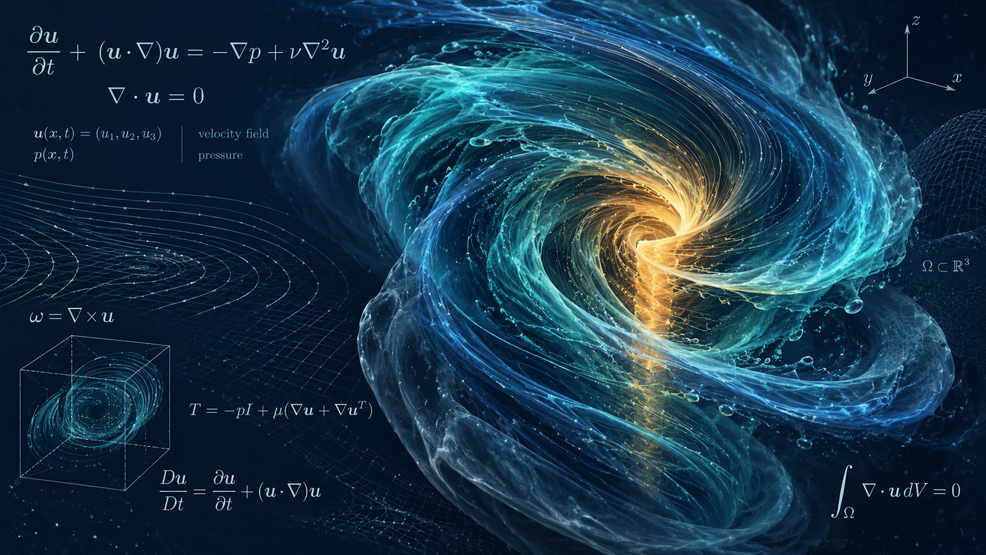
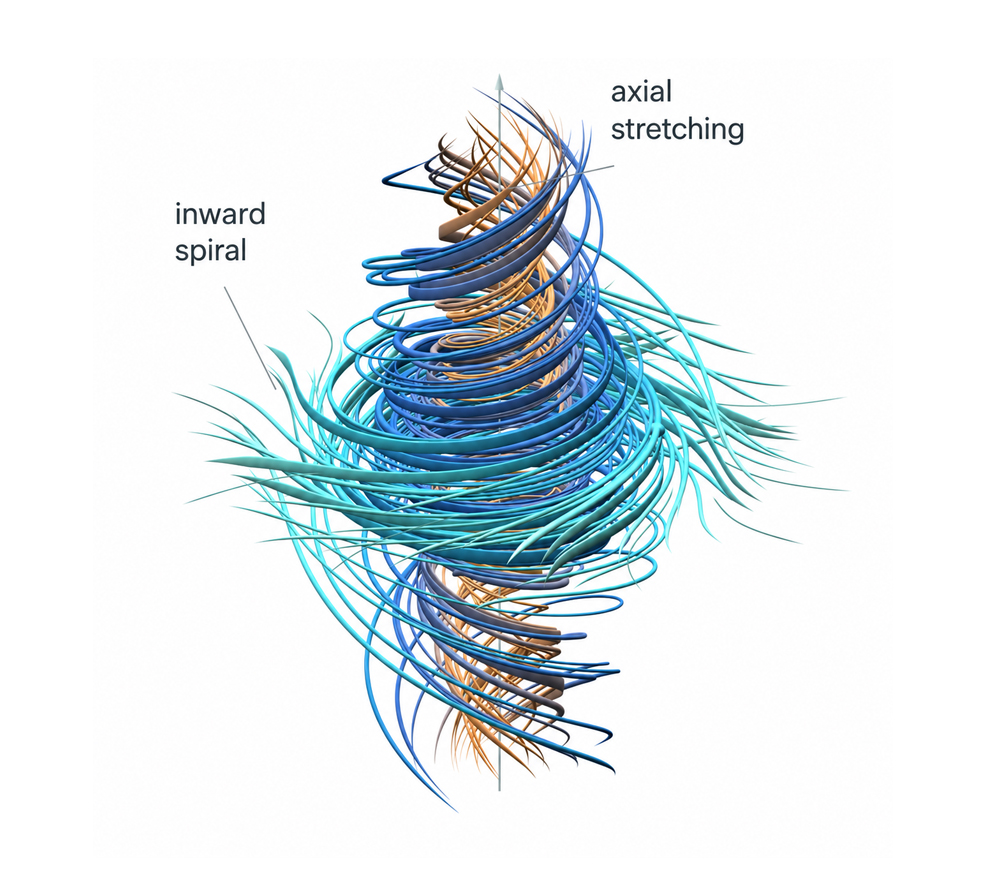
OpenAI has announced a proposed solution to the Navier–Stokes existence and smoothness problem, a mathematical puzzle that has challenged researchers for over 90 years. It ranks among the seven Millennium Prize Problems, which the Clay Mathematics Institute selected in 2000 to highlight some of the deepest and most difficult questions in mathematics. Each carries a $1 million reward. The Navier–Stokes equations take their name from Claude-Louis Navier and George Gabriel Stokes, whose work in the nineteenth century helped explain how liquids and gases move. They apply Newton's laws of motion to fluids, accounting for factors such as pressure and viscosity, a fluid's resistance to flowing. Today, scientists and engineers use them for a wide range of applications, including aircraft design, weather forecasting and the study of blood flow through the body. The equations also describe turbulence – the complex, irregular motion that creates swirling eddies in air and water. Developing a complete understanding of turbulence remains one of the major challenges in physics. Despite the equations' practical success in science and engineering, researchers have struggled for nearly a century to answer a fundamental question: if fluid motion starts smoothly, do the equations guarantee that it stays smooth, or can they predict a mathematical breakdown? OpenAI has now claimed the first proof that such a mathematical breakdown can occur under the specific conditions required to resolve the Navier–Stokes Millennium Prize Problem. This proof concerns fluid motion in three dimensions and assumes that the fluid maintains a constant density. With an external force that varies smoothly, the equations predict a "singularity", where fluid speeds grow without limit within a finite time, even though the total energy stays finite. Real fluids cannot move infinitely fast, so this reveals a limit of the mathematical model, rather than something that water or air could physically do.
The company says around 10,000 AI agents worked together to find the solution in approximately 88 hours. These agents used an unnamed internal model that OpenAI describes as significantly more capable than GPT-6 Astra, its recently released public model. During the Navier–Stokes work, the agents exchanged around 2.7 million messages and generated approximately 130 billion output tokens (chunks of text that AI models process, such as words or parts of words). "Since August 28, we have been training a new internal model that has exhibited unprecedented performance in our benchmarks, including mathematics," explained the company in its announcement. "This model's training is ongoing and its performance continues to improve." The team then used Astra to translate the proof into a form that Lean – a piece of software for checking mathematical proofs – could verify. This translation and verification took another 17 hours. OpenAI has released both a written proof and the Lean version for scrutiny. However, controversy surrounds the research process. Mathematician Tristan Buckmaster, who pursued related work with Levent Alpöge, raised concerns about research credit and whether their unpublished drafts in OpenAI's Codex service could have influenced the system, including through its training. He stressed that he did not know whether OpenAI had used their work. OpenAI acknowledges that rumours about mathematical breakthroughs prompted its project. However, in a subsequent update, the company said its investigation ruled out any influence from Buckmaster's Codex prompts during the two months preceding the announcement. This result follows several other AI-assisted mathematical advances. In May, OpenAI reported a disproof of the Erdős unit-distance conjecture, a proposed mathematical rule about arrangements of points that had challenged human researchers for 80 years. In August, the company announced ten further results spanning high-dimensional geometry, coding theory, arithmetic circuit complexity, group theory, operator algebras, quantum complexity, lattice cryptography and extremal combinatorics. If independent mathematicians confirm the proof, this latest achievement could rank among the year's most significant scientific breakthroughs, both for the mathematics itself and for what it suggests about AI's growing research capabilities. The dispute also highlights wider questions regarding trust and credit as AI takes on a greater role in scientific discovery. The announcement comes amid increasingly stark warnings about AI's potential dangers. In recent days, researchers Jacob Coxon and Evan Hubinger have warned of a greater than 10% chance that AI could cause human extinction within the next decade, while AI pioneer Geoffrey Hinton has described a 10% estimate as "not unreasonable". These figures reflect personal assessments rather than an established scientific consensus, but highlight the depth of concern among some of the technology's own developers. As AI demonstrates its potential to accelerate discovery, its growing capabilities also raise an urgent question: can humans keep it under control?
Comments »
If you enjoyed this article, please consider sharing it:
|