
![[+]](https://www.futuretimeline.net/images/buttons/expand-symbol.gif)
|
|
|
|
|
|
2017-2025
Worsening crisis in Yemen
At the turn of the 21st century, Yemen was already the poorest and least developed nation in the Arab world. 45% of its citizens were living below the poverty line, unemployment was at 35% and its literacy rate was just 58%. It had dwindling natural resources and a ballooning population. Its economy was heavily reliant on hydrocarbons, which accounted for almost 75% of government revenues and 90% of foreign exchange earnings.
Yemen reached peak oil production in 2003 and witnessed a steady decline thereafter. In 2011, a popular uprising was triggered due to worsening economic conditions, rising unemployment and government corruption. This was sparked by simultaneous protests in other Middle Eastern countries.
Over the next decade, the situation continued to deteriorate. Transitioning to a post-carbon economy was proving to be a massive challenge. Neighbouring Saudi Arabia attempted to stabilise the political and economic situation by donating oil and other resources. However, it could only provide this support for so long, as Saudi Arabia itself was facing problems. Yemen's push into the gas sector had also failed to revive its economy significantly.
Alongside this, a new and even greater threat was emerging. Yemen's groundwater levels had fallen sharply in recent decades. Around the capital, Sana'a, borehole drilling was now reaching down to water that fell more than 8,000 years ago, with groundwater levels decreasing by 4-6 metres a year. Additional wells and water mains were desperately needed to service the region, but these for the most part had been lost among the nation's various other problems. Yemen had been battling Shiite Muslim rebels in the north and a separatist movement in the south, whilst contending with a resurgence of Al Qaeda and the scourge of piracy in the Gulf of Aden.
Between 2017 and 2025, a major crisis begins to unfold,* with Sana'a running dangerously low on water.* There is widespread violence, an exodus of refugees and a gradual decline in the country's population, which continues into the following decade and beyond. Parts of the state collapse into anarchy, with a zone of lawlessness expanding into Saudi Arabia and the Horn of Africa.

2017–2025: Yemen is descending into chaos.
2017
Total solar eclipse in the USA
On 21st August this year, a total eclipse occurs in the United States, the first visible from the US since 1991 (just from part of Hawaii), and the first visible from the contiguous US since 1979. Totality occurs along a path curving from Oregon to South Carolina, lasting roughly 2 minutes and 40 seconds. The location and time of "greatest eclipse" is on the western edge of Christian County, Kentucky at 36.97 degrees North and 87.65 degrees West, occurring at 18:25 UTC.
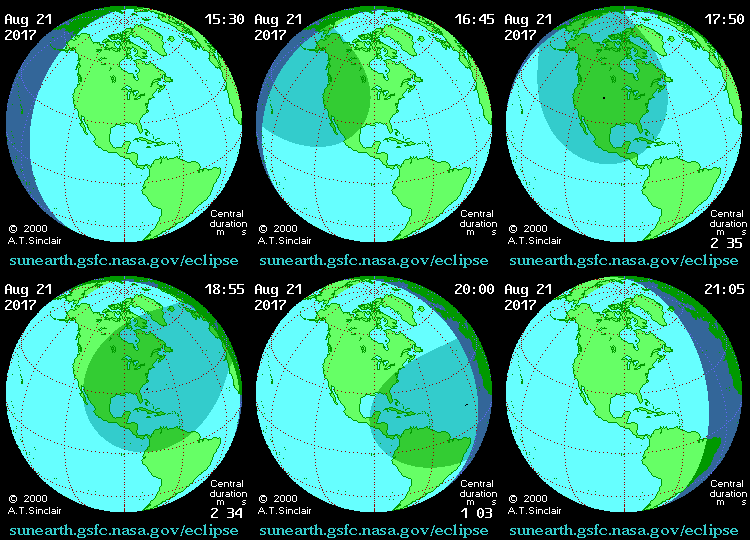
Credit: NASA
The JFK files are released
The Assassination Records Review Board was created as a result of an act passed by the US Congress in 1992, entitled the "President John F. Kennedy Assassination Records Collection Act". It mandated the gathering and release of all government records relating to the assassination of John F. Kennedy.
The Act was passed following the public outcry about the assassination, after the 1991 premiere of Oliver Stone's film JFK, which proposed Kennedy assassination theories involving plots to kill the President. The ARRB collected evidence starting in 1992, then produced a final report in 1998.
The ARRB was not commissioned to determine why or by whom the murder was committed. Its purpose was simply to release the documents after 25 years – allowing the public to draw its own conclusions.* On 26th October 2017, approximately 3,000 files related to the JFK assassination were released; however, President Trump ordered others to be withheld, citing national security concerns.

A handbill circulated on 21 November 1963, in Dallas, one day before the assassination of John F. Kennedy.
Sales of electric and hybrid trucks reach 100,000 annually
Electric and hybrid trucks are now surpassing 100,000 in annual production numbers worldwide.* This includes hybrid electric vehicles, plug-in hybrids, battery-electric and plug-in electric power take-off variations.
Between 2011 and 2017, the overall truck market grew at roughly 4% per year. However, the market for hybrid and electric trucks grew almost 12 times as fast, at 47%. This was partly in response to oil and gas volatility, but was also due to significant technology improvements and, in particular, the falling price of batteries.
The overall cost of hybrid and electric vehicles remains the largest barrier to full market proliferation, but this has improved markedly in recent years, with new battery technology that increases a vehicle's speed and range.* Progress has also been made in the time it takes to recharge,* as well as the availability of electric charging points (now 7.7 million worldwide).* Motors are also becoming available without the need for rare earth metals.*
The largest market for these trucks is still Asia Pacific, with around 41,000 being sold each year. Slowly catching up is North America, where the number is approaching 26,000. As oil prices increase, hybrid and electric trucks will eventually become more cost-effective than fossil fuel-driven ones. Technology in general continues to reshape the shipping industry. Manufacturers are looking into the possibility of driverless, fully automated vehicles, for example.*
The environmental benefits of going electric are potentially huge, as trucking makes up a significant portion of transport emissions, which cumulatively produce over 13% of the world's CO2 emissions.*

10 nanometre chips enter mass production
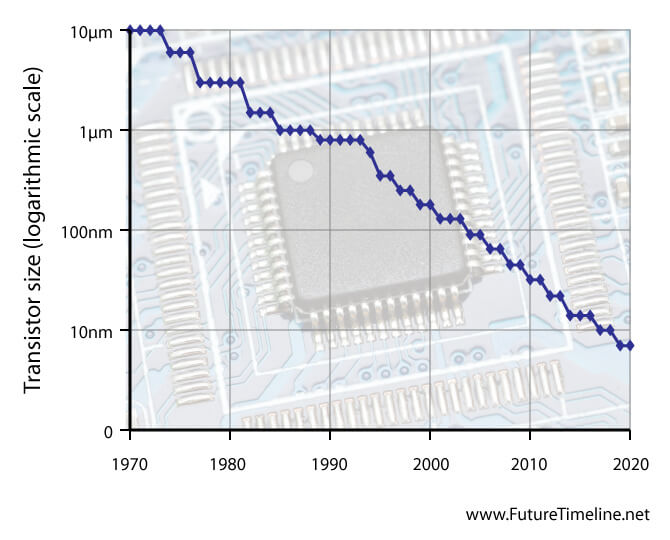
In 2017, the next generation of microprocessor technology is released by Intel, with transistors using a 10 nanometre (nm) manufacturing process* – superseding the 14 nm process. Codenamed "Cannonlake", this family of processors is based on a die-shrink of Intel's Skylake CPU microarchitecture. More than 10 billion transistors can now be packed onto a single chip – bringing greater CPU and GPU performance, and reduced power consumption for computers, phones, tablets and other electronic devices. Moore's Law will soon be hitting a wall, however, as the effects of quantum tunnelling begin to degrade chip performance at such tiny scales. Traditional silicon circuits will reach their limit in the early 2020s, with a new paradigm emerging in the form of graphene and other concepts.
Web-connected video devices exceed the global population
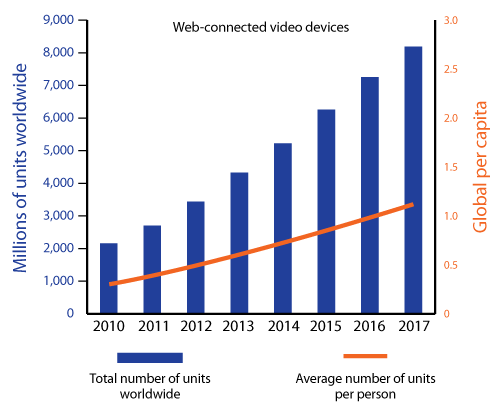
More than 8.2 billion Internet-connected video devices are now installed worldwide, exceeding the population of the planet. This category includes a diverse range of products such as tablets, smart TVs, games consoles, smartphones, connected set-top boxes, Blu-ray players, laptops and PCs. With around 7.4 billion people it is equivalent to 1.1 devices for every global citizen, nearly double the number in 2013. The fastest growth has occurred in the Asia-Pacific region, driven largely by Chinese demand.*
Electronic paper is seeing widespread use
This technology has been in development for over a decade* and is now seeing widespread use.* It works by combining organic, thin film transistors (TFT) with organic, electroluminescent displays. This produces flexible, paper-thin devices just 0.3mm in thickness. Early applications included the first e-readers, but more sophisticated products have now emerged. Smartphones, watches, clothing and textiles with electronic displays, video ID cards, video leaflets, street signs, animated instructions on packaging – these are just some of the items now incorporating this technology. Further development in the years ahead leads to greater contrast ratio, resembling printed paper more than a screen (the latter is hard to see in direct sunlight).
Wireless, implantable devices that monitor health conditions in real time
After several years of testing and development, miniature devices are now available* that monitor a range of substances in the blood, providing instant results via mobile phone. Placed just beneath the skin, they can remain in the body for months before needing to be replaced or removed.
These tiny "laboratories" measure 14mm (0.55") and comprises five sensors, a coil for wireless power as well as miniaturised electronics for radio communication. The entire system is powered by a mere one-tenth of a watt. Each sensor's surface is covered with an enzyme that is used to detect chemicals like ATP, glucose and lactate. Data is transmitted via Bluetooth to a mobile phone, which can then be sent to a doctor, if necessary.
With direct and continuous monitoring in real time, it is particularly useful for chronic conditions such as diabetes and high cholesterol, as well as tracking the impact of drug treatments such as chemotherapy. It can even be used to warn of an impending heart attack. For instance, a molecule called troponin is released by heart muscle around three to four hours before a heart attack, once the heart muscle starts malfunctioning. This can be detected by the implant before a fatal event occurs, giving the user time to seek treatment.
Although still in their infancy, these devices represent a new and emerging generation of personalised medicine that will revolutionise healthcare in the decades ahead. By 2040, such implants are commonplace – even in healthy people* – with further improvements in miniaturisation and complexity.
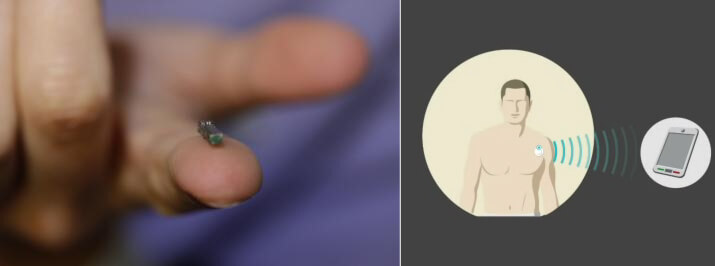
Credit: EPFL
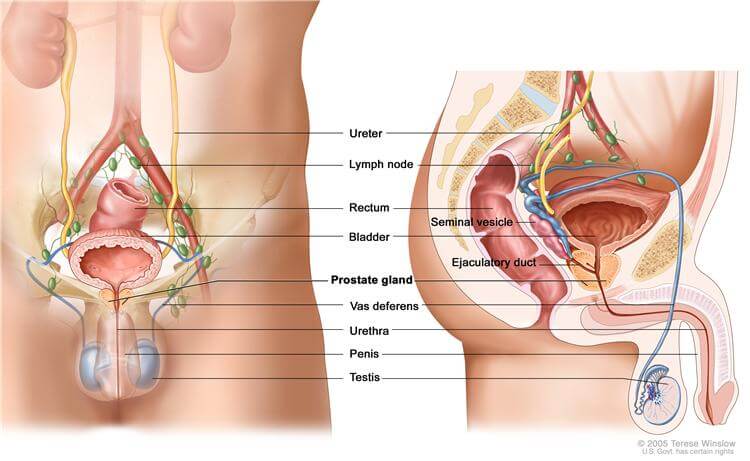
A new treatment for prostate cancer
Prostate cancer is a form of cancer that develops in the prostate, a gland in the male reproductive system. It can cause pain, difficulty in urinating, problems during sexual intercourse, or erectile dysfunction. It can also metastasize (spread) from the prostate to other parts of the body, particularly the bones and lymph nodes. Globally, it is the sixth leading cause of cancer-related death in men (in the USA it is the second). It tends to develop in men over the age of 50 and is most common in the developed world.
In 2012, a study was conducted on a potential new treatment. This used High-Intensity Focused Ultrasound (HIFU) to vibrate tissues the size of a grain of rice, heating them to about 80-90°C (176-194°F). This effectively killed the cancerous cells, in a highly localised area without damage to neighbouring healthy tissues. Because of the beam's extreme precision, there were few reported side effects. Although one in ten were left impotent, this was far less than traditional treatment methods, and none of the volunteers were left incontinent. 95% of study participants were free of cancer after 12 months.
A larger trial was conducted, with similar success. By 2017, the treatment is offered routinely on the NHS* and in many other countries, leading to a marked improvement in survival rates and patient comfort. The procedure is fast and most patients are back home within 24 hours.*
« 2016 |
⇡ Back to top ⇡ |
2018 » |
If you enjoy our content, please consider sharing it:
References
1 Yemen 'faces crisis as oil ends', BBC:
http://news.bbc.co.uk/1/hi/7739402.stm
Accessed 10th June 2011.
2 Article from 2015: "Various estimates predict that the capital Sana'a could run out of water within a decade or as soon as 2017."
See Water scarcity in Yemen: the country's forgotten conflict, The Guardian:
http://www.theguardian.com/global-development-professionals-network/2015/apr/02/water-scarcity-yemen-conflict
Accessed 6th January 2016.
3 "The JFK Act required release of all information in assassination records in the year 2017, 25 years after the passage of the act, so the Review Board employs the term 'postponed' to mean 'redacted until the year 2017.'"
See Final Report of the Assassination Records Review Board, John R. Tunheim:
http://books.google.com/books?vid=ISBN0788177222
Accessed 6th September 2011.
4 Report: Medium, Heavy-Duty Hybrid Trucks to Hit 100,000 Annual Sales by 2017, Hybrid Cars:
http://www.hybridcars.com/report-medium-heavy-duty-hybrid-trucks-hit-100000-annual-sales-2017-30952/
Accessed 31st December 2017.
5 Aluminum-Celmet Could Increase Electric Vehicle Range by 300%, inhabitat:
http://inhabitat.com/aluminum-celmet-could-increase-electric-vehicle-range-by-300/
Accessed 17th September 2011.
6 Batteries Charge Quickly and Retain Capacity, Thanks to New Structure, Science Daily:
http://www.sciencedaily.com/releases/2011/03/110320164225.htm
Accessed 17th September 2011.
7 Electric Vehicle Charging Station Installations to Reach 7.7 Million Worldwide by 2017, Driven by Rapidly Falling Prices, Navigant Research:
https://www.navigantresearch.com/newsroom/electric-vehicle-charging-station-installations-to-reach-7-7-million-worldwide-by-2017-driven-by-rapidly-falling-prices
Accessed 31st December 2017.
8 Japanese researchers develop EV motor not reliant on rare earth metals, PhysOrg:
http://www.physorg.com/news/2011-07-japanese-ev-motor-reliant-rare.html
Accessed 17th September 2011.
9 The robot revolution: Driverless trucks and voice-activated pets could be commonplace by 2019, Daily Mail:
http://www.dailymail.co.uk/sciencetech/article-1207784/
Accessed 17th September 2011.
10 Sources of World's CO2 Emissions, Public Broadcasting Service:
http://www.pbs.org/wgbh/pages/frontline/heat/etc/worldco2.html
Accessed 17th September 2011.
11 Intel Expects to Launch 10nm Chips in 2017, WCCF Tech:
http://wccftech.com/intel-expects-launch-10nm-2017/
Accessed 15th February 2015.
12 Number of internet-connected video devices on the planet to exceed global population by 2017: IHS, Fox Media:
http://www.foxmedia.co.uk/news/101013IHS.htm
Accessed 10th October 2013.
13 Razor-thin TV you can wear as a T-shirt, Daily Mail:
http://www.dailymail.co.uk/sciencetech/article-457670/Razor-TV-screen-wear-T-shirt.html
Accessed 31st Dec 2008.
14 ‘Paper Computer’ Brings New Dimension to Smartphones, The Epoch Times:
https://www.theepochtimes.com/paper-computer-brings-new-dimension-to-smartphones_1498187.html
Accessed 1st January 2018.
15 "Researchers hope the system will be commercially available within 4 years."
See Under the skin, a tiny laboratory, Ecole Polytechnique Fédérale de Lausanne:
http://www.eurekalert.org/pub_releases/2013-03/epfd-uts031513.php
Accessed 21st March 2013.
16 See 2040.
17 "It is hoped that large scale trials can now begin so the treatment could be offered routinely on the NHS within five years."
See New treatment for prostate cancer gives 'perfect results' for nine in ten men: research, The Telegraph:
http://www.telegraph.co.uk/news/health/news/9206425/New-treatment-for-prostate-cancer-gives-perfect-results-for-nine-in-ten-men-research.html
Accessed 1st January 2018.
18 Targeted therapy gives hope to cancer patients, University College London Hospitals NHS Foundation Trust (UCLH):
http://www.uclh.nhs.uk/News/Pages/Targetedtherapygiveshopetocancerpatients.aspx
Accessed 25th August 2012.
 |
|||||||||||||||||||||||||||||||
|
Latest predictions |
Timeline » 21st century |
Blogs » AI & Robotics |
Features » |
About us
|
|||||||||||||||||||||||||||
|
|
|||||||||||||||||||||||||||||||


