
![[+]](https://www.futuretimeline.net/images/buttons/expand-symbol.gif)
|
|
|
|
|
|
2021
The first Arabian mission to Mars
On 9th February 2021, the United Arab Emirates (UAE) became the first Arab country and the fifth country to reach Mars and only the second country to successfully enter Mars' orbit on its first try (India being the first with its 2014 Mars Orbiter).
The uncrewed mission, called Hope, coincided with the 50th anniversary of the UAE's formation. It followed billions of dollars of investment by the UAE into the space sector, aimed at diversifying its economy away from reliance on hydrocarbons and fostering new talent in technology and aerospace fields. It was also motivated by concerns over national security and the growing importance of satellite data, mobile communications, Earth mapping and observation.
The ruler of the UAE's emirate of Dubai, Sheik Mohammed bin Rashid Al Maktoum, had earlier stated that the mission would prove the Arab world was still capable of delivering scientific contributions to humanity, despite the many conflicts across the Middle East: "Our region is a region of civilization. Our destiny is – once again – to explore, to create, to build and to civilize."
The mission had three science objectives, aimed at forming the first complete picture of the Martian atmosphere:
• Understand climate dynamics and the global weather map through characterising the lower atmosphere of Mars.
• Explain how the weather changes the escape of hydrogen and oxygen through correlating the lower atmosphere conditions with the upper atmosphere.
• Understand the structure and variability of hydrogen and oxygen in the upper atmosphere, as well as identifying why Mars is losing them into space.
To achieve these goals, Hope carried state-of-the-art instruments: infrared (IR) and ultraviolet (UV) spectrometers, and a high-resolution camera to measure properties of water, ice, dust, aerosols, and the abundance of ozone.
2021 would prove to be an eventful year for Mars exploration. In addition to the UAE's Hope mission, NASA delivered its Perseverance rover and the first helicopter on the Red Planet, a solar-powered drone called Ingenuity, while China also deployed its first Mars orbiter, lander, and rover.

Credit: Mohammed Bin Rashid Space Centre (MBRSC)
NASA's Perseverance rover lands on Mars
In July 2020, NASA launched an unmanned space probe – Mars 2020 – bound for the Red Planet. This carried a rover, called Perseverance, to search for signs of ancient life and collect samples for return to Earth. The mission would include technology demonstrations to prepare for future human missions.
The design, based on the earlier Curiosity mission that arrived in 2012, featured improvements such as better cameras (a total of 19), refined wheel dimensions and tread design, and a heavier sample capacity. Two microphones were also fitted on the rover to record sounds of the descent from orbit, as well as subsequent surface activities.
The probe arrived in February 2021 and touched down in Jezero crater, just north of the equator. This 49 km (30.4 mi) diameter crater is believed to have been a lake in the distant past, reaching as deep as 250 metres (820 ft). It contains a fan-delta deposit rich in clays, and the lake existed when valley networks were forming on Mars, making it a geologically rich site.
A small helicopter accompanied Perseverance. This solar-powered drone, Ingenuity, served two functions: scouting ahead and calculating the best driving route; and spotting interesting targets for study. Although limited to altitudes of 10 m (33 ft) above ground, it could cover a maximum horizontal distance of 600 metres (2,000 ft) for each three-minute flight. NASA would later adapt this drone design, creating more advanced versions for future human missions.
The rover featured seven scientific instruments, including a Sample Caching System for picking up rocks and soil, with capacity for 43 samples. Its 19 cameras offered an array of views and observation methods, from extreme close-up analysis to distant panoramas and zoom capabilities. Two follow-up missions were jointly planned by NASA and ESA for obtaining and returning the samples, with a return window allowing delivery to Earth in 2033.
A key instrument on Perseverance was MOXIE (Mars Oxygen In-Situ Resource Utilisation Experiment). This technology demonstration achieved the conversion of carbon dioxide into oxygen for use in rocket fuel and breathable air – essential for human missions in the future.
China's first mission to Mars
During the first two decades of the 21st century, China's National Space Administration (CNSA) had focused heavily on the Moon. Its Chang'e series of lunar probes achieved remarkable success.
China began a Mars program in 2009 in partnership with Russia. However, the Russian spacecraft Fobos-Grunt, carrying a Chinese orbiter called Yinghuo-1, crashed in January 2012, days after lift-off. China subsequently began its own independent Mars project, with a mission approved by authorities in 2016.
The new Chinese Mars probe would consist of an orbiter, lander and a rover deployed on the surface of Mars, with scientific objectives being to search for evidence of both current and past life, and to assess the planet's environment. The CNSA named this mission Tianwen-1 ("Heavenly Questions" in Chinese) and the accompanying rover as Zhurong (a Chinese mytho-historical figure associated with fire and light).
The CNSA launched Tianwen-1 aboard a Long March 5 heavy lift rocket in July 2020, with a total payload mass of 5,000 kg (11,000 lb). Orbital insertion at Mars occurred on 10th February 2021, with a surface landing on 14th May 2021. The lander carrying the rover used a parachute, retrorockets, and an airbag to achieve a soft landing, which occurred in Utopia Planitia – a region known to contain a large amount of underground water ice.
Powered by solar panels and fitted with Ground-Penetrating Radar (GPR), the rover scanned as deep as 100 m (330 ft) below the surface. It also performed chemical analyses on Martian soil and looked for biomolecules and biosignatures. The six-wheeled, 200 kg vehicle, although designed to last three months, continued to operate far beyond its expected lifespan.*
The orbiter and rover together carried a total of 12 instruments. In addition to its powerful ground radar, the rover included a Multi-Spectrum Camera (MSC) and a Navigation and Topography Camera (NTC). The orbiter, meanwhile, came equipped with a High-Resolution Camera (HRC) to obtain images with a resolution of 100 m from a 400 km orbit. The surface rover included a demonstration of technology needed for a Mars sample return mission proposed for the 2030s.
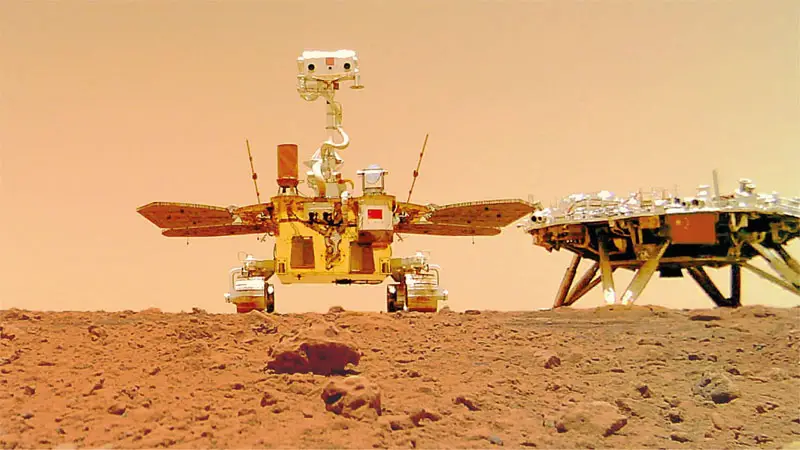
Credit: China National Space Administration
The world's largest insect swarm re-emerges
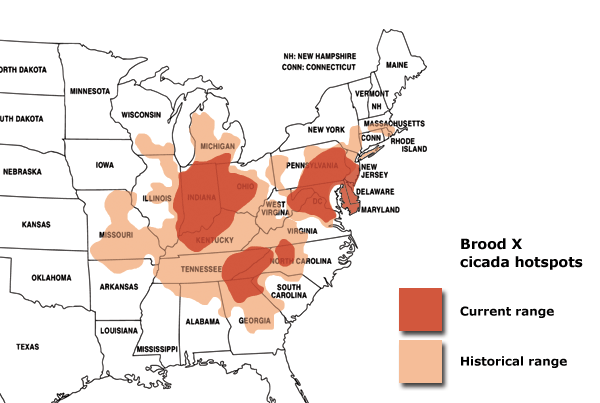
Brood X is the largest of 15 groups of 17-year cicadas. Its members, all of the genus Magicicada, tunnel to the surface en masse, mate and lay eggs, then die. This is the biggest swarm of insects in the world. The area covered stretches from New York, down the East Coast to Georgia and west to Illinois.
Brood X had previously emerged in 2004.* The next brood emerged in April and May 2021. Billions of the insects infested the Eastern USA, with any existing tranquillity ruined by their incessant buzzing during the mating ritual, audible from a mile away. Despite the nuisance caused, the emergence of this swarm like previous generations was relatively short-lived. It also delivered vital nutrients to the topsoil, leaving the native environment noticeably better in the weeks after the ensuing die-off. The next generations of Brood X cicadas emerge in 2038 and 2055.
A prototype artificial kidney
Kidneys perform a vital role in the human body: filtering blood, removing excess fluid, and eliminating waste products. They are essential to the urinary system, the regulation of blood pressure (via salt and water balance) and the production of various hormones.
Kidney diseases are diverse, but their primary causes over the long-term are diabetes and high blood pressure. Among the most serious clinical conditions is end-stage renal disease, affecting two million people worldwide. This can lead to complete failure of the kidneys to work at a level needed for day-to-day life. In the later stages of the illness, the only treatment options are dialysis or transplant. Although dialysis can be life-saving, it lasts for only a short time and then the procedure must be repeated. Organ transplants can help patients to regain their strength and mobility, allowing a return to more normal activities; but there is often a shortage of donors, plus the risk of rejection by their immune system. Stem cell treatments have emerged,* but are yet to provide a complete restoration of kidneys.
A third option has been explored, however: artificial kidneys. Unlike real transplanted kidneys, which last for only 10 to 12 years, a bioartificial kidney could have an indefinite lifespan.
Researchers from the University of California, San Francisco, and the Vanderbilt University Medical Center, Tennessee, began work on a bioartificial kidney project in 1998. Phase 1, which completed by 2010, demonstrated the individual feasibility of a haemofilter and cell bioreactor, two major components of such a device. Phase 2, between 2014 and 2019, involved refinements to the components based on nanotechnology, alongside preclinical animal studies. The researchers began to identify potential partnerships with industry.
The Kidney Project (its official name) then began moving to Phase 3. In September 2021, the team announced a major milestone: the first-ever demonstration of a functional prototype that combined both essential parts – the haemofilter and the bioreactor – successfully refined and implanted for preclinical evaluation.* Powered by blood pressure alone, the units worked in tandem, and without the need for blood thinning or immunosuppressants.
A subsequent final version of the device mimics all vital functions of natural kidneys in humans. The haemofilter removes waste products and toxins from blood, while the bioreactor replicates other kidney functions, like the balance of electrolytes and metabolic actions.
Tokyo hosts the Olympic Games
From 23rd July to 8th August 2021, Tokyo hosted the Olympic Games.* Prior to Tokyo's selection by the Japanese Olympic Committee, Hiroshima had expressed an interest in hosting, but later withdrew their plans to bid. Tokyo had hosted the games 50 years previously and once again used its National Olympic Stadium for the main venue.
In August 2013, the Governor of Tokyo, Naoki Inose, stated that the 2011 nuclear accident at Fukushima would not pose a threat to Tokyo's ability to host the Games. He stated that "the water in Tokyo is safe, and we have released this data on our website" and that "radiation levels are no different than in London or Paris." A letter of assurance over the issue was later sent to the IOC members.
The Olympics had originally been scheduled for the summer of 2020, with preliminary events starting on 22nd July. On 24th March 2020, however, the IOC and the Tokyo Organising Committee officially announced that due to the worldwide COVID-19 pandemic, the 2020 Summer Olympics and Paralympics would be delayed to 2021 (marking the first time that an entire Olympics had ever been postponed). The Games would still be branded and marketed as "Tokyo 2020", even with the change in scheduling.
Tokyo became the first Asian city to host the Olympic Games twice. The previous occasion was in 1964. Its slogan for the 2021 event was "Discover Tomorrow" and robots were featured during the games in reflection of this.

Credit: Dick Thomas Johnson, CC BY 2.0, via Wikimedia Commons
The James Webb Space Telescope is launched
The James Webb Space Telescope (JWST) is the long-awaited successor to the aging Hubble Space Telescope. Named after James E. Webb – the NASA administrator from 1961 to 1968 – it is developed as a collaboration between NASA, the European Space Agency, and the Canadian Space Agency.
The JWST is located near Earth–Sun Lagrangian point L2 with an orbital distance that varies from 374,000 km (232,000 mi) to as far away as 1,500,000 km (930,000 mi). It is designed to offer unprecedented resolution and sensitivity from long-wavelength visible light through the mid-infrared range. While the Hubble Space Telescope had a 4.5 m² (48 sq ft) primary mirror, the JWST's collecting area is nearly six times larger at 25 m² (270 sq ft). This is composed of 18 hexagonal mirror segments working in unison. In terms of magnification, it is 100 times more powerful than Hubble, making it capable of seeing the very first generation of stars that ignited less than 200 million years after the Big Bang – a time when the universe was only 1.4% of its current age. If a bumblebee was placed on the Moon's surface, the JWST would be able to spot the insect both in reflected light, and from its body heat.* A large sunshield keeps the telescope's instruments below 50 K (−220 °C; −370 °F).
The JWST has four main scientific goals:
• To search for light from the first stars and galaxies that formed in the Universe after the Big Bang
• To study the formation and evolution of galaxies
• To understand the formation of stars and planetary systems
• To study planetary systems and the origins of life
The JWST was first proposed in 1996, with a budget of $0.5 billion and expected launch date of 2007. Over the years, however, its costs began to spiral, and the project faced major delays. By 2021, it had mushroomed to over $10 billion. A successful launch finally occurred on Christmas Day 2021.*
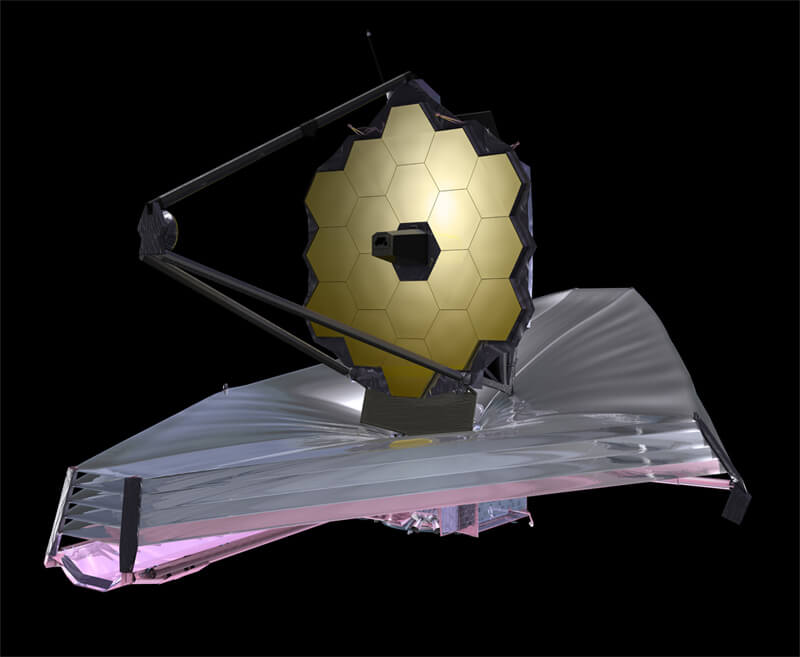
Credit: NASA
« 2020 |
⇡ Back to top ⇡ |
2022 » |
If you enjoy our content, please consider sharing it:
References
1 Tianwen-1, Wikipedia:
https://en.wikipedia.org/wiki/Tianwen-1
Accessed 2nd January 2022.
2 Brood X, Wikipedia:
https://en.wikipedia.org/wiki/Brood_X#2004_emergence
Accessed 2nd January 2022.
3 Cell therapy could replace need for kidney transplants, Science Daily:
https://www.sciencedaily.com/releases/2019/03/190314123215.htm
Accessed 5th January 2020.
4 The Kidney Project successfully tests a prototype bioartificial kidney, University of California, San Francisco:
https://pharmacy.ucsf.edu/news/2021/09/kidney-project
Accessed 2nd January 2022.
5 2020 Summer Olympics, Wikipedia:
https://en.wikipedia.org/wiki/2020_Summer_Olympics
Accessed 13th September 2020.
6 Construction of the James Webb Space Telescope mirror is completed, Future Timeline Blog:
http://www.futuretimeline.net/blog/2016/11/5.htm
Accessed 8th January 2018.
7 James Webb Space Telescope, Wikipedia:
https://en.wikipedia.org/wiki/James_Webb_Space_Telescope
Accessed 2nd January 2021.
 |
|||||||||||||||||||||||||||||||
|
Latest predictions |
Timeline » 21st century |
Blogs » AI & Robotics |
Features » |
About us
|
|||||||||||||||||||||||||||
|
|
|||||||||||||||||||||||||||||||


