
![[+]](https://www.futuretimeline.net/images/buttons/expand-symbol.gif)
|
|
|
|
|
|
2038
The Arctic Ocean is becoming ice-free during summer
Arctic sea ice has long played a critical role in regulating Earth's climate – reflecting substantial amounts of solar radiation back into space due to its high albedo, or whiteness. This icy shield helps to maintain global temperature stability, moderates ocean currents, and supports diverse marine ecosystems, as well as traditional human cultures.
However, since the advent of reliable satellite observations in 1979, scientists have documented a steady decline in the extent and thickness of Arctic sea ice. During the late 20th century, this trend progressed gradually, but by the early 21st century, the melting had accelerated dramatically.* Scientists confirmed that the Arctic warms four times faster than the global average, a phenomenon known as polar amplification.
Advances in satellite technology, providing significantly higher sensitivity and resolution, allowed researchers to observe the region with unprecedented clarity. These improved monitoring tools revealed alarming losses of multi-year ice – thick, resilient ice that normally survived the summer melt season. As global temperatures continued rising, summer melt seasons grew longer and more severe, and the ice became thinner and increasingly fragmented.
Today, in the late 2030s, a long-anticipated threshold is being crossed: the extent of Arctic sea ice is dipping below one million square kilometres for the first time in recorded history. Known in scientific literature as a "blue ocean event," the region is essentially ice-free during its peak summer melting, a stark visual and climatic landmark predicted by scientists in the preceding decades.**

Where thick, reflective ice once shielded the Arctic, expansive areas of open water now absorb vast amounts of solar energy, intensifying regional warming in a reinforcing feedback loop. Temperatures around the Arctic Circle have surged, impacting weather patterns far beyond the polar regions. Northern hemisphere weather systems, once stabilised by the temperature gradient between the polar and temperate zones, have become increasingly erratic. Intense storms, heatwaves, and prolonged droughts have escalated in both frequency and severity across Europe, Asia, and North America, with significant economic and humanitarian consequences.
Moreover, the rapid warming of the Arctic has further accelerated Greenland's ice loss, contributing to global sea-level rise, endangering coastal cities worldwide. Marine ecosystems are being severely disrupted, with iconic species like polar bears now facing existential threats due to habitat loss. Indigenous communities in the Arctic face unprecedented challenges to their traditional ways of life.
Ironically, the opening of two previously inaccessible shipping lanes – the Northern Sea Route and Northwest Passage – is offering substantial economic benefits through reduced travel times and fuel consumption. A third route, the Transpolar Sea Route, running directly across the central Arctic Ocean, is also beginning to emerge as a longer-term possibility.* However, these opportunities pale in comparison to the broader environmental and societal costs of disappearing sea ice. Similarly, while new avenues for deep-sea mining and fossil fuel extraction have emerged, the long-term implications for the Arctic's fragile ecosystems raise profound ethical and ecological concerns.
Globally, the wake-up call of this blue ocean event has reignited international debate around climate policy and emissions reductions. While the science presents a clear and growing urgency, the political response remains uneven and often incremental. Some nations are beginning to invest more heavily in renewable energy and carbon capture technologies, while others continue to delay meaningful action. Geoengineering solutions – once seen as fringe – are now gaining serious attention in negotiations, though concerns persist about their potential risks and unintended consequences. In the late 2030s, the image of an ice-free Arctic stands as a defining symbol of climate change, a milestone that demands more than rhetoric if the world is to avoid deeper and more irreversible impacts.
Older computers are at risk of experiencing major software malfunctions
The Year 2038 problem (also known as "Y2K38" by analogy to the Y2K Millennium bug) gains considerable public and media attention this year. It affects programs written in the C programming language. These were relatively immune to the earlier Y2K problem, but suffer instead from the Year 2038 problem. They use a library of routines called the standard time library. This takes a stored, 32-bit integer and interprets the current value as the number of seconds which have passed since 00:00:00 UTC on Thursday, 1st January 1970.
Because of the limited number of possible values that can be derived from this 32-bit integer, the farthest time that can be represented in this way is 03:14:07 UTC on Tuesday, 19th January 2038. Any times beyond this point will "wrap around" and be stored internally as a negative number, which these systems interpret as a date from 1901, rather than 2038. This is called integer overflow.
For older computers that still use this system, major problems begin to arise with file systems and databases, due to erroneous calculations. Fortunately, most systems have been upgraded by now, and little overall damage is done.

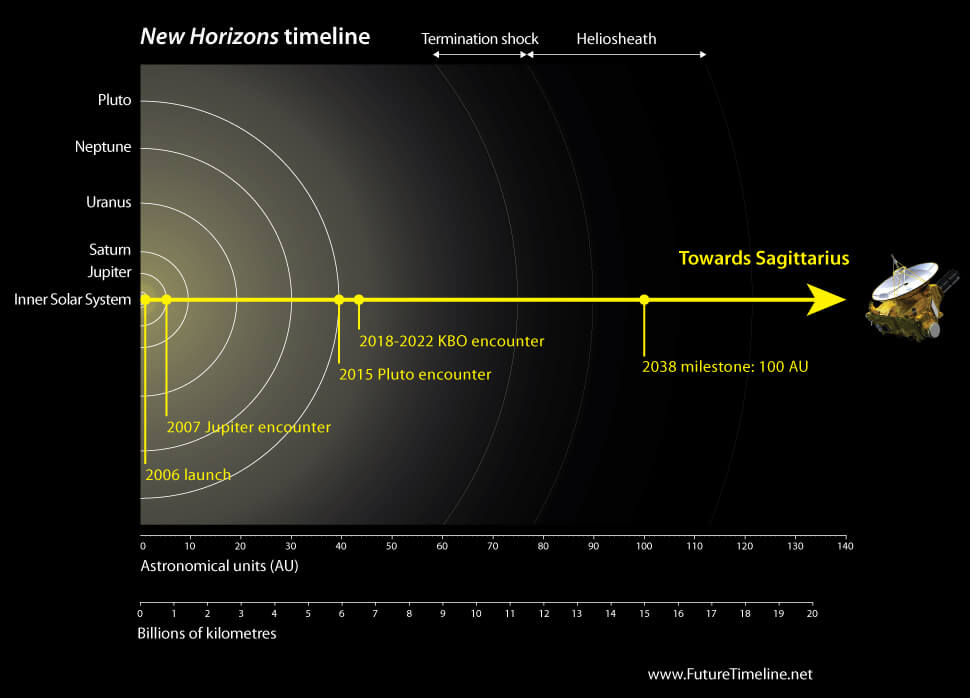
The New Horizons probe is 100 AU from the Sun
The New Horizons probe was launched in 2006, arriving at Pluto in 2015.* After surveying the dwarf planet and its five moons, the spacecraft headed towards the Kuiper Belt where it studied a small, icy body. This phase of the mission lasted until 2022,* after which New Horizons began journeying to a boundary known as the outer heliosphere, where the solar wind meets the local interstellar medium. By 2038, it has reached 100 astronomical units (AU) from the Sun* – equivalent to 100 times the distance between the Earth and Sun – and is moving in the direction of the constellation Sagittarius that includes the supermassive black hole at the centre of our galaxy.
Even though it was launched much faster than any outward probe before it, New Horizons will never overtake Voyager 1 or Voyager 2 as the most distant human-made object. Close flybys of Saturn and Titan gave Voyager 1 an advantage with its gravity assist. When New Horizons reaches 100 AU, it is travelling at 13 km/s (29,000 mph), around 4 km/s (8,900 mph) slower than Voyager 1 at that distance.
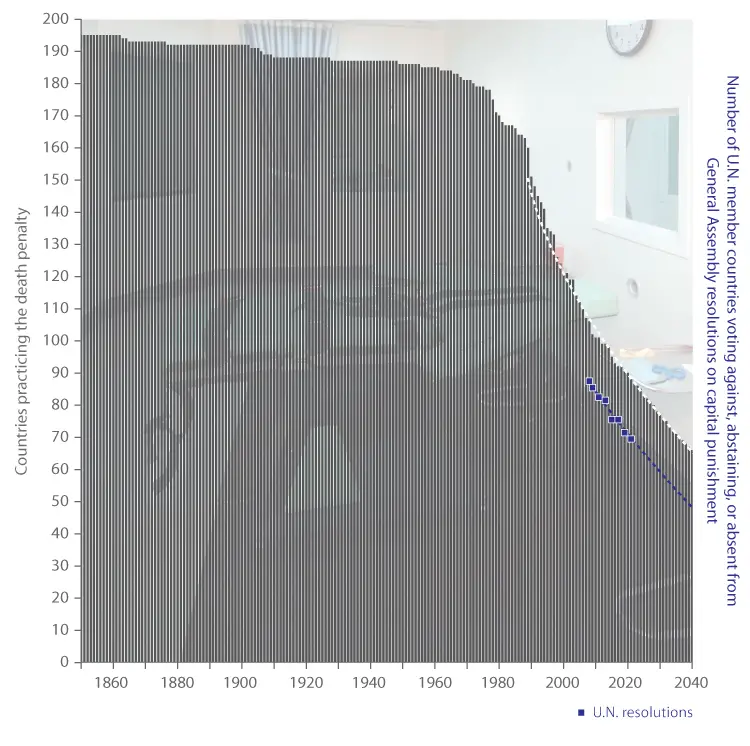
Two-thirds of UN member states have abolished the death penalty
At the start of the 20th century, capital punishment was used in almost every part of the globe – including the most developed nations. In the latter decades of the century, however, many countries abolished it. The last guillotining in France was conducted in 1977, while in the UK, the death sentence for treason was ended in 1998.
Americans' views on the issue varied significantly,* but the number of executions performed in the US showed a consistent long-term decline. Peaking in the mid-1930s, they fell dramatically thereafter, briefly rising in the 1990s before dropping again in the 21st century. Between 2000 and 2010, executions in the US plummeted by over half.** It had also become far cheaper to imprison people for life.*
By 2010, nearly 50% of countries had outlawed the death penalty for all crimes.* This reflected concerns over the possibility of executing the innocent, as well as the morality of such brutal punishments in modern civilised society. Public opinion continued to shift in favour of bans – a trend fuelled by growing access to information brought by the Internet, media and technology in general. This included mistakes revealed by DNA evidence, for example, as well as high-profile media investigations, and the work of international human rights organisations such as Amnesty.
Another factor sustaining this trend was the growing urbanisation and democratisation of the planet,* with cities tending to favour more liberal and progressive policies than smaller, traditional rural communities. Yet another factor was the ongoing influence of feminism in society, with women tending to oppose it more than men.**
However, capital punishment remained entrenched in some regions: notably China, which held more executions than the rest of the world combined, killing thousands of its citizens every year. Iran, North Korea, Saudi Arabia and Yemen were also notorious for their executions, sometimes carried out for highly dubious reasons (e.g. sorcery*).
By the late 2030s, around two-thirds of UN member states have abolished the death penalty. But a significant minority of repressive and pariah states continue to practice it. While its prevalence has fallen in Muslim society as a whole,* the global abolition of capital punishment remains elusive, for now.
Re-emergence of Brood X cicadas
Cicadas are medium-sized insects with prominent eyes set wide apart, short antennae, and membranous front wings. They are widespread, with more than 3,390 extant species found on all continents except Antarctica. Cicadas are known for their extremely loud song. Thopha saccata, for example – also known as the Double Drummer – has the loudest sound of any insect and can reach in excess of 120 dB if large numbers are in close range.
The insects typically live in trees, feeding on watery sap from xylem tissue and laying their eggs in bark. They fall into two main categories: annual cicadas, spotted every year, and periodical cicadas, which spend most of their lives underground and only emerge once every decade or two.
The largest and most concentrated group of periodical cicadas, called Brood X, appears every 17 years. Having previously emerged during 2004 and then again in May 2021, it returns in 2038.* As before, this becomes the world's largest insect swarm, covering much of the eastern United States with as many as 1.5 million insects per acre. The states affected are New York, New Jersey, Pennsylvania, Delaware, Maryland, District of Columbia, Virginia, West Virginia, North Carolina, Georgia, Tennessee, Kentucky, Ohio, Indiana, Illinois, and Michigan.
During this period, which can last for several weeks, many regions have to endure the shrill noise of male cicadas attracting female mates. Although cicadas are not life-threatening to humans, residents are advised to use noise-cancelling earphones or earplugs to prevent ear damage, while avoiding garden activities like planting and pruning. Pets must be kept from consuming the insects, in case of digestive stress. Swimming pools must be covered to avoid damage to filters, while the use of outdoor power tools is discouraged due to the insects being attracted by the sounds.
The insects' full life cycle – from emergence above ground, to their mating and subsequent death – typically lasts for six to ten weeks. The next generation of Brood X emerges in the year 2055.

Photo 195942313 / Cicadas © Gerald D. Tang | Dreamstime.com
The FIFA World Cup trophy is replaced
The current World Cup trophy has been in use since the 1974 World Cup. There is only space for 17 countries to be engraved on its base. In 2038, the final name plaque is filled in, and a replacement cup is commissioned with a new design. Like its predecessor, this is made of 5 kg (11 lb) of 18 carat gold.*

Urban air mobility is a trillion-dollar industry
Recent advances in batteries, autonomous systems, and manufacturing processes have led to a boom in urban air mobility. This began some decades previously with military drones, followed later by electrified, autonomous vertical take-off and landing vehicles (VTOLs) and drone package deliveries.
Growing demand for the faster transport of goods led to companies competing to develop new and innovative last-mile delivery solutions. These included pizzas, medical supplies and other time-sensitive items being carried by drones. With lower technological barriers (weight, size, etc.) as well as fewer regulatory hurdles, these small flying machines saw wider adoption than larger, people-carrying drones. The latter remained expensive and with greater technical and safety issues.
As the 2020s progressed, however, companies improved their aircraft designs, achieved successful test flights and gained regulatory approvals. Flying taxis began to appear in major cities around the world, along with drone delivery services offering greater cargo capacities.
Initially restricted to wealthy customers and serving as niche add-ons to existing transportation infrastructure, these large flying vehicles became increasingly common during the 2030s – taking market share from established car and airline companies. The latest generation of VTOLs had impeccable safety records, providing a sound alternative to road travel and a cost-effective, time-efficient method of hopping across or between cities.
By 2038, the urban air mobility market has reached $1 trillion in size globally,* a 200-fold expansion compared with 2020. Although cars, trucks, trains and other vehicles remain dominant, drones of all sizes and their related infrastructure (such as landing pads, electric charging points, etc.) now form a significant part of the urban environment in many large cities. This is particularly noticeable in China, which accounts for one-third of the worldwide market. As public attitudes shift in favour of autonomy, with safety concerns easing, these flying vehicles continue to gain in popularity into the 2040s and beyond, eventually spreading to smaller towns and rural areas.

Credit: Lilium
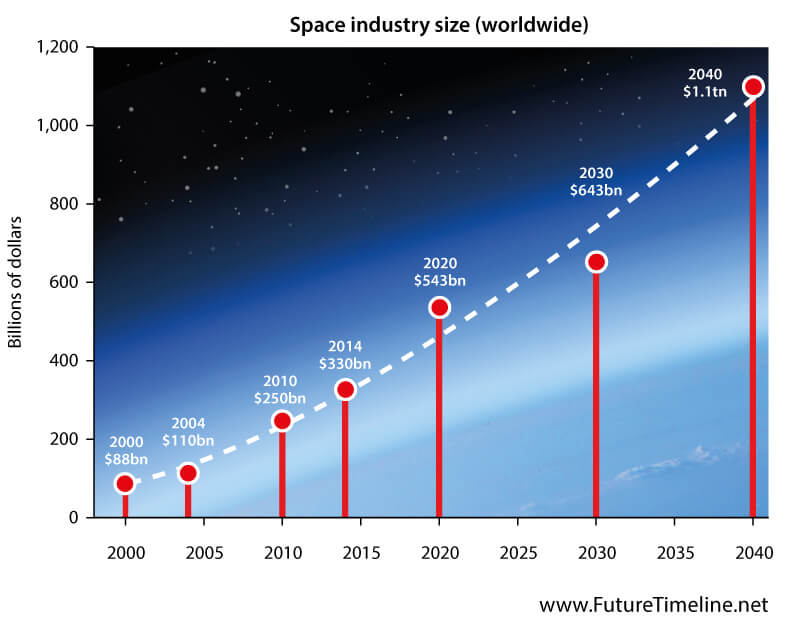
The space industry exceeds $1tn worldwide
By the late 2030s, the worldwide space industry exceeds $1 trillion in size.* This represents a quadrupling compared to 2010* and a tenfold increase since the start of the 21st century. The rapid growth in this sector has been fuelled, in large part, by explosive demand for high-speed Internet services, including the recent establishment of a global, quantum-encrypted satellite network for ultra-secure communications.* However, a number of other areas have started to boom now, including space tourism (via space planes and very high-altitude balloons) and resource extraction from near-Earth asteroids. The latter, while still accounting for only a tiny fraction of global commodities, is now considered a relatively routine activity as the industry is sufficiently mature in technology.
In 1997, private investment in space overtook government spending for the first time. This trend continued into the 21st century, with space becoming more and more commercialised. Access to space was being made cheaper and easier by a new generation of launch vehicles. These and other technological innovations were enabling even small companies to compete and do what only big government agencies had done in the past. Some of the most famous entrepreneurs to emerge during this time included Elon Musk, Jeff Bezos, Peter Diamandis, Robert Bigelow and Richard Branson; but many less well-known individuals and groups were also taking advantage of the changing industry landscape. Crowd-funding, for example, meant that even casual Internet users could now have a stake in the development of space projects – like the new class of "CubeSats". These tiny spacecraft could hitch a ride and piggyback alongside the larger and more expensive missions.
While private commercial enterprises are the dominant driving force, government space agencies still have a role to play. NASA has been developing its manned Mars program and this decade sees its astronauts walking on the Red Planet for the first time. In addition, a number of huge telescopes are being built that dwarf any previous observatory. China, Europe, India, Japan, Russia and other agencies have also made progress in human exploration, with international collaborations to establish the first bases on the Moon. Meanwhile, new countries are now appearing on the scene and establishing their own national space agencies, as their economies become advanced and rich enough to do so. The number of countries with independent launch capability has also continued to increase.
Total solar eclipse in Australasia
A total solar eclipse occurs on 26th December 2038, visible in Australia, New Zealand, and parts of the South Pacific. The shadow passes close to the cities of Adelaide and Melbourne. The instance of greatest eclipse occurs in the Tasman Sea, between Australia and New Zealand, at 12:00:10 (UTC+11), with a duration of 138 seconds (2 m 18 s).*
Bovine tuberculosis (bTB) is eradicated in England
By 2038, England has achieved a landmark victory in its battle against bovine tuberculosis (bTB), eradicating the disease from cattle herds across the country.* This success follows decades of coordinated efforts by farmers, scientists, and policymakers, marking the culmination of a long-term strategy to not only control but eliminate bTB from English livestock.
In 1971, the first known case of a badger infected with bTB emerged, when researchers identified the disease in wildlife in Gloucestershire. Subsequent research established a link between badgers and the spread of bTB to cattle, which often led to severe respiratory issues, weight loss, and lethargy in the infected animals. Being highly contagious, these outbreaks resulted in the need to slaughter infected cattle to prevent further spread, and triggered ongoing debates about badger culling to control the disease. Despite efforts such as testing, culling, and movement restrictions, bTB persisted and led to the need for more comprehensive solutions in the 21st century.
By the early 2020s, the economic impacts of bTB had risen substantially, costing taxpayers over £150 million annually, with more than 21,000 cattle being slaughtered in England each year. Approximately 230,000 badgers had been culled, with growing concern from environmentalists and the public.
A more comprehensive and sustainable approach emerged, as the UK government committed to phasing out badger culling in England by 2029, in favour of badger vaccination programmes and the development of a cattle vaccine. Field trials proved successful, with large-scale deployment of these vaccines during the second half of the decade.
Throughout the 2030s, the combined efforts of vaccination, improved testing and disease surveillance, and strengthened biosecurity practices on farms drove infection rates down. By 2038, farmers no longer face the financial uncertainty and emotional toll of losing livestock to this devastating disease, as its eradication is officially confirmed. This also benefits the public finances, while improving animal welfare too.
England's success with bTB serves as a model for other regions still battling the disease* – showing that with the right mix of tools, policies, and commitment, even the most entrenched diseases can be defeated. Looking ahead, officials and scientists are now applying the lessons learned from the fight against bTB to other agricultural and wildlife diseases, as England continues refining its approach to biosecurity in the 21st century.

« 2037 |
⇡ Back to top ⇡ |
2039 » |
If you enjoy our content, please consider sharing it:
References
1 Arctic sea ice decline, Wikipedia:
https://en.wikipedia.org/wiki/Arctic_sea_ice_decline
Accessed 29th June 2025.
2 "Jahn and Heuzé estimated the first ice-free Arctic day using output from over 300 computer simulations. They found that most models predicted that the first ice-free day could happen within nine to 20 years after 2023 regardless of how humans alter their greenhouse gas emissions."
See Countdown to an ice-free Arctic: New research warns of accelerated timelines, University of Colorado Boulder:
https://www.colorado.edu/today/2024/12/03/countdown-ice-free-arctic-new-research-warns-accelerated-timelines
Accessed 29th June 2025.
3 Observation-constrained CMIP6 runs (pan-Arctic mean + trend) give a median first ice-free September of 2038. See Figure 4, and Table 1.
See Constraining the First Year of Ice-Free Arctic: Importance of Regional Perspective, Earth's Future:
https://agupubs.onlinelibrary.wiley.com/doi/full/10.1029/2022EF003313
Accessed 29th June 2025.
4 Transpolar Sea Route, Wikipedia:
https://en.wikipedia.org/wiki/Transpolar_Sea_Route
Accessed 29th June 2025.
5 See 2015.
6 See 2022.
7 New Horizons Salutes Voyager, Johns Hopkins University Applied Physics Laboratory:
http://pluto.jhuapl.edu/News-Center/News-Article.php?page=081706
Accessed 18th July 2015.
8 In U.S., Support for Death Penalty Falls to 39-Year Low, Gallup:
http://www.gallup.com/poll/150089/support-death-penalty-falls-year-low.aspx
Accessed 5th February 2012.
9 Facts about the Death Penalty, Death Penalty Information Center:
http://www.deathpenaltyinfo.org/documents/FactSheet.pdf
Accessed 5th February 2012.
10 Capital Punishment Declined In 2010, Huffington Post:
http://www.huffingtonpost.com/2010/12/21/death-penalty-tanks-in-po_n_799754.html
11 To execute or not: A question of cost?, MSNBC:
http://www.msnbc.msn.com/id/29552692/ns/us_news-crime_and_courts/t/execute-or-not-question-cost/#.Ty7gC-S6V8E
Accessed 5th February 2012.
12 Figures on the death penalty, Amnesty International:
http://www.amnesty.org/en/death-penalty/numbers
Accessed 5th February 2012.
13 Global Trends in Governance, 1800-2016, The Center for Systemic
Peace (CSP):
http://www.systemicpeace.org/conflicttrends.html
Accessed 29th December 2017.
14 Race, gender, and the death penalty, big think:
http://bigthink.com/ideas/40707
Accessed 5th February 2012.
15 Who Supports the Death Penalty?, Gallup:
http://www.gallup.com/poll/14050/Who-Supports-Death-Penalty.aspx
Accessed 5th February 2012.
16 Saudi Arabian woman executed for "sorcery", CBS News:
http://www.cbsnews.com/8301-202_162-57341381/saudi-arabian-woman-executed-for-sorcery/
Accessed 5th February 2012.
17 Shariah Law Should Not Deter Abolition, Inter Press Service News Agency:
http://ipsnews.net/news.asp?idnews=33678
Accessed 5th February 2012.
18 U.S. awaits chorus of huge, 17-year cicada hatch, Reuters:
https://www.reuters.com/business/environment/us-awaits-chorus-huge-17-year-cicada-hatch-2021-05-17/
Accessed 18th May 2021.
19 FIFA World Cup Trophy, Wikipedia:
http://en.wikipedia.org/wiki/FIFA_World_Cup_Trophy#FIFA_World_Cup_Trophy
Accessed 11th July 2010.
20 Are Flying Cars Preparing for Takeoff?, Morgan Stanley:
https://www.morganstanley.com/ideas/autonomous-aircraft
Accessed 27th November 2021.
21 Morgan Stanley predicts space industry will triple in size: Here's how to invest, CNBC:
https://www.cnbc.com/2017/10/12/morgan-stanley-how-to-invest-in-1-trillion-space-industry.html
Accessed 22nd October 2017.
22 Elon Musk, Jeff Bezos licked by James Lick in space race, Forbes:
https://www.forbes.com/sites/bruceupbin/2010/08/27/elon-musk-jeff-bezos-licked-by-james-lick-in-space-race/
Accessed 22nd October 2017.
23 Entangled photons sent between suborbital space and Earth, Future Timeline Blog:
https://www.futuretimeline.net/blog/2017/06/21.htm
Accessed 22nd October 2017.
24 Solar eclipse of December 26, 2038, Wikipedia:
https://en.wikipedia.org/wiki/Solar_eclipse_of_December_26,_2038
Accessed 28th October 2022.
25 Badger culling to end in England within five years, BBC News:
https://www.bbc.co.uk/news/articles/c9qg52r7jzxo
Accessed 7th September 2024.
26 "New Zealand [...] aims to eradicate bTB by 2055."
See Are predictions of bovine tuberculosis-infected herds unbiased and precise?, National Library of Medicine:
https://www.ncbi.nlm.nih.gov/pmc/articles/PMC10600916/
Accessed 7th September 2024.
 |
|||||||||||||||||||||||||||||||
|
Latest predictions |
Timeline » 21st century |
Blogs » AI & Robotics |
Features » |
About us
|
|||||||||||||||||||||||||||
|
|
|||||||||||||||||||||||||||||||


