
 |
|||
|
|||
 |
 |
||||||||
International
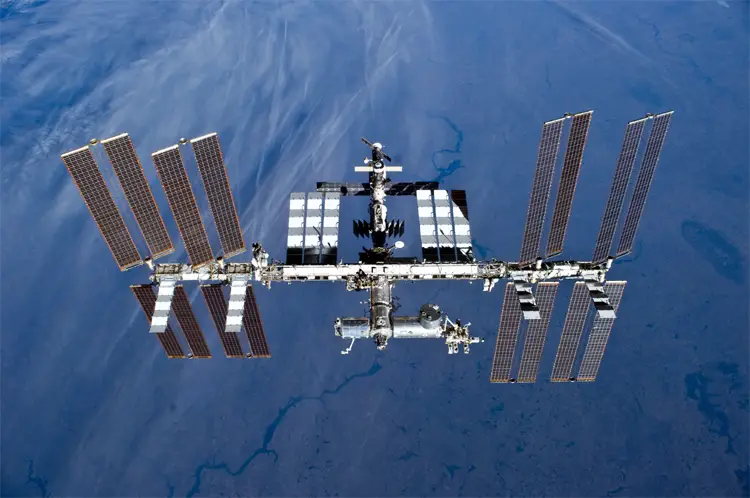
Space Station Costing over $100 billion, it is the largest man-made structure ever put into orbit - measuring nearly 110m wide, with a mass of 345,000 kg and a living volume of 1,000 cubic metres. The primary fields of research on board the station include human research, space medicine, life sciences, physical sciences, astronomy and meteorology. The station is expected to remain in operation until at least 2015, and likely 2020.*
Missions
(unmanned)
2012 - Northern Light 2012 - Phobos-Grunt 2013 - Mars Atmosphere and Volatile EvolutioN (MAVEN) 2013 - Chandrayaan-2 2014 - Rosetta/Philae 2015 - Dawn 2015 - New Horizons 2016 - Astrobiology Field Laboratory 2016 - Juno 2016 - Mars Trace Gas Mission 2018 - ExoMars 2019 - Laser Interferometer Space Antenna 2019 - Mars Astrobiology Explorer-Cacher 2021 - International X-ray Observatory 2022 - Mars Sample Return Mission 2024 - Solar Probe Plus 2026 - Europa Jupiter System Mission 2029 - Titan Saturn System Mission
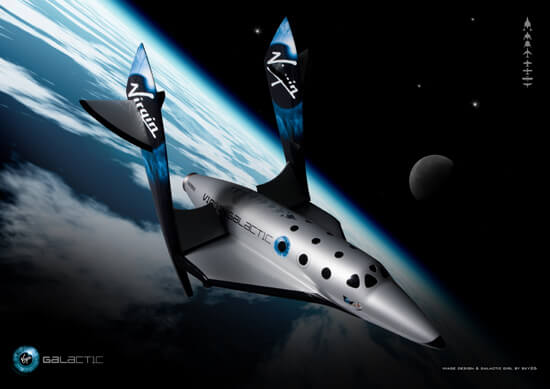
Spaceport Costing around $225 million, the facility is located on 27 square miles (70 km2) of state-owned desert near Upham, an uninhabited part of New Mexico. Among the various companies involved is Richard Branson's Virgin Galactic.* Travelling at over 2,600 mph (4,200 km/h), the spacecraft will carry up to six passengers at a time, to a height of approximately 68 miles (110 km), using a single hybrid rocket motor. When maximum altitude is reached, the engines will be switched off and the passengers will experience up to six minutes of zero-G whilst looking down on the Earth. The ships will use a feathered re-entry system, feasible due to the low speed of re-entry, and designed to re-enter the atmosphere at any angle, for maximum safety. In the 2020s, a new generation of ships will be developed capable of reaching much higher orbits. In the decades after that, trips around the Moon may become possible. Initially, the flights will be around $200,000 per head. However, competition between various companies is expected to reduce costs.
Telescopes
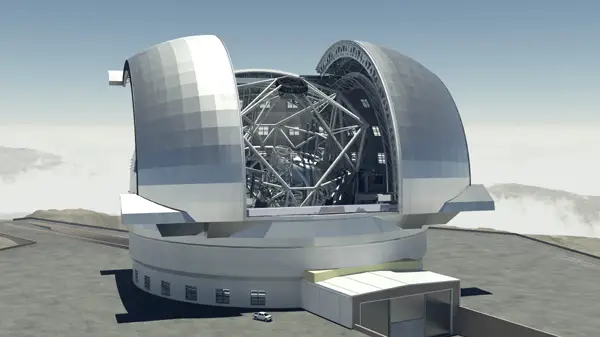
This revolutionary new ground-based telescope has the aim of observing the Universe in greater detail than even the Hubble Space Telescope. A mirror of approximately 42 metres (138 ft) will allow the study of the atmospheres of extrasolar planets. It will also perform "stellar archaeology" - measuring the properties of the first stars and galaxies, as well as probing the nature of dark matter and dark energy. It is planned to become operational in 2022.
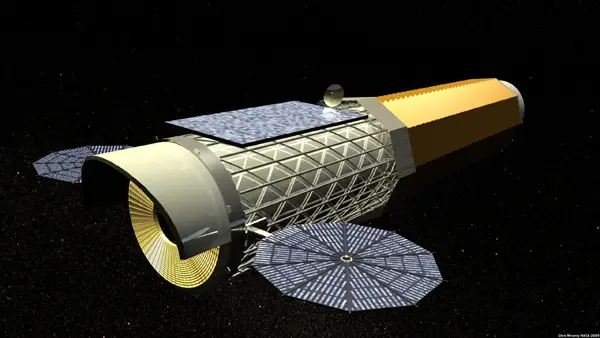
The International X-ray Observatory (IXO) is due to be launched in 2021 as a joint effort between NASA, the European Space Agency (ESA), and the Japan Aerospace Exploration Agency (JAXA). Combining a large X-ray mirror with powerful new instrumentation, it will explore the high energy Universe - peering through dust and obscuring clouds of gas to reveal supermassive black holes, supernovae, neutron stars and other hidden objects. IXO will be designed to operate for a minimum of 5 years, with a goal of 10 years, so operations may last until the early 2030s.
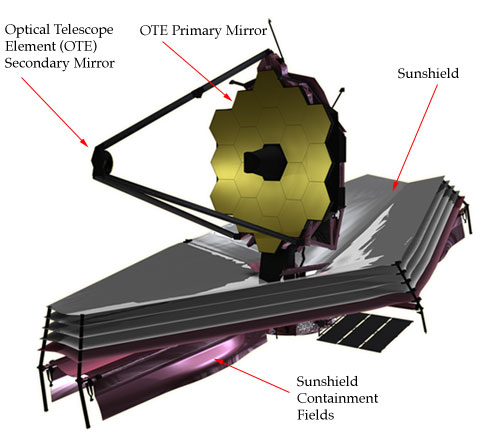
The long-awaited successor to Hubble, the James Webb telescope will be launched in 2018. Its primary mirror will have a collecting area six times larger than Hubble. It will be situated in an L2 orbit, 1.5 million km from Earth.
|
||||||||
 |
||||||||
 Share
Share |
||
|
References 1 International Space Station, Wikipedia: 2 Spaceport America: 3 Virgin Galactic:
|
||
|
||
|
|||
|
|||
|
 |
Follow us »
|
 |


|
|
Latest prediction »
Latest blog »
|
|
|
|
|
Visit our forum »
|
|
|
|
|
|
|
|
|